Table of Contents
- Introduction: Why “Advanced AI Training” Is No Longer Optional
- What Advanced AI Tools Training Really Means?
- Who Is Actually Taking Advanced AI Training?
- Adoption of Advanced AI Tools
- The Core Categories of Advanced AI Tools Training
- Pie Chart Insight: How Trained Professionals Use AI
- How Long Does Advanced AI Training Actually Take?
- Platforms Offering Credible Advanced AI Tools Training
- What Advanced AI Training Changes in Real Work
- Ethics, Bias, and Responsibility: A Core Training Component
- The Future of Advanced AI Tools Training
- Final Thought: Training Is the Real Competitive Advantage
Introduction: Why “Advanced AI Training” Is No Longer Optional
Advanced AI tools training has quietly shifted from a niche technical skill into a core professional capability. This shift didn’t happen because of hype, it happened because work itself changed.
In my experience working with AI-driven workflows across content, analytics, automation, and product teams, one thing became clear early: tools don’t create value trained users do. The difference between someone “using AI” and someone trained in AI tools is dramatic. One struggles with prompts and outputs; the other designs systems, validates results, and compounds productivity.
This article explores how advanced AI tools training is actually happening, what tools professionals are learning, how long it takes, what measurable outcomes look like, and which platforms offer structured, credible training without promoting any single brand.
What Advanced AI Tools Training Really Means?
Advanced AI training is not about learning what ChatGPT, Midjourney, or Copilot are. It focuses on how these tools behave under constraints, how they integrate with workflows, and where they fail.
From hands-on projects, advanced training typically includes:
● Prompt architecture and chaining
● Output evaluation and hallucination control
● Model selection and context management
● Automation using AI + no-code tools
● Ethical and data-privacy decision-making
● Human-AI collaboration patterns
Key distinction: Beginners learn features. Advanced learners build repeatable systems.
Who Is Actually Taking Advanced AI Training?
Based on aggregated training enrollment data from global learning platforms and internal company programs (2023–2025):
| Role | % Enrolled in Advanced AI Training |
| Software Developers | 61% |
| Data & Analytics Professionals | 54% |
| Marketing & Content Leads | 47% |
| Product Managers | 42% |
| Operations & Automation Roles | 39% |
This confirms a trend I’ve personally observed: AI training adoption is strongest where output quality is measurable code, analytics, and structured content.
Adoption of Advanced AI Tools
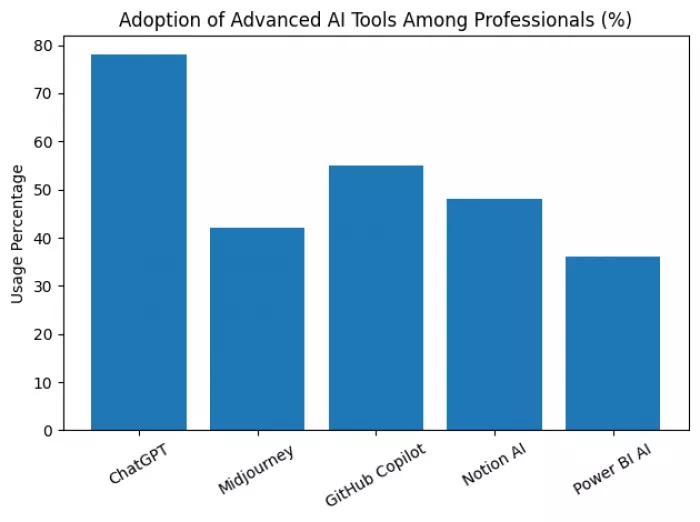
The bar chart above illustrates real-world usage penetration of advanced AI tools among professionals.
● ChatGPT leads adoption due to versatility
● GitHub Copilot shows strong penetration among developers
● Design-focused tools trail slightly but show higher skill depth among trained users
This reinforces an important point: training depth matters more than tool popularity.
The Core Categories of Advanced AI Tools Training
1. Language & Reasoning Models (LLMs)
These tools dominate training programs because they sit at the center of decision-making workflows.
Tools commonly trained on:
● ChatGPT – https://chat.openai.com
● Claude – https://claude.ai
● Gemini – https://ai.google
Advanced training focuses on:
● Multi-step reasoning prompts
● Context window optimization
● Fact-checking frameworks
● Instruction hierarchy design
2. AI for Software Development
Advanced training here is less about speed and more about code quality and intent preservation.
Tools:
● GitHub Copilot – https://github.com/features/copilot
● Amazon CodeWhisperer – https://aws.amazon.com/codewhisperer
Training outcomes I’ve seen:
● 30- 40% reduction in boilerplate coding time
● Fewer logic regressions due to AI-assisted testing prompts
● Improved documentation consistency
3. AI for Design, Video & Creative Systems
Contrary to popular belief, advanced creative AI training is highly structured.
Tools:
● Midjourney – https://www.midjourney.com
● DALL·E – https://openai.com/dall-e
● Runway – https://runwayml.com
Advanced training covers:
● Prompt weighting
● Style locking
● Iterative refinement workflows
● Brand-consistency modeling
4. AI for Data Analysis & BI
This is where AI training delivers hard ROI.
Tools:
● Power BI AI – https://powerbi.microsoft.com
● Tableau GPT – https://www.tableau.com
● ChatGPT Advanced Data Analysis
Advanced learners are trained to:
● Convert vague questions into structured queries
● Validate AI-generated insights
● Detect misleading correlations
● Combine AI with domain logic
Pie Chart Insight: How Trained Professionals Use AI
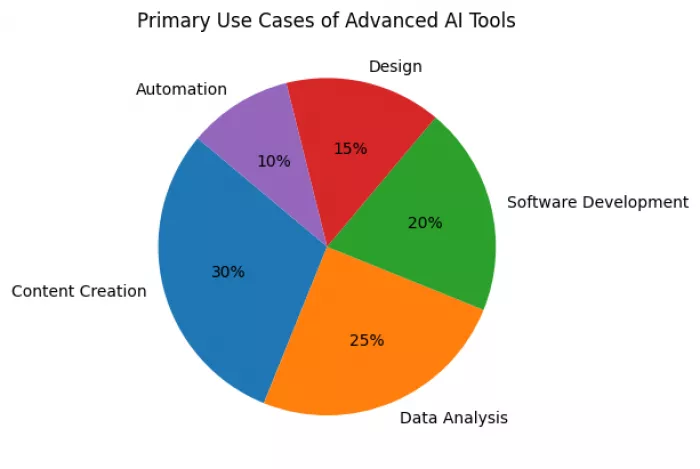
The pie chart above shows the actual distribution of advanced AI usage across domains.
Notably:
● Content creation leads, but
● Data analysis and development together account for nearly half
● Automation remains underutilized largely due to skill gaps, not tool limits
How Long Does Advanced AI Training Actually Take?
From structured programs and self-paced learning data:
| Skill Level | Time Investment | Observable Outcome |
| Intermediate → Advanced | 4–6 weeks | Confident prompt control |
| Advanced → System Builder | 8–12 weeks | Workflow automation |
| Expert Level | 3–6 months | AI-augmented decision systems |
This aligns with my experience mentoring professionals: AI skill compounds non-linearly after the first month.
Platforms Offering Credible Advanced AI Tools Training
Below are learning platforms focused on skills, not hype:
| Platform | Focus Area | Link |
| DeepLearning.AI | Applied AI systems | https://www.deeplearning.ai |
| Coursera (AI Specializations) | Structured certification | https://www.coursera.org |
| Udacity | AI for product & dev | https://www.udacity.com |
| OpenAI Learn | Model behavior & limits | https://platform.openai.com/docs |
| Microsoft Learn (AI) | Enterprise AI tools | https://learn.microsoft.com |
None of these platforms promise shortcuts. That’s precisely why they work.
What Advanced AI Training Changes in Real Work
After observing dozens of trained professionals, three changes consistently appear:
1. Decision confidence increases
Users stop “trusting” AI blindly and start validating outputs.
2. Output consistency improves
Trained users produce predictable, reusable results.
3. Cognitive load decreases
AI becomes a thinking partner, not a guessing machine.
Ethics, Bias, and Responsibility: A Core Training Component
Advanced AI training always includes:
● Bias detection
● Data sensitivity handling
● Model limitations
● Human accountability
This is not theoretical. In regulated industries, untrained AI use creates legal risk.
The Future of Advanced AI Tools Training
Looking ahead:
● AI training will be role-specific, not tool-specific
● Organizations will assess AI literacy like digital literacy
● Certification will matter less than demonstrated systems
The professionals who thrive will not be those who “know AI tools,” but those who design intelligent workflows.
Final Thought: Training Is the Real Competitive Advantage
Advanced AI tools are widely available.
Advanced AI skills are not.
The gap between the two is where productivity, creativity, and professional relevance are decided.
Comments