Most discussions about AI learning platforms flatten them into a single category. In practice, they behave very differently depending on who they were built for, how they structure learning, and what they quietly prioritize.
Before looking at individual platforms, it helps to see how fragmented this space has become.
A quick structural map of the AI learning platform landscape
| Platform Orientation | What It Emphasizes | What It Tends to Downplay |
| University-backed marketplaces | Theory, credentials, breadth | Speed and applied workflows |
| Project-driven bootcamp models | Output and portfolios | Cost efficiency and pacing |
| Interactive skill platforms | Practice and repetition | Conceptual depth |
| Tool-focused platforms | Immediate productivity | Long-term transferability |
| Enterprise LMS systems | Consistency and governance | Individual exploration |
Most platforms sit clearly in one column. Problems usually arise when learners expect behavior from a column the platform was never designed to occupy.
Coursera feels broad because it is built as infrastructure
Coursera does not behave like a course provider so much as a distribution layer for institutions. Its AI catalog spans introductory literacy, advanced machine learning, and role-based professional certificates.
The strength of this model is coverage. Learners can move from non-technical courses to mathematically dense material without leaving the ecosystem. The weakness is cohesion. Courses often feel disconnected from one another, and practical tool usage depends heavily on the instructor rather than the platform itself.
Certificates exist, but the platform’s real value lies in credential signaling, not skill verification. This matters for learners who need formal recognition, less so for those focused on applied outcomes.
edX prioritizes academic framing over convenience

edX occupies a narrower lane. Its AI offerings lean toward computer science foundations, statistics, and formal methods, often delivered through university-designed curricula.
This structure benefits learners who want rigor and context. It is less accommodating for those looking to integrate AI into daily work quickly. Free audits are common, but meaningful progression usually requires paid tracks such as MicroMasters.
The platform’s limitations show up in interaction and pacing. Learning feels solitary, and practical tooling is secondary to conceptual grounding.
Udacity is optimized for output, not exploration
Udacity frames AI learning as a production problem. Its Nanodegree programs focus on building things, submitting projects, and receiving feedback.
This works well for learners who need structure and external pressure. It works poorly for those who want to move slowly or explore adjacent topics. Pricing reinforces this dynamic. The platform assumes a strong commitment and self-selection filters out casual learners.
Mentor feedback and project scaffolding are central strengths. Breadth and affordability are not.
DeepLearning.AI behaves more like a specialist publisher
DeepLearning.AI does not try to be comprehensive. Its courses are narrow, opinionated, and focused on specific areas such as neural networks, large language models, or retrieval-augmented generation.
This makes it useful as a supplement rather than a primary learning platform. Learners often pair it with broader ecosystems. The material is widely respected, but it assumes context and does not attempt to build complete career paths on its own.
Its influence exceeds its size, largely because it defines how many people conceptualize modern AI systems.
DataCamp treats AI as a skill you rehearse
DataCamp approaches AI through repetition and interaction. Lessons are short, exercises are frequent, and progress is measured by completion rather than theory mastery.
This structure benefits analysts and data-oriented learners who want consistent practice. It struggles to convey deeper system-level understanding. Video content is intentionally light, and conceptual discussions are often abbreviated.
DataCamp works best when used continuously. It performs poorly as a one-off learning experience.
fast.ai assumes you already want to build things
fast.ai sits outside most commercial patterns. It is free, technically demanding, and unapologetically practical.
The platform jumps quickly into model training, deployment, and real datasets. This makes it powerful for experienced coders and inaccessible for beginners. There is little hand-holding and no formal credentialing.
Its value lies in exposure to modern practice, not structured progression.
Timtis focuses narrowly on tool usage, by design
Timtis targets non-technical users who want to work with generative AI tools directly. The material centers on prompts, workflows, and automation rather than algorithms or theory.
This makes the platform easy to enter and quick to apply. It also limits its ceiling. Learners seeking deeper understanding of AI systems will need to look elsewhere.
Timtis is best understood as operational training, not education in the traditional sense.
Enterprise AI learning platforms solve a different problem entirely
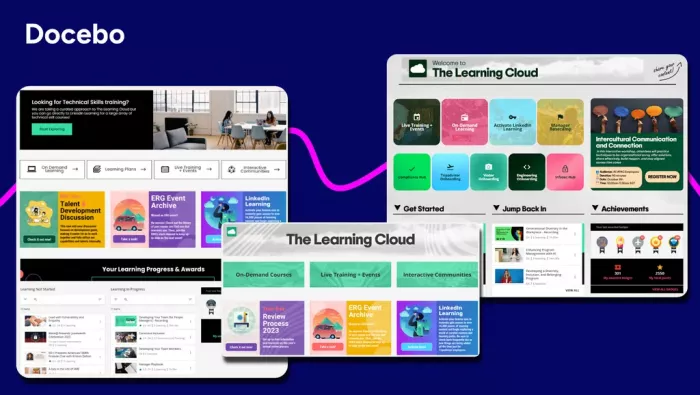
Platforms such as Docebo, Absorb LMS, and 360Learning are not competing for individual learners.
They are built to standardize knowledge across organizations. Personalization exists, but within constraints. Content quality depends heavily on what the organization uploads or commissions.
These systems are effective for compliance, baseline literacy, and internal consistency. They are not designed for deep skill development or independent exploration.
Pricing tells you more than marketing copy
AI learning platforms reveal their priorities through pricing models.
● Subscriptions favor ongoing practice and retention
● High upfront costs signal portfolio-driven outcomes
● Free access usually shifts cost into time and self-direction
● Enterprise pricing optimizes for scale, not depth
Understanding this helps avoid frustration. Price structure often predicts learning experience more accurately than feature lists.
A pattern worth noticing
Across platforms, one pattern repeats.
Platforms that emphasize credentials tend to de-emphasize real-world messiness.
Platforms that emphasize practice often under-explain theory.
Platforms that emphasize tools age faster than they admit.
No platform escapes tradeoffs. The mistake is assuming otherwise.
Conclusion: choosing an AI learning platform is a constraint decision
AI learning platforms are not neutral containers of knowledge. They shape what learners notice, what they ignore, and what they believe matters.
The most useful way to approach them is not to ask which one is best, but which limitations you are willing to accept right now.
Some platforms help you speak the language of AI.
Some help you ship work.
Some help you pass filters.
Some help organizations sleep at night.
None do all four.
Readers get more value when they stop looking for the perfect platform and start using platforms as temporary lenses, not permanent authorities.
Comments