Courses that claim to teach AI tools are everywhere now. Some focus on concepts, others on frameworks, and a growing number promise productivity gains through tools like ChatGPT or TensorFlow. What they rarely explain clearly is what kind of competence a learner will actually walk away with.
This article looks at widely referenced AI tools courses and examines what they do well, where they fall short, and who they realistically serve. The goal is not to rank them, but to reduce confusion for readers trying to decide whether a course teaches practical use, theoretical grounding, or something in between.
What most AI tools courses actually teach

Despite the variety of branding, most AI tools courses fall into three categories.
Some focus on conceptual literacy, explaining what AI is and how it affects work. Others prioritize hands on interaction with frameworks, usually requiring Python and basic math. A third group centers on career outcomes, bundling projects and credentials at a high cost.
The problem is not that these approaches exist. The problem is that they are often marketed as interchangeable when they are not.
Courses designed for non technical learners
These programs are usually framed as accessible starting points. They minimize code and instead emphasize terminology, use cases, and decision making.
AI for Everyone
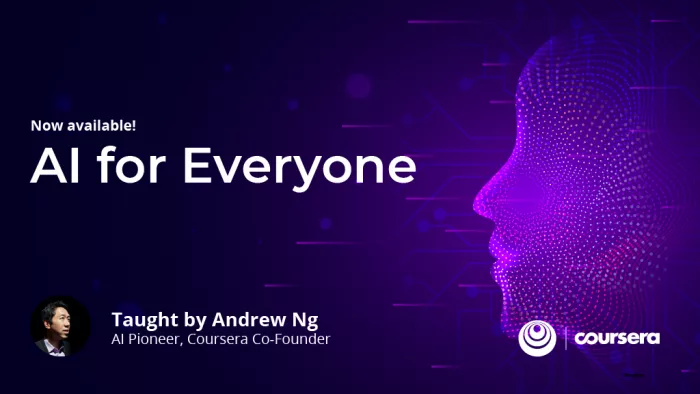
This course is often referenced because of its clarity rather than its scope. It explains machine learning concepts, basic neural network ideas, and how organizations adopt AI. It does not train learners to use modern AI tools in a hands on way.
Its main limitation is timing. While it explains foundational ideas well, it offers little engagement with large language models, prompt engineering, or current tool workflows. For readers seeking practical tool usage, it functions more as orientation than training.
Google AI Essentials
This course focuses on everyday productivity tasks such as drafting text or summarizing information using generative AI. It introduces prompt design and ethical considerations without technical depth.
The strength here is specificity. Learners leave knowing how AI fits into routine work. The weakness is that the course does not attempt to explain how tools function beyond surface behavior. It teaches use, not understanding.
Elements of AI
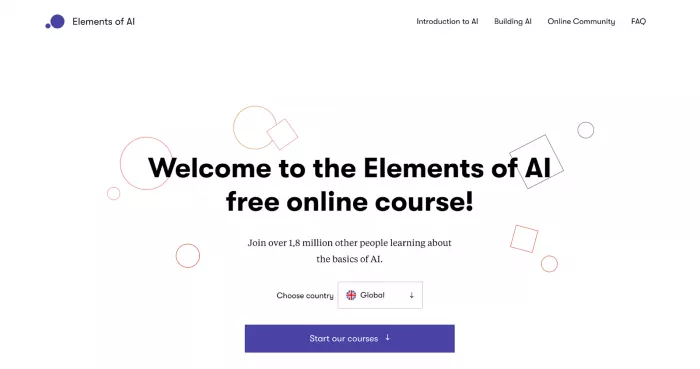
Elements of AI positions itself as a public education initiative. It covers algorithms, bias, and basic AI logic through exercises that require no coding.
Its limitation is intentional. Exercises remain simple, and learners looking to apply tools directly may find the material abstract. The course is better suited for building critical awareness than operational skill.
Courses that move toward hands on tool usage
These programs expect some familiarity with programming and are closer to what people usually mean by learning AI tools.
DeepLearning.AI on Coursera
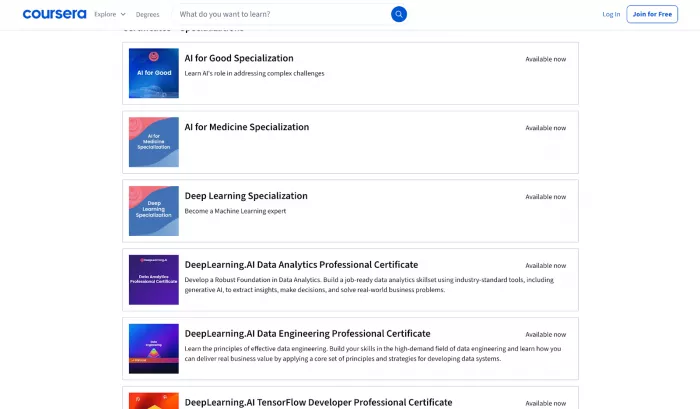
This specialization introduces learners to TensorFlow, neural networks, and applied machine learning through structured assignments. It is one of the more methodical paths available.
The tradeoff is relevance speed. Parts of the curriculum reflect earlier ML workflows, and deployment or modern LLM usage is limited. Learners gain solid foundations, but may need supplementary resources to apply tools in current environments.
DataCamp AI Fundamentals Track
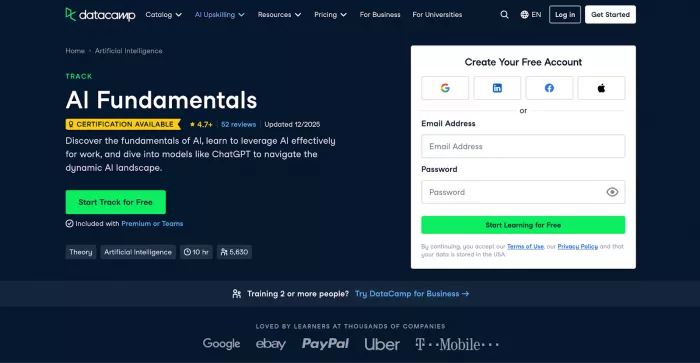
DataCamp emphasizes interactive exercises and short lessons covering machine learning, NLP, and AI assisted workflows. The experience is approachable and fast paced.
Its main weakness is depth. Topics are introduced quickly but not explored extensively. For learners seeking conceptual reinforcement and repeated practice, it works. For those aiming to build complex systems, it may feel incomplete.
fast.ai Practical Deep Learning for Coders
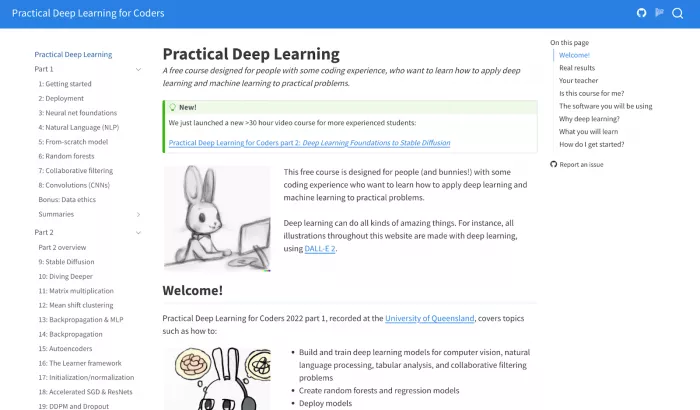
This course takes a very different approach. Learners are pushed into working models early, often before they fully understand the underlying theory. The emphasis is on results rather than gradual explanation.
This works well for experienced programmers. It does not work well for beginners. The pace can feel abrupt, and learners without Python confidence often struggle to keep up.
Programs built around career signaling
These courses are typically expensive and marketed as pathways into AI roles.
Udacity AI Nanodegree programs
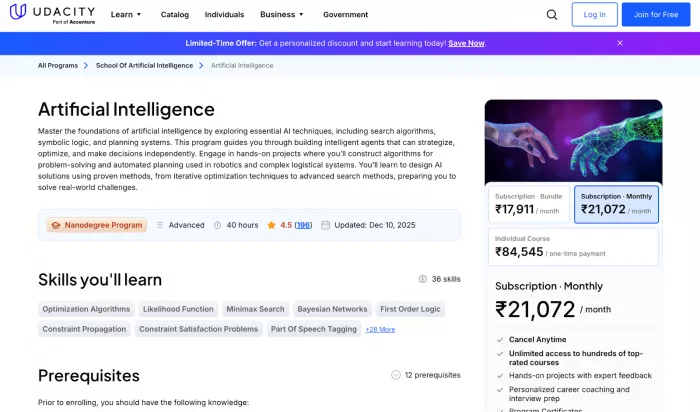
Udacity’s AI focused nanodegrees rely heavily on project based learning. Students build portfolios and receive feedback, which can be useful for career transitions.
The primary criticism is cost relative to outcomes. While projects are practical, coverage can feel rushed, and sustained motivation is required due to limited community interaction. These programs work best for learners who already have direction and need structure, not exploration.
Platform differences that actually matter
Choosing a course often means choosing a platform.
● Coursera emphasizes academic structure and credentials but moves slowly.
● Udacity emphasizes projects and employability, with higher financial risk.
● DataCamp emphasizes practice and repetition, with limited depth.
● edX leans toward university backed rigor, with fewer interactive tools.
● Google Cloud Skills Boost focuses on deployment and cloud tools, not general AI literacy.
None of these platforms is universally better. Each optimizes for a different outcome.
Free versus paid is not the real distinction
The meaningful difference is not cost. It is what the learner wants to do next.
Free courses tend to build understanding and confidence. Paid courses tend to bundle structure, deadlines, and signaling. Neither guarantees competence.
Many experienced learners combine both. They use free courses to understand concepts and paid programs selectively to practice applied skills.
Conclusion
AI tools courses are not interchangeable, even when they appear similar. Some explain ideas. Others teach frameworks. A few help build portfolios. None solve every problem.
The most reliable approach is not finding the best course, but understanding what kind of learning gap you are trying to close. Confusing conceptual literacy with operational skill leads to frustration. Confusing certificates with competence leads to disappointment.
Courses can accelerate learning, but they do not replace experimentation, iteration, or critical thinking. In a field evolving as fast as AI, the most durable skill is not knowing which tool to use, but knowing how to evaluate whether a tool is worth using at all.
Comments