Table of Contents
- 1. Robylon AI – Omnichannel Voice + Chat Automation
- 2. Retell AI – Production‑Ready Voice Agents With Monitoring
- 3. Vapi AI – Developer‑First APIs for Custom Voice Agents
- 4. PolyAI – Enterprise Customer Service Voice Assistants
- 5. CloudTalk – Cloud Call Center With AI Voice Abilities
- 6. Synthflow – No‑Code AI Voice Agent Builder
- 7. Phonecall.bot – Realistic Voices With Simple Setup
- 8. OpenAI Realtime & Deepgram Aura – Core Voice Infrastructure
- How to Pick the Right AI Voice Agent Tool
- Conclusion
AI voice agents have moved from experimental pilots to core CX and revenue infrastructure in SaaS, e‑commerce, healthcare, real estate, and professional services. Instead of just routing calls, these agents can understand intent, pull data from CRMs, and respond in natural language with low latency. For customers, that means shorter wait times and more conversational experiences; for businesses, it means scalable, consistent service across time zones.
When you choose an AI voice agent platform, you’re essentially choosing three things at once: the quality of the voice and conversation, the depth of integrations with your existing tools, and the level of control your team has over flows and logic. The eight tools below cover the spectrum from no‑code builders to developer‑first APIs and enterprise platforms so you can match the technology to your use case and skills.
1. Robylon AI – Omnichannel Voice + Chat Automation
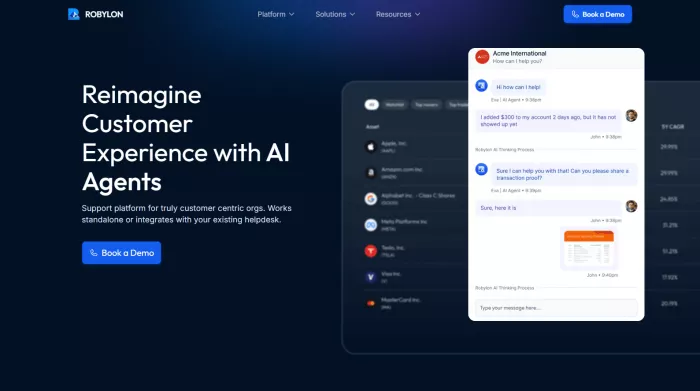
Robylon AI focuses on building a single automation layer that works across both voice and chat. Instead of running separate bots for phone, web chat, and messaging apps, you design one AI brain that can handle conversations on all of them.
Robylon’s platform lets you create AI agents that answer calls, handle website chat, and respond on channels like WhatsApp while staying connected to your CRM and helpdesk. Its analytics help you see which intents are most common, how well automation is working, and where handoffs to humans occur. This makes it a strong fit for support teams that care about consistency across multiple touchpoints rather than treating each channel as an isolated project.
Key highlights:
● Omnichannel agents that work across phone, chat, and messaging.
● Integrations with popular CRMs and helpdesks to keep data unified.
● Built‑in analytics to optimize scripts, intents, and flows over time.
On the downside, Robylon can be more platform than a micro‑business really needs. If you only run a single phone line with simple call flows, you may not fully use its power. It tends to suit mid‑market and enterprise teams with structured support operations and an existing tool stack they want to augment rather than replace.
2. Retell AI – Production‑Ready Voice Agents With Monitoring
Retell AI is aimed at teams that want AI agents in production, not just in a lab. The core idea is that designing an AI call agent is only half the job; the other half is monitoring and improving how it performs under real traffic.
With Retell, you can deploy AI agents for inbound and outbound calls, then track metrics such as automation rate, transfer rate, average handling time, and latency. This level of observability helps teams catch issues early like misunderstanding a common intent or failing to follow compliance scripts and iterate quickly. It’s especially useful in environments where SLAs and customer satisfaction metrics are tightly tracked.
Where Retell shines:
● Strong focus on monitoring, analytics, and reliability in real‑world usage.
● Suitable for higher‑volume operations, call centers, and SaaS products.
● Designed to be part of serious, ongoing automation programs rather than one‑off experiments.
The trade‑off is that Retell generally assumes a certain level of operational and technical maturity. Teams that do not yet track metrics or run structured experiments may under‑leverage its strongest features. Pricing is usually usage‑based, with per‑minute or similar models and more favorable rates at higher volumes, making it most attractive once your call automation starts to scale.
3. Vapi AI – Developer‑First APIs for Custom Voice Agents
Vapi AI is built primarily for developers who want deep control over how AI voice agents behave and integrate with back‑end systems. Rather than giving you only a visual flow builder, it provides APIs and SDKs that let you embed phone agents directly in your product.
A typical Vapi implementation might involve an app that triggers outbound calls when specific events occur, or an inbound line that looks up user data via webhooks in your own database. Because flows can be driven by external APIs and context, you can create highly tailored behaviors that go beyond simple FAQ answering.
Good reasons to choose Vapi:
● You want to embed AI calling into your own app or SaaS product.
● You have developers who are comfortable working with APIs and webhooks.
● You need complex, dynamic logic tied to your own databases or services.
However, this power comes with complexity. Non‑technical teams will usually need engineering support to get real value from Vapi, and it’s not the fastest way to launch a simple AI receptionist. Pricing is typically per‑minute with starter tiers and volume discounts, so the platform scales economically as your product usage grows.
4. PolyAI – Enterprise Customer Service Voice Assistants
PolyAI is positioned firmly in the enterprise segment, powering customer service voice assistants for large brands across sectors like banking, retail, and travel. Its focus is on building robust, natural, and multilingual assistants that can handle complex customer journeys.
For enterprises, PolyAI offers advanced speech recognition tuned for noise and accents, deep natural language understanding, and integrations with internal systems so the assistant can perform tasks like checking balances or booking services. It’s built to handle high call volumes while maintaining consistent quality and adhering to strict compliance requirements.
PolyAI is a strong fit when:
● You are a large B2C brand with global customer bases and multiple languages.
● Calls involve complex, regulated workflows (for example, financial or travel rules).
● You need an assistant that can operate at scale with strong governance and support.
The limitations largely revolve around fit and effort. PolyAI is not designed for small businesses looking to self‑serve a basic bot in an afternoon. Implementations often involve consulting, integration work, and custom design. Pricing is typically enterprise‑contract based, reflecting the high level of customization and support involved.
5. CloudTalk – Cloud Call Center With AI Voice Abilities
CloudTalk started life as a cloud call center solution and has steadily added AI features, including AI‑assisted calling and voice automation. For many organizations, the appeal is that telephony and AI live in one place, instead of being stitched together from multiple vendors.
In CloudTalk, you can manage numbers, routing, IVR, recording, and analytics, while also leveraging AI for tasks like call summarization, routing suggestions, and partially or fully automated calls for simple use cases. This makes it attractive to sales and support teams who want to modernize their phone workflows without completely changing their stack.
CloudTalk works well when:
● You already need a robust cloud phone system for your team.
● You prefer an all‑in‑one platform where AI is an extension of your existing setup.
● Your AI requirements are moderate rather than extremely specialized.
The AI voice components are generally less customizable than builder‑ or API‑centric tools. If you need highly bespoke AI behavior, you might eventually add a specialist platform. Pricing usually follows per‑seat or per‑user plans, plus call usage, which makes costs predictable for teams scaling gradually.
6. Synthflow – No‑Code AI Voice Agent Builder
Synthflow caters to founders, marketers, and operations managers who want AI phone agents without touching code. Its visual builder lets you design flows, define what the AI should say, and connect to calendars or CRMs using a drag‑and‑drop interface.
A typical use case might be a small agency building an AI intake line for clients, or a local business setting up an AI receptionist that answers common questions and books appointments. Because you can change scripts and flows directly, iteration cycles are short and do not depend on engineering sprints.
Reasons to like Synthflow:
● Very friendly for non‑technical teams, with a visual flow builder.
● Good for rapid experimentation and quick deployment.
● Integrations and templates make common use cases easy to set up.
The limitation is that no‑code tools naturally have boundaries. If your logic is very complex, or if you need deep integration with proprietary systems, you may hit those limits sooner. Pricing tends to use a SaaS model with included minutes per month and higher tiers for more usage, making it transparent for agencies and SMBs that bill clients or budget monthly.
7. Phonecall.bot – Realistic Voices With Simple Setup
Phonecall.bot focuses on simplicity and voice quality. Its primary pitch is that you can create natural‑sounding AI callers in multiple languages quickly, making it ideal for reminders, confirmation calls, and basic inbound handling.
After configuring your agent, choosing a voice, defining its role, and setting up call logic, you can use it for tasks like appointment reminders, follow‑up calls, or basic FAQ answering. For many small service businesses, this is exactly the level of automation they need: a professional‑sounding agent that takes care of repetitive calls without requiring complex workflows.
Phonecall.bot is a good option if:
● You run a clinic, salon, small agency, or local service business.
● You care a lot about natural, human‑like voice quality.
● You want a straightforward way to send outbound reminders or handle simple inbound calls.
The main limitation is that it’s not designed as a deep developer platform. If your use case evolves into something more intricate, you may need to combine it with other tools or migrate to a more programmable solution. Pricing is usually usage‑based, with smaller plans for local businesses and larger bundles for agencies.
8. OpenAI Realtime & Deepgram Aura – Core Voice Infrastructure
OpenAI Realtime and Deepgram Aura provide the underlying technology many AI voice platforms depend on: fast speech recognition, natural speech synthesis, and near real‑time conversational capabilities. Instead of giving you a ready‑made call center interface, these services give you the building blocks.
Engineering teams can use these APIs to create their own AI voice agents that plug directly into internal systems, mobile apps, or custom dashboards. This route is attractive for companies that want to own their core experience and differentiate heavily through UX and integration depth.
These tools are ideal when:
● You have a strong engineering team and want maximum flexibility.
● You’re building a product where voice is a core feature, not just an add‑on.
● You’re comfortable managing telephony, monitoring, and orchestration yourself or via separate components.
The downside is that you must handle more responsibilities yourself: telephony carriers, call routing, logging, dashboards, and failover strategies typically sit on your side. Pricing is usage‑based (per minute of audio, tokens, or characters), and can be very cost‑effective at scale if you architect your stack well.
How to Pick the Right AI Voice Agent Tool
With so many options, it helps to anchor your decision on a few practical questions.
Ask yourself:
How technical is my team?
● Non‑technical: Start with no‑code builders like Synthflow or Phonecall.bot, or call‑center platforms like CloudTalk.
● Technical / product‑oriented: Consider Vapi AI, Retell AI, or building with OpenAI/Deepgram directly.
What is my scale and complexity?
● Small business with straightforward calls: No‑code tools or CloudTalk’s AI features will usually be enough.
● Mid‑market with growing support volumes: Robylon or Retell AI can centralize and monitor serious automation.
● Large enterprise with global traffic: Enterprise‑grade platforms like PolyAI or robust omnichannel tools like Robylon are better fits.
How important is ownership and differentiation?
● If you just want a reliable AI receptionist, simplicity and time‑to‑value matter most.
● If voice is a strategic differentiator for your product, deeper, API‑level control is worth the extra effort.
Conclusion
AI voice agents are now a core part of modern customer experience, not just a nice‑to‑have experiment. For small, non‑technical teams, simple no‑code tools and call‑center platforms are usually “best” because they deliver quick wins with minimal setup, while larger or more technical companies get more value from flexible, API‑driven or enterprise‑grade solutions. The right choice depends on your team’s skills, call volume, and how strategic voice is to your business—start with one high‑impact use case, prove ROI, and then scale into more advanced tools and deeper integrations over time.
Comments