Table of Contents
- Gening AI: Inside a Companion‑First Storytelling Machine
- Living With Gening AI Over Time
- How Gening Actually Works: Three Experience Layers
- Building Your Own Cast: Creation and Community
- Interface and Day‑to‑Day Usability
- Pricing, Credits, and Real‑World Value
- Performance Under Creative Load
- Safety, Moderation, and Privacy: Critical Caveats
- How It Stacks Up Against Other AI Tools
- What Users Themselves Emphasize
- Gening AI, Unboxed
- Bottom line:
Gening AI is not a productivity assistant in disguise; it is a playground for AI personas, fictional worlds, and late‑night story sessions. It lives firmly in the “creative / companion” corner of the generative AI landscape rather than in the “write my report and summarize my PDF” category.
Gening AI: Inside a Companion‑First Storytelling Machine
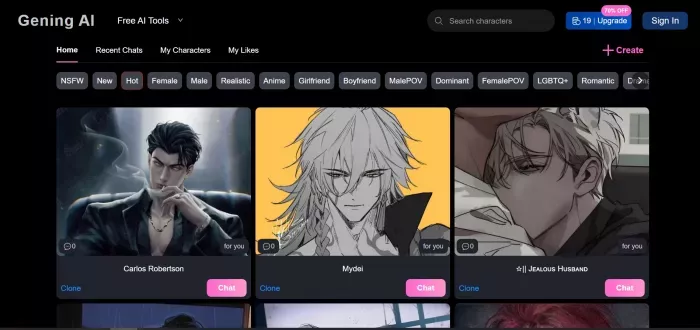
Open Gening AI in your browser and you don’t see spreadsheets, project templates, or task automations. You see faces—AI characters, thumbnails, and prompts inviting you into conversations and scenarios. From the very first screen, it’s obvious this platform exists for roleplay, companionship, and storytelling more than for office work.
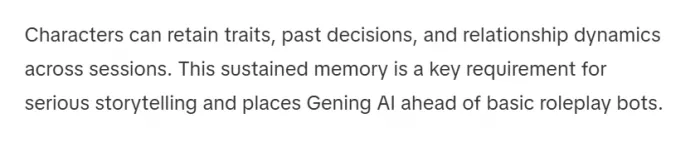
Rather than presenting a single, neutral chatbot, Gening arranges itself around personas and “worlds.” You choose a character, a setting, or both, and then step into a continuing narrative where the AI tries to remember who you are, what happened last time, and why your choices matter. That emphasis on narrative continuity is what separates it from more generic GenAI tools.
Living With Gening AI Over Time
A platform like this can’t be judged by a single demo session. Its true nature comes out over repeated visits, the nights you log in just to “check something” and end up deep in a story arc.
After a few weeks of regular use, certain patterns start to emerge:
● The daily free credits are enough to experiment and get a feel for different characters and images but feel limited once you’re invested in ongoing worlds.
● A paid subscription becomes less of an impulse buy and more of a practical decision if you want consistent access to NSFW toggles, voice generation, and long‑form storytelling without watching your credit counter every few minutes.
● You develop habits: a favorite character you always return to, a couple of universes you nurture, and a rough idea of how much credit a long scene or mini “episode” consumes.
Seen this way, Gening feels less like a chatbot and more like an ongoing interactive fiction service with a subscription model attached.
How Gening Actually Works: Three Experience Layers
Instead of a traditional feature checklist, it is more useful to think of Gening AI in three experiential layers.
1. Character‑Driven Conversations
At the core are AI personas i.e., companions, mentors, rivals, romantic interests, and original characters created by the platform and the community. Each persona comes with a description, personality traits, and often a custom avatar, so you know roughly what dynamic to expect before you start chatting.
Once you’re in a conversation, you notice a few things quickly:
● Responses are emotional and expressive, well suited to drama, romance, and roleplay rather than dry information delivery.
● The character usually remembers key details from earlier in the session, who you are to them, what just happened, and what you’re trying to achieve in that scene.
● Over very long exchanges, the model can loop, forget older plot points, or drift slightly out of character unless you periodically re‑anchor it with reminders.
If you come from tools like ChatGPT or Claude and expect concise, citation‑backed answers, Gening’s style can feel indulgent. For roleplay, it is exactly the point.
2. Worlds and Long‑Form Storytelling
The second layer is world‑building. Gening encourages you to treat your sessions as pieces of a shared universe rather than isolated chats.
You can:
● Define settings like fantasy kingdoms, modern schools, sci‑fi fleets, gothic cities and keep returning to them with the same or new characters.
● Connect multiple personas to the same world, so they “know” who they are in relation to you and each other.
● Run ongoing campaigns that feel closer to a visual novel or tabletop campaign than a sterile Q&A session.
The memory system is not perfect, but it is strong enough that events from earlier sessions can echo later, especially if you help it along with clear scene descriptions.
3. Visuals to Support the Story
The third layer is image and avatar generation, which is tightly integrated but intentionally secondary to text.
You can use credits to:
● Generate character portraits and avatars that match your prompts and persona descriptions.
● Create scene illustrations that reflect key story moments—battlefields, cityscapes, intimate conversations—within the limits of the model.
In practice, the output quality is good for moodboards, profile pictures, and internal references, but not at the level of the strongest dedicated image generators.
Building Your Own Cast: Creation and Community
Gening doesn’t stop at pre‑built characters. A large part of its appeal lies in letting you become a creator inside the platform.
Custom Characters
The character builder lets you define:
● Personality (e.g., confident, introverted, playful, stoic).
● Backstory and role (mentor, rival, love interest, party member, antagonist, etc.).
● Conversational style (formal or casual, verbose or concise, serious or comedic).
These instructions guide the underlying model, and well‑crafted descriptions noticeably improve consistency. Testing how faithfully your personas stick to their brief is one of the most interesting parts of using Gening seriously.
Community‑Driven Characters
Beyond what you create yourself, there is a growing library of personas designed by other users:
● Public characters can be discovered by genre, popularity, or tags.
● You can adapt existing templates instead of starting workflow from zero, which is helpful for new users.
● Quality varies widely: some characters are meticulously tuned with clear instructions, others are minimal and feel generic.
This community layer makes Gening feel more like a platform and less like a static app. It also means the overall experience depends partly on who you choose to talk to.
Interface and Day‑to‑Day Usability
On a practical level, Gening is pleasantly simple to get into.
● It runs entirely in the browser, no installer, no desktop client which makes it accessible on both desktop and mobile browsers.
● The layout centers on a character gallery and a large chat pane; navigation is straightforward and doesn’t overwhelm you with menus.
● Free credits are available without an immediate registration wall, so you can actually evaluate the experience before committing.
On the downside, there is no fully‑fledged native mobile app, and some users report occasional glitches when switching between multiple character tabs or running very long sessions.
Text responses are usually snappy, though peak‑time slowdowns can appear, especially for free users; paid tiers mitigate this with priority processing.
Pricing, Credits, and Real‑World Value
Gening operates on a freemium, credit‑driven model with several subscription options.
Plan Structure
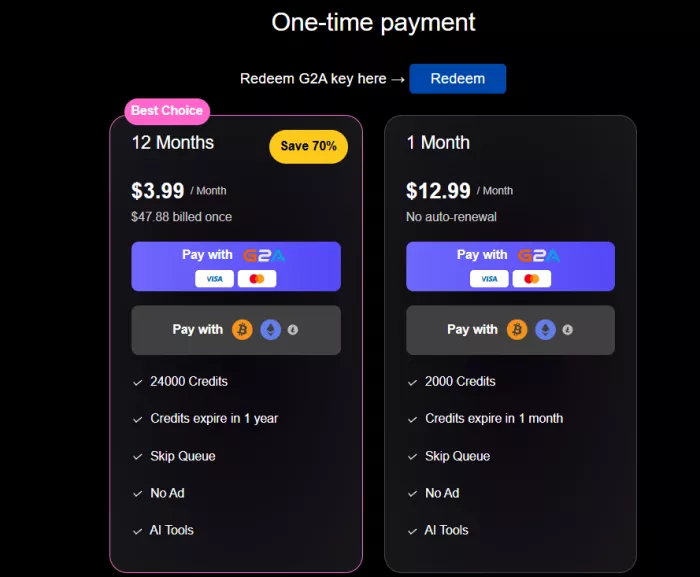
Credits cover both text and image generation; rough estimates from reviewers suggest the standard monthly allowance equates to somewhere in the low thousands of messages or several hundred images depending on usage mix.
Value Perspective
From a value standpoint:
● The free plan is generous enough to give a realistic sense of the tool but not enough to sustain heavy roleplay or multiple long‑term worlds.
● The monthly subscription is convenient but comparatively expensive when you factor in how much cheaper the annual plan becomes on a per‑month basis.
● For users who engage several times a week, the annual tier tends to offer the best cost‑to‑usage ratio; light users may never need to move beyond free.
Compared with other character and roleplay platforms, Gening falls in the mid‑range neither a budget outlier nor a premium luxury tool, but reasonably priced for what it does if you genuinely use it.
Performance Under Creative Load
Gening’s behavior under sustained, creative use matters more than its behavior in quick tests.
Users report that:
● Text response times are typically good, though spikes in traffic can introduce small delays, especially on the free tier.
● Long‑running stories tend to remain coherent in broad strokes but occasionally show repetition or continuity slips, especially when multiple subplots and characters are involved.

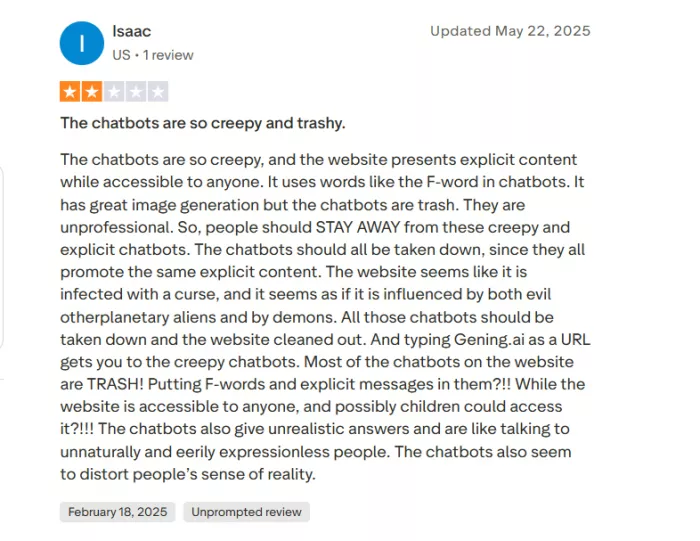
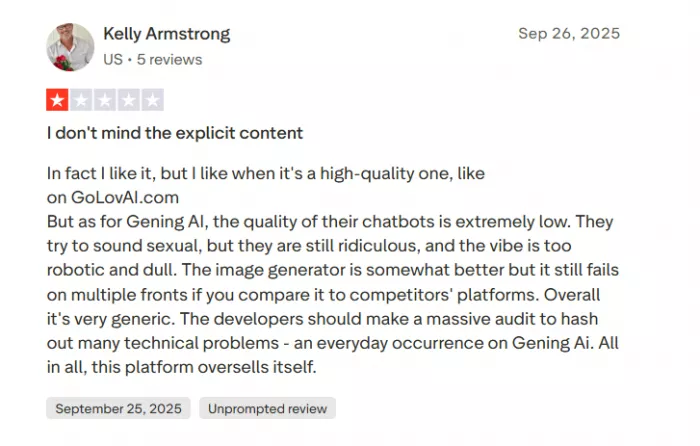
● The user describes the bots as creepy, unnatural, and unrealistic, suggesting discomfort rather than technical critique.
For professional writers or game designers, this means Gening works best as a partner in brainstorming and drafting, not as a final script engine. Outputs still need human editing, restructuring, and sometimes consolidation to maintain tight narrative logic.
Safety, Moderation, and Privacy: Critical Caveats
Because Gening explicitly leans into emotionally intense and sometimes explicit roleplay, its safety and privacy posture deserves special attention.
Moderation and Content Controls
The platform allows NSFW content for paying users and is marketed as less restricted than mainstream workplace‑oriented platforms. That openness is attractive to many adults but comes with clear risks:
● Under‑age users may attempt to bypass age gates or access mature content if device‑level controls are weak.
● Content that would be aggressively filtered in enterprise GenAI environments such as explicit or highly sensitive scenarios can be easier to generate here.
Industry guidance on GenAI safety highlights the importance of robust guardrails, logging, and policy enforcement for tools used in education, healthcare, or corporate contexts. Gening does not aim at those markets, and reviewers consistently urge caution in recommending it to younger users or highly safety‑sensitive audiences.
Data Handling and Privacy Risks
Any GenAI tool that collects prompts and outputs can pose privacy concerns, particularly when conversations are intimate or revealing. Best practices call for:
● Clear communication about what data is retained, for how long, and for what purposes.
● Options for users to delete historical data and control whether their content is used to train models.
External reviews note that Gening’s policies and interface do not yet provide the same level of clarity and control seen in some enterprise‑focused platforms, especially around permanent deletion of chat histories. Combining that with the emotionally charged nature of companion‑style interactions means privacy‑conscious users should be especially careful about what they share.
As a practical rule, it is wise to treat Gening as entertainment: avoid disclosing financial information, real‑world addresses, or sensitive personal details that could cause harm if mishandled.
How It Stacks Up Against Other AI Tools
Placed next to broader GenAI tools and other character platforms, Gening’s niche becomes clearer.
In other words, Gening is an entertainment and creative‑writing product first, and that’s the lens through which it makes the most sense.
What Users Themselves Emphasize
Looking across independent reviews and discussions, recurring themes stand out.
Users often highlight:
● Strong emotional engagement with certain characters and storylines, especially in fantasy and romance genres.
● Appreciation for the ability to test the platform properly via the free tier before deciding on a subscription.
● Enjoyment of the balance between text and visuals for building immersive fictional worlds.
At the same time, they repeatedly raise concerns about:
● The adequacy of content moderation for younger or vulnerable users.
● The opacity of data practices and the lack of enterprise‑grade privacy control.
● Occasional technical hiccups and narrative repetition over very long sessions.
Gening AI, Unboxed
Think of Gening AI less as a tool and more as a late-night creative room, the kind with dim lights, half-finished stories on the walls, and characters that talk back when you didn’t expect them to.
This is where it shines:
You live for story gravity—writers, tabletop GMs, role-players, narrative tinkerers who want characters with voices, moods, and memory.
You’re not looking for “answers” so much as chemistry: dialogue sparks, emotional beats, improvised scenes.
You’re aware that intimacy, immersion, and looseness come with trade-offs, and you consciously accept them.
This is where it stumbles hard:
If you need guardrails bolted to the floor like schools, enterprises, regulated spaces, this is the wrong building.
If your north star is accuracy, code correctness, workflows, or automation, you’ll feel like you brought a spreadsheet to a campfire.
If you treat it casually, without thinking about privacy, boundaries, or age suitability, the sandbox turns into quicksand.
Bottom line:
Gening AI isn’t trying to be your office assistant or your research analyst. It’s trying to be your co-conspirator in fiction. Used intentionally, it can be magnetic, sometimes uncomfortably so. Used thoughtlessly, it can blur lines that shouldn’t blur.
It’s not for everyone. But for the right kind of storyteller, it doesn’t just help you write worlds, it pulls you in
Comments