Table of Contents
- Introduction: Two Roleplay Philosophies
- Platform Overviews
- Character Creation And Customization
- Roleplay Quality And Conversation Style
- Memory, Continuity, And Long-Term Worlds
- Safety, NSFW, And Content Boundaries
- Interface, Learning Curve, And Everyday UX
- Pricing, Plans, And Performance
- Ecosystem, Community, And Typical Use Cases
- So, Character AI Or Janitor AI?
Character AI and Janitor AI sit on the same shelf AI chatbots built for characters and roleplay but they serve very different types of users. Character AI feels like a polished theme park with clear rules, while Janitor AI feels like a sandbox where almost anything can be built if one is willing to get hands‑on.
Introduction: Two Roleplay Philosophies
Character AI works as the “plug in and start chatting” option. It provides curated characters, a friendly interface, and strong safety rails so most people can jump into roleplay without worrying about crossing forbidden lines.
Janitor AI, by contrast, is a playground built for full control. It offers deeper character configuration, stronger long‑term continuity, and far fewer restrictions on what can be done or said but expects a certain level of intent and understanding from the person configuring it.
Both platforms can be excellent, yet they excel in different directions: ease of use versus control, safety versus freedom, and casual chats versus long‑running, highly customized story worlds.
Platform Overviews
Character AI: Mainstream, Curated, Safe
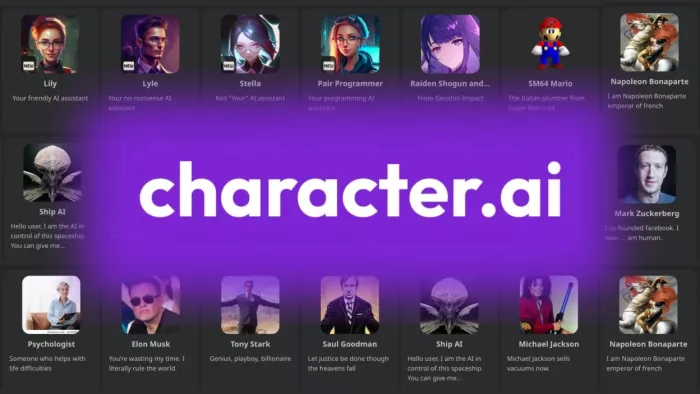
Character AI functions as a mass‑market character chatbot platform where conversations feel like talking to distinct personas rather than a generic assistant. A large library of user‑created characters is available anime figures, fictional heroes, mentors, romantic interests, and more and interaction starts with almost no setup.
The platform runs on conversation‑tuned models and applies strong global safety layers. Emotional coherence, a friendly tone, and consistent behavior are prioritized, while explicit sexual content and sensitive topics are automatically blocked or moderated. The entire experience is clearly oriented toward a teen‑friendly, general‑audience environment.
Character creation follows a structured flow. Personality, backstory, and sample dialogs are defined, while a hidden layer of rules and safety prompts remains above the character. Even when a persona is pushed to extremes, the system tends to “round off the edges” to keep everything within policy.
Janitor AI: Advanced, Flexible, Unfiltered
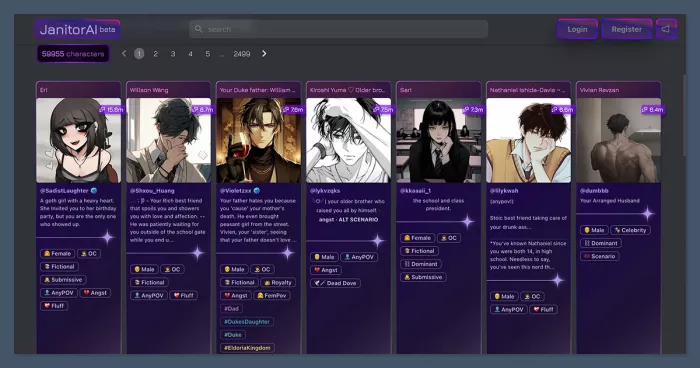
Janitor AI occupies almost the opposite end of the spectrum. It is a character roleplay platform focused on customization and reduced content restrictions. Instead of a single closed proprietary model, it can route to different large language models (via its own backend or external APIs), which introduces flexibility in style, depth, and intensity.
The main attraction is the amount of control available when building characters and scenarios. Multi‑layer prompts, detailed world rules, and fine‑tuned communication styles can be defined. There is no default NSFW filter, so adult, dark, or taboo themes are possible, with responsibility placed on the creator.
The trade‑off is straightforward: more power and freedom, less “it just works” smoothness for beginners. Some experimentation is often needed before landing on optimal model choices and configurations for a preferred roleplay style.
Quick Comparison Snapshot
| Dimension | Character AI | Janitor AI |
| Safety / NSFW | Strict filters, globally enforced | Minimal censorship, user‑defined boundaries |
| Ease of use | Extremely easy, pick‑and‑play | Higher learning curve, more options |
| Customization depth | Good, but bounded by platform rules | Very deep, including system‑level prompt tuning |
| Memory / continuity | Decent, can drift in very long chats | Strong continuity over long‑running stories |
| Target audience | Teens, casual roleplayers, fandom communities | Adults, power roleplayers, world‑builders |
| Monetization | Freemium (free + subscription) | Free core; some setups rely on external paid models |
Character Creation And Customization
Character AI: Guided Creativity Inside Guardrails
Character AI’s builder makes it possible to create believable personas without prompt‑engineering expertise. The interface behaves like a guided questionnaire rather than a blank canvas.
Typically, the creator specifies who the character is, how it behaves, and what dynamic it has with the user. Background lore, key personality traits, relationship preferences, and a few example conversations establish tone and style. Nuanced characters can be produced in minutes.
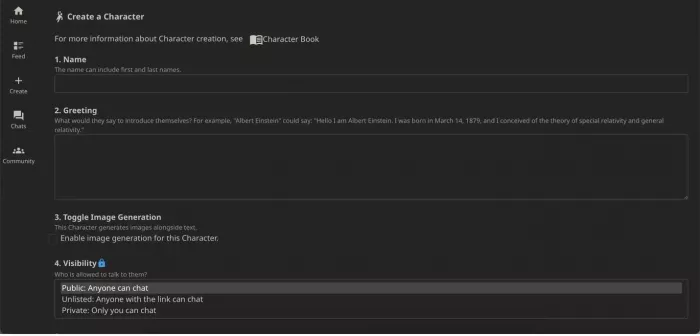
However, the platform’s internal moderation and hidden system prompts still sit above everything. Regardless of how dark, chaotic, or provocative a character is designed to be, strict limits remain. A villain may sound menacing but will not be allowed to cross into certain explicit behaviors.
For rapid character sketching without concern for low‑level control, this structure works very well. For advanced creators, it resembles acting inside a tight costume: freedom exists, but only within predefined bounds.
Janitor AI: Full-Stack Prompt Engineering
Janitor AI approaches character creation like designing an AI agent. The creator specifies not only “who” the character is, but also “how” it should think, respond, and evolve.
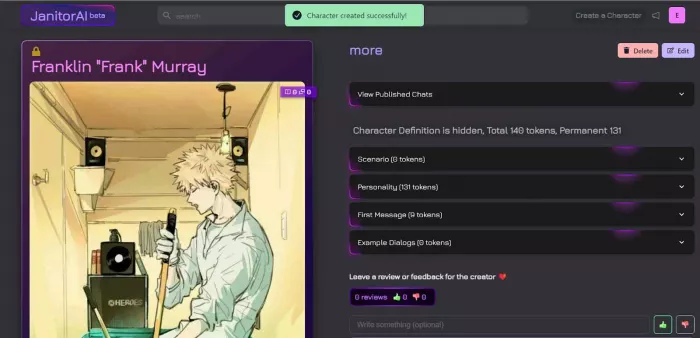
Extensive personality and behavior rules can be written, scenario and world context (time period, lore, relationships, constraints) can be encoded, and separate system prompts can govern style, pacing, and boundaries. Underlying model parameters such as creativity and verbosity are often configurable as well.
Without a heavy global censorship layer, prompts map directly to behavior. A morally grey anti‑hero in a grim, rule‑driven world tends to behave exactly that way, with far fewer “softening” interventions.
The result is a high skill ceiling. Weak prompt design can lead to inconsistent characters, while strong prompt design can produce some of the richest, most coherent personas available on consumer roleplay platforms.
Roleplay Quality And Conversation Style
Character AI: Emotional, Smooth, But Sometimes Blocked
On Character AI, conversations often feel warm, emotionally attuned, and almost cinematic after a few exchanges. The models pick up emotional cues, mirror feelings, and maintain a consistent voice across messages.
This is particularly visible in non‑explicit romance, slice‑of‑life “comfort” chats, and fandom‑based roleplay where a character must resemble a known figure. Dialogue usually flows smoothly, with scenes that feature clear buildup and emotional beats.
When a conversation approaches explicit or very dark territory, global safety systems intervene. Responses may become vague, shift topics abruptly, or flatly decline certain actions. For some, that is reassuring; for others, it breaks immersion at the most intense moments.
Overall, Character AI offers polished, emotionally intelligent roleplay within a strict safety envelope.
Janitor AI: Freeform, Intense, Sometimes Uneven
Janitor AI delivers a more raw and freeform experience. When prompts are carefully crafted and the chosen model is strong, it can sustain long scenes without collapsing into generic assistant‑like talk, escalate naturally into romance, horror, or thriller modes, and maintain complex narrative arcs.
Because configuration and model selection vary, quality can fluctuate more than on a tightly controlled platform. A well‑tuned setup can feel like having a dedicated game master; a quick, minimally configured character can feel flatter or more generic.
For those who prioritize freedom, intensity, and depth over guardrails and fixed polish, this variability is an acceptable and even welcome trade‑off.
Memory, Continuity, And Long-Term Worlds
Character AI: Good Enough For Casual Stories
Character AI maintains context reasonably well during a session. It tends to remember identities, current scenarios, recent events, and general emotional tone.
Over longer arcs, smaller details, side characters, or early twists may fade, and gentle reminders sometimes become necessary. For short stories and casual roleplays, this rarely becomes a serious limitation. For multi‑week campaigns, occasional memory lapses are noticeable.
Janitor AI: Built For Campaigns And Long Arcs
Janitor AI generally handles long‑term continuity more convincingly, especially when the world and relationships are clearly documented in the prompts.
The system is particularly effective at preserving character relationships, adhering to world rules and recurring locations, and tracking long‑running goals or conflicts. Over many sessions, the experience feels more like a persistent narrative universe than a chain of isolated chats.
For campaign‑style or saga‑style storytelling, this continuity becomes a major strength.
Safety, NSFW, And Content Boundaries
Character AI: Corporate-Grade Safety Net
Character AI is designed as a safe‑by‑default environment. Platform‑wide NSFW filters and content policies restrict explicit sexual content, especially illegal or highly sensitive themes, and moderate depictions of violence and self‑harm.
Public characters and group chats are expected to comply with these rules, with sanctions or removal for content that crosses boundaries. This structure makes Character AI suitable for teens, schools, and general audiences, with responsibility for safety resting primarily on the platform.
Janitor AI: Freedom With Responsibility
Janitor AI follows a different philosophy. Without a default NSFW filter, the platform supports adult, explicit, and taboo content, with responsibility shifted to the user base.
As a result, the environment has a strong presence of explicit romance, darker themes, and experimental storytelling that would be blocked outright on heavily moderated platforms. This openness also means the space is inherently adult‑oriented and not appropriate for minors or those seeking strict, external safety enforcement.
The platform functions more as an 18+ creative sandbox than a general‑audience social app.
Interface, Learning Curve, And Everyday UX
Character AI: Social App Vibes
Character AI’s interface resembles a social platform. Trending or recommended characters are presented, a character is selected, and chat begins immediately. The layout is simple: a chat window, message stream, and optional extras such as images or voice for certain personas.
Technical decisions are minimal, which dramatically lowers barriers to entry. This frictionless user experience has been a major driver of the platform’s widespread adoption among non‑technical audiences.
Janitor AI: Control Panel For Roleplayers
Janitor AI’s interface, while still approachable, exposes more internal configuration. Character creation involves multiple text fields, tags, and settings, and in many cases includes model selection or generation behavior tweaks.
For those who enjoy tinkering, this design feels empowering. For purely casual users, it may come across as additional overhead. Many community members start from shared templates or popular characters and gradually move toward more intricate custom configurations.
Pricing, Plans, And Performance
Pricing details can change over time; the structures below reflect commonly reported setups and should be checked against current official information before publication.
Character AI Pricing
Character AI follows a straightforward freemium model with a well‑defined premium tier.
| Plan | Price (Monthly, Approx.) | What Is Included |
| Free | 0 USD | Core access, standard speed, queues at peak times |
| c.ai+ / Premium | around 9.99 USD | Faster responses, priority access, reduced or no queuing |
The free tier suits casual or light‑usage scenarios but can face slowdowns during heavy traffic. The premium plan targets heavy users who want consistently fast responses and priority treatment during peak hours.
Janitor AI Pricing Structure
Janitor AI is typically free at the platform level, while costs emerge mainly when certain underlying models or external APIs are used.
| Component | Price Pattern | Description |
| Platform access | 0 USD | Access to site, character creation, basic usage |
| Built‑in / house models | 0 USD to low tiers (varies) | Usage of Janitor‑managed models within fair‑use limits |
| External LLM APIs | Pay‑as‑you‑go (per usage) | Charges depend on provider, token volume, and model choice |
In practice, Character AI behaves as “free with one clear upgrade path,” while Janitor AI behaves as “free to use, with optional external costs if more powerful or specialized models are integrated.”
Performance reflects these philosophies. Character AI targets consistent platform‑wide behavior, occasionally introducing queues for non‑subscribers under heavy load. Janitor AI’s performance depends more directly on the chosen backend model and any associated usage quotas.
Ecosystem, Community, And Typical Use Cases
Character AI’s ecosystem leans toward fandom and comfort‑oriented content. The platform is rich in fan‑made versions of popular characters, stylized mentors, life‑coach personas, and “boyfriend/girlfriend” archetypes operating within PG‑13 limits. Many participants treat it as a hybrid between story generator and digital companion.
Janitor AI’s community is skewed toward advanced roleplayers, adult creators, and world‑builders. Long narrative campaigns, explorations of darker emotional territory, and prompt‑engineering experiments are common. Community contributions often focus on sophisticated setups and techniques rather than simple “cute” characters.
In metaphorical terms, Character AI feels like an open mall that welcomes everyone, whereas Janitor AI resembles a private club where most attendees arrive with a very specific experience in mind.
So, Character AI Or Janitor AI?
The choice between Character AI and Janitor AI ultimately depends on which aspects of roleplay matter most.
Character AI is the stronger fit where immediate usability, platform‑enforced safety, and emotionally coherent, PG‑friendly roleplay are top priorities. It suits teens, casual participants, and fandom‑driven communities that emphasize comfort and low friction over granular control.
Janitor AI is the better match where fewer restrictions and deeper configuration options are more important. It excels in long‑form campaigns, explicit or very dark themes, highly customized worlds, and scenarios where granular prompt engineering is part of the creative process.
For many serious roleplayers, the ideal toolkit includes both: Character AI as the effortless, low‑friction space for everyday chats and lighter stories, and Janitor AI as the high‑control narrative engine for ambitious, boundary‑pushing projects.
Comments