Table of Contents
- 1. The Real Problem Coursiv Is Trying to Fix
- 2. A Day Inside Coursiv: Not the Brochure Version
- 3. From Course Collector to Daily Practitioner
- 4. What You’re Actually Paying For (Beyond Videos)
- 5. The Invisible Curriculum: How Coursiv Changes Your Mindset
- 6. Zooming Out: Content, Challenges, and Learning Paths
- 7. What the Crowd Really Thinks: User Sentiment in Numbers and Stories
- 8. Two Sides of the Same App: Who Thrives, Who Struggles
- 9. The Money Question: Is the Subscription Justified?
- 10. Three Brutal Questions to Ask Before You Sign Up
- 11. Final Take: Coursiv as a Practice Space, Not Just an App
Imagine you’re scrolling on your phone after a long day, half‑tempted to install one more “learn AI fast” app you’ll probably never open again. Coursiv is designed for exactly that exhausted version of you , not the idealized student with unlimited time, but the real human with 15 spare minutes and a low tolerance for fluff.
Let’s walk through Coursiv experience: what it feels like to live with it, how it quietly reshapes your habits, and what thousands of real users say once the honeymoon phase is over.
1. The Real Problem Coursiv Is Trying to Fix

Most AI education isn’t failing because the content is bad. It’s failing because learners are tired, overwhelmed, and allergic to yet another 40‑hour video course.
Coursiv is aimed at three unspoken problems:
● “I’m curious about AI, but everything looks too technical.”
The platform assumes you’re not an engineer and don’t want to become one. Lessons focus on what you can do today with tools like ChatGPT, Midjourney, DALL·E, and others: write better emails, launch campaigns, generate visuals, and automate small tasks.
● “I keep buying courses I never finish.”
Coursiv removes the giant curriculum anxiety. There’s always just one clear next step, framed as a daily challenge or micro‑lesson, not a mountain of modules.
● “I’m scared I’ll ‘do it wrong’ with AI.”
The app gives you guided prompts, templates, and a built‑in practice playground so you don’t feel like you’re experimenting blindly in a professional tool while your boss waits for results.
Underneath the marketing, the core promise is simple: turn “AI is intimidating” into “AI is just part of how I work now.”
2. A Day Inside Coursiv: Not the Brochure Version
Forget landing pages. What does Coursiv look and feel like on a random Tuesday?
You open the app on your phone on the metro, in bed, or between meetings. No massive course catalog. No pressure. Just a dashboard with three things that matter: your current challenge, today’s task, and a streak that quietly dares you not to break it.
A typical 10–15 minute session might involve:
● A short, plain‑English explanation of what a specific AI tool can do for one concrete scenario (e.g., “rewrite this customer email so it sounds professional, not robotic”).
● A prompt skeleton you fill in much like mad‑libs for productivity where Coursiv provides most of the structure and you inject your context.
● A hands‑on test in a built‑in playground, so you can fire the prompt at an AI model without juggling multiple apps or browser tabs.
● A quick quiz, reflection, or mini‑task to make sure you didn’t just skim; you actually used the idea at least once.
By the time you close the app, you haven’t become an AI expert. You’ve just added one tiny skill to your toolbox, something you can use the same day in a doc, a campaign, or a client project.
That tiny, repeatable feeling of “I did something” is Coursiv’s real product.
3. From Course Collector to Daily Practitioner
There are two types of learners in the AI world:
● The Collector: buys courses, saves Twitter threads, bookmarks YouTube playlists, but rarely implements.
● The Practitioner: touches fewer resources but uses them regularly in real situations.
Coursiv’s entire design tries to move you from Collector to Practitioner.
How it does that:
● Deliberate constraint
Instead of showing you hundreds of options, Coursiv curates a sequence: onboarding questions about your role and goals feed into a recommended path and daily challenge. Fewer decisions, more doing.
● Action before theory
Lessons rarely linger on jargon. You see a tool, a prompt pattern, and a use case, then you’re pushed to try it with your own context. The “book knowledge” lives around small, concrete experiments.
● Momentum over motivation
The platform treats your attention like a scarce resource. Streaks, visible progress, and bite‑sized wins remove the need to “feel motivated”; you can complete a session on low‑energy days without friction.
This turns Coursiv from a static library into something closer to a coach: it doesn’t just give you content; it tells you what to do today.
4. What You’re Actually Paying For (Beyond Videos)
On the surface, the pricing looks straightforward: a subscription (roughly in the 29–39 USD/month range depending on region and plan), a 3‑day free trial via the apps, and access to everything — no separate course purchases.
But it’s more useful to think of what you’re buying in terms of systems, not files:
● A sequenced curriculum for beginners and working professionals
You’re guided from basic AI literacy to applied workflows across 25+ tools, including ChatGPT, Midjourney, DALL·E, Jasper, and others.
● A practice environment
Built‑in playgrounds and interactive exercises let you experiment with prompts safely inside the app, instead of flipping between platforms and losing context.
● A habit framework
Daily challenges, linear tracks (often 14‑ or 28‑day challenges), and visible progress bars give your brain reasons to come back — beyond guilt about a sunk‑cost course purchase.
In other words, the subscription fee isn’t just for “content access”; it’s for a predictable, repeatable structure that makes using that content more likely.
5. The Invisible Curriculum: How Coursiv Changes Your Mindset
On paper, Coursiv teaches you to:
● Use AI to write faster and better (emails, blogs, social content, scripts).
● Generate images and simple designs with prompts.
● Build workflows around marketing, content, productivity, and basic automation.
But underneath that skill layer, something quieter is happening:
● You learn to ask better questions. Prompt templates train you to specify audience, tone, constraints, and desired output which is basically structured thinking.
● You get comfortable collaborating with AI instead of treating it as a mysterious black box. Testing prompts in small, safe challenges builds intuition more than reading docs ever could.
● You reframe AI from a threat to a lever. Over time, seeing AI consistently help with your actual workload reduces fear and increases curiosity.
This mindset shift is hard to quantify but shows up repeatedly in real user stories: people talk less about individual lessons and more about “finally feeling confident using AI at work.”
6. Zooming Out: Content, Challenges, and Learning Paths
Coursiv doesn’t feel like a course marketplace; it feels like one cohesive universe.
Some of the main building blocks:
● AI tools tracks: Step‑by‑step series on ChatGPT, other chatbots, Midjourney, DALL·E, Stable Diffusion, and more all framed around real‑world tasks like writing proposals, summarizing research, or crafting campaign assets.
● High‑income and digital skill paths: AI‑assisted digital marketing, content strategy, social media, freelancing workflows, and online business‑friendly topics are woven into the curriculum instead of existing as separate, generic “business” courses.
● Focused challenges (14‑ and 28‑day): These are designed like fitness programs, but for your brain: daily tasks and micro‑actions that compound into tangible competency. You’re not choosing random lessons; you’re following a storyline.
For many learners, this storytelling “you are on a 28‑day journey to become AI‑confident” matters more than individual module titles.
7. What the Crowd Really Thinks: User Sentiment in Numbers and Stories
Any polished AI platform can look good in screenshots. The better test is, “What do thousands of people say after using it?”
The numbers
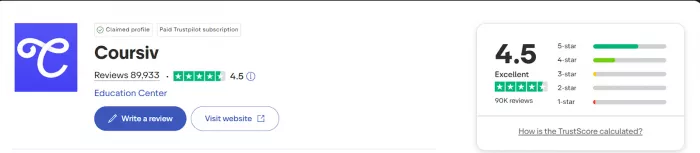
● Coursiv sits around a 4.4+ star TrustScore on Trustpilot, with tens of thousands of reviews (some analyses mention 60K–80K+ reviews, and Coursiv’s own pages reference 100K+ user testimonials across platforms).
● On Google Play, the app rating hovers around 4.5–4.7, with tens of thousands of user reviews and hundreds of thousands of downloads.
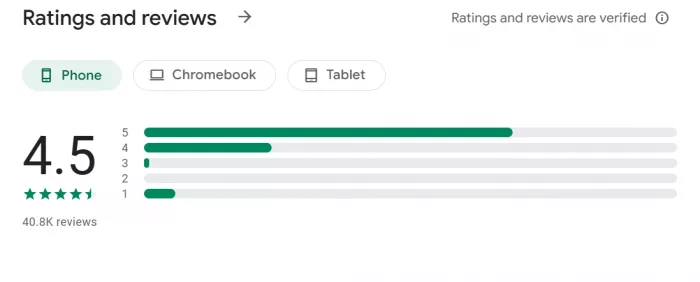
These numbers alone don’t prove quality, but they do suggest the platform resonates with a broad base of beginners and working professionals.
The praise themes
From Trustpilot breakdowns, Reddit threads, and independent blogs, some clear positive patterns emerge:
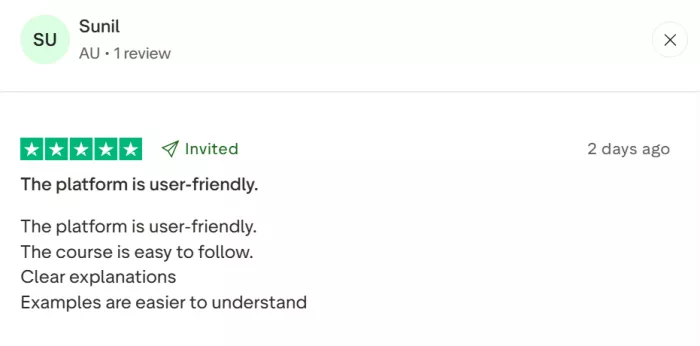
● Accessibility and design: Users repeatedly praise the sleek, mobile‑friendly interface and the way lessons slot into a busy schedule without feeling like homework.
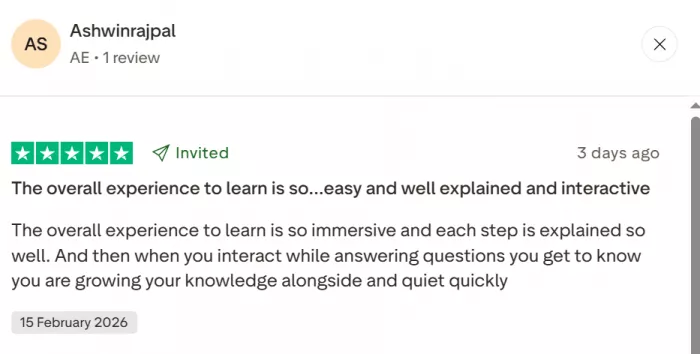
● Hands‑on, not passive: Many reviews highlight that Coursiv makes them do things: quizzes, interactive exercises, direct interaction with AI tools, rather than endless videos.
● Career impact and confidence: Real users talk about applying what they learned to their jobs, freelance work, or consulting, and about finally feeling confident recommending AI tools to others.
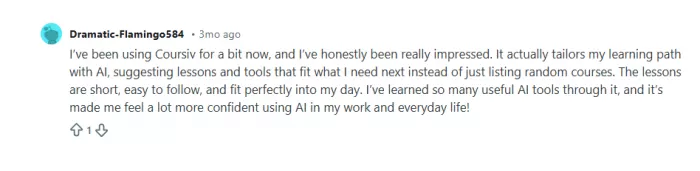
One Trustpilot analysis notes that the 4.4‑star rating largely reflects satisfied beginners who wanted exactly this: structured, hands‑on AI education without theory overload.
The criticism themes
The story isn’t all rosy and that’s important:
● Billing and subscription transparency: On Reddit and in app reviews, multiple users complain about confusing auto‑renewals, unexpected annual plan charges, or difficulty canceling. Some felt upsell flows were too aggressive after initial purchase.
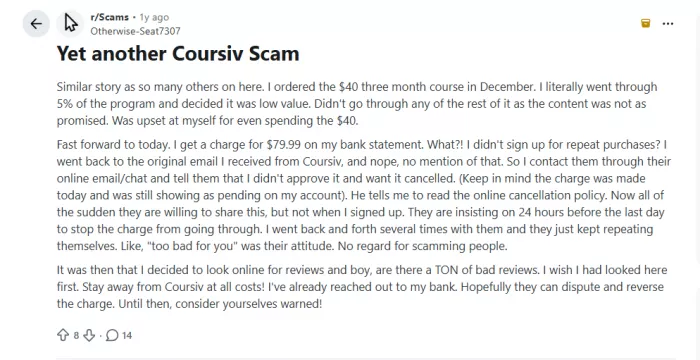
● Content depth for advanced users: Several reviewers and blog authors say the content can feel too basic once you’re past the beginner stage, especially if you already work with AI professionally.
● Perception of overhype: A subset of users feel the marketing is louder than the substance, particularly if they expected university‑level rigor or advanced technical topics. reddit
Interestingly, even critical reviews often admit the app is smooth and the concept is strong. Their frustration is usually about expectations vs reality on billing or depth, not about outright scam claims.
8. Two Sides of the Same App: Who Thrives, Who Struggles
Instead of a generic “pros and cons” list, it’s more honest to ask: who does Coursiv quietly favour?
You’re likely to thrive if:
● You’re a beginner or early‑intermediate user who wants practical AI literacy without diving into research papers or algorithms.
● You’re a busy professional, student, or freelancer who can give 10–15 minutes a day but struggles with multi‑hour lectures.
● You enjoy mobile learning and appreciate app polish, gamification, and simple UX.
● You want prompts, templates, and workflows you can deploy in real work this week.
You’re likely to struggle (or churn quickly) if:
● You’re already comfortable with AI and looking for deep theory, architectures, or advanced engineering topics.
● You prioritize formal academic credentials over practical, non‑accredited certificates.
● You’re sensitive to subscriptions and don’t like navigating trials, renewals, and cancellations.
● You prefer browsing a massive marketplace of courses and choosing your own path.
Coursiv isn’t trying to be everything for everyone and your fit depends more on your stage than your ambition.
9. The Money Question: Is the Subscription Justified?
Strip away the UI and narrative, and the decision often comes down to this: Does Coursiv earn its monthly fee for you personally?
A simple way to evaluate:
● Time ROI: If you realistically can’t spare 10–15 minutes on most days, you won’t get the compounding effect that makes the subscription worthwhile. No system can fix that.
● Outcome ROI: If one better freelance project, one smoother campaign, or one meaningful productivity gain could pay for a few months of subscription, the bar for “worth it” is actually not that high.
● Alternative ROI: You can assemble similar knowledge for free through YouTube, blogs, and Reddit but you’ll pay in time and decision fatigue. Coursiv charges money to reduce that chaos and add structure.
In honest user reviews, the happiest customers are not the ones who worship the brand; they’re the ones who actually showed up consistently and used it as a practice ground for real work.
10. Three Brutal Questions to Ask Before You Sign Up
To keep this grounded, ask yourself:
1. Do I need guided practice or just information?
If you mainly want a reference library, free content might be enough. If you want a coach‑like structure, Coursiv’s daily challenges make more sense.
2. Am I okay with a subscription if I genuinely use it for 2–3 months?
Don’t think “forever.” Think: “Can I squeeze full value from this over one focused quarter?”
3. Will I apply at least one idea per week to my real work?
If you treat it like a Netflix show, it won’t change your life. If you treat it like a gym where every session feeds into real‑world strength, the subscription becomes easier to justify.
11. Final Take: Coursiv as a Practice Space, Not Just an App
The simplest way to describe Coursiv is this: it’s less a library of AI knowledge and more a small, structured room you can step into each day to practice using AI without fear or friction.
Inside that room:
● You’re nudged to try tiny, specific things instead of drowning in possibilities.
● You’re given ready‑made scaffolds prompts, templates, workflows that you gradually learn to adapt and own.
● You’re surrounded, indirectly, by thousands of other learners wrestling with the same transition from “AI is hype” to “AI is part of my workflow now.”
If you’re stuck at the “I know AI matters, but I’ll start next month” stage, Coursiv won’t magically give you more hours in the day. What it does offer is a low‑friction doorway you can walk through in 10 minutes and a structure that makes it more likely you’ll come back tomorrow.
In a world where most people will keep collecting courses and postponing action, that quiet shift from intention to practice might be the most valuable thing you pay for.
Comments