Table of Contents
- Meet FakeYou
- Product overview: a community voice lab dressed as a platform
- Features in practice: voice variety vs quality control
- Pricing and value for money
- Real user sentiment: what people love and hate
- Legal, ethical, and safety considerations
- Performance, reliability, and support as a service
- Alternatives and where FakeYou fits
- Pros, cons, and overall verdict
- Final Verdict
FakeYou looks simple on the surface, a website where you type a line, pick a character, and get an AI voice back but once you dig in, it feels more like a chaotic community voice lab trying to behave like a serious SaaS product. It sits in a strange middle ground: too playful and inconsistent to be a reliable studio backbone, yet far more powerful than a meme toy if you learn its strengths and limits.
Meet FakeYou
FakeYou is an AI-powered voice generator and conversion platform that turns text (and sometimes your own recordings) into synthetic voices, many of them styled after celebrities, fictional characters, and community-created personas. It grew out of the earlier Vocodes project and kept the same meme-friendly DNA: huge voice variety, lots of fan-made models, and a strong emphasis on fun experimentation rather than corporate-grade narration. It’s a web-first platform, with extra capabilities exposed through an API and voice creation tools for more advanced users.
The typical FakeYou user isn’t a Fortune 500 team, it’s more often a YouTuber, streamer, meme creator, or hobbyist looking for recognizable voices for skits and short-form content. However, paid tiers, private models, and an API show the platform is also targeting semi-professional creators and developers who want more than a novelty tool without building their own voice tech. That tension between playground and product defines the FakeYou experience.
For casual users, FakeYou offers quick laughs and occasionally impressive impressions. For serious creators or businesses, the trade-off is less clear: you gain ease of use and character variety but must accept inconsistency, legal gray areas, and a subscription model that may not scale smoothly.
Product overview: a community voice lab dressed as a platform
At its core, FakeYou is built around four main pillars:
1. Text-to-Speech (TTS): This is the default experience: open the site, pick a voice from the library, enter text, and generate audio. The interface is simple (voice selector, text box, “speak” button), so even beginners can create clips quickly. Voices are organized into categories like celebrities, anime, and video games, with search and filters for easy browsing.
2. Voice Conversion (Voice-to-Voice): Instead of typing text, you upload or record your own audio and have FakeYou re-render it in another voice. This appeals to creators who want to keep their original timing and emotion. Results vary—some sound impressively realistic, while others can be metallic, glitchy, or lose expression.
3. Voice Designer and Custom Models: Power users can train custom voices by uploading audio samples and following the platform’s guidelines. This pushes FakeYou toward creator infrastructure, but the process can be trial-and-error, with mixed quality and occasional failures.
4. API and Developer Hooks: FakeYou also offers an API for developers to integrate voices into apps, bots, or automated workflows. It’s less heavily promoted than some API-first competitors but useful for building features like automated character voice generation.
Features in practice: voice variety vs quality control
The voice library: huge, chaotic, and very uneven
Voice variety is FakeYou’s biggest selling point and its biggest liability at the same time. There are thousands of voices, many based on popular figures from TV, anime, movies, YouTube, and gaming and new community models appear regularly. For meme creators and fans, this is a dream: you can jump from an anime protagonist to a political figure to a streamer in seconds.
However, quality control is minimal. Within a single category, you can find:
● A handful of voices that sound almost spot-on: tone, pacing, and accent close enough to pass in a short parody.
● A larger number of “usable” voices: recognizable enough for internal drafts or casual content, but with audible artifacts, mispronounced words, or flat emotion.
● A long tail of poor models: distorted, robotic, or so far from the intended voice that they’re effectively unusable.
If you plan to rely on FakeYou for repeatable content, you’ll spend a significant amount of time testing, bookmarking the 5–10 voices that meet your quality bar, and ignoring most of the library. That’s fine for hobbyists, but it’s extra overhead for professionals who want “pick any voice and trust it” reliability.
Generation quality and speed
On the technical side, FakeYou’s TTS quality ranges from impressively natural to obviously synthetic. Short sentences with simple phrasing often sound smoother than long, complex passages. Emotional nuance is limited: you can get “neutral,” “slightly enthusiastic,” or “slightly annoyed,” but you won’t find deeply expressive performances or subtle delivery the way you might from top-tier, studio-focused providers.
Speed depends heavily on your plan:
● On the free tier, you’re placed in a queue. At quiet times, you might get audio within seconds; during busy hours, the wait can stretch to minutes, and some generations can fail or time out.
● Paid tiers significantly cut wait times and improve reliability, especially for medium-length clips. For creators who generate many takes, this difference alone can justify the upgrade.
For voice conversion, the demands are higher and the results less predictable. The system has to both understand your source audio and re-render it in a target voice while preserving timing and intonation. When it works, it can be uncanny; when it doesn’t, you get jittery, hollow-sounding lines that need to be discarded.
Creation tools: promising but frustrating
Voice Designer and custom model tools are what attract serious experimenters: the idea of training your own voice or a fictional persona is compelling. In practice:
● You need reasonably clean, well-segmented audio, often more than casual users expect.
● Training can take time and may require several attempts before producing something usable.
● A fair share of community feedback mentions disappointment: results that sound generic, noisy, or too far from the target voice.
For advanced users who enjoy tinkering, this is acceptable. For busy professionals, the lack of predictable, reproducible quality can be a dealbreaker, especially when compared to platforms that offer managed, higher-touch model creation services.
Pricing and value for money
FakeYou follows a familiar pattern: a generous free tier to pull you in, and subscription-based paid plans to unlock better speed, longer clips, and more powerful features.
Free tier
The free plan is excellent for testing the waters:
● You can experiment with many voices without paying.
● You can generate short clips, sufficient for memes, tests, or tiny voice stingers.
● The main trade-offs are queues, occasional failures, and limits on clip length and concurrency.
For casual or first-time users, this is more than enough. They can stay on the free tier indefinitely as long as they accept waiting and working around length limits.
Paid tiers
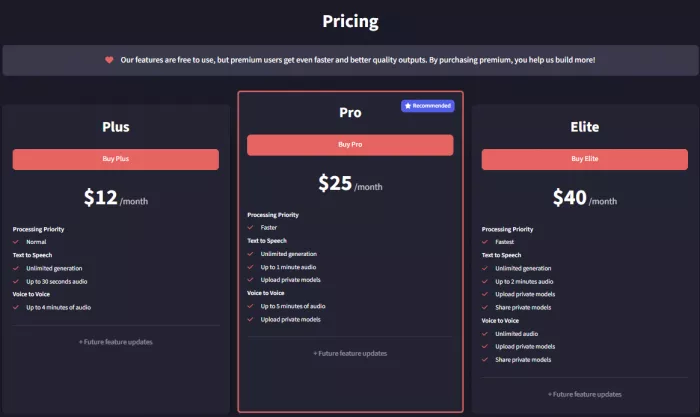
From a value perspective, FakeYou’s subscriptions are reasonable for individual creators who generate moderate volumes every month. The equation becomes less attractive for enterprises or high-volume studios who might prefer usage-based pricing (pay-per-minute or pay-per-character) and stricter reliability guarantees. For them, a flat subscription that caps output length and doesn’t come with strong service commitments can feel like poor value.
Real user sentiment: what people love and hate
To understand FakeYou’s real-world reputation, you have to look beyond feature lists and into user feedback across review platforms and community forums.
What users love
A recurring theme among satisfied users is fun. People appreciate:
● The sheer number of character and celebrity voices available.
● The ability to quickly bring parody scripts, skits, and fan content to life.
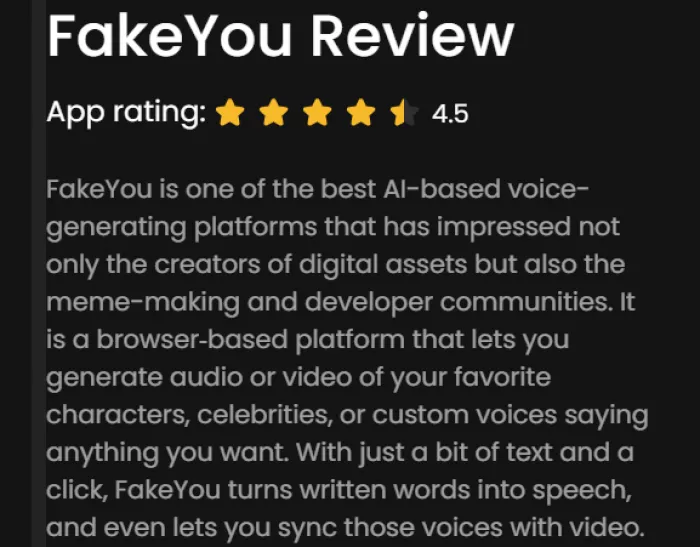
● The fact that they can experiment on a free tier before committing money.
● The sense of community around custom voices and shared models.
Creators who come from a meme or fan-content background often describe FakeYou as “good enough,” especially for short, humorous clips where a slight mismatch or artifact doesn’t ruin the joke.
What users complain about
On the other side, there are consistent criticisms:
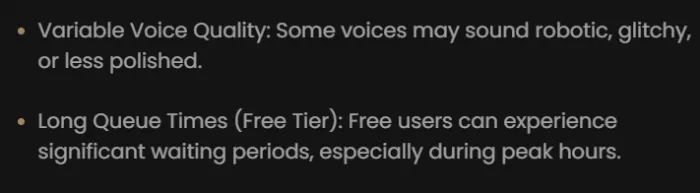
● Inconsistent quality: Many voices are under-trained, noisy, or nowhere near the intended persona. Users often have to sift through dozens of models to find a small handful that sound acceptable.
● Queue times and reliability: Free-tier users regularly report long waits, failed generations, or slow performance during peak hours. Even some paying users feel that performance should be more predictable.
● Voice Designer frustrations: Some advanced users complain that custom models fail to train properly or produce robotic output that isn’t usable in real projects.
● Pricing vs reliability: For users who want to use FakeYou in more serious contexts, the combination of subscription pricing and inconsistent results can feel like a mismatch. They compare it unfavorably to pay-per-use platforms or enterprise-grade providers where each dollar buys more predictability.
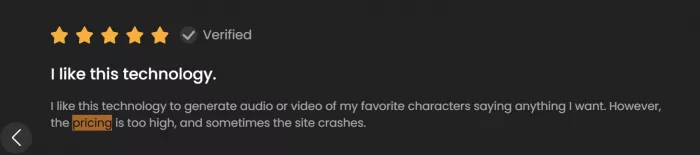
Overall, user sentiment paints a picture of a platform that delights when used in the right context (short, fun, experimental content) but disappoints when treated as an all-purpose professional voice backbone.
Legal, ethical, and safety considerations
Any platform that lets you sound like celebrities, public figures, or copyrighted characters inevitably raises legal and ethical questions.
Legal grey zones
FakeYou’s voice styles frequently resemble real people and fictional IP. While parody and satire are often protected in many jurisdictions, the lines are blurry when:
● You use a voice to impersonate someone in a way that could mislead or harm others (fraud, harassment, defamation).
● You monetize content heavily using voices that are clearly modeled on copyrighted characters or well-known personalities.
● You present AI-generated voice as if it were a real recording in contexts like news, politics, or sensitive communications.
Different countries interpret these issues differently. Even if a platform’s terms of service discourage misuse, actual enforcement tends to lag behind user behavior. As a creator, you remain legally and reputationally responsible for how you use the output, regardless of what the tool makes technically possible.
Ethical and platform risk
Beyond strict legality, there are softer but important risks:
● Platform moderation and takedowns: If a platform decides to clamp down on certain uses of celebrity or character voices, your existing content could be at risk of removal or demonetization.
● Audience trust: If you use FakeYou to convincingly mimic someone’s voice without disclosure, you may erode trust with your audience or clients if they feel misled.
● Victim impact: Using AI voices to harass individuals, fake statements, or impersonate people in sensitive contexts can cause real harm, even if it’s technically “just a joke.”
For ethical and practical reasons, it’s wise to:
● Use AI voices transparently, especially in serious contexts.
● Clearly signal when voices are AI-generated.
● Avoid impersonating real people for anything that could be taken as factual or serious.
If you treat FakeYou as a creative and comedic tool—and set your own boundaries accordingly, you’ll reduce the chances of running into both legal and reputational problems.
Performance, reliability, and support as a service
Beyond raw features, FakeYou also has to be judged as a service you might rely on week after week.
Uptime and stability
FakeYou generally stays available, but performance can fluctuate. High demand periods mean longer queues, more timeouts, and occasional glitches. For hobbyists and casual creators, this is an annoyance. For a professional workflow with deadlines, it’s a serious constraint.
Support and documentation
Support is more limited than on enterprise-oriented platforms. You’ll find basic documentation, community discussions, and some troubleshooting resources, but you won’t get the kind of dedicated onboarding, technical account managers, or contractual guarantees that larger organizations expect. For most solo creators, this is acceptable; they rely on community advice and trial-and-error. For agencies or production houses, it means more risk to project timelines.
Production readiness
If you think in terms of a checklist for “production readiness” (SLA, guaranteed throughput, predictable latency, clear licensing, strong support), FakeYou scores modestly. It’s best classified as a semi-professional tool: perfectly fine for side projects, prototypes, and certain types of content channels, but not something you’d lean on as the sole voice engine in a high-stakes, regulated, or large-scale environment.
Alternatives and where FakeYou fits
To understand FakeYou’s role in your tool stack, it’s useful to place it among three broad categories of alternatives:
1. Narration-focused TTS platforms
These prioritize clean, neutral voices for e-learning, corporate training, audiobooks, or IVR systems. They often have fewer voices, stricter licensing, and more polished, consistent quality. For formal narration where you don’t care about “celebrity” or “character” flavor, these tools usually beat FakeYou on reliability and clarity.
2. API-first voice providers
These are built for developers and enterprises with usage-based pricing, robust APIs, and clear service-level expectations. They typically support custom voice cloning through managed processes, and they care deeply about latency, scaling, and documentation. FakeYou has an API, but it doesn’t lead with this enterprise narrative.
3. Video and lip-sync tools with integrated voices
Some platforms package voice generation together with lip-sync and video-editing tools, targeting creators who want full video output rather than audio alone. FakeYou can complement these tools—by providing more playful voices but it doesn’t replace a full video pipeline by itself.
In short, FakeYou is strongest where others are weak: character variety, community-driven experimentation, and meme-friendliness. It’s weakest where others are strongest: strict reliability, formal narration, and enterprise-grade governance.
Pros, cons, and overall verdict
Pros
● Huge voice library with thousands of character, celebrity, and community models, ideal for memes, parodies, and fan content.
● Very low barrier to entry: a simple web interface, no account requirement for basic use, and a genuinely useful free tier.
● Flexible modes: text-to-speech, voice conversion, custom voice training, and an API for advanced users.
● Active community around model creation and usage, leading to a constantly evolving library and new voices.
Cons
● Quality is inconsistent: many voices are noisy, off-character, or too robotic for serious use, which forces users to test and curate their own short list.
● Free-tier queues can be long, and even paid tiers don’t always deliver the rock-solid predictability that professional workflows demand.
● Custom voice creation tools are powerful but unstable and often frustrating, delivering results that fall short of user expectations.
● Legal and ethical grey zones around impersonation and IP usage create risk, especially for serious or commercial projects that rely on recognizable voices.
Who should use FakeYou?
FakeYou is an excellent fit if you:
● Create meme videos, parody skits, or fan edits and want access to a large, eccentric library of character voices.
● Run a small YouTube or social channel where “fun and recognizable” matters more than “studio-perfect.”
● Enjoy experimenting with AI voices and are willing to accept some failures and rough edges along the way.
You should be cautious or look elsewhere if you:
● Need consistent, broadcast-quality narration for e-learning, corporate content, or branded audio.
● Work in a context where legal and reputational risk around impersonation is high (news, politics, regulated industries).
● Require strong SLAs, usage-based pricing, and enterprise-grade support.
Taken as a whole, FakeYou is best understood not as a replacement for traditional voiceover or high-end TTS, but as a community-driven playground for synthetic voices. Used with the right expectations and ethical boundaries, it can be an incredibly fun and surprisingly useful addition to a creator’s toolkit. Miscast in a role that demands reliability and legal clarity, it will quickly show its limitations.
Final Verdict
FakeYou works best as a creative sidekick rather than a standalone hero. It excels as a playful sandbox for character voices, memes, parodies, and experimental projects, giving solo creators an easy way to explore synthetic voices without complex ML work. In that role, its large community library, free tier, and simple workflow are genuine strengths that make quick, fun content creation very accessible.
However, it begins to show limits when used as a primary, production-grade voice engine. Inconsistent output quality, queue delays, limited support, and legal gray areas around impersonation make it risky for brand-critical or professional audio. The smartest approach is to treat FakeYou as an R&D and creative booster while relying on more stable, tightly governed tools and human voice talent when needed for high-stakes work.
Comments