Table of Contents
- Quick Verdict: Is Gauth AI Worth Using in 2026?
- What Is Gauth?
- How Gauth Works in Real Life
- Features That Truly Matter
- The Real User Experience
- Accuracy and Quality: Hit or Miss
- Tutor Support: Good Idea, Mixed Execution
- Free vs Paid: A Noticeable Shift
- Emotional and Practical Reactions
- Advantages and Limitations
- What Do Current Users Think?
- Privacy and Student Data
- Best Alternatives to Gauth
- How to Choose the Right Tool
- Summary: The Best Fit for Different Learners
- Final Verdict
Late-night homework stress is something most students know all too well. You stare at a problem, reread it five times, search online, and still feel stuck. This is where AI-powered homework tools step in, promising clarity, speed, and relief. Among them, Gauth has become one of the most talked-about platforms for solving math and science problems.
But is Gauth genuinely helpful, or just another flashy app with hidden paywalls? After exploring its features, user experience, and alternatives, here is a complete, honest, and student-focused review.
Quick Verdict: Is Gauth AI Worth Using in 2026?
Gauth remains one of the most accessible AI study tools for students who want to photograph a problem and receive step-by-step help, but it has grown considerably beyond its original homework-solver format. In 2026, Gauth combines AI problem solving with an AI Live Tutor, human expert support, study tools, interactive courses, quizzes, flashcards and newer visual-learning experiences such as Gauth Atlas.
For students working through school-level math and STEM questions, its speed and photo-based workflow remain major strengths. The bigger concern is reliability: like other AI study tools, Gauth can still misunderstand a question or produce an incorrect explanation, so important answers should be independently checked rather than treated as authoritative.
The free version is useful for testing the experience, while Gauth PLUS is primarily aimed at frequent users who want broader access to answers, more advanced AI features and priority support. Current standard U.S. App Store pricing is $11.99 per month, $31.99 per quarter or $99.99 per year, although promotional and regional prices can differ.
Gauth AI at a Glance
| Category | Current information |
|---|---|
| Product | Gauth: AI Study Companion |
| Former name | Gauthmath |
| Renamed | 2024 |
| Developer | GAUTHTECH PTE. LTD. |
| Platforms | Web, iOS and Android |
| Core use | AI-powered study assistance and step-by-step problem solving |
| Main subjects | Math, calculus, physics, chemistry, biology and other subjects |
| AI tutoring | AI Live Tutor with voice and virtual whiteboard |
| Human assistance | Real expert support is available |
| Free plan | Available, with usage limitations |
| PLUS pricing in the U.S. | $11.99 monthly / $31.99 quarterly / $99.99 annually |
| Google Play | 100M+ downloads; approximately 4.8/5 |
| U.S. App Store | Approximately 4.8/5 from 1.5M ratings |
| Best for | Students who want fast explanations and step-by-step homework guidance |
| Main caution | AI answers can still be incorrect and should be verified |
What Is Gauth?
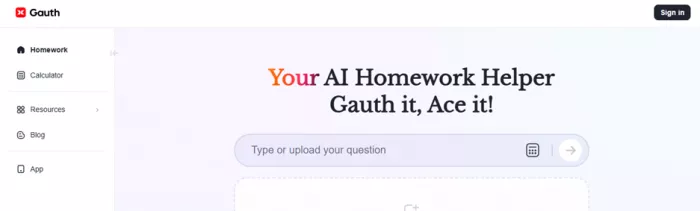
Gauth is an AI-powered homework assistant designed to help students solve academic problems quickly and clearly. Originally known as Gauthmath, the platform has expanded beyond basic equations to include algebra, geometry, trigonometry, calculus, statistics, and even science subjects like physics and chemistry.
What makes Gauth appealing is its simplicity. Instead of typing long formulas, students can simply take a photo of their question. The system scans it, understands the structure, and produces a step-by-step solution. This makes the tool especially attractive for learners who struggle with traditional textbooks or need instant clarification.
How Gauth Works in Real Life
Step 1: Capture or Type Your Question
You begin by either taking a photo of your homework problem using your phone or uploading an image from your device. If you prefer, you can also type the question directly into the app or website.
Step 2: AI Scans and Understands the Problem
Once uploaded, Gauth’s AI instantly reads the image. It recognizes numbers, symbols, equations, and even handwritten text. The system then interprets the structure of the question, whether it is algebra, calculus, geometry, or a word problem.
Step 3: The Problem Is Analyzed Logically
Instead of jumping to the answer, the AI breaks the problem into smaller logical steps. It identifies which formulas, rules, or concepts are required to solve it.
Step 4: Step-by-Step Solution Is Generated
Gauth displays a detailed solution, showing each calculation and explanation clearly. This allows you to follow the reasoning rather than simply copying the final answer.
Step 5: Review and Learn From the Explanation
You can scroll through each step, understand where you went wrong, and compare it with your own method. This makes it feel like a private tutor guiding you through the process.
Step 6: Save or Ask for More Help
You can save the solution for later revision. If the answer seems unclear or incomplete, Gauth often gives the option to request help from a human tutor (available with paid plans).
Features That Truly Matter
Photo-Based Problem Solver
Simply take a picture of your question, and Gauth instantly scans and understands there is no need to type long equations.
Step-by-Step Explanations
Instead of showing only the final answer, Gauth breaks down every step so you can actually understand how the solution is reached.
Wide Subject Coverage
Supports algebra, geometry, trigonometry, calculus, statistics, and even science subjects like physics and chemistry.
Handwriting Recognition
Reads handwritten problems accurately, making it useful for notebook and whiteboard questions.
Multiple Solution Methods
In many cases, Gauth shows more than one way to solve the same problem, helping you learn alternative approaches.
Human Tutor Support (Premium)
If the AI fails or you want deeper clarification, you can request help from a real tutor (available in paid plans).
Saved History & Revisions
All your solved questions are stored, allowing you to revisit and revise anytime.
Fast Results
Most answers appear within seconds, making it ideal for quick homework help and exam preparation.
Simple, Clean Interface
The design is intuitive and beginner-friendly, so even first-time users can navigate it easily.
Cross-Platform Access
Works on both mobile apps and web browsers, letting you study anytime, anywhere.
The Real User Experience
First Impressions: Easy to Start, But Limits Quickly Appear
Many users report that getting started with Gauth feels straightforward and intuitive. Taking a photo of a math problem and receiving a solution is almost instantaneous, even for handwritten questions which is one of the app’s most praised features because it feels like having a personal tutor in your pocket.

However, those first few “free tries” can be misleading. A common theme in user comments is that after a couple of quick answers, the app starts prompting for payment or limits access unless you buy a subscription or watch ads. Several reviewers expressed frustration that this isn’t clearly disclosed upfront, making the free tier feel more like a teaser than a genuinely useful free tool.
Accuracy and Quality: Hit or Miss
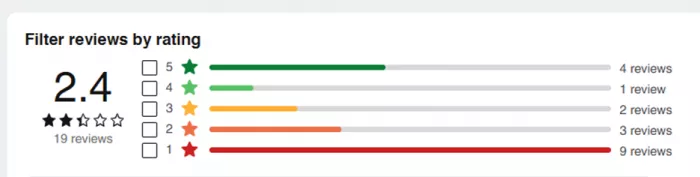
One of the most frequently mentioned aspects of Gauth’s real-life use is inconsistent accuracy. While it often solves basic algebra and high-school level math correctly and explains steps clearly, users regularly report incorrect solutions, especially for more complex questions. Some say it even tries to answer questions with unrelated subjects or formulas, leaving them more confused than before.
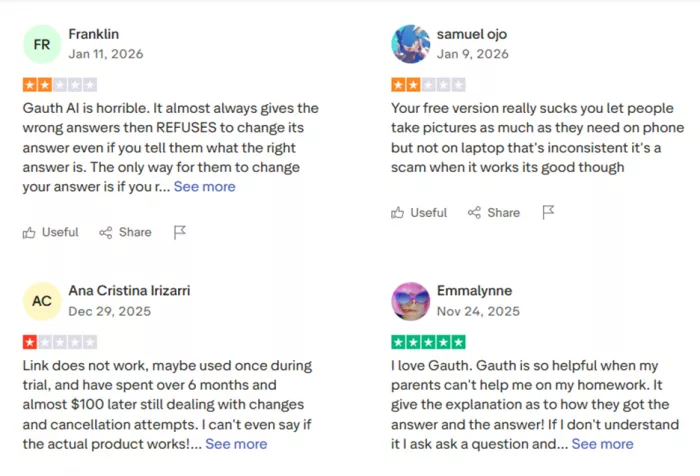
This inconsistency means students cannot rely on Gauth as a sole source of truth. Instead, it works best when combined with independent verification either with a teacher, classmate, or another reference source.
Tutor Support: Good Idea, Mixed Execution
Gauth's tutoring system is more interesting now because it no longer refers to just one type of help. The platform currently combines an AI Live Tutor with access to human subject-matter experts, and the two are useful in different situations.
The AI Live Tutor is designed for immediate follow-up help. Instead of returning another block of text, it supports real-time voice interaction and uses a virtual whiteboard to work through concepts visually. This makes it more useful when a step-by-step solution leaves you wondering why a formula was chosen or how one part of a problem connects to the next. Students can continue asking questions rather than repeatedly uploading variations of the same problem.
Human expert support fills a different gap. Gauth advertises round-the-clock access to subject specialists for more detailed walkthroughs in areas such as mathematics and science. Gauth Plus also includes priority expert guidance.
The limitation is that neither option should automatically be treated as a guarantee of a perfect explanation. AI tutoring can still misunderstand a question or explain a correct answer poorly, while the usefulness of human support depends on the individual expert and the problem being asked.
The strongest part of Gauth's tutor setup is therefore choice. A student can start with the instant AI explanation, move into a conversational AI tutoring session when a concept is unclear, and use expert support when the problem needs deeper attention. That makes tutoring feel more connected to the study workflow rather than being a completely separate feature.
Free vs Paid: A Noticeable Shift
Many early users recalled that earlier versions of Gauth offered broader access with fewer restrictions. Over time, they feel the app has shifted toward monetization: more features require payment, and free users see limits on daily questions or have to watch ads to proceed. People who used the app in the past often describe it as “great” originally, but less useful now because of increasing paywalls.
This change has affected user satisfaction significantly; some claim they stopped recommending the app altogether, saying it now feels more like a money-focused product than a helpful study tool.
Emotional and Practical Reactions
Users’ emotional reactions to Gauth vary widely:
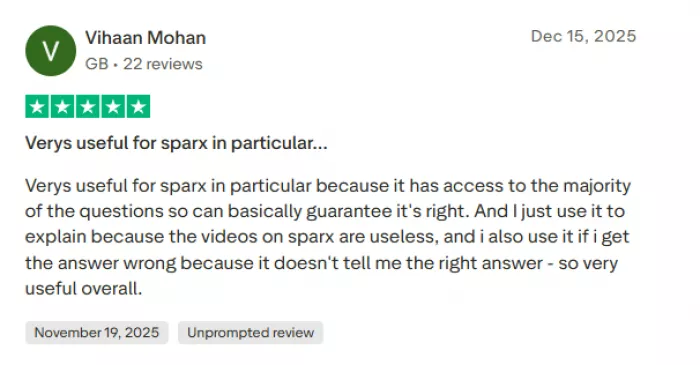
- Positive experiences highlight how the app has saved them during crunch times, especially late-night homework or complex problems they couldn’t solve alone. They appreciate the clarity of step-by-step solutions and how the app can cut through frustration.
- Negative experiences emphasize inaccurate answers, unexpected charges, and confusing explanations. Some reviewers use very strong language to describe their disappointment, pointing out that incorrect guidance can actually hurt their grades if followed blindly.
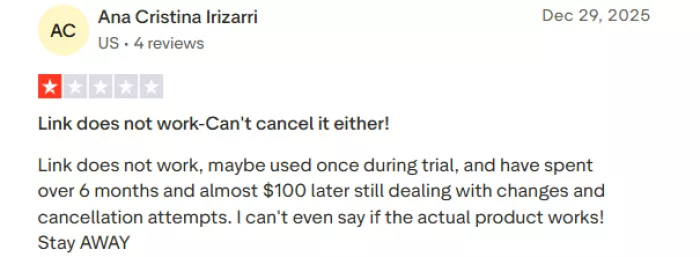
Overall, this polarization shows that Gauth can be a helpful assistant when used carefully, but also a source of frustration if treated as a definitive solution provider.
Advantages and Limitations
| Advantages | Limitations |
| Fast Problem Solving: Provides almost instant solutions for many math and science problems, which saves time and helps maintain study momentum. | Accuracy Can Vary: Many users report that Gauth sometimes gives incorrect or incomplete answers, especially on complex, poorly formatted, or advanced problems. |
| Step-by-Step Explanations: Solutions are broken down clearly, making it easier for students to follow the logic rather than just seeing the final result. | Limited Free Access: The free version restricts the number of daily questions, pushing users toward paid plans for regular use. |
| Hybrid AI-Human Support: Offers human tutor assistance when the AI alone isn’t enough, which can be very valuable for tricky questions. | Subscription Pressure: Constant upsells and paywalls can feel frustrating for students who expected a more generous free plan. |
| Multi-Subject Coverage: Supports more than basic math including physics and chemistry making it useful across STEM fields. | Dependence Risk: Easy access to answers might encourage students to skip trying problems independently, which can weaken learning over time. |
| Easy Photo Input: Great camera and OCR (optical character recognition) make it convenient to capture problems directly from textbooks or notebooks. | Poor Offline Support: Requires a stable internet connection to work in offline mode means it’s useless without internet. |
| Cross-Platform Access: Available on iOS, Android, and web so students can use it on phones, tablets, or laptops. | Not a Teaching Replacement: While it shows steps, it doesn’t deeply teach the underlying concepts you may still need additional learning resources. |
| 24/7 Availability: AI is always ready to help at any hour particularly useful for late-night study sessions. | Human Tutor Consistency Varies: Some users report that tutor responses are slow or inconsistent in quality. |
| Affordable Compared to Tutors: Premium plans cost significantly less than hiring a private tutor, making academic support more accessible. | Privacy and Billing Issues (Reported): Some users complain about confusing free-trial billing, cancellation difficulties, or unclear data policies. |
Pricing: What You Get vs What You Pay
Gauth can be used for free, which is enough to test its basic question-solving workflow and decide whether the explanations suit the way you study. The paid Gauth Plus plan becomes more relevant for students who use the app regularly and want fewer limits, enhanced AI support, and access to more advanced learning features.
According to the current U.S. App Store listing, the standard subscription options include:
| Gauth Plus Plan | Price |
|---|---|
| Monthly | $11.99/month |
| Quarterly | $31.99/quarter |
| Annual | $99.99/year |
Gauth notes that subscription prices and introductory offers may vary by country, account, and the offer displayed inside the app, so the price you see may be different.
Plus is more than simply a higher usage limit. Gauth currently advertises unlimited access to detailed explanations, enhanced AI accuracy, advanced interactive tutor sessions, priority 24/7 expert guidance, and a library of more than 20 million tutorial videos and 100 million practice questions.
For an occasional homework question, the free version will make more sense. The subscription becomes easier to justify for students who use Gauth throughout the week for problem solving, exam preparation, follow-up explanations, and tutoring. At $11.99 per month, however, it is expensive enough that casual users should first check whether the free tools already cover what they actually need
What Do Current Users Think?
Gauth's public ratings show why a balanced review should not rely on a single review platform.
| Platform | Current public signal | What it tells us |
|---|---|---|
| U.S. Apple App Store | About 4.8/5 from 1.5M ratings | Very large mobile-user sample and strongly positive overall sentiment |
| Google Play | About 4.8/5 with roughly 1.9M reviews and 100M+ downloads | Shows enormous Android adoption and generally positive app-level feedback |
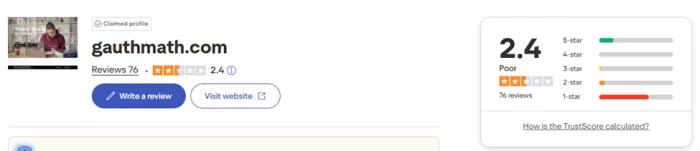
| Trustpilot | 2.3/5 from roughly 86 reviews | Much smaller sample with substantially more complaints, especially around accuracy, ads, support and billing |
These scores should not be averaged together. The platforms have very different user populations and sample sizes. App-store ratings reflect millions of interactions with the mobile product, whereas Trustpilot contains fewer than 100 reviews and attracts users who may be specifically motivated to report customer-service or billing problems.
The contrast is still worth mentioning. It shows that while overall app satisfaction is high, readers should also pay attention to recurring negative reports concerning incorrect answers, advertising, subscriptions and cancellation experiences.
Individual user reviews are anecdotal rather than proof of a product-wide problem, so complaints should be described as reports unless TimTis independently reproduces them.
Privacy and Student Data
Because Gauth works with uploaded photos, typed questions, account information, and other study material, privacy deserves more attention than it usually gets in homework-app reviews. Its privacy policy covers information provided through an account as well as user-created content such as photographs and related metadata.
For everyday homework, this is unlikely to change how most students use the app, but it does change what should be uploaded. Avoid including your full name, student ID, school login details, private teacher comments, or other sensitive information in a photo just because the actual question happens to be on the same page.
Gauth itself advises users not to disclose confidential or sensitive information when interacting with its AI tools. A simple habit helps: crop the image down to the problem you actually need solved before uploading it. You still get the convenience of the photo solver without sending unnecessary personal information along with the question.
Best Alternatives to Gauth
While Gauth is powerful for solving math and science problems quickly, it isn’t perfect for every student or every subject level. Thankfully, several other tools offer different strengths, some excel in step-by-step explanations, others in breadth of topics, and some combine AI with human feedback in unique ways.
If you want something closer to Gauth rather than a completely different type of study tool, the Goth AI vs Gauth comparison is a useful place to start. Both focus on quick homework help, but the differences become clearer once accuracy, tutoring support, pricing, and overall reliability are compared side by side.
Below are the top alternatives, explained clearly so your readers can choose what fits their needs.
1. Photomath
What Is It?
Photomath is one of the longest-running and most widely used homework help apps. It lets users scan math problems with their phone camera and see solution steps instantly.
Strengths
- Excellent step-by-step explanations: Very clear and easy to follow logic, great for learners who want to understand the “why” behind each step.
- Best for middle- and high-school math: Particularly strong in algebra, geometry, and basic calculus.
- Intuitive interface: Clean design that’s beginner-friendly.
- Good handwriting recognition: Works well even when problems are written neatly on paper.
Limitations
- Less powerful with word problems: Not as strong at interpreting long text questions.
- Advanced topics limited: Not ideal for upper-college or specialized STEM topics.
- Some features require subscription: Full step explanations often require Photomath Plus.
Who It’s Best For
Students in middle school through early college who need clear instructional steps and simple problem explanations.
2. Symbolab
What Is It?
Symbolab is a comprehensive math solver with powerful symbolic computation. It’s excellent for a wide range of math levels, from algebra to advanced calculus and differential equations.
Strengths
- Very wide topic coverage: From basic arithmetic to university-level calculus and beyond.
- Powerful symbolic engine: Offers detailed derivations that show exact procedure logic.
- Useful for proofs and algebra manipulation: Ideal for students tackling complex expressions.
- Graphing capabilities: Useful for visual learners.
Limitations
- Premium required for steps: The free version often shows only final answers.
- Learning curve: A more advanced interface can feel overwhelming for beginners.
Who It’s Best For
High school through college students especially those tackling advanced math topics or needing symbolic manipulation.
3. Mathway
What Is It?
Mathway is an all-around homework solver that covers math, statistics, and science calculations. It’s flexible, fast, and supports a broad range of disciplines.
Strengths
- Extensive topic list: Algebra, calculus, trigonometry, statistics, chemistry, and more.
- Quick results: Answers appear rapidly once the question is input.
- Mobile and web access: Easy to use on any device.
Limitations
- Premium needed for full steps: The free tier gives answers only; detailed steps require subscription.
- Explanation depth varies: Some solutions are more concise and less teaching-oriented.
Who It’s Best For
Students who want speed and breadth of topic coverage especially those juggling multiple STEM subjects.
4. Socratic
What Is It?
Socratic (by Google) uses AI and Google search knowledge to solve homework problems across subjects. It’s especially helpful for school-level work.
Strengths
- Wide academic coverage: Math, science, history, English, and more.
- Explains concepts, not just answers: Integrates definitions, examples, and visuals.
- Free to use: No paywalls for basic features.
Limitations
- Less precise for advanced math: Not designed for complex calculus or college-level problem solving.
- Solutions can be brief: Not always detailed step-by-step.
Who It’s Best For
School students who need help across multiple subjects, not just math.
5. Chegg
What Is It?
Chegg is a subscription-based study platform with textbook solutions, expert Q&A, and tutoring. It’s a full academic support service rather than a simple solver.
Strengths
- Real human help: Offers live or text-based tutoring by qualified educators.
- Textbook solutions: Step-by-step answers straight from popular textbooks.
- Wide subject coverage: More than just math, also engineering, science, business, etc.
Limitations
- High cost: More expensive than most solver apps.
- Subscription model: Requires paid plans for most valuable features.
Who It’s Best For
Students who want in-depth help and tutoring, not just automated answers — especially useful for college coursework.
6. AI Chat Tools (e.g., ChatGPT, Claude, Bard)
What Are They?
General purpose AI assistants that can help with homework, explain concepts, and answer questions across nearly all academic subjects.
Strengths
- Deep explanation ability: Can break down concepts conversationally.
- Flexible responses: Can adapt to follow-up questions and clarify.
- Extensive subject knowledge: Capable beyond just math.
Limitations
- Requires good prompting: Users need to know how to ask questions effectively.
- May lack specific math formatting: Compared to solver apps, math steps may not be as neatly rendered.
Who It’s Best For
Learners who want conceptual understanding or help with explanations rather than just calculations.
How to Choose the Right Tool
Here are some simple tips to help your readers decide:
- Need quick answers with clear steps? Try Photomath or Symbolab.
- Want help across subjects, not just math? Socratic or ChatGPT-style AI can be great.
- Preparing for college or tough exams? Chegg or Symbolab gives deeper solutions.
- Want human interaction and teaching? Choose Chegg’s tutors.
The choice also changes if solving individual questions is not your main problem. Gauth is built around getting unstuck on specific homework, while tools focused on flashcards and repeated review approach studying very differently. The Gizmo AI vs Gauth AI comparison shows that distinction particularly well for students deciding between immediate answers and longer-term revision.
Summary: The Best Fit for Different Learners
| Learner Type | Best Alternatives |
| School math help | Photomath, Socratic |
| Advanced math | Symbolab, Mathway |
| Multi-subject homework | Socratic, AI Chat tools |
| Deep tutoring help | Chegg |
| Conceptual learning | AI chat assistants |
Accuracy, Ethics, and Learning Responsibility
While Gauth can guide you through a problem, it is not always perfect. AI can make mistakes, and copying answers without understanding defeats the purpose of learning. The best approach is to use Gauth as a tutor, not a cheat sheet—study the steps, question the logic, and practice on your own.
Final Verdict
Gauth is a powerful, convenient, and beginner-friendly homework assistant that can transform how students approach difficult problems. Its instant solutions and step-by-step guidance make learning less intimidating and more accessible.
However, it should not replace genuine study. Used wisely, Gauth can become a valuable academic companion one that supports your growth rather than doing the work for you.
Comments

Brandon Coleman
1 month agoI tried the "live tutor" feature because the ai couldn't solve my problem. waited 45 minutes for a response and when it finally came they said my photo was "too blurry" when it literally wasn't. retook it three times same response. they just didn't want to deal with it. complete waste of time and money. customer service doesn't exist either.
Login To Reply ↪
Oliver Pinkkman
3 weeks agoGauth caught an embarrassing mistake in my calculus work that I had stared at for nearly ten minutes. I took a photo of the page and the explanation showed exactly where I had gone off track instead of just throwing the final answer at me. That’s what I liked most about it. It felt more like checking my work with someone who actually explains things properly. I’ve also used it for a couple of physics questions and the answers were usually clear enough that I could go back and solve similar problems on my own.
Login To Reply ↪