Table of Contents
- The Front Desk: How Questions Enter Gauth’s World
- The Classrooms: Multi‑Subject, Multi‑Grade
- The Brain: DeepThinking Instead Of One‑Line Answers
- The Staff Room: Human Experts On Call
- The Tool Wall: Beyond Single Questions
- The Ticket System: Free Help, Paid Immersion
- The Report Card: How Accurate Is “Good Enough”?
- The Honor Code: What Gauth Says vs. What Students Do
- The Crowd’s Verdict: Five Stars, One‑Star, And Everything Between
- Where Gauth Actually Belongs In A Student’s Life
- Final Word: A School In Your Pocket, But You’re Still The Student
Some education apps are built like calculators. Gauth AI is built more like a small, always‑open school hidden inside a phone. It has a front desk that recognizes your handwriting, a row of subject‑specific classrooms, a hallway of AI tutors, and behind a door that says “Premium” a staff room full of human experts who can jump in when the machines get confused. Whether this feels like a lifesaver, a shortcut, or a problem depends entirely on how you walk through that building.
The Front Desk: How Questions Enter Gauth’s World
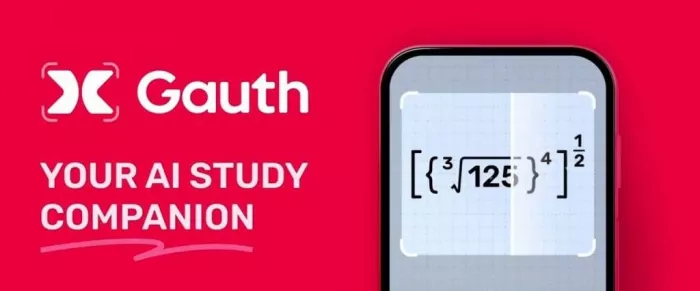
Every interaction with Gauth begins with a question trying to get inside the system.
Most students don’t start by typing formulas; they start with the camera. You hold your phone over a textbook or notebook, drag a frame around the problem, and Gauth’s OCR engine goes to work—cleaning up messy handwriting, straightening skewed pages, and transforming the image into something its AI models can interpret. For clean printed text, it’s usually effortless; for dim lighting and hurried scribbles, it’s good enough surprisingly often, but not invincible.
If the camera feels too risky, there’s the keyboard route. Typed questions avoid mis‑reads and are better for long, multi‑part problems or essay prompts. Gauth lets you paste entire word problems, theoretical questions, or reading passages, then responds as if you’d handed a teacher your notebook and said, “Start here.”
Then there’s the PDF and screenshot drawer. Assignments don’t always live on paper anymore, so you can upload files: full worksheets, exam practice sets, or class slides. Gauth treats these like a stack of digital worksheets, letting you pick questions section by section rather than juggling photos in your gallery.
Whichever door you use, camera, text, or file, the destination is the same: Gauth’s internal stack of AI models and, if needed, its global network of human tutors.
The Classrooms: Multi‑Subject, Multi‑Grade
Once a question is inside, Gauth routes it to the right “room.” Unlike older tools that stay in the math lane, Gauth now behaves like a small school with multiple departments:
● Math: algebra, geometry, calculus, statistics, logic and proof.
● Physics and Chemistry: kinematics, forces, circuits, stoichiometry, equilibrium, basic thermodynamics.
● Biology: cell biology, genetics, ecology, and standard school‑level concepts.
● Economics and other social sciences: graphs, basic micro/macro concepts, data interpretation.
● Language and humanities: literature analysis, reading comprehension, grammar, and writing assistance.
In the quantitative “rooms,” Gauth behaves like a methodical exam coach. It identifies known values, selects formulas, substitutes, rearranges, and simplifies showing each step instead of hiding it behind “click for solution.” In the text‑heavy rooms, it becomes more conversational: summarizing passages, explaining themes, suggesting outlines, or polishing grammar.
For students, this multi‑subject design matters. It matches the real rhythm of homework: a math problem here, a physics question there, a biology diagram next, and a reading passage after that. The promise Gauth makes is simple: you don’t have to switch apps to switch subjects.
The Brain: DeepThinking Instead Of One‑Line Answers
What distinguishes Gauth from a glorified answer key is how it chooses to think.
At its core, Gauth stacks several advanced AI models including vision‑enabled and language models to interpret questions and construct a reasoned path to a solution. This “DeepThinking” mode isn’t just a marketing slogan; it’s the app’s attempt to replace “shortcut answers” with structured reasoning:
● It breaks problems into smaller logical steps.
● It explains transitions between steps instead of skipping the algebra.
● It can adjust its explanations—more detailed or more concise—when you push back with follow‑up questions.
In a typical interaction, you might see:
1. Problem restatement (“We are given…”).
2. Identification of knowns and unknowns.
3. Choice of formula or principle.
4. Step‑by‑step manipulation.
5. Final answer plus a short interpretation.
The same machinery also powers richer content: automatically generated practice questions, short video explanations with animated diagrams, and even function plots that visualize how an equation behaves instead of leaving everything in symbols.
Used intentionally, this turns Gauth into a reasoning partner instead of a result machine. Used carelessly, it still risks becoming exactly what its critics fear: a polished way to outsource thinking.
The Staff Room: Human Experts On Call
Behind the AI classrooms is a staff room full of human experts. Gauth doesn’t rely on AI alone; it blends machine answers with a global tutor network that steps in when questions are too complex, ambiguous, or specialized.
For most everyday homework, the AI handles things in seconds. But independent analyses suggest that roughly a small percentage of questions—especially those that are multi‑step, poorly framed, or advanced are better handled by humans. In those cases:
● The question is routed to a human tutor.
● The tutor crafts a step‑by‑step solution, often adding clarifying notes.
● The student sees the result as just another Gauth answer, with an option to ask further questions.
These tutors are not faceless; they’re often graduates, teachers, and subject matter experts spread across multiple countries, working under performance metrics that reward clarity and accuracy. Top performers can earn significant side income, which incentivizes better explanations and quicker responses.
For the student, the distinction between “AI answer” and “human answer” is less important than whether the explanation makes sense. But knowing that humans exist in the loop is critical when judging Gauth’s potential reliability and its costs.
The Tool Wall: Beyond Single Questions
Walk a little further into this imaginary school, and you hit a wall full of tools that go beyond “solve this one question”:
● AI writing assistant for essays, lab reports, and short answers, with suggestions on structure and phrasing.
● Reading simplifier for dense textbook pages and academic passages.
● Calculators and graphers for exploring functions, roots, limits, and trends visually.
● Custom practice set generator, which can build quizzes by topic and difficulty, adapting as you improve.
● Video explanations and linked tutorials from a massive library of example problems.
The idea is subtle but important: homework isn’t just about finishing a list of assigned questions; it’s also about revising, testing yourself, and revisiting concepts from new angles. Gauth is trying to be the place where all of that lives especially for students who don’t have the time, money, or proximity to access multiple offline resources.
The Ticket System: Free Help, Paid Immersion
All of this costs real infrastructure, which is why Gauth avoids the illusion of being fully free.
On day one, the app behaves like a generous host. You can ask a fixed number of questions per day often around the low double digits at no cost. You may see ads, but you still get full step‑by‑step explanations, access to multiple subjects, and occasional use of advanced features.
You can stretch that with referrals and rewards: invite friends, complete tasks, and you receive extra question “tickets.” For light or occasional users, this free + tickets combo is enough.
But the system is designed with heavy users in mind. When nightly sessions become routine, you eventually walk into a message: limit reached. At that moment, Gauth offers you Gauth Plus, the paid key that unlocks:
● Unlimited AI questions (within fair use).
● Full access to Super Gauth AI and deeper reasoning modes.
● Faster responses and priority routing.
● 24/7 human expert access bundled more generously.
● Ad‑free, less cluttered study sessions.
Pricing depends on where you live, but the general pattern is:
● Monthly subscription (around the price of a few coffees in many regions).
● Quarterly or annual plans that reduce per‑month cost.
● Occasionally, lighter “basic” tiers or single ticket packs for top‑ups.
The Report Card: How Accurate Is “Good Enough”?
Gauth’s marketing copy promises high accuracy, fast responses, and deep explanations. Independent reviews and user ratings largely agree up to a point.
On standard school‑level math and science questions, Gauth is usually reliable. Evaluations show it handles classic algebraic equations, typical physics setups, and common chemistry problems with consistency, giving results that align with textbook methods. Many students explicitly credit the app with better grades and a clearer sense of the steps required to solve problems independently.
But accuracy is not uniform across the map. Problems become trickier when:
● The question is badly photographed or partially captured.
● The wording is vague or non‑standard.
● The topic falls beyond mainstream school curricula (for example, specialized university‑level questions).
In those cases, Gauth can present clean, confident steps that still arrive at the wrong endpoint or apply a method that looks plausible but doesn’t quite fit the question. This is the classic AI problem: outputs that look right until you already know the answer.
The human tutor layer reduces some of that risk, but at the cost of time and variability. One night, an expert gives a beautifully detailed explanation that feels better than a private lesson. Another night, you might get something functional but thin. For critical exams or edge‑case topics, relying solely on Gauth AI or human without cross‑checking can be risky.
The fairest grade? Gauth is strong for mainstream homework, useful but fallible for advanced work, and best viewed as a guide rather than a final judge.
The Honor Code: What Gauth Says vs. What Students Do
Somewhere in Gauth’s ecosystem is a statement many students skip past: the Honor Code.
It spells out a simple idea: Gauth is supposed to support learning, not replace it. Students are urged to:
● Use solutions as explanations, not as copy‑paste material.
● Attempt problems first, then check, instead of flipping that order.
● Respect school policies and teacher guidelines on AI tool usage.
This aligns with broader university and school discussions around generative AI: the tools themselves are not inherently misconduct; dishonest use is. Gauth positions itself on the right side of that line rhetorically.
But the user experience tells its own story. In practice, Gauth’s workflow is frictionless for both responsible and irresponsible use:
1. Snap or type a problem.
2. Receive a complete, neatly structured solution.
3. Decide—quietly—whether to learn from it or submit it.
No AI, no app design, and no policy page can fully control that choice. What Gauth can do is nudge students with messaging, emphasize study features (practice sets, explanations, concept videos), and publish its Honor Code. The rest is a human problem: habits, values, and exam rules.
The Crowd’s Verdict: Five Stars, One‑Star, And Everything Between
Scroll through app stores, blogs, and review platforms, and Gauth’s reputation looks like a noisy but recognizable pattern.
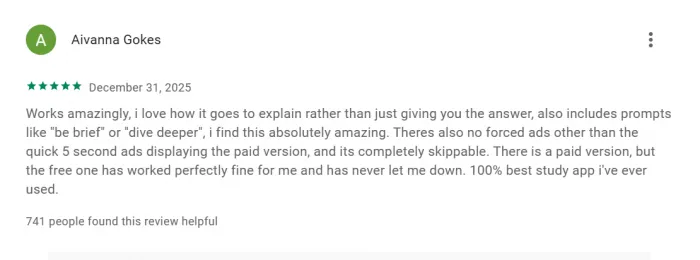
On Google Play and the App Store, ratings tend to skew high, with millions of downloads and an average score in the upper range. Students praise:
● Fast, accurate help on daily homework.
● Clear, step‑by‑step breakdowns that “actually teach.”
● Multi‑subject support and availability at odd hours.
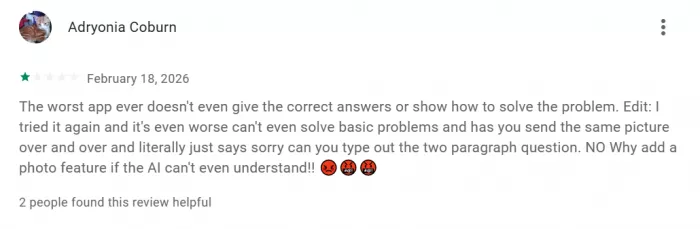
On external review sites and critical blog posts, a different tone emerges. Users highlight:
● Wrong answers on niche or advanced questions that they only caught later.
● Glitches, image errors, and occasional app instability.
● Frustration with billing and cancellation experiences.
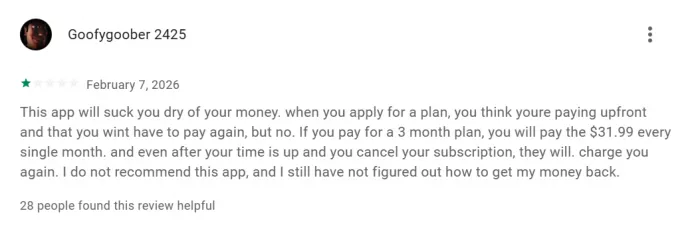
Put together, these voices suggest that Gauth delivers tremendous value for a huge number of everyday scenarios but it isn’t the flawless oracle its store pages might imply. It’s a powerful tool with rough edges that show up most clearly when you push it to its limits, fail to read the billing fine print, or treat it as a replacement for thinking.
Where Gauth Actually Belongs In A Student’s Life
If you lay out the modern study toolkit on a table, you see a spectrum:
● At one end: traditional textbooks, notes, and offline tutors.
● In the middle: search engines, Q&A forums, YouTube explainers.
● At the other end: AI‑heavy tools like Gauth that promise instant, personalized help.
Gauth lives in that AI‑heavy end, but it is less “cheat website” and more “compressed study space.” It can:
● Act like a calculator that explains itself.
● Act like a tutor that never sleeps.
● Act like a practice generator and concept library.
For some students, that combination is transformational. For others, it is dangerously convenient. For parents, it can be a cost‑effective supplement to human tutoring if monitored. For teachers, it’s both a powerful ally in explaining concepts and a new source of answer‑shaped shortcuts they must design around.
The most honest way to frame Gauth is this:
It lowers the barrier between “I don’t understand” and “I can see the steps,” but it does not and cannot decide whether you walk those steps yourself or just photocopy them.
Final Word: A School In Your Pocket, But You’re Still The Student
Gauth AI is, in effect, a miniature school packed into an app: admissions at the camera, classrooms for each subject, AI instructors on duty, human staff ready for escalation, a library of videos and practice, an honor code pinned on the wall, and a bursar’s office that manages subscriptions.
Used with intention, it can be the extra teacher many students never had, filling gaps late at night or early in the morning, breaking complex ideas into digestible steps, and offering endless practice for the price of a monthly plan. Used without intention, it can quietly train a different skill: the art of outsourcing, of turning every hard problem into a camera moment and every explanation into a copy‑paste opportunity.
The technology is impressive. The subject coverage is broad. The blend of AI and human tutors is clever. The pricing is, for many, cheaper than a weekly coaching session. But the single most important factor in Gauth’s impact isn’t coded into the app at all, it’s the mindset of the person holding the phone.
Comments