100 confidence score on my Drake test, fast and correct | ~67% true-positive rate in independent testing | ~23% false-positive rate, so verify every match |
Facial recognition used to be the stuff of spy films and airport security. Now it is a website you can open on your phone during your lunch break. FaceCheck.ID is one of the most talked-about names in that space: upload a photo of a face, and it claims to scour the public internet to tell you where else that face shows up, including social profiles, news stories, blogs, and, more provocatively, mugshot databases and sex offender registries.
That last part is what makes people curious and uneasy in equal measure. So instead of summarizing what the marketing copy says, I sat down and actually used it. I poked at the login, watched what it asked for, tried to pay, and ran a real search. What follows is the honest, blow-by-blow account, paired with the data I dug up to put my experience in context.
What FaceCheck.ID Claims to Be
At its core, FaceCheck.ID is a reverse face search engine, which is a different animal from a reverse image search like Google Lens or TinEye. Tools like Google Lens look for copies of an image. FaceCheck isolates the actual face in your photo, converts the geometry (eye spacing, nose shape, jawline contours, dozens of landmarks) into a mathematical signature, and hunts for that same face across entirely different pictures.
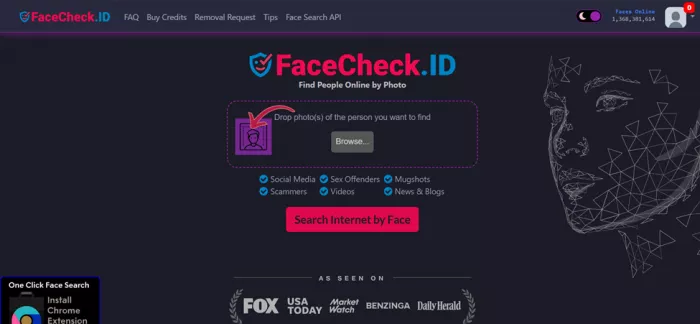
The marketing pitch is online safety: spotting catfish on dating apps, vetting a marketplace seller, checking a business contact before a meeting, or letting a parent see where a stranger's face turns up online. Independent coverage pegs its index at somewhere between 700 million and 1.3 billion-plus faces depending on the source, and during my own search the counter claimed it had scanned 1,368,342,274 faces. Whatever the exact number, it is enormous.
The Six Categories It Searches
One of the first things I noticed is that FaceCheck is upfront about where it looks. It groups its sources into six clearly labelled buckets you can see right on the interface:

✓ Social Media Public profiles, all major platforms | ⚑ Sex Offenders Public offender registries | ⚑ Mugshots Booking photos & arrest records |
⚑ Scammers Known fraud-linked profiles | ✓ Videos Thumbnails & frame captures | ✓ News & Blogs Articles, posts & coverage |
This is genuinely useful framing. Most face-search tools just say "the public web." FaceCheck tells you the categories it cares about, and the heavy lean toward mugshots, offenders, and scammers reveals its real personality. This is not a nostalgic "find my long-lost cousin" tool. It is built to flag people who would rather not be found, which is both its strongest selling point and the root of its ethical baggage.
Logging In: Frictionless, Slightly Eerie
Here is where my hands-on test got interesting fast. I braced myself for the usual onboarding gauntlet: give us your email, link a social account, verify a code. None of that happened. FaceCheck did not ask for an email. It did not ask me to connect any socials. The entire "login" was two clicks:
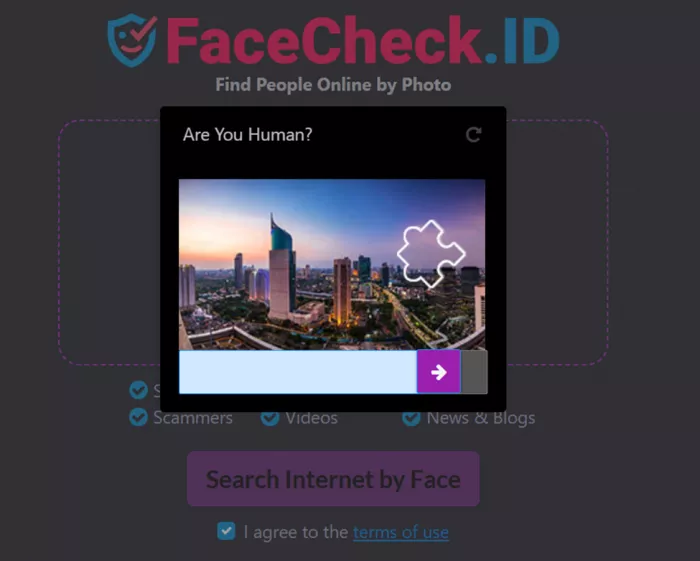
| 1 | Agree to terms & conditions A single checkbox. No account, no email, no password. |
| 2 | Pass a "Are you Human" check Standard bot gate, and that was the entire gateway. |
| → | You are in. No inbox confirmation, nothing to forget. Straight to searching. |
I have mixed feelings about this. The anonymity is a feature, not a bug, and it matches what reviewers consistently note: no login required, so you can search privately. If you are a scam victim trying to identify someone, the last thing you want is to hand over your identity to do it. On the other hand, the total absence of friction underscores how casual face-searching strangers has become. There is no gatekeeping, no "why are you searching this person" speed bump. You agree, you click, you are hunting faces.
Then It Immediately Asked Me to Pay (And Stumbled)
The moment I was through the door, FaceCheck got down to its business. Almost immediately, it pushed me toward buying credits. This matches how the service works everywhere: basic searches are free but return blurred or limited previews, and unlocking the actual matched images and source links costs credits.
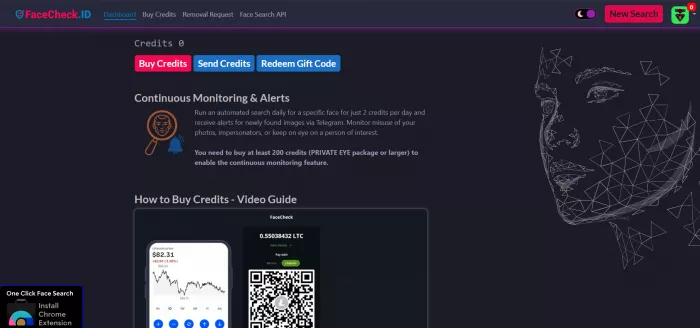
So I clicked "buy credits" to see the pricing and flow for myself. And here is my second surprise of the session:
⚑ WHAT I HIT Instead of a checkout page, I got a "Service Temporarily Unavailable" page. The very first time the product asked me for money, the payment door was jammed. |
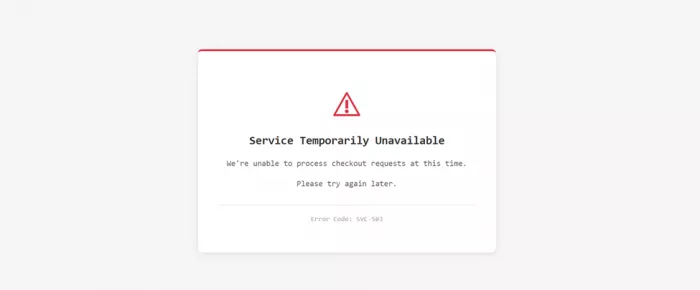
I cannot tell you whether it was a momentary server hiccup or something more persistent, but as a first-time user it is not confidence-inspiring. When the first thing a product does is ask for money and the payment door will not open, you start wondering how reliable the rest of the operation is. It is the kind of small friction that, multiplied across thousands of curious visitors, quietly costs trust.
For context on what I would have been paying into: FaceCheck runs on a credit system with no flat monthly subscription. Public pricing tiers have been reported roughly as follows.
| Plan | Price | Credits / Searches | Validity |
|---|---|---|---|
| Just a Peek | ~$6 | 36 credits (~12 searches) | 2 days |
| Rookie Sleuth | ~$19 | 150 credits (~50 searches) | 14 days |
| Private Eye | ~$49 | 400 credits | 2 months |
| Deep Investigator | ~$197 | 2,000 credits | 6 months |
| The Professional | ~$597 | 10,000 credits | 1 year |
Roughly 3 credits per search.
⚠ BEFORE YOU SPEND The service moved to cryptocurrency-only payments (Bitcoin, Litecoin and a few others) in late 2024. No credit cards, no PayPal. Combine that with the cheapest plan's credits expiring in just two days, and "just testing it out" is more of a commitment than it looks. |
The Real Test
Searching for Drake
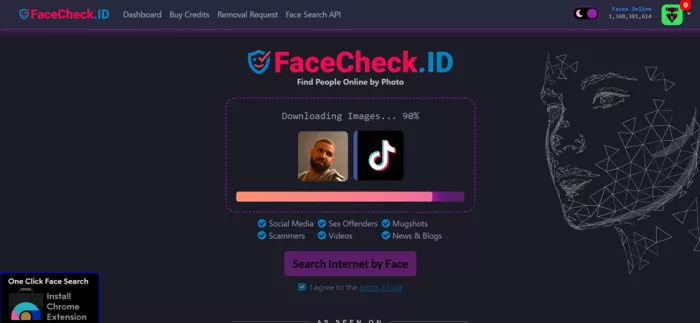
To actually see results, I needed a face. I used a clear, well-lit, front-facing photo of Drake, a deliberately easy case. A famous, heavily photographed public figure with a clean image is exactly the scenario facial recognition should ace. If a tool cannot nail Drake, it cannot nail anyone.
FaceCheck did not disappoint on the mechanics. Within seconds, the results screen filled in. Here is what the output told me, straight from the readout:
facecheck.id — search result > top match confidence: 100 / 100 "Certain Match" (98x badge) > faces searched: 1,368,342,274 > search time: 9.0 sec @ 151,346,052 faces/sec > download: 2.3 sec time in Q: 2.0 sec free RAM: 312.3 GB > retention: deleted in 24h unless permanent link created |
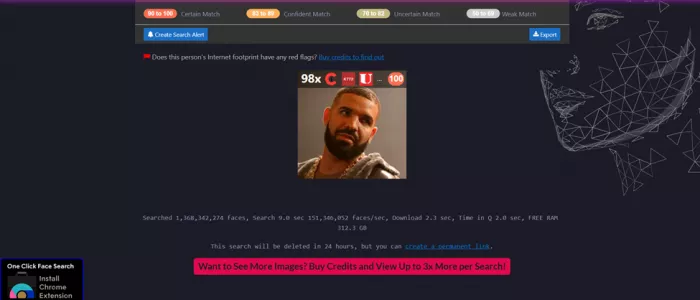
The top result came back with a confidence score of 100 and a "98x" multiplier badge, indicating dozens of corroborating matches across different sources, with little source icons stacked beside it. In plain terms: the system was as certain as it gets that this was the same person across many indexed images. For an easy target like Drake, that is the correct answer, and it arrived fast.
A few honest observations from the results page:
•The matched thumbnail was shown, but the whole screen was wrapped in upsell: a red banner nudging "Want to See More Images? Buy Credits and View Up to 3x More per Search!" plus a separate "does this person have red flags?" prompt, also behind a buy-credits link.
•It offered to create a search alert and to export results.
•A note said the search would be deleted in 24 hours unless I created a permanent link, a small privacy-conscious touch.
•A sticky corner widget pushed a "One Click Face Search" Chrome extension. The tool clearly wants to live in your browser, not just on its site.
So the free tier did exactly what reviewers describe: it confirmed that matches exist and how confident the system is, while keeping the full payload (every link, every image) locked behind credits I could not actually buy that session.
Decoding the Confidence Scores
The most genuinely useful part of FaceCheck is its calibrated scoring. Every match comes with a number on a four-tier scale, and the interface lays it out clearly:
| Range | Label | What it means |
|---|---|---|
| 90-100 | Certain Match | Almost certainly the same person |
| 83-89 | Confident Match | High confidence, very likely the same person |
| 70-82 | Uncertain Match | Treat with real skepticism |
| 50-69 | Weak Match | Probably a doppelganger; do not rely on it |
This matters because facial recognition without calibration is just guessing with extra steps. The score tells you how seriously to take a result before you click through. My Drake search landing at 100 sits firmly in "Certain Match" territory, exactly where it should be for a clean celebrity photo.
But Does It Actually Work?
A perfect score on Drake is encouraging, but one easy win does not make a verdict. Here is where the broader data matters, and it is more sobering. Independent testing across reviewers puts FaceCheck's true-positive rate at roughly 67% overall, and photo quality swings that wildly:
| Photo type | Correct-match rate |
|---|---|
| Professional / clear front-facing | ~75-80% |
| Overall average | ~67% |
| Low-light or side-angle | ~38-45% |
| False-positive rate | ~23% |
Even more striking, one testing team reported that even "Certain Match" scores of 90-100 were wrong about 8% of the time, including a case where an ordinary teacher was mistakenly matched to a criminal mugshot.
| The scenario that makes FaceCheck feel powerful, "this face is linked to a mugshot," is exactly the scenario where a false positive does the most damage. |
My Drake test worked because I fed it the easiest possible input. Real-world inputs are blurry, angled, badly lit, and aging, and that is where the cracks show. A confidence score is a hypothesis, not a verdict.
Who Should Actually Use It
Reasonable fits ✓ Online daters verifying a match's photos are real. The free blurred preview alone tells you whether a face exists elsewhere. ✓ Parents checking who their kid is talking to, thanks to the simple interface. ✓ Journalists & OSINT researchers using it as one signal among many, always confirming via the source link. | Use with caution ! Hiring managers. Face recognition in employment decisions carries real legal exposure, with none of the audit trail regulated background checks provide. ! Anyone treating a result as proof. With ~23% false positives, no single match should ever be the sole basis for a real-world decision. |
The Privacy Trade-off You Cannot Ignore
I would be doing you a disservice if I wrapped up without naming the discomfort. FaceCheck.ID works both ways. The same engine that lets you check a sketchy seller lets anyone (an ex, a stalker, a stranger who snapped your photo on the train) find your other accounts and where you appear online. It reinforces a world where your face is a permanent, searchable key whether you consented or not.
ⓘ TO ITS CREDIT FaceCheck offers a photo-removal request process to delist images, which not every competitor provides. But the broader reality stands: tools like this normalize searching strangers' faces, and the legal framework is still catching up. |
The VerdictUse it as a starting point, never an endpoint FaceCheck.ID is a real, functional tool, not a scam, not vaporware. My hands-on session proved the core engine is fast and, on an easy target, dead accurate: a 100 confidence score on Drake in nine seconds, drawn from a claimed 1.3 billion-plus faces. But the experience surfaced every reason to keep expectations grounded. The login asked for nothing but a checkbox and a robot test, frictionless yet a little unsettling. It pushed me to pay almost instantly, then served a "Service Temporarily Unavailable" page when I tried. The full results stayed locked behind crypto-only credits that expire fast. And the wider data (a ~67% true-positive rate, ~23% false positives, and "certain" matches wrong 8% of the time) means this is a tool for generating leads, never conclusions. Let the free preview tell you whether a match exists, treat every score as a hypothesis, and verify everything through the actual source before you act, especially when a stranger's reputation is on the line. |
Comments

Roman Mathews
2 months agojust tried to pay for credits and got hit with "service temporarily unavailable" like... okay? you want my money but your payment system is broken? that's giving unreliable. and then i found out it's crypto only which is so unhinged. who is carrying bitcoin in 2026 for a face search. the cheapest plan expires in two days anyway so you're basically throwing money away. deleted the tab immediately.
Login To Reply ↪
Matt Warren
2 months agoThe privacy implications here are wild. anyone can upload your face and find all your socials? without you knowing? that's so invasive. i get that it works both ways but i don't want to live in a world where some random on the train can reverse search my face. also the site says they delete searches in 24 hours but who actually knows if that's true. no thanks, hard pass.
Login To Reply ↪