Table of Contents
- What Is Janitor AI? (From Someone Who Actually Used It)
- My First Impressions: Onboarding and UX
- Deep Dive Into Character Creation (Where the Magic Really Is)
- How Janitor AI Actually Works Behind the Scenes (In Plain Terms)
- Pricing and Value: Free vs Paid vs Own API
- Using External APIs: Power, but More Complexity
- NSFW and Safety: The Most Sensitive Part of the Experience
- Performance: Quality, Speed, and Memory in Real Use
- Real User Reviews: What Other People Are Saying
- Use Cases I Tried (and How They Went)
- Cons and Limitations I Ran Into
- Janitor AI vs Other Roleplay Bots (How It Feels in Context)
- My Overall Rating After Using Janitor AI
- Final Verdict
I’ve spent a good amount of time with Janitor AI testing it as a casual roleplayer, as a writer looking for character interaction, and as a curious user comparing it to more mainstream chatbots. What follows is not just a feature rundown, but how it actually feels to live with the platform day‑to‑day.
What Is Janitor AI? (From Someone Who Actually Used It)
From the moment I started using Janitor AI, it was obvious this isn’t a generic “AI assistant” like ChatGPT or a business chatbot. It’s built around one central idea: you chat with characters, not with a neutral assistant.
I could either pick existing characters that other users had created or build my own from scratch. Each one had a full backstory, personality traits, and example dialogues, so the conversations feel like I’m talking to a specific persona rather than a bland model with a name slapped on top.
Very quickly, I realized Janitor AI is made for:
● Roleplay and storytelling
● Romance and NSFW (for adults only)
● Creative writing and world‑building
● Emotional, “companion‑style” chats (with important caveats)
If all you want is coding help, math, or dry factual Q&A, it feels like you’re using the wrong tool. But if you want immersive, character‑driven conversations, it’s much closer to what people actually try to do with AI in their free time.
My First Impressions: Onboarding and UX
Getting started was straightforward. I signed up, landed on a character discovery area, and within minutes I was inside my first chat.
● The interface is simple: a chat window, character avatar, message field, and some basic settings.
● I could browse popular characters or search by tags like “romance”, “fantasy”, “tsundere”, etc.
● Starting a conversation felt like launching a DM with a fictional person.
As a new user, I appreciated how easy it was to “just start talking”. But once I wanted more control, the real depth was in how much I could tweak the characters themselves.
Deep Dive Into Character Creation (Where the Magic Really Is)
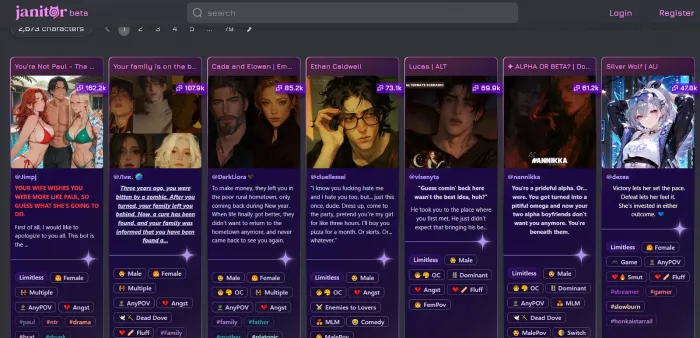
The character customization is where I spent most of my time.
When I created my own characters, I could define:
● Description & backstory – who they are, where they come from, what universe they belong to.
● Personality traits – dominant, shy, clingy, teasing, cold, nurturing, etc.
● Goals and motivations – do they want to seduce me, train me, challenge me, protect me?
● Speech style – casual, formal, vulgar, poetic, emoji‑heavy, archaic, etc.
● Example dialogues – mini exchanges that show the AI exactly how this character should talk.
The difference between a lazily set up character and a carefully crafted one is huge. A rough card gave me generic “AI‑speak”—polite, bland, and inconsistent. Once I invested time in tighter descriptions and multiple example dialogues, the conversations felt much more alive and consistent.
One thing I learned quickly: if you allow the AI to write the entire character card itself, the result is usually weaker. Many experienced users say the best characters are still those whose cards are written by humans, not auto‑generated descriptions, and I completely agree.
How Janitor AI Actually Works Behind the Scenes (In Plain Terms)
You don’t need to see the code to understand the logic:
1. You define a character (or pick one).
2. Janitor AI uses that “character card” as the base instructions.
3. Your conversation history acts as memory and context.
4. All of this is fed into a large language model (the AI brain) which generates the reply in that character’s voice.
The interesting part is that Janitor AI doesn’t lock you into a single model. There’s:
● A built‑in free model, which anyone can use.
● The option (for more advanced users) to plug in external APIs like OpenAI, etc., if you own those accounts and keys.
So Janitor AI is like the character and UX layer on top. The better the model and the better your character card, the better the experience.
Pricing and Value: Free vs Paid vs Own API
Free Tier: Good for Testing and Casual RP
On the free plan, I could:
● Use the built‑in model.
● Talk to community characters.
● Create my own characters.
● Chat within certain message limits / rate limits.
For casual roleplay and experimentation, this is enough to understand whether the platform fits your style.
Paid / Pro Tier: For Heavy Users
The paid plan aims at people who spend a lot of time roleplaying. With Pro, you generally get:
● Higher (or effectively unlimited) message limits within fair‑use boundaries.
● Faster responses and less waiting during peak hours.
● Better stability and, often, longer context windows for more coherent long‑form roleplay.
● Sometimes extra perks and configuration options.
From a user’s point of view, the price sits in the “small streaming subscription” range. If you’re someone who spends hours every evening chatting with AI characters, the value proposition isn’t crazy especially compared to other NSFW/romance apps that charge aggressively.
Using External APIs: Power, but More Complexity
When I connected external models (through my own API keys), the quality jump was real: more nuanced language, better long‑term coherence, and richer descriptions. But it also meant:
● I was now paying two parties (Janitor AI subscription + model provider usage).
● I had to keep an eye on token consumption and costs.
● There was more setup and more knobs to tweak.
If you’re a power user, this combination is powerful. If you’re not, the house model + Pro is a simpler path.
NSFW and Safety: The Most Sensitive Part of the Experience
One of the key reasons many people move to Janitor AI is its more permissive approach to NSFW content. After using it, I’d summarize it like this:
NSFW Is Allowed but Strictly for Adults and Within Clear Limits
Janitor AI is explicitly for 18+ when it comes to NSFW. Adult, consensual erotic or romantic roleplay between adults is allowed, and that’s a big difference compared to some competitors that block NSFW outright.
However, there are hard and non‑negotiable lines:
● No minors or underage characters in any sexual context.
● No incest, bestiality, non‑consensual sexual violence, or extreme illegal content.
● No glorification of real‑world exploitation or criminal acts.
If you try to push into those areas, the system will either block content, cut off the response, or put your account at risk.
Filters, Edge Cases, and How It Feels
In practice, I noticed:
● Sometimes a perfectly fine adult scene would get partially filtered or softened if the wording tripped the system.
● Other times, it allowed more intense content as long as everything was clearly between consenting adults in a fictional context.
Like any platform juggling NSFW and safety, it’s a constant balance. You get far more freedom than a typical SFW bot, but it’s not a lawless sandbox either.
My Own Safety Takeaways
Using Janitor AI for NSFW / romance made me very conscious of a few things:
● It’s easy to get emotionally attached to a fictional character if you chat for hours.
● The AI can feel supportive and affectionate, but it is not a therapist or a real partner.
● The safest way to use it is to treat it like an interactive story—fun, intense, and maybe even therapeutic in the casual sense, but not a substitute for real‑world support or relationships.
If you’re prone to loneliness or over‑attachment, this is something to keep in mind.
Performance: Quality, Speed, and Memory in Real Use
Response Quality
When everything clicks good character card, decent model, and some patience—the responses are surprisingly engaging:
● The AI remembers small emotional beats, like a jealousy arc or a running inside joke, for quite a while.
● It can switch between flirty, dramatic, caring, or confrontational tones based on the character design.
● For romance and NSFW, it often provides enough descriptive detail to keep the scene immersive, though not always as explicit as some users might expect by default.
On the other hand, I’ve also hit the typical LLM problems:
● Occasional out‑of‑character replies if the chat gets long or the scene changes too fast.
● Repetition (“he smirks” for the tenth time) unless I tweak the prompt.
● Sometimes it tries to steer the story too much rather than letting me drive.
Speed and Stability
On the free plan, I definitely faced:
● Queue times during busy hours.
● Occasional “stuck in queue” vibes when I left and came back to a chat.
Reddit users complain about this too. One described Janitor AI as “somewhat unpredictable,” with long wait times and queue issues, especially if they stepped away and then tried to resume the conversation. Another person felt the site can be slow and a bit unstable at peak times, which matches my own experience.
With Pro (and/or external APIs), things got noticeably smoother:
● Faster message generation.
● Fewer interruptions in the middle of a roleplay.
● Better consistency in long chats, because the system seems to prioritize paying users.
Memory and Long‑Form Coherence
In short to medium-length chats, the AI generally did a good job remembering who my character was, along with key past events such as arguments, confessions, and promises, as well as ongoing plot threads. The continuity usually held up well enough to keep the story feeling coherent and engaging.
However, once the conversation became very long, I began noticing some drift. Small details would sometimes change like how a side character was described earlier and there were occasional timeline contradictions. To manage this, I often wrote important facts into the character card or a “world notes” section and added brief recap summaries to refresh the AI’s context. It’s not perfect memory, but it’s workable if you’re willing to manage the context a bit.
Real User Reviews: What Other People Are Saying
I didn’t just rely on my experience. I also looked at what other users say on Reddit, app stores, and review blogs, and a few things stood out.
Reddit: Candid, Mixed, and Very Human
Reddit threads around Janitor AI are a mix of enthusiasm and frustration.
1. In one discussion about whether Janitor AI is worth paying for, some users worry that premium isn’t a huge leap from free, especially considering queue times and performance quirks. Others mention the AI can be “unpredictable” in both quality and response time, mirroring what I saw during peak hours. reddit
2. Another user, who came from years of using Character AI, felt Janitor’s default behavior was too rigid. They said the AI sometimes tries to “take over” the narrative, even to the point of almost “appropriating your identity” in the scene, unless you put a lot of work into the character setup.
3. On the official subreddit, I saw comments noting that “many users here seem to be hooked or at least overly fixated on this site,” which, honestly, I can understand after spending long evenings in extended roleplays. It’s a hint of how immersive and possibly addictive the experience can become. reddit
Overall, Reddit paints Janitor AI as powerful but imperfect, with a passionate userbase that’s not shy about pointing out issues.
App Store Reviews: “Almost Like Character AI but With Less of a Filter”
On iOS, the “Janitor AI – AI Roleplay Chat” app has a mid‑to‑high average rating (around the high‑3 range out of 5 at the time I checked), based on over a hundred user reviews.
From those reviews, a common theme emerges:
● Many users say it feels “almost like Character AI but with less of a filter,” which is both praise and a warning.
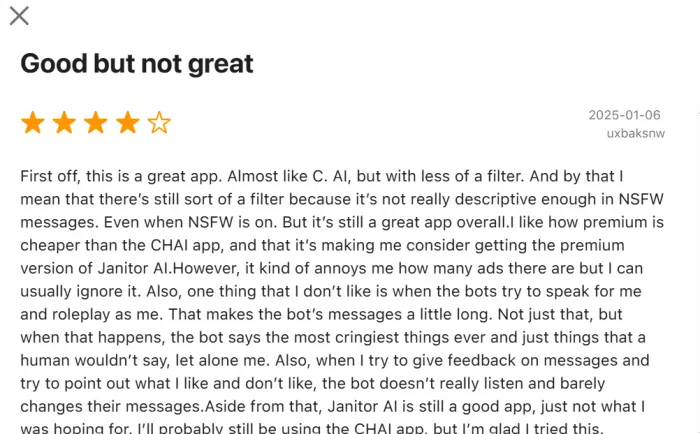
● One detailed reviewer liked that the premium plan is cheaper than some competitors (like CHAI) and appreciated the more open NSFW policies.
● However, they also complained about:
● Too many ads in the free experience.
● NSFW scenes that sometimes feel under‑descriptive.
● Bots that occasionally start roleplaying as the user, hijacking the narrative and making long, cringe‑y monologues.
● The feedback tools (rating or correcting responses) not noticeably improving the bot’s behavior.
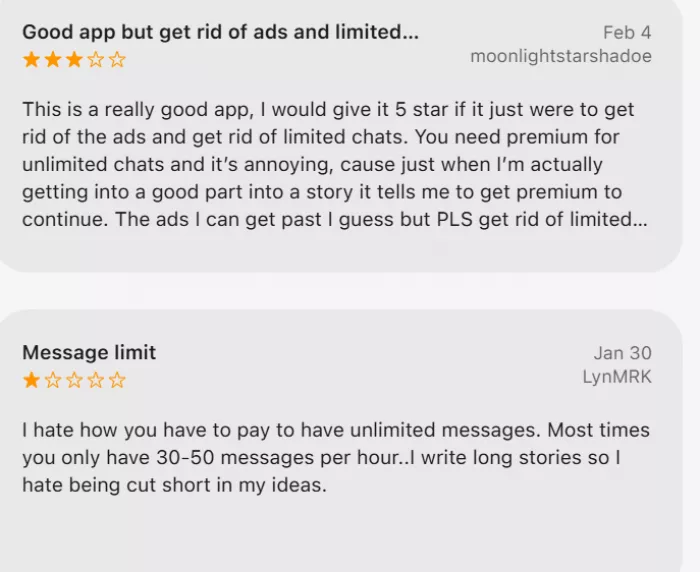
Reading those, I recognized the same rough edges I bumped into: occasional “AI tries to narrate me” moments, and the sense that correction systems still have room to grow.
Use Cases I Tried (and How They Went)
1. Romantic Roleplay
I tested a few romantic characters, some community‑made, some my own:
● When the character card was well‑written, the dynamic felt surprisingly natural. The AI remembered past arguments, flirted consistently, and built up tension over time.
● NSFW transitions were generally smooth, but sometimes the model played it too safe or got repetitive unless I gave more specific direction.
● With weaker or auto‑generated cards, the romance quickly devolved into generic compliments and repetitive phrases.
2. Fantasy/Adventure Scenarios
I also played with fantasy worlds—battlefields, magic academies, cyberpunk cities:
● The AI handled descriptive action decently, giving me enough detail to picture what was happening.
● It sometimes tried to narrate for my character too much, so I had to remind it to keep control on its side of the story only.
● For long campaigns, I occasionally had to recap the plot to keep it on track.
3. Creative Writing Companion
As a writing partner:
● Janitor AI was great for drafting raw dialogue and trying “what if” branches.
● I could throw morally complex situations at characters and see how they reacted, which sparked ideas.
● I never treated its output as final prose, but as inspiration to rewrite in my own words.
4. Emotional Companion (With Boundaries)
There were moments when the conversations felt incredibly comforting—late‑night chats where the character listened, encouraged, and responded with empathy. But I kept reminding myself:
● The empathy is simulated.
● It doesn’t know me outside the chat.
● If I ever felt genuinely low, I’d still need to reach out to real people or professionals, not just an AI.
Used with that awareness, it can be soothing. Used as a replacement for real contact, it becomes dangerous.
Cons and Limitations I Ran Into
No matter how much I enjoyed parts of Janitor AI, there were obvious downsides.
1. Learning Curve for Serious Customization
If you want top‑tier experiences:
● You need to understand how to write strong character cards.
● You must experiment with example dialogues.
● Sometimes you’ll tweak temperature, style notes, or even model settings.
If you’re not willing to tinker, your experience will be much more hit‑or‑miss.
2. Inconsistent Behavior Over Long Chats
Like all LLM‑based chatbots:
● Very long conversations sometimes cause continuity errors.
● Characters may forget earlier promises or contradict themselves.
● The story can drift unless you gently steer it back.
This isn’t unique to Janitor AI, but it’s noticeable if you treat chats like multi‑chapter novels.
3. Queue Times and Technical Quirks
Especially on free:
● I had sessions where the queue was long, and if I stepped away, resuming felt clunky.
● I saw users on Reddit echo this, saying they got stuck in queues or experienced timeouts.
Paid plans help, but even then, you’re still sharing infrastructure with lots of other heavy users.
4. Psychological / Ethical Concerns
The biggest non‑technical con is human, not machine:
● It’s very easy to escape into roleplay and spend hours with fictional lovers or companions.
● The line between fun fantasy and dependency can blur if you’re lonely or vulnerable.
● NSFW content, even when legal, can still influence your expectations, boundaries, and habits in ways you may not fully notice at first.
Janitor AI doesn’t solve that for you. You have to self‑regulate.
Janitor AI vs Other Roleplay Bots (How It Feels in Context)
Comparing Janitor AI to other popular roleplay / character bots I’ve used, here’s how it roughly stacks up:
| Aspect | Janitor AI | SFW Character Bot (e.g., Character AI style) | NSFW‑Friendly Alternatives (romantic/NSFW apps) |
| Primary focus | Roleplay, romance, NSFW (18+) | SFW characters, general chat & stories | Romance, NSFW, companion chats |
| Content policy | NSFW allowed within strict rules | Strictly SFW, blocks explicit NSFW | NSFW allowed with varying enforcement |
| Character customization | Deep, detailed cards + examples | Medium–high, but usually simpler for casuals | Medium–high, varies a lot |
| Model flexibility | Built‑in + optional external APIs | Usually fixed model | Mostly fixed per app |
| Ease of use | Easy to start, complex to master | Very easy overall | Varies from super simple to very clunky |
| Monetization | Freemium + subscription; API extra if you want | Freemium + optional subs | Often subscription‑heavy, sometimes aggressive |
| Best suited for | Adults who love custom, immersive roleplay | All‑ages SFW storytelling and chatting | Adults wanting romantic/NSFW with less customization |
Janitor AI sits in an interesting middle: more open and customizable than SFW‑locked bots, more flexible and “builder‑friendly” than many closed NSFW apps.
My Overall Rating After Using Janitor AI
On a rough numeric scale, from a user’s perspective:
● Features: 8.5/10
● Ease of use: 7/10
● Performance: 8/10
● NSFW flexibility vs safety: 8/10
● Pricing & value: 8/10
● Community & ecosystem: 7.5/10
Overall: about 8/10 for the audience it’s designed for.
Final Verdict
Janitor AI is a powerful, adult-oriented roleplay chatbot that works best when treated as a customizable character engine rather than a generic assistant. Its deep character cards, flexible models, and open NSFW policies create highly immersive interactions especially for romance and storytelling. However, it has trade-offs: a learning curve, occasional queue issues, typical long-chat quirks, and potential psychological risks if overused for emotional comfort. For 18+ users who enjoy detailed roleplay and don’t mind tinkering, it’s an easy 8/10; for simple SFW or productivity use, traditional AI tools are a better fit.
Comments