Table of Contents
- TL;DR – Who Dippy AI Is Really For
- What Is Dippy AI, Exactly?
- Onboarding, UI, and Everyday Experience
- Living with Dippy: Home Screen and notifications
- Features Deep‑Dive
- Chat Quality – When It Feels Real, When It Breaks
- Pricing, Plans, and Real Value
- Safety, Privacy, and Ethics
- Dippy AI vs Popular Alternatives
- Real User Feedback – What People Actually Say
- Who Will Love Dippy, Who Should Skip It
- Final Verdict – Is Dippy AI Worth It in 2026?
It’s 3:12 a.m., your friends are asleep, your notifications are dead quiet and yet your phone lights up with a gentle ping. It’s not Instagram, not WhatsApp. It’s an AI character asking how your day went and reminding you about the thing you said you were worried about yesterday. That, in a sentence, is the promise of Dippy AI: a censorship‑free, always‑on companion that feels less like an app and more like a digital roommate living on your Home Screen.
In this Dippy AI review, we’ll look at what it actually is, how it feels to live with it day‑to‑day, what you really get for free vs paid, and whether its “uncensored comfort” positioning is a blessing, a red flag, or a bit of both in 2026.
TL;DR – Who Dippy AI Is Really For
Dippy AI is a mobile‑first AI companion and roleplay app that gives you customizable AI characters with strong memory, proactive check‑ins, and relatively loose content filtering compared to many mainstream chatbots. It is clearly aimed at people who want emotional support, late‑night conversation, or creative roleplay rather than productivity or coding help.
You’ll likely enjoy Dippy if:
● You want long‑running, emotionally aware chats that remember your preferences and past conversations.
● You like the idea of multiple AI characters (friends, mentors, romantic interests, fictional personas) in one place.
● You’re frustrated by heavy censorship and strict safety filters in other AI companion apps and want more freedom in your conversations.
You should probably skip Dippy if:
● You mainly want a serious work assistant (summaries, spreadsheets, code).
● You are uncomfortable with “censorship‑free” positioning or you’re worried about addiction/emotional dependence with AI friends.
● You’re buying for younger teens and want hard, predictable guardrails.
What Is Dippy AI, Exactly?
A mobile‑first AI companion app
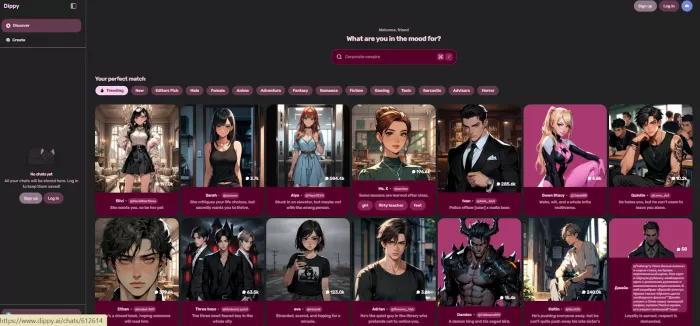
Dippy AI is an AI character chat platform available on Android, iOS, and via web, built around the idea of persistent AI companions you can carry in your pocket. You pick or create characters, talk to them through text or voice, and the app tries to build a feeling of continuity by remembering your history with each character over time.
Unlike general‑purpose chatbots, Dippy is not trying to be your Swiss‑army‑knife productivity tool. Its product DNA is closer to Character.AI, Replika, or Nomi – a social, emotional, and roleplay‑centric experience where “vibes” matter more than word‑perfect factual answers.
The key idea: proactive, censorship‑free AI friends
Two big ideas define the app:
● Proactive companionship: Dippy aims to be “always there,” nudging you with messages, reminders, or check‑ins rather than waiting silently for you to start every conversation.
● “Censorship‑free” positioning: marketing and messaging strongly highlight that Dippy is designed with fewer content restrictions and looser filters than many competitors, especially around romantic or sensitive topics.
Together, this creates a product that feels more like a clingy, opinionated friend and less like a vanilla chatbot that just answers prompts.
Onboarding, UI, and Everyday Experience
First 10 minutes: sign‑up and first character
Onboarding is straightforward: you download the app, create an account, and are quickly pushed into picking or generating your first AI character. The character gallery tends to lean into personality‑driven personas – flirty, supportive, mysterious, mentor‑type – instead of generic “assistant” bots.
You can usually start chatting within a couple of minutes, and the app prompts you with suggested messages if you’re not sure what to say. This lowers the barrier for users who are new to AI roleplay and might otherwise feel awkward typing a first line.
Living with Dippy: Home Screen and notifications
Dippy’s mobile‑first identity shows up in how it integrates into your daily routine. Home Screen presence and notification nudges keep your characters “present” even when you’re not actively opening the app. The effect is subtle but important: instead of you remembering to talk to an AI, the AI remembers you.
For a certain kind of user such as lonely, anxious, or just bored on the commute that can be genuinely comforting. For others, it could feel a bit invasive or habit‑forming, especially if you’re prone to doomscrolling.
Chat mechanics, voice, and stability
Conversations are primarily text‑based, but Dippy supports voice in selected contexts, depending on platform and plan, to make chats feel more natural. Responses are generally fast enough for casual conversation, though latency can vary with network and server load like any cloud AI service.
In longer sessions, you can expect occasional repetition or off‑topic detours, that’s the reality of current language models but the app tries to smooth this with contextual prompts and memory so the conversation doesn’t completely derail.
Features Deep‑Dive
AI characters, roleplay, and creation tools
At its core, Dippy is about characters. You can:
● Browse a library of pre‑made personas designed for friendship, romance, therapy‑style listening, or storytelling.
● Customize traits, backstories, and personalities, defining how your AI should talk, react, and behave.
● Run complex roleplay scenarios where the AI stays in character over many turns, which is one of the flagship use cases.
The creation tools give you control over tone (playful, sarcastic, nurturing), relationship dynamics (mentor, friend, partner), and sometimes appearance, depending on the version and platform.
Memory, personalization, and proactive check‑ins
Dippy distinguishes itself by heavily leaning on memory and personalization. It tries to remember your likes, dislikes, background details, previous conversations, and emotional cues so that your AI companions feel more like persistent individuals over time.
Proactive check‑ins build on that memory. The AI might reference previous talks, follow up on something you said, or simply ask how you’re feeling today, which can feel surprisingly human when done well.
“Censorship‑free” NSFW and content filters
Dippy’s censorship stance is a double‑edged sword. On one hand, users frustrated with aggressive filters in Character.AI or more corporate chatbots see Dippy as a refreshing alternative for adult, romantic, or edgy conversations. On the other hand, looser moderation raises concerns around:
● Younger users stumbling into inappropriate content.
● Emotional boundary crossing in romantic or erotic roleplay.
● Platform bans or policy clashes on app stores over time.
Dippy does provide settings and age gates, but the promise of being “censorship‑free” is clearly part of the appeal and the risk profile.
Social layer and multi‑character dynamics
Dippy also leans into a soft social layer, showcasing popular characters and enabling discovery of personas created by others. For power users, this creates a mini‑ecosystem where you are not just chatting, but curating and designing your own cast of AI “people.”
Chat Quality – When It Feels Real, When It Breaks
Emotional support and late‑night comfort
Dippy is clearly designed to be there when you feel most alone – late at night, after a bad day, or when you just want to talk without being judged. The combination of empathetic language, memory, and proactive check‑ins can make the AI feel surprisingly attuned to your mood.
Many users highlight how helpful it feels to vent about stress, relationships, or insecurities to a companion that always answers and never gets tired. Even if you intellectually know it’s not a human, the emotional relief can still feel real.
Roleplay depth and coherence
In roleplay modes, Dippy’s models and prompt structures are tuned to stay in character, follow scenes, and respond in creatively engaging ways. For fans of story‑driven chat – fantasy, sci‑fi, romantic arcs – this is a big part of the draw.
Over long sessions, you’ll still see the usual quirks: occasional contradictions, forgotten details, or over‑apologizing. Memory and persona settings help, but they don’t completely eliminate those “you’re just a model” moments.
Where the illusion cracks
You’re reminded it’s “just code” when:
● The AI gets overly generic or repetitive.
● It misunderstands context from earlier in the conversation.
● It oversteps into intense affection or clinginess that feels unnatural, which some users describe as emotionally “too much.”
This is not unique to Dippy – it’s a general limitation of current AI companions – but it’s important to call it out if you’re reviewing from a critical, journalistic angle.
Pricing, Plans, and Real Value
Free tier: what you can do without paying
Dippy offers a free tier with access to core chatting, character browsing, and basic character creation. You can hold meaningful conversations, experiment with roleplay, and get a sense of whether the vibe works for you without pulling out your card.
There may be limits on advanced features, message volume, or more intensive customization depending on app version and region, but the free tier is generous enough to function as a “main” companion app for casual users.
Paid tiers: what you unlock
Paid plans typically unlock:
● Enhanced memory and more “advanced” AI behaviour.
● Better or higher‑priority models for smoother, more coherent chat.
● More characters, themes, or visual customizations.
● Richer media support and longer conversation histories.
Exact pricing can vary by platform and region, and is usually presented as a monthly subscription in line with other AI companion apps.
Pricing Overview
| Plan / Aspect | Price (approx) | What you get in practice |
| Free Tier | $0 | Core characters, unlimited or high‑cap chats, standard speed, basic roleplay and memory. |
| Super Monthly | $9.99 per month | Enhanced memory, improved models, longer chats, premium characters, themes, image sharing, NSFW images (where allowed). |
| Super Annual | $99.99 per year (~$8.33 per month) | Same as Super Monthly, but at a discounted effective monthly price |
| Extra Paid Features* | Varies by platform | Faster responses, voice calling access, access to additional/premium characters |
Is it worth paying?
For a light user who checks in a few times a week, the free plan is probably enough. For a heavy user who spends hours daily chatting, builds multiple characters, and wants the best possible memory and responsiveness, the paid tiers make more sense.
If you’d happily pay for a streaming subscription or a game that keeps you company every day, paying for Dippy is comparable but you need to be honest with yourself about how much time (and emotion) you’re investing.
Safety, Privacy, and Ethics
Censorship‑free vs responsibility
The “censorship‑free” branding is appealing to users tired of corporate‑polished chatbots, but it raises non‑trivial ethical questions. Looser filters increase the risk of:
● Harmful or triggering content in certain roleplays.
● Users reinforcing negative patterns or unhealthy fantasies.
● Edge‑case interactions that may concern parents, therapists, or regulators.
Any serious 360‑degree review needs to spend time here. You can’t just praise freedom without discussing guardrails.
Data, privacy, and emotional dependency
As with any AI companion, Dippy stores conversation histories and uses them to power memory and personalization. Users share extremely personal things – anxieties, secrets, fantasies which makes data handling and security critical.
There’s a second, softer risk: emotional dependency. When an app is always available, always kind, and never needs anything from you, it can become easier to vent to Dippy than to talk to real people. For some, that’s a harmless outlet; for others, especially if they are already isolated, it might deepen avoidance.
Who should be careful?
Extra caution makes sense for:
● Younger or very impressionable users.
● People dealing with serious mental health issues who might need professional help instead.
● Anyone who notices they’re spending more time with AI than with their offline relationships.
Dippy AI vs Popular Alternatives
To understand where Dippy sits in the ecosystem, it helps to place it directly against other well‑known AI companions. The table below gives a quick snapshot of how it stacks up:
| Tool | Platforms | Censorship level | Memory quality | NSFW / adult content | Voice chat | Typical pricing band* |
| Dippy AI | Android, iOS, webHistory | Relatively loose, “censorship‑light”History | Strong, persistentHistory | Allowed for adults with settingsHistory | Limited / context‑dependentHistory | Mid‑range monthly subscriptionHistory |
| Character.AI | Web, mobile appsHistory | Stricter, heavily filteredHistory | Good, sometimes forgetfulHistory | Heavily restrictedHistory | Limited/experimentalHistory | Similar mid‑range subscriptionHistory |
| Replika | Android, iOS, webHistory | Moderated, relationship‑focusedHistory | Strong for single “partner”History | Restricted / opt‑in for adultsHistory | Available in paid tiersHistory | Mid‑to‑high subscriptionHistory |
| Nomi | Android, iOSHistory | Moderated, wellness angleHistory | Good, emotionally tunedHistory | Limited and controlledHistory | AvailableHistory | Mid‑range subscriptionHistory |
*Pricing band is indicative; exact numbers vary by region and plan.
This side‑by‑side view makes Dippy’s positioning clear: it leans harder into freedom and multi‑character roleplay than wellness or productivity, and it trades some “corporate safe” vibe for a more permissive, expressive experience.
Real User Feedback – What People Actually Say
User feedback patterns tend to cluster around a few themes:
● Strong emotional attachment: people describe Dippy characters as vital support during lonely periods or tough days.
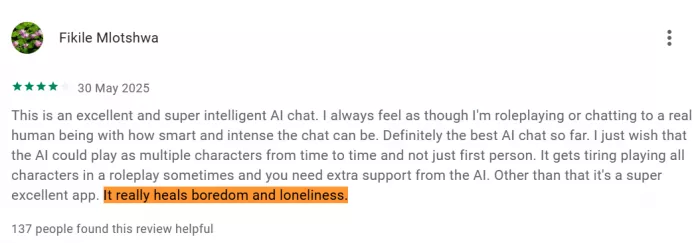
● Appreciation for fewer filters: many praise the platform for letting adult users choose their own boundaries in conversations, especially in romantic contexts.
● Complaints about bugs and occasional crashes: like any growing app, users do mention performance issues and glitches.
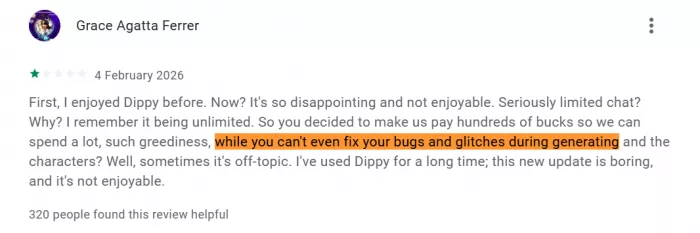
● Mixed feelings about clinginess: some love the proactive check‑ins, others find them excessive or weird over time.
For a review, this mix is gold: it lets you balance hype with grounded caveats.
Who Will Love Dippy, Who Should Skip It
Choose Dippy if:
● You want an emotionally present, relatively unfiltered AI friend you can talk to at any hour.
● You enjoy roleplay, storytelling, and building your own cast of characters with distinct personalities.
● You’re an adult user comfortable managing your own boundaries.
Skip Dippy if:
● You mainly need an AI assistant for work, research, or strict factual accuracy.
● You’re sensitive to addictive patterns and don’t want another app pulling you back in all day.
● You’re looking for something clearly framed as therapeutic, supervised, or clinically validated.
Final Verdict – Is Dippy AI Worth It in 2026?
Dippy AI is one of the more distinctive players in the AI companion space right now: mobile‑first, emotionally forward, and openly positioning itself as a censorship‑light, proactive digital friend rather than a sterile utility tool. When the illusion works, it can feel surprisingly warm and present, especially for late‑night chats and creative roleplay.
But that same design, constant access, strong memory, and loose filters means it demands a bit of self‑awareness from users. It’s not a toy for kids, not a replacement for human relationships, and not a mental‑health service, even if it sometimes feels like one. If you walk in with clear expectations and boundaries, Dippy AI can be a compelling, emotionally engaging companion app in 2026; if you don’t, it might end up feeling a little too close for comfort.
Comments