Nvidia is preparing to launch a new artificial intelligence processor designed specifically to speed up inference, the stage where AI models generate answers in a move that could reshape how the world’s biggest tech companies build and deploy AI systems. People familiar with the plan say the chip and its surrounding platform are aimed at customers such as OpenAI, promising faster, more efficient AI processing and signaling a broader shift in how Nvidia defines its core products.
A New AI Inference Workhorse
The new processor is being developed as the centerpiece of a fresh architecture for “inference computing,” the part of AI workloads focused not on training models, but on running them at scale for real-world users. Unlike Nvidia’s current flagship AI GPUs, which dominate training of large language models, this platform is tuned for high-throughput, low-latency deployment of already-trained systems in data centers.
According to people briefed on the project, Nvidia plans to unveil the chip and platform at its next GTC developer conference in San Jose, underscoring how central inference has become to its strategy. The system is expected to integrate tightly with Nvidia’s existing data-center stack including networking, software and developer tools – so that cloud providers and AI labs can plug it into existing infrastructure with minimal changes.
One distinctive detail under discussion is the use of technology from Groq, a startup known for ultra-fast, low-latency AI inference processors, which is expected to feature in the new platform. That pairing would marry Nvidia’s ecosystem and system-level integration with Groq’s specialization in deterministic, high-speed inference, potentially offering an alternative to traditional GPU-only approaches for running frontier models.
Why Nvidia Is Pivoting Hard Into Inference
For much of the last two years, Nvidia’s data-center business has been defined by its Hopper-generation accelerators (H100 and H200), which power the training of large language models and multimodal systems at companies including OpenAI, Microsoft and Google. Training has been the headline story and the biggest source of demand – as firms raced to build larger, more capable foundation models.
But as those models move from experimental labs into mainstream products, the economics of inference are becoming just as critical. AI services such as chatbots, copilots, video generation and real-time translation need to answer billions of queries with tight latency and energy budgets, and the cost of serving each query can determine whether a product is viable at scale. Nvidia’s planned chip directly targets that bottleneck by improving performance-per-watt and total throughput for inference-heavy workloads, especially when models must run continuously for consumer and enterprise applications.
OpenAI, one of Nvidia’s most important customers, has already signaled it plans to invest heavily in “dedicated inference capacity” from Nvidia, and is expected to be a leading early user of the new processor. That demand reflects a broader shift among hyperscalers, who increasingly treat AI inference not as an add-on but as a core part of their cloud infrastructure, on par with storage or general-purpose compute.
Positioned Inside a Bigger 2026 AI Roadmap
The new inference-focused chip does not arrive in isolation; it sits inside an aggressive roadmap that has Nvidia refreshing its AI platforms roughly yearly and redefining what it sells from individual GPUs to full rack-scale systems.
Over the past cycle, Nvidia’s Hopper architecture (H100/H200) gave way to the Blackwell generation, which brings significantly higher memory bandwidth, improved mixed-precision performance and chiplet-based scaling for both training and inference. Blackwell-based platforms such as GB200 pair GPUs with Nvidia’s Grace CPUs and high-speed interconnects, creating tightly integrated systems optimized for large clusters and continuous AI workloads.
At GTC 2025, CEO Jensen Huang went further and unveiled Rubin, Nvidia’s next family of GPUs named after astronomer Vera Rubin, scheduled to roll out from the second half of 2026. Rubin GPUs are expected to deliver on the order of triple the performance of the latest Blackwell parts, while maintaining or improving energy efficiency for generative and agentic AI workloads.
Nvidia has also announced a Rubin-based AI chip for complex content generation – including video and software creation known as Rubin CPX, planned for launch by the end of next year. Taken together, the roadmap points to a portfolio where specialized chips handle different phases of the AI lifecycle: training, high-throughput inference, and domain-specific generation, all bound together by Nvidia’s software stack and data-center platforms.
From Chips to Full AI Systems
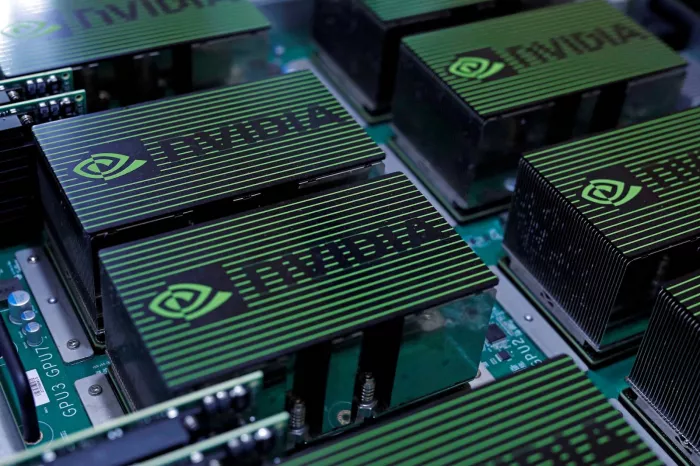
The company’s strategy around the new inference processor mirrors a broader shift away from selling standalone GPUs and toward delivering complete AI systems measured at the rack or data-hall level. At CES 2026, Nvidia used its keynote to highlight rack-scale platforms like the NVL72 AI supercomputer, built around Vera Rubin and slated for production in the second half of 2026, rather than announcing consumer graphics cards.
These pre-integrated systems combine GPUs or specialized AI chips, CPUs, high-speed networking, storage and cooling, along with Nvidia’s CUDA, cuDNN and higher-level AI frameworks, to form what Huang has described as “coherent machines” for AI. They are designed to be dropped into hyperscale data centers as standardized building blocks, accelerating deployment and reducing the tuning work required by customers, who increasingly buy compute in units of racks or clusters rather than individual cards.
The new inference platform is expected to follow the same pattern: sold not just as a bare processor, but as part of complete systems optimized for inference workloads, from model hosting and retrieval-augmented generation to interactive agents and real-time analytics. That system-level approach helps Nvidia maintain a moat around its ecosystem at a time when large customers are experimenting with in-house accelerators and alternative architectures.
Competitive and Regulatory Stakes
Nvidia’s push into a dedicated inference chip comes as its dominance in AI accelerators draws scrutiny from regulators and pushes rivals to step up their efforts. Competing offerings from AMD, Intel and a growing number of AI startups aim to undercut Nvidia on price, efficiency or workload specialization, particularly for inference where cost pressures are highest.
Cloud providers such as Amazon, Google and Microsoft are also developing their own custom AI chips to lessen dependence on Nvidia and tailor performance to their internal workloads. At the same time, export controls and geopolitical tensions have forced Nvidia to produce modified chips for markets such as China, including adjusted variants of its Hopper-based products, after Washington tightened restrictions on AI-related compute power.
Despite those headwinds, analysts note that Nvidia’s vertical integration combining GPUs, CPUs, networking, software and now more specialized inference silicon leaves it in a strong position to remain the default choice for many cutting-edge AI deployments. The planned inference chip and its Groq-linked architecture could make it harder for competitors to win share on cost alone if Nvidia can deliver better end-to-end performance and simpler deployment across its ecosystem.
What It Means for OpenAI and Hyperscalers
For OpenAI, a dedicated Nvidia inference platform promises more predictable performance and potentially lower unit costs for running models that power services like ChatGPT and developer APIs. Rather than relying solely on general-purpose training accelerators repurposed for inference, OpenAI could reserve specialized systems optimized for its heaviest, latency-sensitive workloads.
Other hyperscalers and AI labs are likely to view the new chip as another option in a toolkit increasingly defined by heterogeneous compute: mixing training GPUs, custom inference accelerators, CPUs and even older-generation hardware, depending on the model and latency requirements. For enterprises, including sectors such as healthcare, automotive and manufacturing, Nvidia’s roadmap from Hopper and Blackwell to Rubin and the upcoming inference platform signals that the company intends to provide tailored solutions for everything from model training to robotic automation.
Nvidia has already showcased partnerships with companies like GM, Google and Disney around Rubin-era hardware and AI robotics, indicating that future chips will target not just cloud-scale AI, but also physical-world systems such as industrial robots and autonomous machines. As inference workloads spread from the data center to edge and on-premises deployments, specialized processors could become core to industries that increasingly rely on real-time computer vision, speech and decision-making.
A High-Stakes Bet on the Next Phase of AI
The planned inference processor is both an incremental and a symbolic step for Nvidia: incremental because it extends the company’s existing dominance in AI accelerators into a more focused segment, symbolic because it underscores a shift from selling general-purpose GPUs to shipping full-stack AI infrastructure. Performance details and pricing remain under wraps, and the company has not publicly confirmed timelines beyond its broader roadmap, but expectations are that the chip will be introduced at GTC and ramped as part of Nvidia’s 2026 portfolio.
If Nvidia can deliver meaningful gains in throughput and efficiency for inference, the processor could become a central component in the next wave of AI deployments, supporting everything from conversational agents and copilots to generative video and code generation at massive scale. For competitors, it raises the bar in a market already described as an AI compute arms race, while for cloud providers and AI developers, it offers a clearer path to scaling services without runaway costs.
As the AI industry moves from building ever-larger models to operating them as everyday infrastructure, the chips that power inference may matter as much as those that train them and Nvidia is moving quickly to make sure those future systems run on its silicon.
Comments