Table of Contents
- 1. What Practical AI Tools Learning Really Means
- 2. Why Practical AI Learning Is Replacing Theory-First Models
- 3. Core AI Tools Commonly Used in Practical Learning
- 4. Practical Learning Through Real Tool Usage
- 5. Learning Effort vs Skill Output
- 6. Pricing Models and Accessibility
- 7. Learning Paths Based on Real User Profiles
- 8. 90-Day Practical AI Learning Roadmap
- 9. Common Mistakes in Practical AI Tools Learning
- 10. How Long Does It Actually Take to Learn AI Tools?
- 11. Trust, Ethics, and Responsible Usage
- 12. Why Practical AI Tools Learning Is a Career Skill
- Conclusion: Practical Learning Is the New AI Literacy
Artificial intelligence is no longer learned primarily through equations, academic papers, or abstract theory. In 2026, the most effective AI learners are not those who understand every algorithm but those who can apply AI tools to real tasks. This shift has given rise to what is now widely referred to as practical AI tools learning.
Practical AI tools learning focuses on doing, not memorizing. It is about learning how AI fits into everyday workflows: drafting content faster, analyzing data more efficiently, designing visuals without a design background, or automating repetitive work. This article explores what practical AI tools learning truly means, how it differs from traditional approaches, which tools matter most, and how learners can build real-world AI skills with measurable outcomes.
1. What Practical AI Tools Learning Really Means
Practical AI tools learning is the process of acquiring AI skills through direct interaction with AI-powered tools, rather than through theory-first education. The goal is not to “understand AI,” but to use AI effectively.
Practical vs Traditional AI Learning
| Aspect | Traditional AI Learning | Practical AI Tools Learning |
| Entry barrier | High (math, coding) | Low to moderate |
| Focus | Algorithms & theory | Task completion |
| Time to results | Months or years | Days or weeks |
| Target audience | Researchers, engineers | Students, professionals, creators |
| Outcome | Conceptual understanding | Usable, job-ready skills |
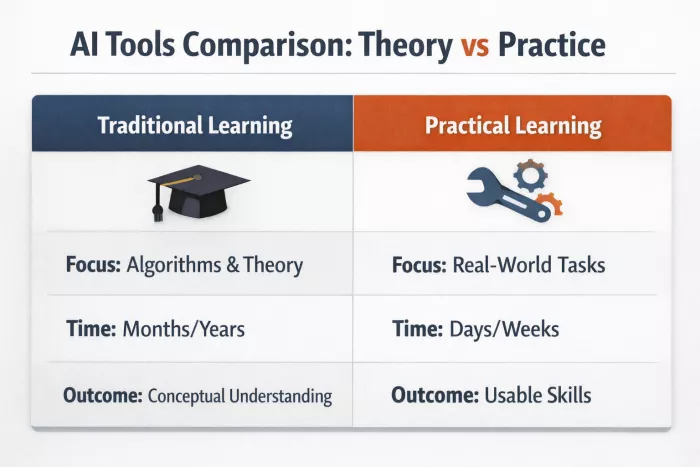
In practice, most learners experience their first “AI breakthrough” not when they understand neural networks, but when they successfully automate a real task summarizing a report, generating a design, or extracting insights from raw data.
2. Why Practical AI Learning Is Replacing Theory-First Models
Multiple global studies show a rapid rise in AI adoption driven by tool accessibility, not academic knowledge. According to enterprise surveys published between 2023–2024, most AI usage occurs through off-the-shelf tools, not custom model development.
The reasons are simple:
● AI tools abstract complexity
● Learning curves are shorter
● Results are immediately visible
● Skills transfer directly to work
This is why practical AI tools learning is now dominant in:
● Marketing teams
● Content production
● Business operations
● Education
● Freelancing and entrepreneurship
3. Core AI Tools Commonly Used in Practical Learning
Rather than overwhelming learners with hundreds of tools, practical AI learning focuses on high-utility platforms that deliver fast skill gains.
Tool Comparison: Learning Value Over Hype
| Tool | Primary Use Case | Learning Curve | Free Access | Practical Skill Gained |
| ChatGPT | Writing, analysis, ideation | Easy | Yes | Task automation |
| Canva AI | Visual content creation | Very easy | Yes | Design execution |
| Notion AI | Knowledge & workflow management | Medium | Limited | Process optimization |
| Descript | Audio/video editing | Medium | Yes | Media production |
| AutoML tools | Predictive modeling | Hard | No | Model deployment |
What matters here is not popularity, but learning efficiency how quickly a learner can translate usage into real capability.
4. Practical Learning Through Real Tool Usage
ChatGPT: Learning AI Through Daily Work
ChatGPT is often the first AI tool learners interact with, not because it is the most powerful, but because it integrates naturally into everyday tasks.
What learners actually learn:
● Prompt structuring
● Context management
● Iterative refinement
● Task delegation to AI
Common learning friction:
Many users initially struggle with vague prompts. The real learning happens when they discover that specific instructions outperform clever wording.
Pricing:
● Free tier available
● Paid plans unlock advanced models and higher usage limits
Canva AI: Visual Skills Without Design Training
Canva AI demonstrates one of the clearest benefits of practical AI learning: skill substitution. Learners acquire usable design output without formal training.
Practical outcomes:
● Social media graphics
● Presentations
● Marketing visuals
● Brand assets
Learning curve insight:
Most users achieve usable results within 2–3 hours, making it one of the fastest tools for confidence-building.
Notion AI: Learning AI Inside Workflows
Notion AI introduces learners to AI embedded in structured thinking. Instead of isolated outputs, users learn how AI supports:
● Documentation
● Planning
● Knowledge retrieval
● Process writing
This tool teaches an underrated AI skill: workflow thinking, how AI fits into ongoing systems rather than single tasks.
Descript: AI for Audio and Video Editing
Descript transforms audio and video editing into a text-based experience. For learners, this removes a major technical barrier.
Skills learned practically:
● AI transcription
● Content restructuring
● Audio cleanup
● Multi-format publishing
For creators and educators, Descript often represents the first time AI directly replaces a technical bottleneck.
AutoML Tools: Where Practical Learning Becomes Advanced
AutoML platforms allow non-experts to build predictive models using structured data. However, practical learning here is slower.
Key limitation:
Without basic data understanding, learners often misuse AutoML outputs. This is where practical learning still benefits from foundational knowledge.
5. Learning Effort vs Skill Output
One reason practical AI tools learning works so well is the asymmetry between effort and output.
Learning Effort vs Skill Output (Conceptual Chart)
| Tool Type | Avg Learning Time (hrs) | Skill Output Score (1–10) |
| ChatGPT | 8 | 9 |
| Canva AI | 6 | 8 |
| Notion AI | 10 | 7 |
| AutoML Tools | 40 | 6 |
| Traditional ML | 120 | 5 |
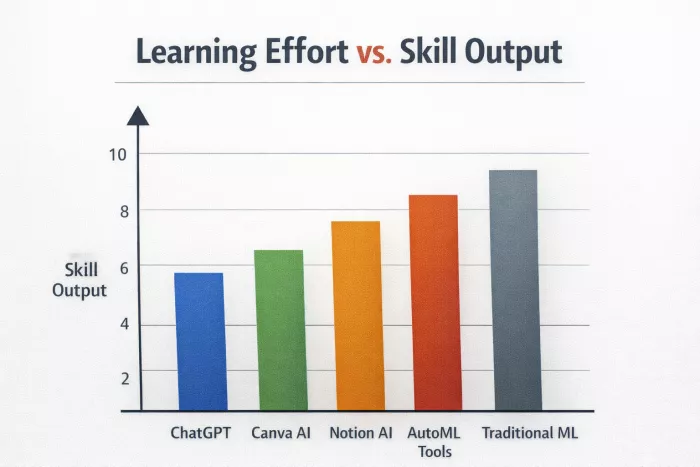
This explains why professionals gravitate toward tools rather than theory-heavy programs.
6. Pricing Models and Accessibility
Pricing strongly influences learning adoption.
Pricing Model Distribution Across AI Tools
| Pricing Model | Approx Share |
| Freemium | 42% |
| Subscription | 38% |
| Pay-as-you-go | 12% |
| Enterprise-only | 8% |
Freemium access lowers experimentation risk, which directly supports practical learning.
7. Learning Paths Based on Real User Profiles
Students
● Focus on: ChatGPT, Canva, Notion AI
● Outcome: Assignment efficiency, presentation skills
● Time to competence: 2–4 weeks
Professionals
● Focus on: ChatGPT, Notion AI, Descript
● Outcome: Productivity, reporting, communication
● Time to competence: 3–6 weeks
Creators
● Focus on: Canva AI, Descript, generative image tools
● Outcome: Faster content production
● Time to competence: 1–3 weeks
Business Owners
● Focus on: ChatGPT, workflow AI, automation tools
● Outcome: Process automation, decision support
● Time to competence: 4–8 weeks
8. 90-Day Practical AI Learning Roadmap
| Timeframe | Focus Area | Skills Acquired |
| Days 1–7 | Core tools | Task completion |
| Days 8–30 | Workflow usage | Productivity gains |
| Days 31–60 | Tool combination | Automation |
| Days 61–90 | Real projects | Applied confidence |
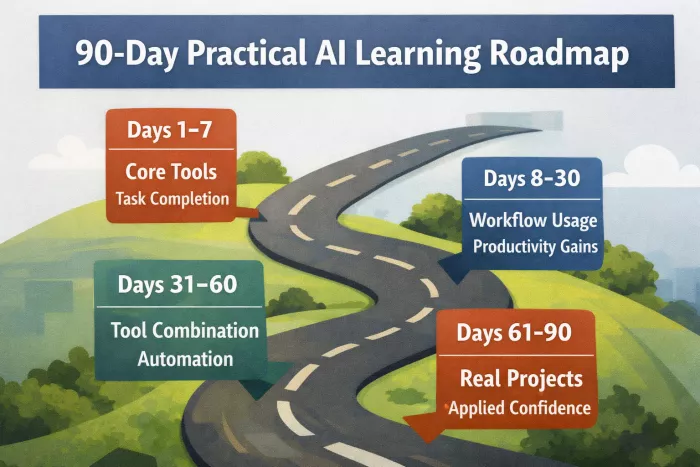
The defining feature of this roadmap is output measurement, not content completion.
9. Common Mistakes in Practical AI Tools Learning
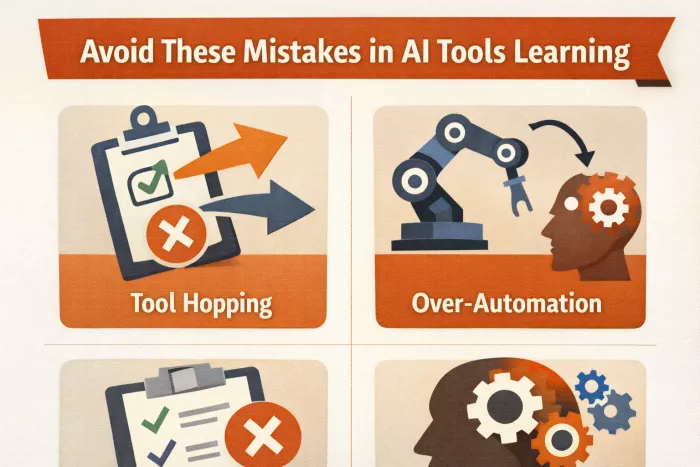
Despite accessibility, many learners stall. Common issues include:
● Tool hopping: Switching tools before mastering one
● Over-automation: Trusting outputs without validation
● No feedback loop: Not measuring time saved or quality improved
● Ignoring context: Treating AI as a replacement instead of an assistant
Practical learning succeeds when learners critique AI outputs, not just accept them.
10. How Long Does It Actually Take to Learn AI Tools?
Contrary to marketing claims, mastery is not instant, but it is measurable.
| Skill Level | Time Investment | Capability |
| Basic usage | 5–10 hours | Task execution |
| Functional skill | 20–40 hours | Workflow integration |
| Advanced usage | 60+ hours | Automation & optimization |
This timeline applies to most mainstream AI tools.
11. Trust, Ethics, and Responsible Usage
Practical AI tools learning must also address:
● Data privacy
● Bias awareness
● Human oversight
● Attribution and originality
Responsible use strengthens long-term skill credibility, especially in professional contexts.
12. Why Practical AI Tools Learning Is a Career Skill
AI literacy is increasingly evaluated not by certificates, but by:
● Demonstrable outputs
● Workflow examples
● Efficiency gains
● Problem-solving ability
Practical learners build portfolio-worthy evidence, even without formal credentials.
Conclusion: Practical Learning Is the New AI Literacy
Practical AI tools learning represents a shift from knowing about AI to working with AI. It prioritizes experience over explanation, outcomes over theory, and usability over abstraction.
For learners, this approach delivers faster confidence, transferable skills, and real-world relevance. For organizations, it creates immediate value. And for the broader ecosystem, it democratizes access to AI capability without diluting responsibility.
The future of AI education is not less rigorous, it is more applied. And practical AI tools learning is where that future is already taking shape.
Comments