Table of Contents
- Introduction: The AI Career Revolution Is Already Here
- Section 1: The Data Behind the Shift - Why AI Adoption Among Students and Creators Is Accelerating
- Section 2: How Students Are Using AI Tools to Build Career-Ready Skills
- Section 3: How Creators Are Using AI to Build Sustainable Careers
- Section 4: The Top AI Tools Students and Creators Are Actually Using
- Section 5: AI-Enabled Career Paths - Roles, Tools, and Earning Potential
- Section 6: A Step-by-Step Roadmap to Building Your AI-Powered Career
- Phase 1 in Detail: Choosing Your Starting Tool
- Section 7: Challenges and Ethical Considerations Students and Creators Must Know
- Section 8: The Future Outlook - What Is Coming Next for AI-Powered Careers
- Conclusion: Your AI Career Starts with One Tool and One Decision
- Quick Reference: Top Resources to Start Your AI Career Journey Today
Introduction: The AI Career Revolution Is Already Here
Not long ago, the idea of a college student building a full-time freelance income from their dorm room using artificial intelligence would have sounded far-fetched. Today, it is an everyday reality. From a computer science sophomore automating code reviews with GitHub Copilot to a fine arts graduate selling AI-generated illustrations on Etsy for thousands of dollars a month, the intersection of AI tools and human ambition is creating entirely new career trajectories.
This is not a guide built on speculation. It is grounded in real numbers, real tools, and real workflows that students and creators around the world are using right now. The AI career revolution is not coming. For millions of young professionals, it is already here.
The numbers are striking. According to a 2025 study by the Higher Education Policy Institute, 92 percent of university students now use AI tools, a jump from 66 percent just one year earlier. Meanwhile, Adobe surveyed over 16,000 creators globally and found that 86 percent are already integrating generative AI into their creative workflows. These are not marginal trends. They represent a fundamental shift in how the next generation is building skills, creating value, and earning money.
"76 percent of creators say creative generative AI is positively shaping the creator economy, helping them reach new audiences, scale their businesses, and amplify their creative expression." - Adobe Creators' Toolkit Report, 2025
This guide breaks down exactly how students and creators are using AI tools in the real world, with specific use cases, recommended tools, income examples, and a step-by-step roadmap you can follow to build your own AI-powered career path.
Section 1: The Data Behind the Shift - Why AI Adoption Among Students and Creators Is Accelerating
Before diving into specific use cases, it is worth understanding just how fast the landscape is changing. The statistics below are not projections or estimates. They represent documented behavior from 2025 surveys across multiple countries and industries.
Key AI Adoption Statistics at a Glance
| Metric | Statistic |
|---|---|
| University students using AI tools (2025) | 92% (up from 66% in 2024) |
| Students using AI for assessments (2025) | 88% (up from 53% in 2024) |
| Creators using generative AI tools | 86% globally (Adobe, 2025) |
| Gen Z workers who say AI helps their career | 87% |
| Organizations using AI in at least one function | 78% (Stanford AI Index, 2025) |
| AI education market value (end of 2025) | $7.57 billion (up from $5.47B) |
| AI-augmented freelancer earnings growth | 25% year-over-year increase |
| Office workers who say AI helps their career | 76% (2025 survey) |
These numbers tell a clear story: AI adoption among students and creators has crossed a critical threshold. It is no longer an edge-case behavior practiced by early adopters. It is mainstream, and those who are not engaging with these tools are increasingly at a disadvantage.
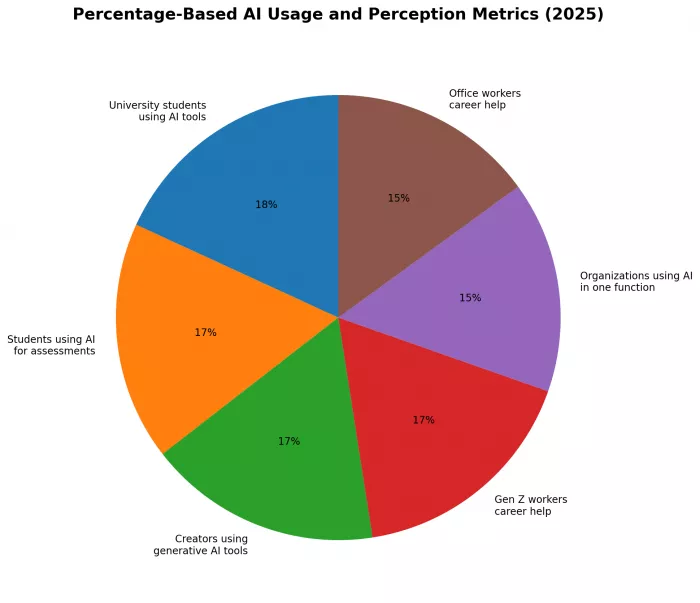
From a career standpoint, the implications are especially significant. A 2025 survey found that 87 percent of Gen Z office workers believe AI helps their career development, compared to 76 percent of the general workforce. Meanwhile, Stanford's 2025 AI Index Report revealed that 78 percent of organizations are already using AI in at least one part of their operations, up from 55 percent the previous year. Employers are not just curious about AI. They are actively restructuring workflows around it, and they expect new hires to keep up.
Section 2: How Students Are Using AI Tools to Build Career-Ready Skills
Students today are not waiting for the job market to teach them AI. They are self-educating, self-experimenting, and in many cases, self-monetizing. Below are the most impactful real-world ways students are leveraging AI to build skills and launch careers.
2.1 Resume, Cover Letter, and Interview Preparation
The most universally adopted AI use case among students is career document preparation. According to the Digital Education Council's Global AI Student Survey, 76 percent of students say resume and cover letter writing is the most useful application of AI for their career journey.
Tools like ChatGPT, Claude, and Grammarly allow students to transform rough bullet points into polished, ATS-optimized professional documents in minutes. More importantly, AI enables personalization at scale. A student can now tailor a resume and cover letter to each specific job posting, a practice that significantly increases interview rates but was previously too time-consuming to do consistently.
Practical steps students are taking right now:
•Uploading a job description to ChatGPT and asking it to align their existing resume bullet points with the required keywords
•Using Claude to generate multiple versions of a cover letter in different tones (formal, enthusiastic, concise)
•Practicing mock interviews by prompting AI to simulate common interview questions in their target industry
•Running resumes through AI checkers like Resumly's ATS Resume Checker to ensure they pass automated screening
2.2 Accelerated Skill Acquisition and Self-Study
AI has dramatically compressed the time it takes to develop marketable skills. Students are using tools like ChatGPT and Claude as personalized tutors that can explain complex concepts, generate practice problems, provide feedback on their work, and suggest learning pathways.
A computer science student, for example, can use GitHub Copilot to learn how to write better code by seeing AI completions in real time, understanding why certain patterns are suggested, and iterating faster than any textbook would allow. Legal students at top universities have seen productivity gains of 38 to 115 percent when using AI tools for drafting and analyzing legal documents, according to a 2025 study cited in AI Literacy Review.
Beyond technical subjects, AI is democratizing access to knowledge in creative fields. A student without formal design training can use Canva AI and Midjourney to produce professional-grade visual assets. A non-native English speaker can use Grammarly and Claude to write with the clarity and precision of a seasoned professional. The playing field is leveling quickly.
2.3 Building Real Portfolio Projects
One of the most powerful ways students are using AI is to close the experience gap. Employers want to see what you have built. AI makes it possible for students to build more, build faster, and build things that actually demonstrate industry-relevant skills.
Examples of AI-powered student portfolio projects gaining real traction in hiring processes:
•A marketing student who used ChatGPT and Canva AI to create a full social media strategy and content calendar for a fictional brand, complete with post designs, engagement analytics, and campaign reports
•A data science student who used Python with GPT integration to build a sentiment analysis tool for Twitter data, then documented the methodology and deployed it on GitHub
•A journalism student who used Perplexity AI and Claude to research, outline, and draft a long-form investigative article, then published it on Medium to demonstrate professional-grade writing
•A UX design student who used AI-generated user personas, wireframes, and prototype descriptions to build a complete case study for their design portfolio
The key insight here is that AI does not replace the student's thinking. It amplifies it. The student still defines the problem, directs the strategy, and exercises judgment. AI handles the production work that previously required either more time or more technical expertise.
2.4 Freelancing While Still in School
Perhaps the most striking trend is the number of students who are not just building skills with AI, but actively earning money with it. College students are landing freelance clients on Upwork and Fiverr, charging rates that would have been unthinkable for an undergraduate just a few years ago.
Real example: Jake T., a college student, uses ChatGPT Plus and Claude Pro to write blog content for tech startups. He earns $2,200 per month while working part-time hours.
Freelance earnings from AI-related services have risen 25 percent year over year according to PeoplePerHour's 2025 platform data. AI-augmented freelancers now consistently earn more per hour than peers who rely on traditional workflows. The reason is simple: AI multiplies output. A writer who previously produced 2,000 words a day can produce 6,000 to 8,000 words of edited, polished content. A designer who needed three days for a brand kit can deliver it in one. This speed advantage translates directly into more clients, better rates, and more income.
Section 3: How Creators Are Using AI to Build Sustainable Careers
The creator economy has been one of the fastest-growing economic sectors of the last decade. In 2025, AI is accelerating that growth further by removing production bottlenecks, reducing costs, and enabling solo creators to operate at a scale that previously required full teams.
3.1 Content Creation at Scale
Content volume and consistency are among the biggest barriers for independent creators. Posting regularly across platforms like YouTube, Instagram, TikTok, and LinkedIn requires enormous amounts of writing, designing, filming, and editing. AI has fundamentally changed this equation.
Creators are using AI to build content systems, not just individual pieces. This means:
•Using ChatGPT or Jasper to generate a month of social media post drafts in a single afternoon
•Using Pictory to turn a long-form blog post into a short-form video automatically
•Using ElevenLabs to generate professional voiceovers for YouTube videos without recording a single word
•Using Canva AI to produce thumbnail variations and test which performs better without hiring a designer
•Using Buffer with AI scheduling features to optimize posting times based on audience behavior data
Adobe's 2025 Creators' Toolkit Report found that 60 percent of creators now use more than one AI tool in their workflow, mixing and matching tools to match the right capability to the right task. The creators winning in this environment are not those who use the most AI, but those who have built intentional systems where each tool serves a clear purpose.
3.2 AI-Powered Digital Products and Passive Income
One of the most lucrative and underrated applications of AI for creators is the production of digital products. These are one-time-created assets that generate ongoing sales with no additional effort required.
Categories of AI-assisted digital products that are selling well in 2025:
•AI-generated art prints and illustrations sold on Etsy and Redbubble
•Prompt libraries and AI workflow templates sold on Gumroad
•AI-researched and AI-written ebooks on niche topics
•Printable planners, workbooks, and templates designed using Canva AI
•Logo packs, brand kits, and icon sets created using Midjourney and refined with Adobe tools
Real example: Emily R. built a $3,200 per month Etsy shop using Midjourney for art creation and Canva for mockups, working 8 to 10 hours per week.
The economics here are compelling. A $30-per-month Midjourney subscription that enables even a modest Etsy shop earning $500 per month in profit represents a 16x return on tool investment. As volumes scale, the margins become even more attractive because the marginal cost of producing the next design is effectively zero.
3.3 AI-Enhanced Video and Podcast Production
Video and audio content have historically been among the most time-intensive forms of content creation. AI is dramatically changing the production economics. Creators who once needed hours of editing, color correction, script writing, and audio mixing can now complete those tasks in a fraction of the time.
Key tools transforming video and podcast production:
•Descript: Allows creators to edit video by editing the transcript text, reducing editing time by up to 70 percent
•ElevenLabs: Produces hyper-realistic AI voices for narration, translations, and faceless channel content
•Pictory: Converts blog posts, scripts, and long-form content into short-form videos with auto-captioning
•CapCut AI: Automated video editing with style presets, AI captions, and background removal
•Adobe Podcast AI: Enhances audio quality automatically, removing background noise and improving vocal clarity
Faceless YouTube channels, where creators use AI-generated visuals and AI voice narration without ever appearing on camera, have become a significant income stream for creators who are camera-shy or want to produce multiple channels simultaneously. Several creators managing three to five such channels report combined monthly revenues exceeding $5,000 from YouTube ad revenue alone, before factoring in sponsorships and product sales.
3.4 Prompt Engineering and AI Consulting as a Service
As AI becomes central to business operations, a new professional category has emerged: the AI strategist or prompt engineer. These are individuals who understand how to get the best results from AI tools and can help businesses integrate them into their workflows.
This is not just a niche skill anymore. Companies are paying meaningful premiums for people who can structure AI workflows, build custom prompts, train teams on tool usage, and deliver brand-consistent, accurate AI output. Prompt engineering services now command among the highest per-hour rates on major freelance platforms, with experienced consultants charging $75 to $200 per hour.
Creators who have built a public following by documenting their AI workflows are particularly well-positioned for this consulting path. Their social media presence serves as a portfolio that attracts inbound client inquiries, turning their content creation into a lead-generation channel for higher-paying B2B work.
Section 4: The Top AI Tools Students and Creators Are Actually Using
With hundreds of AI tools now available, knowing which ones deserve your time and money is genuinely difficult. The table below cuts through the noise and presents the tools that are most widely adopted and most impactful across student and creator use cases, based on 2025 platform data and community surveys.
| AI Tool | Primary Use Case | Best For | Pricing (2025) |
|---|---|---|---|
| ChatGPT (OpenAI) | Writing, research, coding | Students, freelancers | Free / $20/month (Plus) |
| Claude (Anthropic) | Long-form writing, analysis | Researchers, writers | Free / $20/month (Pro) |
| Midjourney | Image generation | Designers, artists | $10-$30/month |
| Canva AI | Graphics, presentations | Creators, marketers | Free / $15/month (Pro) |
| GitHub Copilot | Code generation, debugging | Developers, CS students | $10/month |
| Grammarly | Writing enhancement, proofreading | All students, writers | Free / $12/month |
| ElevenLabs | AI voice, audio content | Podcasters, YouTubers | Free / $5/month |
| Pictory | Video creation from text | Video creators | $19/month (Starter) |
| Perplexity AI | Research, citations | Students, journalists | Free / $20/month |
| Jasper AI | Marketing copy, blogs | Marketers, bloggers | $49/month (Creator) |
A few practical notes on tool selection:
•Start with one general-purpose tool (ChatGPT or Claude) and learn it deeply before adding specialized tools
•Most successful earners use three to five tools maximum, chosen for specific complementary functions
•Free tiers of ChatGPT, Canva, and Grammarly can generate real income. Paid versions offer significantly higher productivity
•A $20 per month ChatGPT Plus subscription typically pays for itself after two to three small freelance projects
•60 percent of successful creators use more than one AI tool, mixing tools to match capabilities to specific tasks
Section 5: AI-Enabled Career Paths - Roles, Tools, and Earning Potential
The table below provides a practical overview of the specific career paths that students and creators are building using AI tools, including realistic earning potential based on 2025 market data from Upwork, Glassdoor, Fiverr, and PeoplePerHour.
| Career Path | Key AI Tools Used | Avg. Monthly Earning Potential | Entry Barrier |
|---|---|---|---|
| AI-Augmented Freelance Writer | ChatGPT, Jasper, Grammarly | $1,500 - $4,000 | Low |
| AI Graphic Designer | Midjourney, Canva AI, Adobe Firefly | $2,000 - $5,000 | Low-Medium |
| AI Video Creator / YouTuber | Pictory, ElevenLabs, CapCut AI | $500 - $8,000+ | Medium |
| Prompt Engineer / AI Consultant | ChatGPT, Claude, custom GPTs | $3,000 - $10,000 | Medium |
| AI-Powered Developer | GitHub Copilot, Cursor, ChatGPT | $4,000 - $15,000+ | Medium-High |
| Digital Product Creator (Etsy etc.) | Midjourney, Canva, ChatGPT | $500 - $5,000 | Low |
| AI Data Analyst | Python + GPT, Tableau AI | $5,000 - $12,000+ | High |
| Social Media Manager (AI-enhanced) | Buffer, Canva AI, ChatGPT | $1,000 - $4,000 | Low |
A few important notes on these income figures: earnings at the lower end typically reflect part-time students or those in their first three to six months. Experienced practitioners with strong portfolios and client networks frequently exceed the upper end of these ranges. The median U.S. salary for AI-adjacent roles reached $110,000 in 2025 according to Glassdoor, with freelance and side-hustle positions rising fastest.
The AI data analytics and AI-powered developer paths carry higher barriers to entry but significantly higher earning ceilings. For students with technical backgrounds, these paths represent among the most financially rewarding applications of AI skills. For non-technical students and creators, the writing, design, video, and social media paths offer the most accessible entry points with meaningful income potential.
Section 6: A Step-by-Step Roadmap to Building Your AI-Powered Career
Knowing that AI tools exist and that people are making money with them is one thing. Knowing exactly what to do next is another. The roadmap below is a structured, phase-based plan that any student or creator can follow, regardless of their current skill level or technical background.
| Phase | Timeline | Action Steps |
|---|---|---|
| 1 - Learn | Weeks 1-4 | Pick 1-2 core AI tools. Complete free courses on Coursera, Google AI Hub, or YouTube. Practice daily prompting. |
| 2 - Build | Weeks 5-8 | Create 3-5 portfolio pieces using AI. Document your workflow and results. Publish on GitHub, Behance, or a personal site. |
| 3 - Pitch | Weeks 9-12 | Join Upwork or Fiverr. Apply for internships or entry-level roles. List AI skills prominently on LinkedIn and resume. |
| 4 - Earn | Month 4+ | Land first paid project. Reinvest earnings into specialized AI tools. Collect testimonials and track measurable outcomes. |
| 5 - Scale | Month 6+ | Expand service offerings. Create passive income products. Build an audience through content that showcases your AI workflow. |
Phase 1 in Detail: Choosing Your Starting Tool
The single biggest mistake beginners make is trying to learn five tools at once. Pick one. If you are a writer or researcher, start with ChatGPT or Claude. If you are a designer, start with Canva AI or Midjourney. If you are a developer, start with GitHub Copilot. Use that tool every single day for at least four weeks before adding anything else. Depth of skill in one tool is more valuable than shallow familiarity with many.
Free learning resources that require no prior AI experience:
•Google's AI Essentials course (free, no coding required)
•Coursera's Generative AI for Everyone by Andrew Ng (free to audit)
•Anthropic's Claude usage guides and prompt engineering documentation
•YouTube channels dedicated to practical AI workflows (search 'AI for freelancers 2025')
•OpenAI's prompt engineering guide, available free on their documentation site
Phase 2 in Detail: Building a Portfolio That Gets Noticed
Your portfolio in 2025 needs to do more than show finished work. It needs to demonstrate your thinking process and your AI workflow. The most successful AI-augmented creators and students who land freelance clients and job offers are those who show not just what they made, but how they made it.
A strong AI portfolio piece includes:
1. The problem or brief you were solving (real or hypothetical)
2. The AI tools you used and why you chose them
3. Your specific prompting strategy or workflow
4. The output produced, with before-and-after comparisons where relevant
5. Measurable outcomes: time saved, quality improvement, client satisfaction rating
Platforms where AI portfolio work performs well include GitHub (for technical projects), Behance and Dribbble (for design), Medium and Substack (for writing), and a personal website built using tools like 10Web or Webflow, which now both integrate AI assistance into the site-building process itself.
Phase 3 and Beyond: Finding Clients and Getting Paid
Freelance platforms including Upwork, Fiverr, and PeoplePerHour all show growing demand for AI-augmented services. When creating profiles or applying for work, use language that explicitly highlights your AI capabilities, because recruiters and clients are now actively filtering for this.
Effective positioning phrases for your profile or resume:
• 'AI-augmented content creation with 48-hour turnaround'
• 'ChatGPT and Claude-assisted research and writing, edited and fact-checked by a human expert'
• 'AI-enhanced graphic design: higher volume, faster delivery, same creative quality'
• ‘Prompt engineering and AI workflow setup for [specific industry]’
Beyond freelance platforms, creators who build a LinkedIn or social media presence documenting their AI projects consistently report inbound client inquiries. Sharing your process, not just your output, is the highest-leverage content strategy for attracting both clients and employers.
Section 7: Challenges and Ethical Considerations Students and Creators Must Know
This guide would be incomplete without addressing the real challenges and ethical questions that come with building a career using AI tools. Being aware of these issues is not just an ethical obligation. It is also a practical career necessity, because employers, clients, and platforms are increasingly scrutinizing how AI is used.
7.1 Academic Integrity and Institutional Policies
With 92 percent of students now using AI and 88 percent using it for assessments, academic institutions are responding with increasingly detailed policies. Currently, only about 38 percent of teachers allow students to use ChatGPT freely, according to 2025 survey data. The remaining majority either prohibit it, require disclosure, or allow it only for specific tasks.
Students building AI skills for career purposes need to maintain a clear distinction between AI use for learning and skill development versus AI use that violates their institution's academic integrity policies. Using AI to help you understand a concept is very different from submitting AI-generated work as your own original assignment.
7.2 Over-Reliance and Skill Atrophy
A legitimate concern among educators and industry professionals is that students who rely too heavily on AI for core tasks may fail to develop the foundational skills that make their AI-augmented work valuable in the first place. AI cannot substitute for genuine domain expertise. A writer who cannot judge whether an AI-generated paragraph is actually accurate, well-argued, or stylistically appropriate is not an AI-augmented writer. They are simply an uncritical publisher of AI content.
The creators and students earning the most from AI are consistently those with real underlying skills that they use AI to amplify. Learn the fundamentals of your craft first. Then let AI make you faster.
7.3 Copyright, Data Privacy, and Content Ownership
Adobe's 2025 survey found that 69 percent of creators are concerned about their content being used to train AI without permission. This is a legitimate concern that extends in both directions. Creators using AI-generated content in commercial work need to understand the licensing terms of the tools they use. Midjourney, Adobe Firefly, DALL-E, and Stable Diffusion each have different commercial use policies, and these policies have evolved over time.
Additionally, students and creators sharing proprietary client information with AI tools need to review the data retention and privacy policies of each platform. Most major AI providers now offer privacy-focused options, including enterprise tiers that do not train on your data.
7.4 Transparency and Disclosure
The most sustainable approach to AI-assisted career building is one grounded in transparency. Many clients, employers, and publishers now ask directly whether AI was used in the creation of work. Developing a clear, honest disclosure practice protects your professional reputation and builds the kind of trust that leads to long-term client relationships.
Best practice: develop a personal disclosure statement you include when relevant. Something like: 'This project was researched and structured using AI tools. All factual claims were verified, and the final work was edited and approved by me.' This approach is honest, professional, and positions you as someone who uses AI responsibly rather than hiding it.
Section 8: The Future Outlook - What Is Coming Next for AI-Powered Careers
Understanding the current landscape is valuable. Understanding where it is heading is essential for making good long-term career decisions.
Several trends are particularly important to track:
Agentic AI: The Next Major Shift
Adobe's 2025 Creators' Toolkit Report identified agentic AI as the next major leap: AI tools that proactively assist, suggest, and take multi-step actions on a user's behalf. This means AI that does not just respond to prompts but actively manages workflows, monitors performance, and executes multi-step tasks autonomously. For creators and students who build systems now, the transition to agentic AI will amplify their productivity even further.
AI Skills as a Baseline Hiring Requirement
The IT, digital, and AI category is now the most sought-after skill set among recruiters globally according to the Stepstone and ISE survey. This is shifting from a competitive advantage to a baseline requirement. By 2026 and beyond, job descriptions that previously listed Microsoft Office proficiency as a requirement will list AI tool proficiency instead. Developing these skills now creates a multi-year head start.
The Expansion of the Creator Economy
The global creator economy is projected to continue growing rapidly. AI is removing the largest production barriers that prevented talented individuals from scaling: time, technical skill requirements, and production costs. As these barriers fall, more creators will enter the market, and differentiation will depend increasingly on taste, judgment, authentic voice, and strategic thinking. These are human qualities that AI cannot replicate. They are also exactly the qualities that should define how you use these tools.
Net Job Growth Despite Disruption
The World Economic Forum's Future of Jobs 2025 report projected that while approximately 92 million jobs may be displaced by AI through 2030, around 78 million new roles will be created, with a net positive outcome for those who adapt. The AI education market itself is projected to grow from $7.57 billion in 2025 to over $112 billion by 2034, according to current forecasts. Students and creators who develop AI fluency today are positioning themselves for roles that do not yet exist but will represent some of the most valuable and well-compensated work of the next decade.
Conclusion: Your AI Career Starts with One Tool and One Decision
The evidence is clear and the opportunities are real. Students and creators around the world are using AI tools to build portfolios, earn freelance income, land jobs, and create sustainable careers. They are not waiting for institutions to catch up or for the perfect moment to begin. They are starting now, learning by doing, and iterating based on results.

What separates those who succeed from those who stay on the sidelines is not technical genius or special access. It is the decision to begin, followed by consistent daily practice with one tool. Pick the AI tool most relevant to your field. Spend thirty days using it deeply. Build something real. Share what you learned. Then repeat.
The AI career revolution is not waiting for anyone. But it is genuinely accessible to anyone willing to show up, experiment, and build. The next generation of designers, writers, developers, consultants, and creators will not look back on AI as a threat they had to survive. They will look back on it as the tool that gave them their first real opportunity.
The best time to start learning AI tools for your career was two years ago. The second-best time is today.
Quick Reference: Top Resources to Start Your AI Career Journey Today
Free Learning Platforms:
• Coursera: Generative AI for Everyone by Andrew Ng (free to audit)
• Google AI Essentials: free, beginner-friendly, no coding required
• edX AI courses from MIT, Harvard, and UC Berkeley (free to audit)
• YouTube: Search “AI for [your field] 2025” for practical tutorials
• Timtis: beginner-friendly AI learning platform with practical resources
Platforms to Find AI-Related Freelance Work:
•Upwork: Strong demand for AI-assisted writing, design, data analysis, and automation
•Fiverr: Excellent for AI art, AI video editing, and AI content services
•PeoplePerHour: Growing market for prompt engineering and AI consulting
•Toptal: High-end marketplace for experienced AI developers and consultants
Platforms to Sell AI-Created Digital Products:
•Etsy: AI-generated art, templates, printables, and planners
•Gumroad: Prompt libraries, AI workflow guides, and digital downloads
•Creative Market: AI-assisted design assets and brand kits
•Amazon KDP: AI-assisted low-content books, journals, and workbooks
Communities to Join for Ongoing Learning:
•r/ChatGPT and r/ClaudeAI on Reddit for peer learning and use case inspiration
•LinkedIn AI communities for professional networking and job opportunities
•Discord servers for Midjourney, ElevenLabs, and other major AI tools
•Twitter/X: Follow AI practitioners and researchers for daily insights and discoveries
Comments