By 2026, online course platforms have stopped competing on features alone. Nearly all of them can host videos, process payments, and issue certificates. The real differences now sit in places that are harder to see on pricing pages: friction, lock-in, scaling costs, and how much control the platform quietly takes as you grow.
This article does not try to crown a single winner. Instead, it looks at the platforms people consistently migrate to, and away from, once they move beyond their first course.
How to read this list
Before diving in, one clarification matters:
● These platforms are not interchangeable
● They are built around different assumptions
● Problems usually arise when users expect one category to behave like another
The section below lists the platforms that dominate creator conversations in 2026, discussed as systems rather than products.
Best online course platforms in 2026
1. Thinkific
Thinkific remains one of the most commonly adopted platforms once creators outgrow entry-level tools.
What becomes obvious in real use is that Thinkific is engineered around course structure first, not marketing or community. That design choice keeps things stable but also limits how expressive the platform feels.
Where it holds up:
● Reliable course hosting even with large libraries
● No platform transaction fees on most paid plans
● Solid assessment and certification features
Where friction shows:
● Community tools feel secondary and underpowered
● Marketing workflows require external software
● Custom experiences hit a ceiling faster than expected
Thinkific works best when the course itself is the product, not when the course is one piece of a larger brand ecosystem.
2. Kajabi
Kajabi behaves less like a course platform and more like an operating system for selling knowledge.
That distinction matters. Kajabi assumes you are running an education business, not just hosting lessons. Everything — email, checkout, funnels, and content — is designed to live under one roof.
Where Kajabi earns its reputation:
● Tight integration between content and marketing
● Automation reduces dependency on third-party tools
● Scales cleanly for teams and multi-product setups
Where the trade-offs appear:
● Cost increases quickly as features unlock
● Less flexibility than modular setups
● Not everyone wants marketing embedded into teaching
Kajabi is not inefficient, but it is opinionated. If you disagree with its assumptions, friction shows up early.
3. Teachable
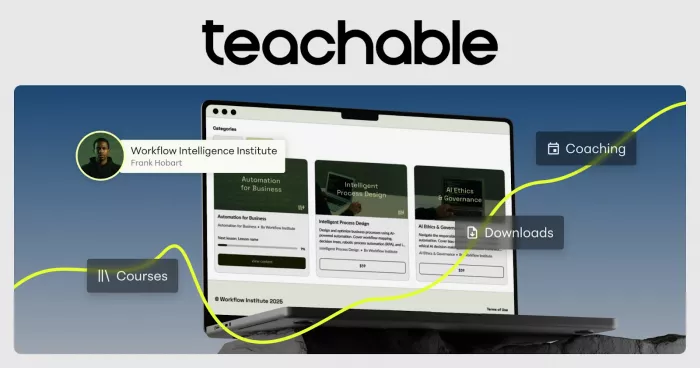
Teachable continues to attract first-time course creators, mostly because it lowers the psychological barrier to entry.
Setup is straightforward. The interface is forgiving. Payments and taxes are handled with minimal configuration. That simplicity is real — and so are its limits.
Strengths that still matter:
● Fast launch with minimal configuration
● Predictable workflows
● Built-in tax handling for global sales
Limitations that surface later:
● Transaction fees on lower tiers
● Limited control over learning experience
● Scaling often requires migration
Teachable is rarely the final destination. It is often the starting point.
4. LearnWorlds

LearnWorlds operates in a different lane than most creator-focused platforms.
It is more common in professional training, compliance education, and corporate learning environments where interaction depth matters more than speed of launch.
What sets it apart:
● Interactive video elements
● SCORM support for structured learning programs
● Detailed learner analytics
Where it demands effort:
● Steeper learning curve
● More setup time per course
● Overkill for simple video education
LearnWorlds is rarely chosen casually. It is selected deliberately when learning outcomes need to be measured.
5. Podia
Podia treats courses as just one type of digital product among many.
This design choice makes it attractive for creators selling a mix of downloads, memberships, and courses without wanting a complex tech stack.
Where Podia works well:
● Simple pricing without transaction fees
● Low operational overhead
● Clear product bundling
Where it falls short:
● Limited learning analytics
● Basic assessment tools
● Minimal automation depth
Podia is efficient, but not expressive. It prioritizes clarity over control.
6. Circle
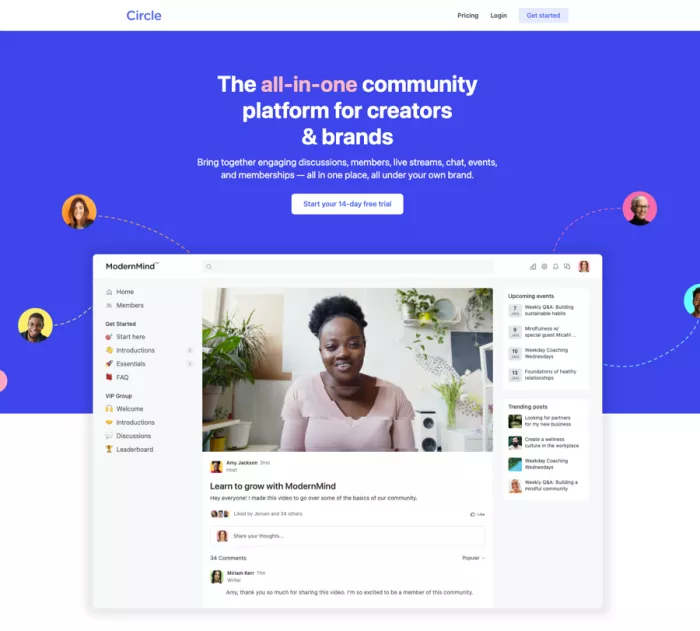
Circle is not a course platform in the traditional sense, but it keeps showing up in education stacks for a reason.
It treats learning as something that happens between people, not inside modules.
What Circle enables:
● Strong engagement and retention
● Events, discussions, and peer learning
● Clear identity and community ownership
What it does not try to be:
● A formal LMS
● An assessment-heavy system
● A certification engine
Circle works best when learning is ongoing and social rather than linear.
7. Mighty Networks
Mighty Networks occupies a similar space to Circle but leans more heavily into social structure and mobile experience.
Strengths:
● Native mobile apps
● Branded community environments
● Strong event and feed mechanics
Constraints:
● Limited testing and assessment tools
● Courses feel secondary to interaction
● Less suitable for formal education models
It is a community engine first, a course platform second.
8. Systeme.io
Systeme.io exists at the budget end of the all-in-one spectrum.
Its value lies in consolidation rather than sophistication.
Where it helps:
● Free and low-cost entry points
● Funnels, email, and courses in one place
● Minimal setup friction
Where limitations appear:
● Shallow learning tools
● Basic analytics
● Not built for complex education workflows
Systeme.io is often chosen to reduce tool sprawl, not to build premium learning experiences.
9. Udemy

Udemy operates under an entirely different logic than self-hosted platforms.
It trades control for reach.
What it provides:
● Immediate access to a large audience
● No upfront platform fees
● Low technical barrier
What it costs:
● Significant revenue share
● Limited pricing control
● Weak brand ownership
Udemy functions more like a distribution channel than a platform.
10. Timtis
Timtis is a niche platform focused on applied AI skills rather than general education.
It appears most often alongside other platforms rather than replacing them.
Observed characteristics:
● Tool-based learning (AI workflows, automation)
● Project-driven instruction
● Mix of recorded and live formats
Limitations:
● Narrow subject scope
● Not designed for broad curricula
● Smaller ecosystem
Timtis fills a specific gap rather than competing broadly.
Cost behavior most people underestimate
One consistent pattern across platforms in 2026 is that initial pricing rarely reflects long-term cost.
What changes over time:
● Feature unlocks raise monthly fees
● Add-ons accumulate quietly
● Transaction fees compound at scale
For many creators, total platform cost increases 30–50 percent within the first year of growth.
Closing thoughts
The mistake most people make is searching for the best online course platform.
By 2026, that question is mostly irrelevant.
The more useful question is:
Which platform’s constraints match how you actually plan to teach, sell, and maintain learning over time?
Some systems assume marketing is central.
Some assume structure matters more than speed.
Some assume learning happens in conversation, not modules.
Choosing correctly is less about features and more about aligning with those assumptions early — before migration becomes inevitable.
Comments