Introduction
Research used to mean late nights, scattered browser tabs, and the slow grind of chasing one good citation across paywalled journals. The picture has shifted in 2026. AI tools can now scan hundreds of millions of papers in seconds, surface citation context, and turn a stack of PDFs into a structured literature review draft. The mechanical parts of research that used to eat entire afternoons can be compressed into minutes.
The harder problem now is choice. The space is crowded, every product calls itself the best, and most overpromise. This guide focuses on eight tools that genuinely move the needle for academic and professional research, ordered alphabetically, with concrete pricing, real database sizes, and an honest look at where each one falls short. No single tool wins outright. The strongest stack in 2026 is two or three tools combined, and this guide makes that combination easier to choose.
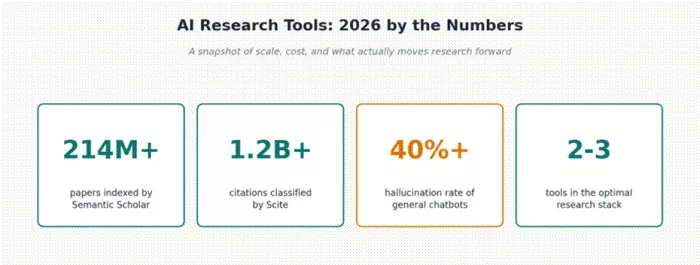
Four numbers that frame the choice. Scale, cost, and the limits of general-purpose chatbots all matter.
At a Glance: The Eight Tools Compared
Three of the eight tools cost nothing. Two more start below ten dollars per month. The most expensive option sits at twenty dollars per month for individual use. Compared to the cost of a missed citation or a rejected manuscript, the economics tilt heavily in favor of a thoughtful stack.
| Tool | Standout Feature | Database Size | Free Tier | Paid Plan |
|---|---|---|---|---|
| Consensus | Consensus Meter (Yes/Mixed/No) | 200M+ via Semantic Scholar | 10 analyses/mo, refreshing | $8.99/mo annual |
| Elicit | Multi-column extraction tables | 125M+ papers | 5,000 one-time credits | $12/mo Plus |
| NotebookLM | Audio Overview + inline cites | 50 uploads per notebook | Full free tier | Plus via Google One |
| Perplexity | Academic mode with live citations | Web + academic indices | 5 Pro searches / 4 hrs | $20/mo Pro |
| Research Rabbit | Similar / Earlier / Later graphs | Semantic Scholar backed | Unlimited | None (fully free) |
| Scite | 1.2B+ classified citations | 1.2B+ statements indexed | Preview only | $20/mo Individual |
| SciSpace | Copilot highlight-to-explain | 270M+ papers | 5 questions/day | $12/mo Premium |
| Semantic Scholar | TLDR + Influential Citations | 214M+ papers | Full, no gating | None (fully free) |
Pricing reflects starting individual tier in 2026. All paid tools on this list also offer a free entry point.
The Eight Tools, Reviewed
Each tool below is rated on a five-star scale, with a one-line tagline, a clear best-for line, a tight context block, the strengths that earn the rating, and an at-a-glance specs table. Order is alphabetical, which is the only fair way to rank tools that serve different stages of research.
Consensus

The evidence meter for empirical questions.
★★★★½
Best for: Researchers who need quick, evidence-backed answers across peer-reviewed literature.
Consensus pulls from over two hundred million papers via the Semantic Scholar corpus and runs GPT-style synthesis on top of it. Its standout feature is the Consensus Meter, which classifies findings across multiple papers as supporting, mixed, or contradicting a specific claim. That makes it especially useful for medical, psychological, and policy questions where the answer depends on weighing the literature rather than citing a single study. The free tier refreshes monthly with ten analyses, which is genuinely useful rather than a teaser. Students get a forty percent discount on annual Premium. Honest limitation: Consensus is built for focused empirical questions, not deep PDF analysis, and power users on heavy review schedules hit rate limits quickly.
Where it shines:
•Consensus Meter classifies findings as supporting, mixed, or contradicting
•Free tier refreshes ten analyses every month rather than capping forever
•GPT-style synthesis grounded in peer-reviewed papers only
•Student discount of forty percent on annual Premium
| Spec | Value |
| Database | 200M+ peer-reviewed papers (Semantic Scholar corpus) |
| Paid plan | $8.99/mo annual, $11.99/mo monthly |
| Student price | $5.39/mo annual (40% discount) |
| Free tier | 10 analyses per month, refreshing monthly |
| Signature feature | Consensus Meter: Yes / Possibly / Mixed / No |
| Best use case | Yes-no empirical questions across multiple studies |
| Skip if | Running formal Cochrane-style systematic reviews |
Elicit

The systematic review workhorse.
★★★★½
Best for: PhD students and researchers running structured literature reviews with extraction tables.
Elicit accepts a research question, screens thousands of papers, and pulls structured data such as sample sizes, methods, and outcomes into editable tables. The semantic search runs across one hundred and twenty-five million papers, and extraction quality is notably better than general chatbots on methodology fields. For systematic reviews where columns of comparable data save days of manual coding, Elicit is the strongest paid option in its lane.
Pricing catches many new users. The starter free tier offers five thousand one-time credits, not refreshing monthly credits. Plus sits at twelve dollars per month, with team tiers reaching several hundred dollars per user. Community cost data suggests the median Elicit buyer pays around twelve hundred dollars per year. The platform earns its cost on heavy review work but rarely justifies a paid plan for lighter use.
Where it shines:
•Structured data extraction into comparable tables
•Semantic search across 125M+ papers
•Automated screening with inclusion and exclusion criteria
•Strong methodology field accuracy compared to general chatbots
| Spec | Value |
| Database | 125M+ papers via Semantic Scholar |
| Paid plans | $12/mo Plus, $49/mo Pro, up to $780/user/mo Enterprise |
| Median annual spend | $1,249/year (community-verified) |
| Free tier | 5,000 one-time credits, non-refreshing |
| Signature feature | Editable extraction tables for methods, sample size, outcomes |
| Best use case | 5+ systematic reviews per year requiring structured data |
| Skip if | Doing fewer than 5 literature reviews annually |
NotebookLM

Source-grounded synthesis with zero hallucination on uploaded content.
★★★★★
Best for: Researchers analyzing a curated set of PDFs without risk of fabricated citations.
NotebookLM, built by Google on Gemini, only references documents that get uploaded into a notebook. That single design choice eliminates the hallucinated-citation problem that plagues most general AI tools. Up to fifty sources per notebook on the free tier, with inline citations linking back to exact source passages. The Audio Overview feature converts uploaded sources into a podcast-style discussion, useful for absorbing material in adjacent fields. Honest limitation: NotebookLM does not search external databases, so discovery happens elsewhere, and the fifty-source cap is tight for dissertation-scale work without the NotebookLM Plus upgrade.
Where it shines:
•Source-grounded answers eliminate fabricated citations
•Up to 50 sources per notebook on free tier
•Audio Overview generates podcast-style summaries
•Inline citations link to exact source passages
| Spec | Value |
| Source limit | 50 per notebook (free), 300 on Plus |
| Source size cap | 500,000 words per source |
| Paid plan | NotebookLM Plus via Google One AI Premium ($19.99/mo) |
| Hallucination rate | Effectively zero on uploaded content |
| Signature feature | Audio Overview podcast + inline citations to exact passages |
| Best use case | Synthesizing 10-50 curated PDFs without invented references |
| Skip if | Discovery is the bottleneck (no external search) |
Perplexity

The cited search engine that straddles web and academia.
★★★★
Best for: Quick orientation, cross-domain queries, and citation-aware web research.
Perplexity combines live web search with academic sources and returns inline citations for every claim. The Academic mode focuses scoring on scholarly literature rather than the open web. The free tier is generous, and Perplexity Pro at twenty dollars per month unlocks deeper models and unlimited Pro searches. For topics that sit at the intersection of academic research and current events, such as recent policy shifts, Perplexity is faster than purely academic tools.
Honest limitation: Perplexity is excellent for orientation, not formal sourcing. Citation rigor trails purpose-built tools like Elicit or Scite, and the free tier occasionally hallucinates references. The right use is scoping a topic and surfacing leads, then validating those leads in academic-specific tools before anything reaches a citation list.
Where it shines:
•Inline source links attached to every answer
•Academic mode prioritizes scholarly literature
•Combines live web data with academic indexing
•Generous free tier with Pro at $20/month
| Spec | Value |
| Database | Open web + academic indices (200M+ papers) |
| Paid plans | $20/mo Pro, $200/mo Max |
| Free tier | 5 Pro searches every 4 hours, unlimited basic |
| Pro searches on $20 plan | Unlimited |
| Signature feature | Academic mode with inline live citations |
| Best use case | Cross-domain scoping spanning academia and current events |
| Skip if | Citations must land in a peer-reviewed manuscript |
Research Rabbit

Spotify for research papers.
★★★★½
Best for: Mapping citation networks and surfacing related work missed by keyword search.
Research Rabbit builds visual graphs around a seed paper, showing related work, citation chains, and adjacent authors. The Spotify nickname fits: the platform learns from saved collections and recommends new papers based on reading patterns. Zotero integration is native, enabling a one-click pipeline from discovery into reference management. Across independent reviewer reports, Research Rabbit consistently surfaces three to five highly relevant papers that keyword search and other tools miss, often older seminal works or adjacent-field papers using different terminology. Honest limitation: it is a discovery tool, not an analysis tool, and the interface can feel busy on first use.
Where it shines:
•Visual citation network maps from a seed paper
•Free with full features and no paid tier
•Native Zotero integration for one-click import
•Learns from saved collections to refine recommendations
| Spec | Value |
| Database | Semantic Scholar backed (200M+ papers) |
| Paid plan | None - fully free |
| Free tier | Unlimited collections, graphs, and recommendations |
| Native integration | Zotero one-click import |
| Signature feature | Similar Work + Earlier Work + Later Work citation graphs |
| Best use case | Network discovery from a seed paper, surfacing missed adjacent work |
| Skip if | The job is summarizing or analyzing papers, not finding them |
Scite
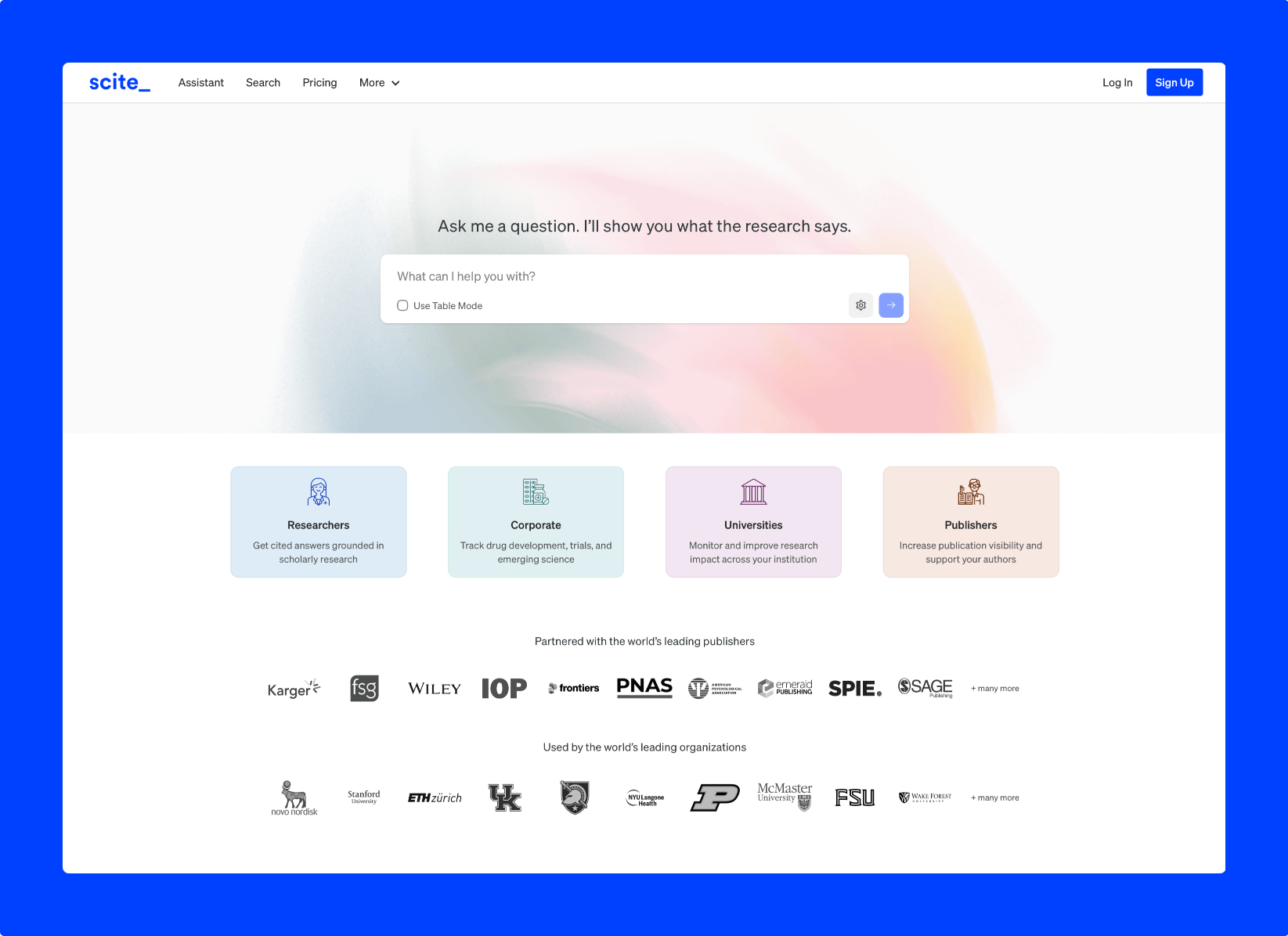
Smart Citations that show support or contradiction.
★★★★½
Best for: Verifying whether cited papers actually support the claims attached to them.
Scite has classified more than one point two billion citation statements as supporting, contrasting, or mentioning the original claim. For systematic reviews and pre-submission citation audits, that classification is the strongest verification feature in this category. Part of Scite's funding comes from the National Science Foundation and the National Institutes of Health, lending credibility to the underlying methodology.
Pricing is twenty dollars per month for Individual access. Honest limitation: there is no transparent team or student pricing without institutional involvement, and the free tier limits Smart Citations too tightly for serious work. The pre-submission citation audit is the single highest-leverage use of the tool for working academics.
Where it shines:
•1.2B+ classified citation statements
•Supporting, contrasting, and mentioning labels with context
•Citation report exports for pre-submission audits
•Browser extension for inline citation checking
| Spec | Value |
| Database | 1.2B+ classified citation statements |
| Paid plan | $20/mo Individual; institutional pricing quoted privately |
| Free tier | Limited Smart Citations preview (exact cap undisclosed) |
| Funding | Partly from NSF and NIH grants |
| Signature feature | Smart Citations: Supporting / Contrasting / Mentioning labels |
| Best use case | Pre-submission citation audit on top 5-10 references |
| Skip if | No manuscript submission planned in the next 6 months |
SciSpace
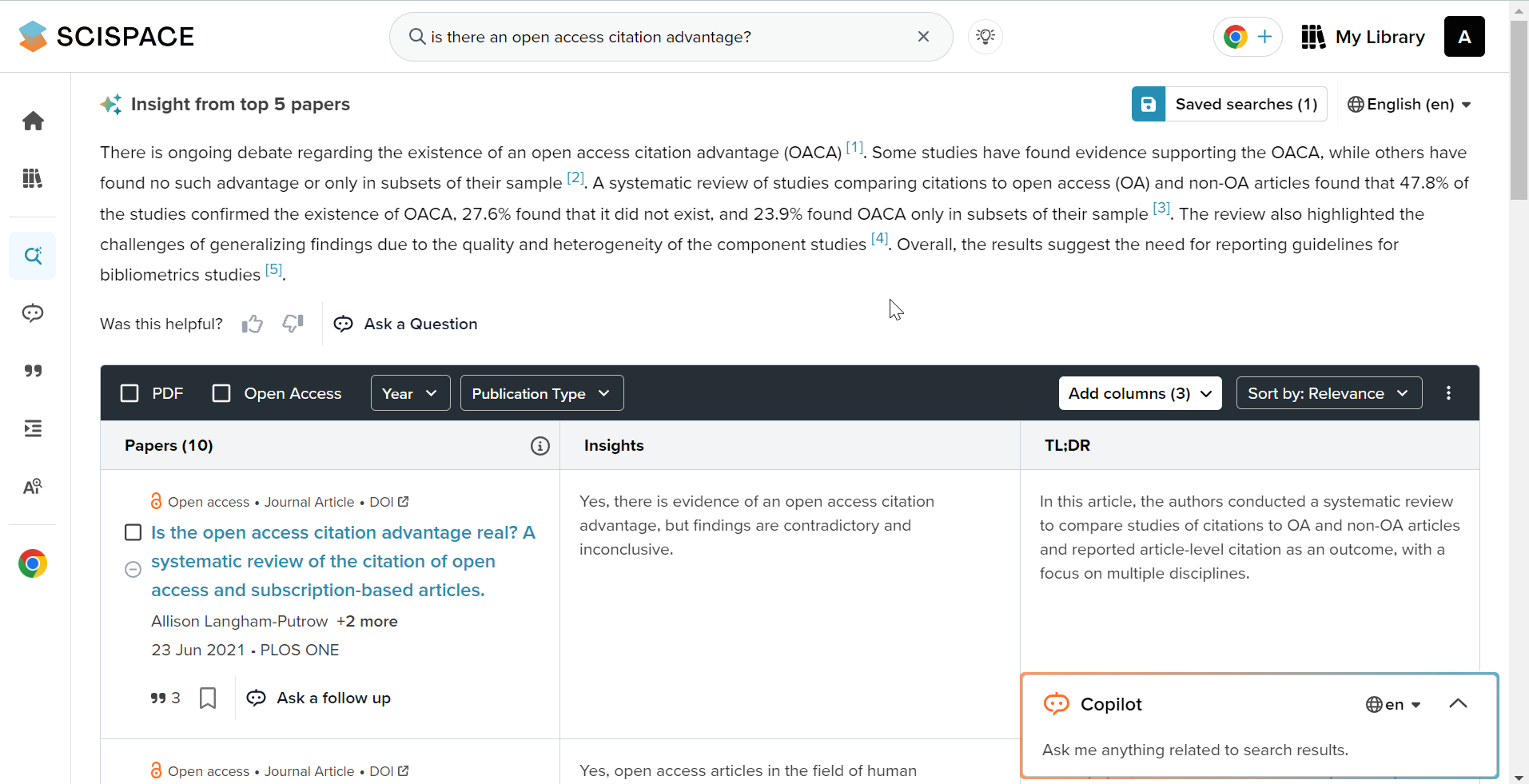
The reading and comprehension layer.
★★★★
Best for: Reading dense papers and parsing unfamiliar methodology or notation.
SciSpace's Copilot sits inside any open paper. Highlight an equation, a table, or a paragraph, and the assistant explains it in plain language with linked references. The Deep Review feature on the Advanced plan processes a set of uploaded papers and generates a structured first-draft synthesis with citations. SciSpace also surfaces journal matching suggestions for manuscripts looking for the right submission target. For interdisciplinary reviews involving papers outside a researcher's home field, the comprehension layer saves real time and reduces misinterpretation. Honest limitation: the free tier caps at five questions per day, which is tight during intensive reviews, and in-domain summaries occasionally oversimplify.
Where it shines:
•Highlight-to-explain Copilot inside any paper
•Deep Review generates first-draft syntheses (Advanced)
•270M+ paper coverage with journal matching
•Chrome extension for inline reading on the open web
| Spec | Value |
| Database | 270M+ papers |
| Paid plans | $12/mo Premium, $20/mo Advanced |
| Free tier | 5 Copilot questions per day |
| Advanced features | Deep Review (multi-paper synthesis), journal matching, Chrome extension |
| Signature feature | Highlight-to-explain Copilot inside any paper or web page |
| Best use case | Reading dense methodology in fields outside primary expertise |
| Skip if | Working only within a researcher's home discipline |
Semantic Scholar
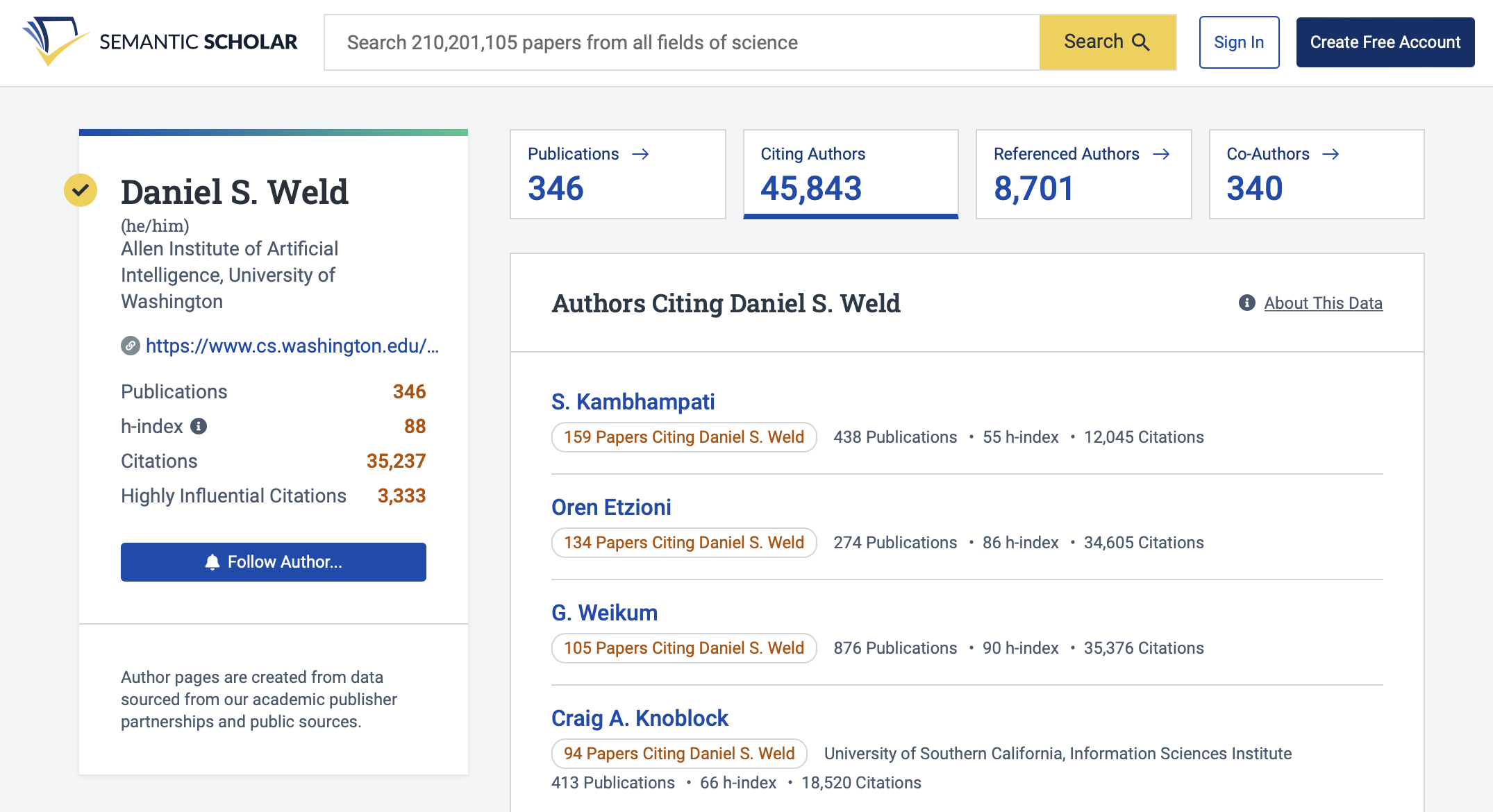
The free engine that powers half the field.
★★★★★
Best for: Broad academic search, citation tracing, and budget-conscious literature work.
Built by the Allen Institute for AI, Semantic Scholar indexes more than two hundred and fourteen million papers with TLDR summaries, Highly Influential Citations classification, the Semantic Reader, and personalized Research Feeds. The platform is completely free, with no feature gating, and powers the back-end search of several paid tools on this list, including Consensus, Research Rabbit, and parts of Elicit. Honest limitation: coverage is strongest in computer science, AI, and biomedicine, while humanities and non-English literature trail Scopus and Web of Science. For citation tracing and as a foundation layer for any research workflow, Semantic Scholar has no equal at its price point, which is zero.
Where it shines:
•214M+ papers indexed with no feature gating
•TLDR auto-summaries on most papers
•Highly Influential Citations classifier surfaces seminal work
•Public API and SPECTER2 embeddings for developers
| Spec | Value |
| Database | 214M+ papers indexed |
| Paid plan | None - fully free, no feature gating |
| API access | Free Academic Graph API + SPECTER2 embeddings |
| Coverage strength | Computer science, AI, biomedicine |
| Signature feature | TLDR summaries + Highly Influential Citations classifier |
| Native exports | BibTeX, RIS (Zotero, Mendeley, EndNote compatible) |
| Skip if | Working primarily in humanities or non-English literature |
Where Each Tool Fits in the Research Workflow
The point of this guide is not to crown one tool. The flow below maps the eight tools onto five stages of academic work, from discovery through final manuscript prep, with brief notes on which tool earns its place at each step.
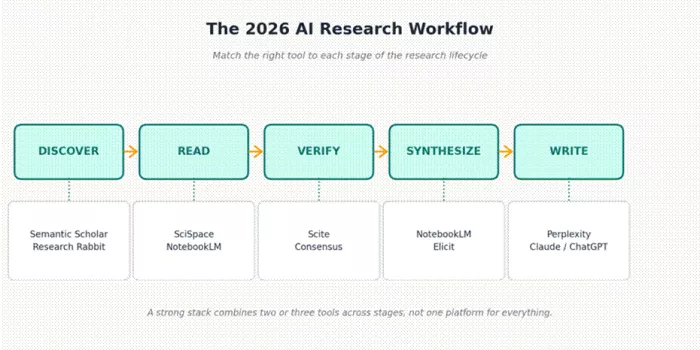
The five-stage workflow most academic researchers follow. The right stack picks one tool per stage rather than overlapping.
Pricing Side by Side
Cost matters, especially for students and independent researchers. The chart below ranks the eight tools by starting monthly price for individual use. Three cost nothing. The two highest-priced options, Perplexity Pro and Scite, sit at twenty dollars per month, modest compared to a single rejected submission's revision cycle.
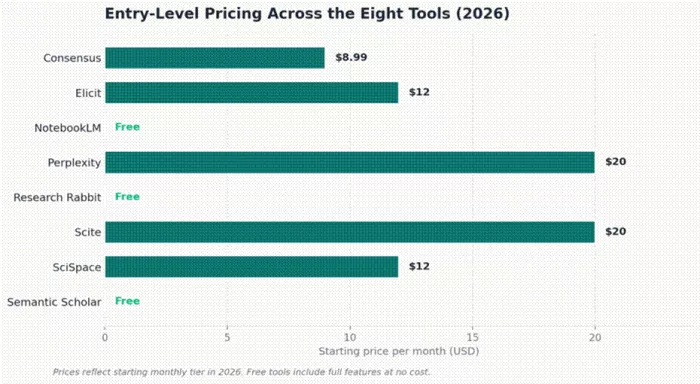
Starting individual tier across the eight tools, in USD per month.
The Master Comparison: Strengths and Weaknesses
The table to bookmark: eight tools scored on strongest and weakest dimension, with a verdict on where each earns a spot in a research stack.
| Tool | Standout Capability | Hard Limit | Concrete Verdict |
|---|---|---|---|
| Consensus | Consensus Meter across 200M+ papers | No deep PDF analysis | Add at $8.99/mo for empirical Q&A |
| Elicit | 5-column extraction tables | 5K credits non-refreshing | Worth $12/mo for 5+ reviews/year |
| NotebookLM | Zero hallucination on 50 PDFs | No external paper search | Free; the synthesis must-have |
| Perplexity | Live academic citations | Hallucinates on free tier | $20/mo for scoping, not final cites |
| Research Rabbit | Similar/Earlier/Later graphs | Discovery only, no analysis | Free; run parallel to Elicit |
| Scite | 1.2B+ classified citations | $20/mo, no student pricing | Buy 1 month pre-submission |
| SciSpace | Highlight-to-explain Copilot | 5 questions/day free cap | $12/mo for interdisciplinary work |
| Semantic Scholar | TLDR + SPECTER2 across 214M papers | Weak in humanities | Foundation of every stack |
Each tool earns its spot based on what it does best, not on raw feature count.
How to Pick the Right Stack
The simplest framing: discovery, reading, verification, synthesis, and writing each call for a different tool. A research stack does not need to cover every box from one vendor. In fact, the best stacks rarely do.
For PhD students and independent researchers on a zero-dollar budget, the most effective free stack pairs Semantic Scholar for discovery, Research Rabbit for network mapping, and NotebookLM for synthesis. Three tools, all free, covering most of a literature review. Add Zotero for reference management and the pipeline is complete.
For working academics with deadlines and budget, the strongest paid stack pairs Elicit for systematic extraction with Scite for citation audits and Consensus for evidence checks. Total cost lands around forty dollars per month and meaningfully compresses timelines on high-stakes projects. The single biggest mistake to avoid is paying for two tools that overlap.
Final Verdict
The honest takeaway from a year of independent testing and reviewer reports: no single tool wins. The strongest research stack in 2026 is two or three tools combined, not one platform doing everything. For a free workflow covering the entire pipeline, Semantic Scholar plus Research Rabbit plus NotebookLM handles discovery, mapping, and synthesis at zero cost. Add Elicit for systematic extraction and Scite for pre-submission citation audits when the project demands them.
The biggest mistake researchers make is paying for a tool that overlaps with one already in the stack. The second biggest is trusting any AI-generated citation without verification. Hallucination rates on general chatbots still exceed forty percent on academic references. Every claim that lands in a published paper deserves a manual cross-check against the original source.
AI tools should compress the mechanical parts of research, the literature scoping, the citation tracking, the first-draft synthesis. Reading, judgment, methodology, and original contribution remain the work of the researcher. Kept honestly, that balance turns these tools from gimmicks into genuine timesavers.
Comments