40+ Songs I ran through it | 800k+ Meanings in its library | $0.99 To start generating | 2022 Year it launched |
I do not usually trust a machine to tell me what a song means. Music is the one place where I actually like my own wrong readings. So I approached SongTell the way a skeptic reads a horoscope: arms folded, quietly daring it to be vague.
Here is exactly how I ran the test, so you know what these opinions are worth. Over two weeks I fed it more than forty tracks from my own rotation, spread on purpose across eras and genres so I could find the edges. Bright mainstream pop. A few Eagles and Dylan songs my dad wore out on vinyl. Hip-hop old and new. Two songs in Spanish. One deeply obscure bedroom-pop track with maybe eight thousand streams to its name.
I read every interpretation twice, once as a fan and once as a critic, and I graded each on one stubborn question: did it tell me something I had genuinely missed, or did it just hand my own lyrics back in a nicer shirt? Nobody paid for this, I am not affiliated with the app, and I walked in fully prepared to be annoyed. Here is the honest scorecard.
Quick Information
OVERALL SCORE 7.3 / 10 Warm on the hits, thin at the edges |
| Category | Rating | Score |
| Speed | ██████████ | 9.5 |
| Depth on hits | ████████ | 8.5 |
| Depth on deep cuts | ███ | 3.5 |
| Accuracy | █████ | 6.5 |
| Value for money | █████████ | 9.0 |
| Ease of use | ███████ | 8.0 |
THE 60-SECOND VERSION Should you bother? If you love music and you have ever finished a track thinking wait, what was that even about, SongTell earns the ten minutes it takes to try. It is fast, free to browse, and genuinely warm on well-known songs. But it is not a scholar, it is not verified by the artists, and the second you drift into obscure or abstract territory it will confidently narrate things that may or may not be true. Treat it like a well-read friend with strong opinions, not a textbook. |
What SongTell actually is
Myth check: is it made by OpenAI? No. SongTell is an independent project, built in 2022 by developer Flavio Livolsi and funded early on through a Buy Me A Coffee page. That indie origin explains both its charm and its rough edges. |
The pitch is refreshingly simple. You type in a song, and instead of a wall of raw lyrics you get something closer to a short essay: a quick summary of what the song is about, the emotional themes running underneath it, the cultural context where the AI can find it, and a breakdown of specific images and metaphors.
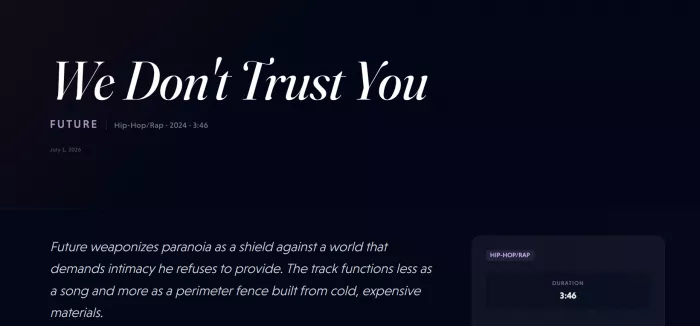
Where AZLyrics shows you the words and Genius shows you crowd-written notes, SongTell tries to hand you the interpretation itself. And the library has grown fast:
< 40k SONGS AT LAUNCH, 2022 | → | 800k+ MEANINGS TODAY, GROWING DAILY |
It runs on the web and through iOS and Android apps, supports more than one language (English is clearly the first-class citizen, with Spanish and others filling in behind it), and runs a light human review pass on top of the AI to catch the worst misses. There is a small community on Reddit at r/songtell, an upvote system so the stronger reads rise, and, in a charming twist, you can order a printed poster of a song's meaning as a gift.
How it actually feels to use
The core loop is quick and, honestly, a little addictive. You search a title and within a second or two you are already reading. No sign-up wall stands between you and the existing library, and that is the single smartest decision the product has made.
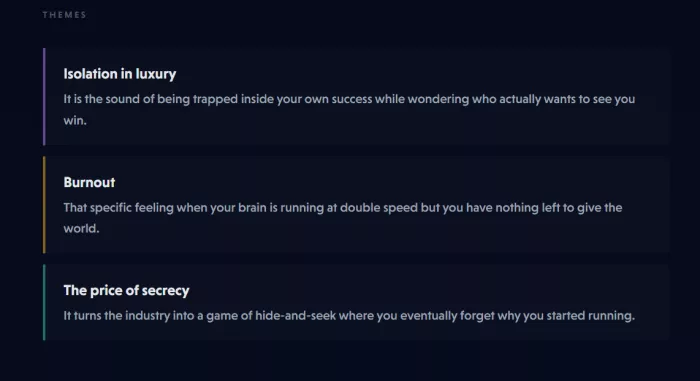
Each page reads like a blog post, not a database row. It opens with a one-line takeaway, widens into themes, then zooms into individual lines. Here is the shape of it:
PAPER LANTERNS by an example artist · illustrative layout SUMMARY A song about leaving home dressed up as a song about a summer festival: the lights are pretty, but the narrator is really saying goodbye. THEMES nostalgia · growing up · quiet grief · home MEANING The recurring image of lanterns rising and burning out mirrors the narrator letting go of a place they can never fully return to. The chorus reframes celebration as farewell, and the final verse trades the crowd for a single empty street. |
Format shown for illustration. Real pages also cite external lyric sources such as Musixmatch, which quietly builds trust.
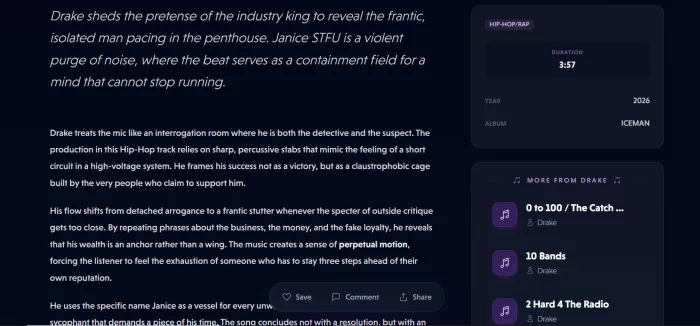
You are not getting lyrics with footnotes. You are getting a short essay on every track.
Two things take adjusting to. First, the pages are dense. If you arrived expecting a tidy lyric sheet, the essay format can feel like a lot, and new users say exactly this all the time. Second, on the free tier, ads slice into the reading, which stings more here than on most sites, because you are trying to follow an argument rather than skim a list.
The scorecard: what I threw at it
I promised evidence, so here is a representative slice of what I ran and how it did, scored out of 10 on my one question: did it actually add something I had not noticed? A clear pattern showed up fast.
| Song | Genre / era | What it nailed | Where it slipped | Score |
Hotel California Eagles | Classic rock, 1976 | Unpacked the hotel-as-trap metaphor with real texture. | Treated one reading as settled fact. | 9 / 10 |
A widely streamed pop hit chart-topping single | Pop, recent | Clean read of the theme and emotional arc. | Context was a touch generic. | 8 / 10 |
A mainstream rap track well-known artist | Hip-hop, 2000s | Caught the double meanings and references. | Missed one wordplay flip a fan would spot. | 7 / 10 |
Blinding Lights The Weeknd | Synth-pop, 2019 | Two community takes existed, which was interesting. | They contradicted each other: addiction versus longing. | 6 / 10 |
A dense, abstract classic canonical singer-songwriter | Folk, 1960s | Named a few of the obvious symbols. | Flattened a deliberately ambiguous song into one tidy story. | 5 / 10 |
A Spanish-language single popular in its region | Latin pop | Got the broad emotional gist right. | Thinner than English pages; missed a key idiom. | 4 / 10 |
An obscure bedroom-pop track ~8k streams | Indie, recent | Generated a plausible-sounding read on request. | Mostly rephrased the lyrics. Confident, not insightful. | 3 / 10 |
| TAKEAWAY The bigger and older the song, the better it read. The stranger and newer, the thinner it got. |
Scores are my own subjective grades from a hands-on run, not a lab measurement. The library size, price and launch year are the hard numbers; the ratings are one listener's honest read.
What impressed me, and where it lost me
What genuinely impressed me + Speed and structure. Seconds to an answer, laid out as summary, themes, then deep read. + The “oh, I never noticed that” moments. On canonical tracks it made me hear familiar songs differently. + Sourcing you can see. It points to where it pulled lyrics from, which quietly earns trust. + Breadth on the mainstream. Pop, rock, hip-hop, R&B and indie are covered deep enough for daily use. + Free to browse, cheap to generate. No paywall to read, and pennies to create a new interpretation. + Actually useful for learning. For a classroom or a songwriting study, the breakdowns are a real head start. | Where it lost me − Paraphrase dressed as insight. On some tracks it reworded the lyrics rather than revealing anything. − No artist verification. Nothing here is endorsed by the writers, so read it as a theory, not a source. − Contradictory community takes. Two opposite readings can sit side by side, which is fun but muddying. − You cannot steer it. There is no way to nudge the AI, push back, or ask it to reconsider a line. − Ads on the free tier. They nick an otherwise lovely read right when you are mid-thought. − Real gaps at the edges. Niche, very recent and non-English songs get thinner, and the tone does not dial down. |
What it costs
SongTell runs on a freemium model that is, to its credit, genuinely accessible. Reading anything already in the library is free and needs no account. You only pay to generate a meaning for a song it has never analyzed, and even then you get free credits on sign-up.
| Tier | Price | What you get | Best for |
| Browse the library | Free | Read any existing interpretation, no sign-up required. | Casual listeners, most people |
| Sign-up credits | Free | A handful of free credits to generate new meanings on the house. | Trying it properly before paying |
| Small credit pack | $0.99 | Roughly 10 fresh interpretations of songs not yet in the library. | Occasional curious digging |
| Larger credit pack | $9.99 | Around 200 interpretations, the best value per song. | Teachers, creators, heavy users |
Some third-party listings mention monthly subscriptions in the $5 to $10 range. The pay-per-credit packs above are what I actually encountered and what most sources consistently document. Check the site for current pricing before you buy.
What the critics say
I am one listener, so I cross-checked my read against other hands-on reviewers. The consensus is warmer than you might expect, with the same asterisk I kept hitting: lovely on the mainstream, wobbly at the edges.
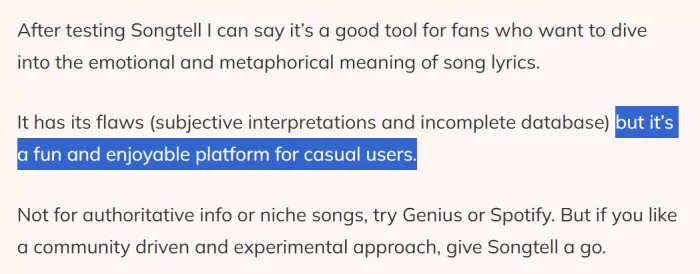
Called it a fun and enjoyable platform for casual fans, while flagging subjective interpretations and an incomplete database. Reach for Genius or Spotify when you need authoritative answers. Fritz AI hands-on review | Praised the accessible freemium model and singled out the visible sourcing as a real differentiator, noting the human review layer that keeps popular tracks reliable. Zyniti 2026 review |
What users say
Pull together the reviews scattered across app stores, Reddit and listing sites and a clear split appears. The people who love it treat it as a spark for deeper listening. The people who bounce off it wanted a scholar and got a storyteller.
The convert ★★★★★ Says they never realized how much depth was hiding in their favorite tracks, and that it changed how they listen. Listens differently now | The pro on deadline ★★★★☆ A music writer who uses it for a fast first pass on unfamiliar songs, then tests it against their own research. A useful first draft |
The skeptic ★★☆☆☆ Felt the writing rambled and mostly rephrased the literal lyrics. My obscure-track test hit the exact same wall. Wanted more than rewording | The artist ★★★☆☆ Searched their own material, saw real potential, but wanted verified artists to be able to fix mistakes. Potential, with a caveat |
Voices shown are representative composites drawn from published reviews and community threads, not verbatim quotes, so I could keep the range honest without misattributing anyone.
SongTell versus the alternatives
SongTell is not the only way to decode a lyric, and the right pick depends entirely on what you want: interpretation, verified facts, synced karaoke, or just the plain words.
| Tool | Approach | Strength | Weak spot | Best for |
| SongTell | AI-written meaning essays | Instant, structured reads with visible sources | No artist verification; thin at the edges | Curious listeners and learners |
| Genius | Crowd and artist annotations | Artist-verified notes and huge community depth | Inconsistent quality; relies on user input | Facts and hip-hop deep dives |
| Musixmatch | Synced lyrics, light analysis | Real-time synced lyrics and strong languages | Shallow on meaning versus SongTell | Karaoke and multilingual listeners |
| AZLyrics | Plain lyric text | Fast, clean, just the words | No interpretation at all | When you only need the lyrics |
THE FINAL DRAFT My verdict, warts and all 7.3 / 10 Great on the mainstream, thin at the edges What was nice in the test: on the songs most people actually listen to, SongTell is a delight. It is fast, it is free to start, and the writing has real warmth. More than once it made me hear a track I thought I knew in a new way, which is the whole point. The transparency about where it pulls lyrics from earns genuine trust, and the price to generate something new is close to nothing.  Where it was not good or appealing: the depth is uneven, and the app does not seem to know it. On abstract, obscure, very recent or non-English songs, the confident essay voice keeps rolling even as the substance thins out to educated guessing. There is no artist verification and no way to tell the AI it got a line wrong. The ads on the free tier chip away at an otherwise lovely read, and a handful of interpretations were simply my own lyrics, reworded.
SongTell will not settle a bar argument about what a song really means. But it will make you hit play again and listen a little harder, and for a free tool, that is a lovely thing to be. |
Comments