Quick riddle: what do a panicked recruiter at 11 p.m., a backend engineer Googling “what is LangChain” on her phone, and a CFO trying to spell “agentic” all have in common?
All three are reading the same shortlist of fastest-growing AI skills, and none of them want to admit it.
Funny how an entire industry can pretend it knew what RAG meant six months before it actually did. The hiring market in 2026 has stopped asking whether AI matters and started asking who can build with it, deploy it, fix it when it hallucinates, and keep regulators from showing up at the office with friendly questions.
The phrase “AI skills” got blurry fast. Pretending to use ChatGPT in a job interview is not a skill. Knowing which model to pick for which task, why a retrieval pipeline beats a bigger context window for enterprise data, and what a prompt eval suite is, those are skills. The fastest-growing ones, according to LinkedIn’s Skills on the Rise 2026 report, Upwork’s 2026 In-Demand Skills, and Gartner’s enterprise tracking, cluster around a tight list of seven.
The Seven Skills That Made the Cut
AI Engineering (LLM Application Development)
The rebrand of the year. AI Engineering does not mean training models from scratch. That is ML Engineering, a related but older trade. An AI Engineer takes existing models (Claude, GPT, Gemini, Llama) and builds production systems around them: APIs, retrieval pipelines, vector indexes, evaluation harnesses, deployment infrastructure.
LinkedIn ranks AI Engineer as the single fastest-growing role in the United States for 2026. The typical stack is LangChain or LlamaIndex, a vector database such as Pinecone or Weaviate, Python, FastAPI, and one cloud platform. Retrieval-Augmented Generation is the dominant pattern, since most enterprise problems involve grounding an LLM in private data.
Pay band: US mid-level total compensation lands between $170,000 and $260,000; senior between $220,000 and $350,000 or higher. In India, the range is 15 to 40 LPA at mid-level and 45 to 70 LPA at senior product companies.
Best for: Software engineers and full-stack developers who already ship code.
Agentic AI and Multi-Agent Orchestration
The breakout category. Job postings mentioning agentic AI skills jumped 986 percent between 2023 and 2024, and Gartner reported a 1,445 percent surge in enterprise inquiries about multi-agent systems between Q1 2024 and Q2 2025.
Agentic AI means systems that plan, reason, and execute multi-step actions instead of merely answering a prompt. Multi-agent orchestration goes a step further: specialized agents (a researcher, a coder, a reviewer) coordinate through an orchestrator. The core stack is LangGraph, CrewAI, AutoGen, and Anthropic’s Model Context Protocol for tool integration.
The skill bar is genuinely higher here. Building a single-prompt chatbot is undergrad work. Designing memory architectures, planning loops, safety guardrails, and rollback paths is graduate-level engineering with no settled textbooks.
Pay band: Agentic AI Developers command a 15 to 20 percent premium over standard ML engineers. AI Agent Architect roles in the US clear $250,000 base at senior levels, with total comp regularly above $400,000 at frontier labs.
Best for: Engineers who enjoy distributed systems and like the idea of debugging code that occasionally lies to them.
LLM Fine-Tuning and Model Optimization
The highest-paid AI skill on the chart, by a clear margin. Fine-tuning means adapting a base model to a specific domain (legal text, medical triage, internal codebases) using parameter-efficient methods such as LoRA, QLoRA, and full PEFT pipelines. Sub-skills include dataset curation, evaluation against domain benchmarks, hallucination mitigation, and quantization for cheaper inference.
The reason pay is high: only about 1 percent of US companies have scaled AI beyond pilot phase, and fine-tuning is one of the load-bearing bottlenecks. Custom LLM specialization carries a 47 percent salary premium over generalist AI roles.
Pay band: US: $195,000 to $350,000 at mid-level. Senior specialists in finance and healthcare clear $400,000 plus equity. India: 25 to 65 LPA at senior product companies.
Best for: ML engineers and applied researchers who read arXiv papers before the press release goes out.
MLOps and Production AI Deployment
The unsung skill that decides whether AI projects ship or rot in Jupyter notebooks. MLOps engineers handle CI/CD for models, drift monitoring, A/B testing, retraining pipelines, and infrastructure cost control. Kubernetes appears in 17.6 percent of MLOps job postings; Docker in 15.4 percent. Add MLflow, Apache Airflow, and at least one cloud AI platform (AWS SageMaker, Vertex AI, or Azure ML).
MLOps has become the load-bearing wall between prototype and production for every enterprise AI initiative, which is why a deployed AI system without an MLOps owner usually starts decaying within a quarter.
Pay band: Mid-level $145,000 to $200,000 in the US; senior $210,000 to $280,000 plus. In India, MLOps roles range from $180,000 to $300,000 for global remote contracts and up to 50 LPA locally.
Best for: Backend engineers and SREs tired of writing the same Terraform but curious about model graveyards.
Chart One: Where the Demand Signal Is Loudest
Three datasets, one direction. Two skills sit so far above the rest on a year-over-year hiring scale that they distort the axis, which is in itself the headline finding.
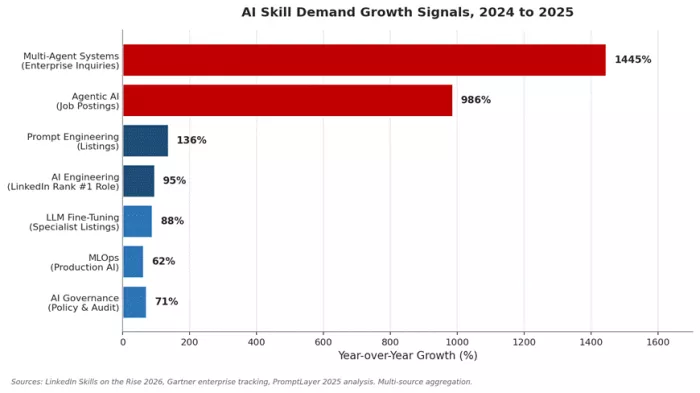
Multi-agent and agentic AI growth dwarfs every adjacent category. Prompt engineering, despite the obituaries, continues to grow.
Prompt Engineering (Now Reborn as Applied AI)
The rumors of its death were exaggerated. Standalone Prompt Engineer titles are vanishing, but prompt engineering as a sub-skill grew 135.8 percent in posting frequency over the past year, per PromptLayer’s 2025 analysis. The skill survived by merging into broader roles: Applied AI Engineer, GenAI Developer, AI Product Engineer.
What modern prompt engineering looks like in 2026: building structured prompt libraries with version control, designing tool-use schemas for function calling, writing rigorous evaluation suites, and choosing between models for cost-quality tradeoffs. The work is closer to compiler design than to creative writing.
Pay band: As a bundle skill, prompt engineering adds a 35 to 43 percent uplift in non-technical fields. As a primary skill paired with Python and RAG, it lifts compensation into Applied AI Engineer ranges, roughly $150,000 to $230,000 mid-level in the US.
Best for: Product-minded engineers, technical writers who code, and developer advocates.
AI Evaluation Engineering
The skill that separates senior AI engineers from juniors with confidence. Evaluation engineering means designing reliable, automated tests for non-deterministic systems. The standard tooling is LangSmith, Promptfoo, OpenAI Evals, custom LLM-as-judge pipelines, and rubric-based scoring.
Most AI failures in production trace back to weak evals. Companies that took eval design seriously in 2024 are the ones shipping reliable copilots in 2026; the rest are still in pilot. Because model behavior shifts with every release, the eval layer is the only stable contract between an LLM and a business process, and hiring managers consistently flag it as the single biggest differentiator in technical interview loops.
Pay band: Folded into AI Engineer and ML Engineer bands, with a documented 10 to 15 percent premium for candidates carrying a portfolio of eval work.
Best for: QA engineers, data scientists with strong statistical instincts, and anyone who has watched a working demo break live on a customer call.
AI Governance and Responsible AI
The fastest-growing non-technical AI skill. The EU AI Act, India’s DPDP Act, the draft Indian AI Bill, and SOC-2 frameworks for AI systems have created a parallel hiring track. AI Governance Leads audit prompts, design red-team protocols, write model cards, monitor bias, and own incident response when an AI system misbehaves.
LinkedIn’s 2026 list places AI business strategy, including data governance and responsible AI, as a top-three category alongside AI engineering itself. The role welcomes non-CS backgrounds in law, public policy, and philosophy, provided the candidate is technical enough to read a system card and argue with an engineer about it.
Pay band: US: $130,000 to $250,000 for security and governance specialists. India: 20 to 45 LPA for governance leads at consulting firms.
Best for: Lawyers, compliance professionals, policy researchers, and engineers who have started reading audit logs more carefully.
Master Comparison Table
Side-by-side, the seven sort cleanly by fit and ramp time. Time-to-employability assumes working Python fluency; without that, add three to six months to each row.
| Skill | Demand Growth | Core Stack | Best Fit | US Mid Pay | Ramp |
|---|---|---|---|---|---|
| AI Engineering (LLM Apps) | LinkedIn #1 role | LangChain, RAG, Pinecone, FastAPI | Software engineers shipping production code | $170K to $260K | 4 to 6 months |
| Agentic AI | 986% YoY postings | LangGraph, CrewAI, AutoGen, MCP | Engineers comfortable with distributed systems | $200K to $290K | 6 to 9 months |
| LLM Fine-Tuning | 47% pay premium | PyTorch, LoRA, PEFT, Hugging Face | ML engineers and applied researchers | $195K to $350K | 9 to 12 months |
| MLOps | $39B market by 2034 | Docker, K8s, MLflow, Airflow | Backend engineers and SREs | $145K to $200K | 6 to 9 months |
| Prompt Engineering (Applied AI) | 136% YoY listings | Claude API, function calling, eval suites | Product-minded engineers and tech writers | $150K to $230K | 2 to 4 months |
| AI Evaluation Engineering | 10 to 15% pay premium | LangSmith, Promptfoo, LLM-as-judge | QA engineers and statistically minded data scientists | $180K to $240K | 3 to 5 months |
| AI Governance | Top-3 LinkedIn 2026 category | EU AI Act, DPDP, model cards, red-teaming | Lawyers, compliance, policy researchers | $130K to $250K | 3 to 6 months |
Demand growth metrics come from different source measures and are not strictly comparable. The table is a directional guide, not a ranking.
Chart Two: What Each Skill Actually Pays
Growth is one signal. Cash is another. Note the gap between MLOps and Fine-Tuning: roughly $100,000 at the midpoint, despite both being equally indispensable to a production AI system.
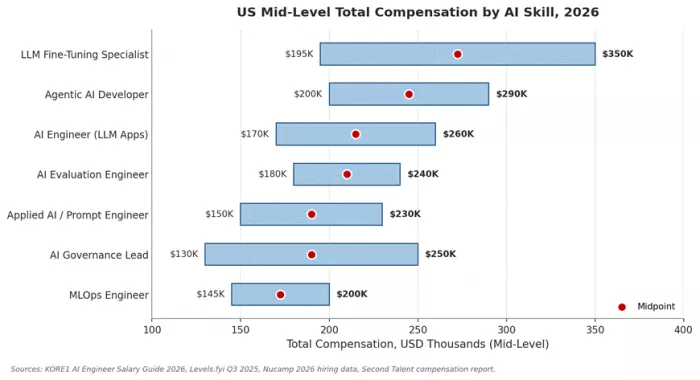
Salary ranges reflect mid-level total comp. Senior bands are typically 30 to 60 percent higher than the upper bound shown.
The Skill Stacks That Actually Land Jobs
Pairing matters more than any single skill on this list. The combinations that show up most often in 2026 hiring data are predictable once the table above is read carefully:
•For developers: AI Engineering plus RAG plus Agentic AI Development. The Applied AI Engineer profile, currently the densest cluster in job postings.
•For ML engineers: Fine-Tuning plus MLOps plus Evaluation Engineering. The highest-pay corridor on the chart, with total comp routinely above $300,000 at senior levels.
•For product managers and analysts: Prompt Engineering plus Evaluation plus AI Governance. The AI Product Lead profile, in heavy demand at companies past the pilot stage.
•For lawyers and policy professionals: AI Governance plus technical literacy on at least one stack. The AI Compliance Officer role, currently understaffed at most large enterprises.
A single skill on this list is rarely enough on its own. Two complementary skills usually clear interview loops. Three plus a deployed portfolio project typically wins offers.
The Short, Honest Close
Notice how the seven skills above interlock. RAG belongs to AI Engineering. Fine-Tuning lives next to MLOps. Evaluation Engineering glues everything together. Governance sits on top of all of it. Agentic AI is the layer being built across every other category. None of these skills is a silo; each one is half of a larger system.
The careers that age well from this point forward will not belong to whoever learned the most tools. They will belong to whoever learned which two or three of these skills compose into the kind of system a business actually pays to keep running. That is the entire game, and the data on this page is the map.
That shift is also reshaping how people learn AI itself. Instead of chasing disconnected tutorials, more learners are moving toward structured platforms that teach workflow-level thinking across automation, prompting, development, and AI operations, which is partly why learning hubs like Timtis are starting to gain attention in the broader AI upskilling space.
The remaining variable is who opens a terminal tonight.
Comments