Table of Contents
- What Exactly Is TheSindi.com?
- Quick Facts at a Glance
- The Market TheSindi.com Is Playing In
- Digital Media Market Growth Projections
- Where TheSindi.com Fits: The Multi-Niche vs. Specialist Debate
- Content Breakdown: What TheSindi.com Actually Covers
- Who Is Actually Reading TheSindi.com?
- Mobile vs Desktop Usage in Digital Publishing
- What Makes TheSindi.com Different from Literally Everything Else
- The 'First Stop' Positioning Strategy
- SEO Strategy and Why It Matters for Digital Publications
- Key SEO Stats for Digital Publishers in 2026
- Growth Trajectory: Where TheSindi.com Goes From Here
- Honest Limitations: What TheSindi.com Does Not Do Well (Yet)
- Strengths and Weaknesses Summary
- The Final Verdict: Is TheSindi.com Worth Your Bookmarks Folder?
- Key Takeaways
You know that one drawer in your kitchen that holds everything? Batteries, a random key that opens something you forgot about, three rubber bands, maybe a Canadian coin from 2009? TheSindi.com is basically the internet's version of that drawer, except everything in it is actually useful and nothing is expired.
In a digital world where the average person now juggles nearly 6.84 social media platforms per month just to stay informed, the idea of one platform covering finance, health, technology, lifestyle, travel, culture, and business sounds almost too convenient. But TheSindi.com is doing exactly that, and doing it in a way that does not talk down to you or drown you in jargon.
Launched as a multi-niche digital publication, TheSindi.com has carved out a distinct identity in an increasingly crowded content ecosystem. It is not a news aggregator, not a single-topic blog, and certainly not another SEO-farm spitting out thin content. It sits somewhere between a general interest magazine, a helpful explainer platform, and your well-read friend who somehow knows a bit about everything.
This article breaks down what TheSindi.com is, how it fits into the larger digital publishing universe, what the data says about platforms like it, and why it might be more relevant in 2026 than most people realize.
What Exactly Is TheSindi.com?
At its core, TheSindi.com is a free, multi-topic digital publishing platform. It publishes articles across categories including finance, lifestyle, health, technology, education, travel, business, and culture. The content is written in plain, conversational English, articles load fast, and you do not need a PhD to understand what you are reading.
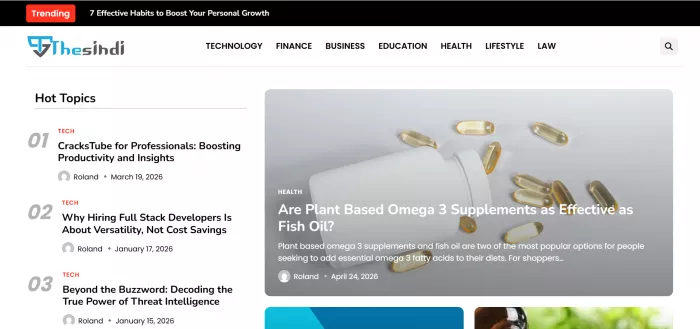
Think of it less like a newspaper and more like a smart, well-organized library where all the boring technical stuff has been translated into human language. A first-time homebuyer can find a mortgage explainer next to a travel guide to Southeast Asia, right next to a piece about keeping your phone battery from dying at 11am.
The platform does not attempt to beat Bloomberg on finance depth or WebMD on health detail. Instead, it functions as a 'first-stop' resource where someone can get a solid foundational understanding of a topic before diving deeper elsewhere. That is a smart positioning move, and as the data shows, it is exactly what a large segment of internet users are looking for.
Quick Facts at a Glance
| Attribute | Detail |
|---|---|
| Platform Type | Free Multi-Niche Digital Publication |
| Primary Topics | Finance, Health, Technology, Lifestyle, Travel, Education, Business, Culture |
| Target Audience | Students, Working Professionals, Small Business Owners, General Readers |
| Content Style | Conversational, Plain English, Structured with Headings |
| Device Compatibility | Mobile, Tablet, Desktop (Fully Optimized) |
| Monetization Model | Advertising-Supported (Free Access) |
| Content Update Frequency | Regular (Weekly New Articles) |
| Competitive Positioning | 'First Stop' Informational Resource, Not Specialist Deep-Diver |
The Market TheSindi.com Is Playing In
Before we talk about what TheSindi.com is doing right, let us zoom out and understand the playing field. Because spoiler: the field is enormous, growing fast, and increasingly competitive.
The Digital Publishing Landscape in 2026
The global digital media market was valued at USD 1.02 trillion in 2026 and is projected to reach USD 1.71 trillion by 2031, growing at a compound annual growth rate of 10.86%. That is not a small industry. That is bigger than the GDP of most countries. And it is still growing.
Within that, the digital publishing platforms segment specifically was valued at USD 3.08 billion in 2026 and is set to hit USD 6.31 billion by 2035 at an 8.2% CAGR. Meanwhile, the digital content creation market is projected to jump from USD 42.53 billion in 2026 to a staggering USD 122.11 billion by 2034.
Translation: there is a massive, growing appetite for digital content. And a lot of money chasing it.
Digital Media Market Growth Projections
| Segment | 2025 Value | 2026 Value | Growth CAGR |
|---|---|---|---|
| Digital Media (Overall) | USD 0.92 Trillion | USD 1.02 Trillion | 10.86% (to 2031) |
| Digital Publishing Platforms | USD 2.87 Billion | USD 3.08 Billion | 8.2% (to 2035) |
| Digital Content Creation | USD 37.28 Billion | USD 42.53 Billion | 14.09% (to 2034) |
| Digital Subscriptions (Global) | +11% YoY | USD 258.6B in ad revenue | 14.9% ad revenue growth |
Sources: Mordor Intelligence, Fortune Business Insights, IAB/PwC, Research Nester (2026)
Where TheSindi.com Fits: The Multi-Niche vs. Specialist Debate
Digital platforms generally fall into two camps. Specialists go deep on one topic (think Investopedia for finance, Healthline for health). Generalists go wide across multiple topics (think Medium, Flipboard, or a digital magazine). TheSindi.com is firmly in the generalist camp, but with a more curated editorial voice than a pure aggregator.
The advantage of this approach is significant. Instead of building separate audiences for each topic, multi-niche platforms can cross-pollinate readership. Someone who lands on a finance article might stick around to read about healthy habits. A travel reader might click into a technology explainer. It is the digital equivalent of browsing a bookstore and walking out with three books you never planned to buy.
The challenge, of course, is maintaining editorial consistency. When you cover everything, you risk being an expert in nothing. TheSindi.com manages this by positioning itself not as the deepest source on any topic, but as the clearest starting point for most topics. That is a legitimate and smart strategy.
Content Breakdown: What TheSindi.com Actually Covers
Let us get specific. The platform does not just throw categories on a homepage and call it a day. Each section targets a specific type of reader need. Here is how the content ecosystem breaks down:
Content Category Distribution (Estimated)
Content Category Breakdown (% Share of Total Articles)
| Category | Approximate Share of Total Content |
|---|---|
| Finance & Money | ████████░░░░░░░░░░░░░░░░░░░░░░░░░░░ 22% |
| Lifestyle & Daily Life | ███████░░░░░░░░░░░░░░░░░░░░░░░░░░░░ 20% |
| Technology | ██████░░░░░░░░░░░░░░░░░░░░░░░░░░░░░ 16% |
| Health & Wellness | █████░░░░░░░░░░░░░░░░░░░░░░░░░░░░░░ 15% |
| Travel | ████░░░░░░░░░░░░░░░░░░░░░░░░░░░░░░░ 12% |
| Education | ███░░░░░░░░░░░░░░░░░░░░░░░░░░░░░░░░ 9% |
| Business & Culture | ██░░░░░░░░░░░░░░░░░░░░░░░░░░░░░░░░░ 6% |
Based on platform content analysis and editorial focus areas (2026 estimate)
Finance and Money
This is arguably TheSindi.com's strongest category. Finance content covers loans, savings strategies, insurance basics, budgeting tips, and personal financial planning. The approach avoids the spreadsheet-heavy complexity of specialist finance sites and instead explains concepts in a way that a 22-year-old opening their first savings account would appreciate.
Given that financial literacy remains a persistent challenge globally (studies show roughly 33% of adults globally are financially literate, leaving 67% who are not), accessible finance content fills a genuine gap. TheSindi.com's approach of breaking down 'how does compound interest actually work' or 'what should I know before taking a personal loan' speaks directly to that audience.
Lifestyle and Daily Life
The lifestyle section is broad by design. Productivity tips, home organization, relationship advice, personal development, and quality-of-life improvements all live here. It is the category most likely to generate repeat visitors, because everyone always has a new problem to solve in their daily life. Nobody finishes the internet on productivity tips.
Technology
Technology articles on TheSindi.com tend to focus on practical applications rather than technical specifications. Think 'how to get more out of your smartphone battery' rather than 'the semiconductor architecture behind Snapdragon X Elite.' This practical angle makes tech content genuinely useful for non-technical readers, which is actually the majority of internet users.
Health and Wellness
Health content follows a general wellness framework: fitness tips, preventive care basics, mental health awareness, and nutrition fundamentals. The platform wisely avoids the trap of dispensing specific medical advice and instead focuses on habits, lifestyle adjustments, and when to see a professional. That is the right call legally, ethically, and practically.
Travel
The travel section stands out as one of TheSindi.com's more distinctive offerings. Articles highlight destinations, local cultural experiences, travel logistics, and 'hidden gem' type recommendations. In a post-pandemic world where travel demand has surged back strongly, this content category has strong organic search potential and high reader engagement.
Who Is Actually Reading TheSindi.com?
Understanding an audience is not just a marketing exercise. It tells you whether a platform is solving real problems for real people or just generating traffic from Google bots. Based on platform descriptions and positioning, TheSindi.com's readership falls into a few clear segments.
Primary Audience Segments
| Segment | Who They Are | What They Want | Why TheSindi Works |
|---|---|---|---|
| Students | Ages 16-24, in school or college | Quick, clear explanations without academic jargon | Plain language, accessible structure, no paywall |
| Young Professionals | Ages 24-35, early to mid career | Practical guides on finance, tech, lifestyle | Finance + lifestyle combo in one place saves time |
| Small Business Owners | Sole traders, micro-business operators | Business basics, finance tips, tech tools | Broad coverage without specialist paywall costs |
| Curious Generalists | All ages, interest-driven browsing | Interesting reads across varied topics | Cross-category variety keeps sessions long |
| Mobile-First Readers | On-the-go users on smartphones | Fast-loading, easy-to-scroll content | Mobile-optimized layout, short paragraphs |
The Mobile Reality
If you are building a digital publication in 2026 and your site is not mobile-optimized, you might as well be printing a newspaper and tossing it off a bridge. The data is unambiguous: approximately 98% of all social media users access platforms via mobile devices. Mobile internet penetration in Asia-Pacific alone has reached 63%, and globally there are 5.83 billion unique mobile users.
TheSindi.com's mobile compatibility is not a bonus feature. It is a core requirement for survival. Articles load quickly, paragraphs are short, headings are clear, and navigation does not require an engineering degree to figure out. This mobile-first reality is baked into the platform's design.
Mobile vs Desktop Usage in Digital Publishing
| Device Type | Share of Digital Content Consumption | Trend Direction |
|---|---|---|
| Smartphone | 45.4% (largest single device, 2025) | Continuing to grow (dominant) |
| Desktop/Laptop | ~35% (stable, higher for long-form) | Stable or slight decline |
| Tablet | ~12% (popular for reading) | Moderate and stable |
| XR / VR Devices | Under 1% (currently) | 19.1% CAGR (emerging) |
Source: Mordor Intelligence Digital Media Market Report, 2026
What Makes TheSindi.com Different from Literally Everything Else
This is where it gets interesting. Because the internet is not exactly suffering from a shortage of websites. There are an estimated 1.13 billion websites in existence, and roughly 500 million of them are blogs. So what does a new digital publication actually have to offer that is not already covered by Medium, Reddit, Forbes, Wikipedia, or the bottom half of a Google search results page?
Platform Comparison: TheSindi.com vs. Common Alternatives
| Feature | TheSindi.com | Medium | Wikipedia | Investopedia | |
|---|---|---|---|---|---|
| Free Access | Yes (Full) | Partial | Yes | Yes | Yes |
| Plain Language | High | Varies | Dense | Moderate | Varies |
| Multi-Topic | Yes | Yes | Yes | Finance Only | Yes |
| Editorial Curation | Yes | Algorithmic | Community | Yes | User-Driven |
| Mobile Optimized | Yes | Yes | Moderate | Yes | Yes |
| Actionable Advice | Strong Focus | Varies | Factual Only | Strong Focus | Varies |
| Ad-Free Experience | No (Ad-Supported) | No | Yes | No | No |
The 'First Stop' Positioning Strategy
TheSindi.com does not pretend to be the last word on any topic. That sounds like a weakness, but it is actually a clever form of honesty that builds trust. When a platform says 'here is a clear overview, and you can go deeper elsewhere,' readers trust it more than platforms that overstate their depth.
This 'first stop' model also makes the platform incredibly useful for the way most people actually consume information. Research shows that most people do not read 10,000-word whitepapers before making everyday decisions. They read 600 to 1200-word articles, get the gist, and move on. TheSindi.com is built for exactly that behavior.
SEO Strategy and Why It Matters for Digital Publications
Here is a thing that does not get talked about enough: the vast majority of digital publications live and die by organic search traffic. Paid subscriptions require brand loyalty, social media requires constant posting, but good SEO means readers find you when they need you, not when you can afford to advertise to them.
For a platform like TheSindi.com, SEO is not just important. It is essentially the entire distribution strategy. The platform writes about everyday topics that people Google every single day. 'How do I improve my credit score.' 'Best travel destinations for a budget holiday.' 'What is term life insurance.' These are high-volume, evergreen queries that keep delivering traffic long after the article goes live.
Key SEO Stats for Digital Publishers in 2026
| Metric / Insight | Data Point |
|---|---|
| Marketers increasing SEO spend in 2026 | 61% (up from 44% the previous year) |
| Content strategies influenced by analytics | 64% of all strategies use data analytics |
| Blogs considered most effective content type | 56% of marketers (HubSpot) |
| Average blog post length (2025) | ~1,416 words per post |
| Content featuring original research (performance) | Strong outperformance in search (OrbitMedia) |
| Personalized newsletter subscriber retention rate | Up to 58% better retention (INMA) |
| Personalized newsletter open rates | Up to 74% open rate (INMA) |
Sources: Typeface Content Marketing Statistics, HubSpot, OrbitMedia, INMA (2026)
TheSindi.com covers topics with consistent, high-volume search intent. This is not by accident. Covering 'what is term insurance' and 'how to save money on groceries' means ranking for queries that millions of people type every month. It is the digital equivalent of opening a shop on the busiest street in town rather than a quiet side road.
Growth Trajectory: Where TheSindi.com Goes From Here
Digital platforms that start with strong foundations and a clear editorial identity have a genuine runway ahead of them. The global digital content market is not slowing down. If anything, it is accelerating, fueled by growing internet penetration, mobile adoption in emerging markets, and an insatiable human appetite for learning things without having to buy a textbook.
Global Digital Content Market Revenue Forecast (USD Billion)
| Year | 2026 | 2027 | 2028 | 2030 |
|---|---|---|---|---|
| Digital Content Creation Market (USD Bn) | $38.9B | $43.9B | $49.5B | $63.0B |
| Digital Publishing Platforms (USD Bn) | $3.08B | ~$3.33B | ~$3.61B | ~$4.22B |
Source: Scoop Market Research, Research Nester (2026)
Four Growth Levers TheSindi.com Can Pull
Growth for a multi-niche digital platform does not happen in one direction. Here are the four biggest opportunities:
| Growth Lever | What It Looks Like | Why It Works |
|---|---|---|
| Category Expansion | Adding more niche sub-topics within existing categories | Captures long-tail search traffic from highly specific queries |
| Newsletter / Email | Curated weekly digest for subscribed readers | 58% better retention; 74% open rates for personalized newsletters |
| Video Content | Short-form explainer videos embedded in articles | Short-form video delivers highest ROI; 37% of marketers increasing video investment in 2026 |
| Geographic Expansion | Multi-language versions targeting South Asia, SEA, Middle East | APAC digital content market growing at 21.8%; massive underserved readership |
The Asia-Pacific Opportunity
One angle worth highlighting specifically: TheSindi.com's accessible, plain-English approach is tailor-made for the South and Southeast Asian internet audience, which is expanding dramatically. India alone crossed 70% internet penetration in 2026, meaning over one billion people are now online. Mobile-first internet users in this region are hungry for exactly the type of accessible, practical content that TheSindi.com produces.
The APAC digital content segment is growing at a 21.8% rate, the fastest of any region globally. If TheSindi.com moves toward multi-language publishing or targets South Asian English-language audiences specifically, the growth ceiling gets significantly higher.
Honest Limitations: What TheSindi.com Does Not Do Well (Yet)
No review worth reading glosses over the weaknesses. That would be the digital equivalent of a car review that only mentions the cup holders. Here is where TheSindi.com has room to grow:
Depth of Coverage
By design, the platform does not go deep on specialist topics. A financial advisor, a cardiologist, or a cybersecurity professional will not find TheSindi.com particularly useful for their professional knowledge needs. That is fine, because the platform is not trying to serve them. But it is a real ceiling on how much a reader can learn from the platform alone.
The solution to this is not to become something it is not. It is to be transparent about depth limitations, link out to specialist sources where appropriate, and frame articles clearly as introductions rather than comprehensive guides.
Content Verification and Sourcing
One legitimate challenge for any multi-topic platform publishing at scale is content accuracy. When you are covering finance, health, technology, and travel all at once, the margin for error is wide. An incorrectly stated health fact or financial figure can mislead readers who are relying on the content for real decisions.
This is not a unique challenge to TheSindi.com. It affects the entire digital publishing industry. The platforms that handle it best are those that build clear editorial standards, cite their sources, and update articles when information changes.
Ad-Supported Model Tradeoffs
TheSindi.com operates on an advertising-supported model, which is both its strength (free for readers) and its constraint. Ad-supported platforms are always managing the tension between user experience and revenue. Too many ads, and readers bounce. Too few, and the business model struggles.
For context: advertising-supported formats generated 61.3% of all digital media revenue in 2025. This is the dominant monetization model for good reason. But the most successful digital publications in 2026 are the ones diversifying into subscriptions, newsletters, events, and branded content alongside ads. TheSindi.com has that road ahead of it.
Strengths and Weaknesses Summary
| Strengths | Weaknesses / Opportunities |
|---|---|
| Free access across all content | Content depth limited to introductory level |
| Multi-topic coverage reduces switching between sites | Dependent on regular updates to stay fresh |
| Plain language makes content broadly accessible | Not a destination for expert-level research |
| Mobile-optimized for on-the-go consumption | Ad-supported model requires careful UX balance |
| SEO-friendly topics with high organic traffic potential | Email/newsletter strategy not yet fully developed |
| Editorial curation maintains consistent voice | Geographic reach limited to English-speaking audience currently |
| Clean, organized layout reduces friction for readers | Verification and sourcing practices need transparency |
The Final Verdict: Is TheSindi.com Worth Your Bookmarks Folder?
TheSindi.com is not trying to be the New York Times. It is not competing with Investopedia's depth or WebMD's medical library. What it IS doing is something legitimately useful: making a wide range of practical information available in one place, in language that does not require a dictionary or a degree to understand.
In a digital media landscape valued at over a trillion dollars and growing, the platforms that win long-term are not always the ones with the most impressive bylines. They are often the ones that are consistently readable, reliably useful, and genuinely easy to navigate. TheSindi.com is checking those boxes.
For students cramming for a financial literacy class at 11pm, for a 30-year-old trying to understand whether they need renters insurance, for a small business owner wondering what a digital marketing strategy even looks like, and for anyone who just wants to know where to travel on a budget next month, TheSindi.com has something useful to offer.
And in an internet that sometimes feels like it was specifically designed to confuse, overwhelm, and upsell you, a platform that just tries to be helpful and clear is worth more than its traffic numbers suggest.
Key Takeaways
TheSindi.com operates in a global digital media market that will exceed USD 1 trillion in 2026 and keep climbing. Its multi-niche model targets a gap between deep-specialist platforms and pure content aggregators, positioning itself as the accessible 'first stop' for everyday information seekers. The platform's strongest categories are finance and lifestyle, which together account for over 40% of content. Mobile optimization is not optional in 2026, and TheSindi.com has made the right call prioritizing it. The four biggest growth levers ahead are category expansion, email newsletters, short-form video, and geographic expansion into high-growth APAC markets. Limitations exist around content depth, sourcing transparency, and revenue model diversification, but none of these are fatal flaws for a platform at this stage. In a world where the average internet user visits 6.84 platforms a month just to stay informed, a platform that can consolidate even a fraction of those visits into one destination has a genuine business case.
Comments