Why Tools Like This Even Exist
Let’s be real for a second.
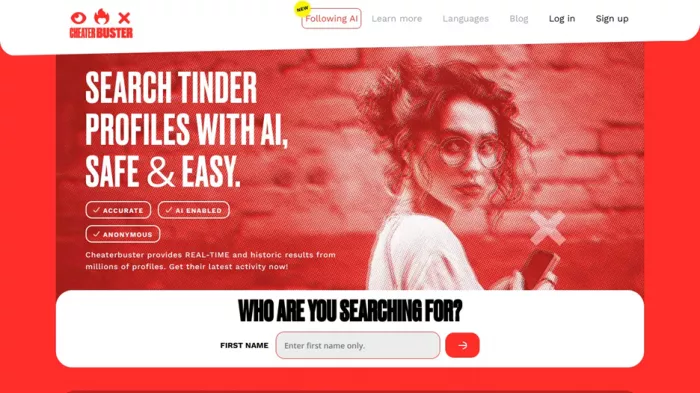
Nobody searches for something like Cheaterbuster when everything is going fine.
You end up here because something feels off. Maybe it’s a gut feeling. Maybe it’s a small detail that doesn’t add up. And instead of asking directly, people look for a shortcut.
That’s exactly where tools like Cheaterbuster step in. They promise clarity without confrontation.
But the real question is not what it promises.
It’s whether it actually delivers anything you can trust.
What Cheaterbuster Actually Is
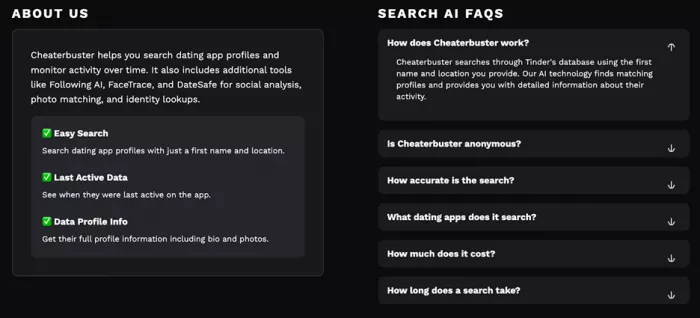
At its core, Cheaterbuster is a search tool designed to detect Tinder profiles using basic information like name, age, and location.
You can also upload a photo, and the platform will try to match faces using AI.
The idea is simple.
You enter details, and the system scans its data to find profiles that match.
If it finds something, you might see:
- Profile pictures
- Bio information
- Estimated location
- Linked social accounts
It sounds powerful on paper.
But once you understand how it actually works, the picture becomes a lot more nuanced .
How It Works Behind the Scenes
Despite all the AI branding, the system is not magic.
It works more like a database matching tool combined with pattern recognition.
Here’s what happens in simple terms.
You enter information. The system scans its stored data. If you upload a photo, it compares facial features. Then it generates possible matches.
That’s it.
There is no direct connection to Tinder. No real-time tracking. No guaranteed access to private data.
Everything depends on how accurate your input is and how complete their data is.
And that’s where things start to fall apart.
The Experience Most People Actually Have
The first time you use it, it feels straightforward.
You enter the details. You pay. You wait.
Then you get results.
Sometimes those results look convincing. Other times they feel completely off.
And here’s the uncomfortable truth.
Both experiences are common.
Some users do find profiles that match what they were looking for. Others get irrelevant results or nothing at all.
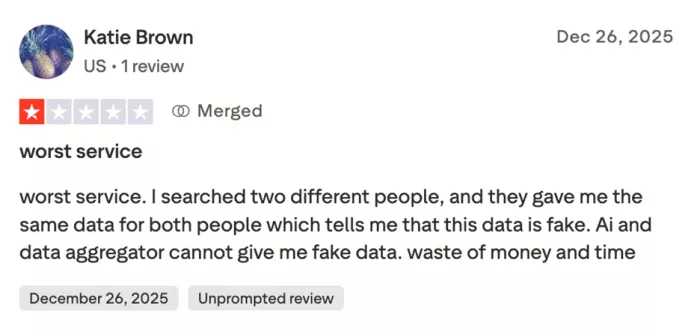
That inconsistency is not rare. It’s one of the most reported issues across reviews.
Accuracy: The Biggest Problem Nobody Can Ignore
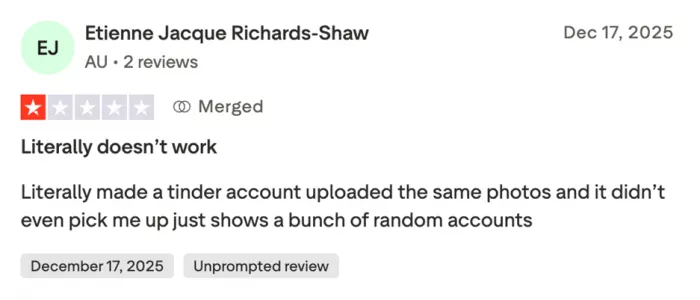
This is the part that matters most.
Because if the tool is not accurate, nothing else matters.
Cheaterbuster works best when:
- The name is uncommon
- The location is precise
- The age is accurate
- The photo is clear
When those conditions are met, it can sometimes find correct matches.
But the moment anything is slightly off, things change.
Common names create confusion. Location changes break matches. Old photos reduce accuracy.
And suddenly, the results become unreliable.
This is why many users describe it as a probability tool, not a confirmation tool.
It can suggest something.
It cannot prove anything.
What Real Reviews Reveal
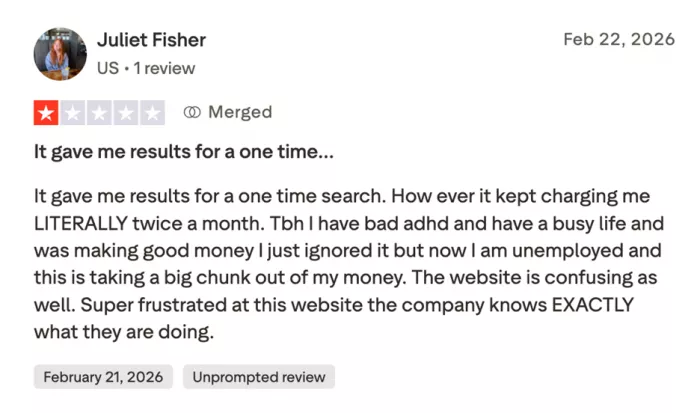
When you look at actual user feedback, the pattern becomes obvious.
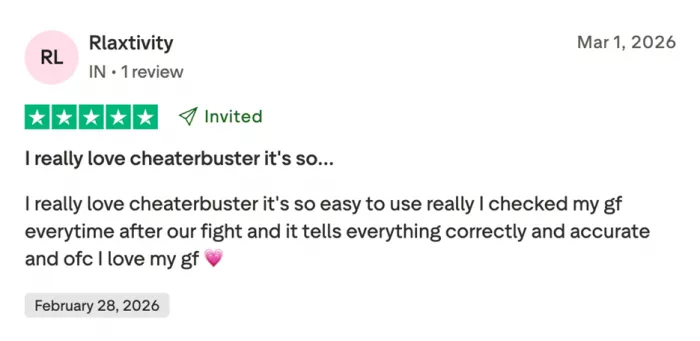
Some users say it worked. Others say it failed completely.
Across review platforms, the sentiment is mixed.
On one hand, people mention that the tool helped them uncover profiles they did not know about.
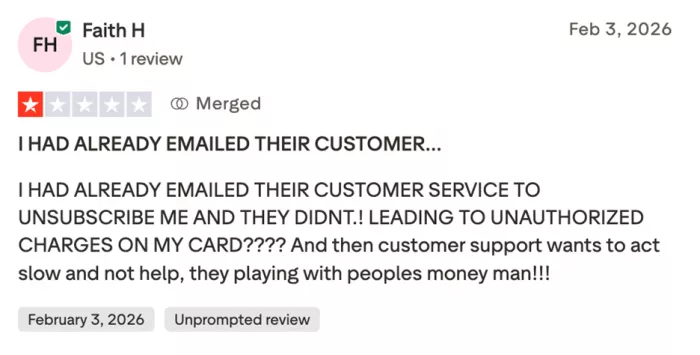
On the other hand, many users report:
Incorrect matches
Missing profiles that should exist
Frustrating billing issues
Limited or no refunds
Some reviews even mention being charged unexpectedly or struggling to cancel subscriptions .
That kind of feedback matters more than any feature list.
Because it reflects real-world use.
The Pricing Problem Most People Notice Too Late
Cheaterbuster is not free.
You pay before you see results.
That alone creates risk.
If the search works, it feels justified. If it does not, it feels like wasted money.
Pricing usually sits around:
- One search for roughly $18
- Small bundles for slightly better value
The issue is not the price itself.
It’s the lack of certainty before paying.
You are essentially paying for a chance, not a guaranteed result.
And many users don’t realize that until after they’ve already paid .
Privacy and Ethical Concerns You Should Not Ignore
This is where things go beyond just functionality.
Tools like this operate in a grey area.
You are searching for someone without their knowledge. You are uploading their image. You are analyzing their digital presence.
That raises real questions.
Where is the data coming from?
How long is it stored?
Who has access to it?
There are no clear answers for most of these.
And that lack of transparency is one of the biggest concerns raised by critics .
Final Rating Breakdown (Honest Assessment)
Here’s a grounded evaluation based on features, user feedback, and real-world performance:
- Ease of Use: ⭐⭐⭐⭐⭐ (5/5)
- Accuracy: ⭐⭐⭐☆☆ (3/5)
- Value for Money: ⭐⭐☆☆☆ (2/5)
- Transparency: ⭐⭐☆☆☆ (2/5)
- Trustworthiness: ⭐⭐⭐☆☆ (3/5)
Overall Rating: ⭐⭐⭐☆☆ (3 / 5)
So… Should You Use Cheaterbuster?
Here’s the honest answer.
If you’re curious and understand the limitations, you can try it.
But if you’re looking for certainty, this is not the tool that will give it to you.
Because at the end of the day, this platform does not uncover truth.
It surfaces possibilities.
And those two things are very different.
Final Thoughts
The reason tools like this exist is not because technology can solve trust issues.
It’s because people want answers without having difficult conversations.
Cheaterbuster taps into that feeling perfectly.
But no tool, no matter how advanced, can replace clarity, communication, and trust.
It can only give you fragments.
What you do with those fragments is up to you.
Comments