Shopping in the online market has made transactions of goods easier than ever before. Be it electronic gadgets, fashion items, household appliances, or any other goods, one can get anything through the internet with a simple click. But on the other hand, with growing online transactions, there is an increasing probability of online market scams. Cyber scammers generally use fake product pictures to trick people into accepting false offers.
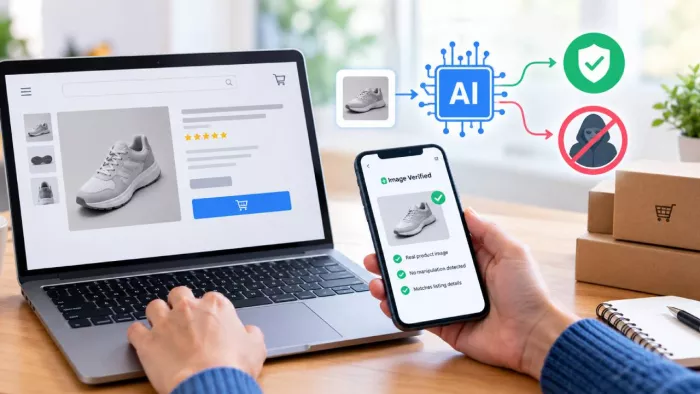
A good solution for dealing with this increasing challenge would be AI image verification. With the help of AI technology, which can analyze product images and look for possible manipulations or misuses, it is possible to prevent dubious products from being advertised on online marketplace platforms.
Understanding Online Marketplace Scams
The online marketplace scams vary widely. There are some sellers that post products that they themselves don’t possess, and there are some that post images that have been downloaded from other legitimate sites to create counterfeits.
Common examples include:
● Stolen product images: Fraudsters use photographs from genuine sellers’ websites in order to appear legitimate.
● Fake or misleading product listings: The photographs may show an authentic product despite the actual item for sale being different or non-existent.
● Manipulated images: Fraudulent sellers use doctored pictures of the product to hide any blemishes or provide false visual evidence.
● Counterfeit goods: The sellers use authentic images of products to market counterfeit products that have no similarity to those of the advertised brands.
● Duplicate fraudulent listings: Such images might appear in several accounts, which can show some suspicion about selling practices.
However, conventional ways of ensuring moderation include manual review and user reports. While the above is still relevant, they may not be able to match the speed at which the new listings will be appearing. AI-based image verification can also be used for another layer of security.
What Is AI Image Verification?
Image verification technology is done through the utilization of artificial intelligence and computer vision in analyzing images to determine their authenticity, duplication, or suspicious activities.
According to the technology involved, an image verification process will check for patterns, metadata, image differences, and similarities in images. Certain image verification methods will also allow the comparison of an uploaded image with other uploaded listings or images.
It is not about whether the image is convincing to the naked eye. The technology will help us detect signals that can prove that the image has been tampered with or has been used out of context.
For online marketplaces, such a feature can help to prevent fraud before an item that is potentially fraudulent reaches many people.
How AI Image Verification Helps Reduce Marketplace Scams
1. Detecting Reused and Stolen Product Images
Copying the pictures of products sold by genuine sellers is one of the most frequent approaches that scammers use on the Internet. The pictures make a scam look very professional despite the fact that the scammer does not have the goods at all.
Image matching using artificial intelligence is capable of comparing an uploaded picture to pictures that already exist to determine duplicates as well as similar images. This can be based on whether the system can recognize images that have been altered in any way.
However, in case of such suspicion, the marketplace can tag the item for review purposes. This will assist the moderating team in detecting possible fraudsters and repeated abuse of product pictures.
2. Identifying Manipulated or AI-Generated Images
However, the emergence of photo editing software and generative AI has enabled people to create highly realistic photos for their products. Though there is nothing wrong with that, it is worth mentioning that those tools can also be used for malicious purposes.
Image validation programs developed by AI may analyze any inconsistencies or artifacts in the image related to any editing process. In addition to this, some specialized software may check for any traces of AI-generated images.
However, no method of detection is entirely foolproof. There have been cases where valid images have been misinterpreted and advanced forms of manipulation have gone unnoticed. It is because of this that the use of image analysis for verification should be accompanied by other methods and not solely relied upon.
3. Flagging Suspicious Listings Before Buyers Are Affected
The sooner suspicious content is recognized within the marketplace, the better its chance of preventing possible losses.
AI-based image verification can be included within the listing submission process. Upon the uploading of images for products by the sellers, the system will automatically analyze these and determine the risks according to set criteria.
For instance, an item may be suspected if it has pictures that resemble those of other unrelated sellers, show signs of manipulation, or contradict other existing listing details.
According to how the marketplace is run and what review process it uses, these listings may be reviewed manually, put through further checks to see if they are legitimate, or temporarily suspended.
This approach will enable platforms to detect any unusual activities before any fraudulent listings draw buyers to them.
4. Improving Seller Verification and Accountability
Images can be valuable indicators when analyzing the conduct of sellers. When several accounts keep posting similar product pictures or pictures related to any reported scam, there is a need for such accounts to be reviewed.
The use of AI can provide a link to images of similar listings and repeated use of images. Together with other information such as an account history, transaction history, user complaints, and identity validation, this information can be used to detect fraud.
In any case, similar product images do not necessarily signify misconduct on the part of the seller because legitimate resellers and retailers could be using the same product image provided by the manufacturer.
5. Building Buyer Trust and Confidence
Trust is an important aspect of online marketplaces. People will be more willing to buy if they have trust in the accuracy of the products and the reliability of the sellers.
AI image verification will help build trust in such platforms through the identification of misleading images and prioritizing suspicious listings for review, improving the quality of product information.
Another way marketplaces can motivate sellers is by encouraging them to use their own photos, provide multiple angles of the products, as well as relevant information in pictures such as serial numbers.
This way, in combination with proper image verification, consumers will be able to make more informed decisions and avoid many typical scams.
Why Image Detector Technology Matters
An AI image detector can be an important component of fraud detection for a marketplace if it is helpful in detecting suspicious images, duplicate images, or image tampering.
In the case of organizations having to deal with thousands and even millions of items in their catalogs, automatic image analysis can help alleviate the problem for moderation teams, as they will not have to evaluate all images equally but only those that pose higher risks.
An efficient image detection system can include such features as:
● Image similarity analysis: Finding identical copies and images that look alike within listings.
● Manipulation detection: Searching for possible evidence that suggests the image is a modified one.
● AI-generated image analysis: Predicting if an image may have traits indicative of synthetic images.
● Automated risk flagging: Identifying ads that satisfy certain fraudulent criteria.
● Moderation workflow integration: Suspected instances are sent for analysis by humans.
However, the features that these tools provide differ from each other. Companies need to consider detection effectiveness, compatible image formats, speed, privacy protection measures, and integration opportunities when selecting the solution.
Combining AI Image Verification With Other Fraud Prevention Methods
Image verification may prove to be extremely useful but only if complemented by other security measures.
Marketplace security strategy can consist of:
Seller identity verification: The process of verifying the sellers’ identity and the accounts helps to make the business harder to conduct anonymously.
Product and listing checks: Comparing pictures with descriptions, specifications, pricing, and references can help one notice discrepancies that image analysis might not have detected.
Transaction monitoring: Strange billing patterns, repeated cancellations, and suspicious purchasing patterns may be an indication of fraud.
Customer reporting systems: The buyers need an easy method for flagging suspicious listings and fake merchandise through misleading images.
Human review: They can analyze the context, conduct investigations for any cases that have been flagged, and handle cases when automated systems fail to know what to do.
Continuous model improvement: The detection methods need to be tested from time to time using samples that represent both fraudulent and authentic ads.
Through such a combination of techniques, the marketplace will be able to create a more robust defense against scams.
Challenges and Limitations of AI Image Verification
Although there are several advantages to using AI for image verification, it still has some disadvantages that should be taken into account.
One problem that can arise is the impact on genuine sellers because their pictures will be similar to other items listed or contain editing flaws. Second, the scammers can update their tactics by changing pictures or using image generators, and so forth. Third, finding out an image has been manipulated does not mean there was malicious intent.
Another factor to consider is privacy. The platform must manage the images uploaded and the accompanying metadata appropriately and ensure proper access controls are put in place.
The final aspect is that AI requires constant testing because its effectiveness may be affected by factors such as the quality of images, product type, manipulation methods, and training dataset.
Being aware of these constraints allows organizations to deploy AI systems appropriately without compromising on a balanced experience for honest buyers and sellers.
The Future of AI-Powered Marketplace Security
Fraud detection mechanisms will have to evolve in accordance with evolving methods of deception when it comes to e-commerce transactions. Developments in computer vision, digital image forensics, and multimodal artificial intelligence could aid in better analysis of images in addition to text and sellers' identities.
For instance, future systems might become more adept at comparing pictures of products with their descriptions, spotting repetitive visual patterns from networks of listings, and focusing on suspicious actions that need further investigation.
Image provenance tools could also assist in determining the source of the image as well as whether it has been altered, depending on whether provenance information exists for the image. The lack of provenance information does not necessarily imply that the image is fraudulent.
However, the most successful ones may be those that use a combination of various technologies in conjunction with each other.
Conclusion
Scams on online marketplaces may result in loss of faith and financial losses. With sellers increasingly using advanced methods of stealing, tampering with, and even creating AI-generated images, marketplaces should have efficient ways of detecting any suspicious visual content.
AI-based image validation is an effective means of protection in that it will assist in the detection of duplicate images, any evidence of tampering, suspicious advertisements, and enable more effective moderation. Combined with seller authentication, transaction surveillance, customer reporting, and human validation, it can be an effective way to fight against fraud.
However, the aim should be not just relying solely on the AI but to integrate it into a bigger security system. With the proper development of image verification techniques and fraud prevention methods, online stores will be able to create a safer environment for all the users.
Comments