Table of Contents
- The 2026 AI Skills Market: Why This Suddenly Matters
- Coursera: The University-Backed All-Rounder
- DeepLearning.AI: The Specialist Built by the People Who Build AI
- TimTis: The Affordable, AI-Tools-First Companion
- Udemy: The Marketplace That Rewards Patient Bargain Hunters
- 5. edX: The Academic Heavyweight for Theory-First Learners
- The Quiet Truth About Learning AI in 2026
Open YouTube on any random Tuesday and a hundred new AI tutorials have already gone live. Three weeks later the average viewer has watched forty videos, opened a dozen tools, mastered none of them, and somehow feels further behind than at the start. That paradox is a learning-design problem, not a content problem. AI tools are not hard to use. The way most people approach them is.
The fix in 2026 is unsentimental: trade passive tutorial loops for a structured learning platform with a curriculum, accountability, and a finish line. The data on what is happening in hiring right now makes the case better than any creator can.
The 2026 AI Skills Market: Why This Suddenly Matters
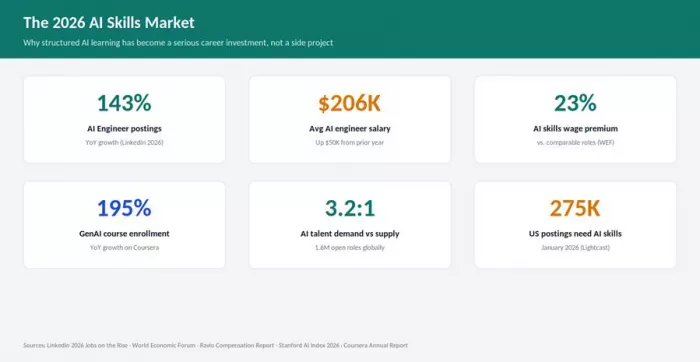
Figure 1: Six numbers explaining why structured AI learning has become a serious career investment.
AI Engineer is the fastest-growing job title in the United States, with postings up 143% year over year per LinkedIn's 2026 Jobs on the Rise report. Lightcast data shows over 275,000 US listings asked for AI skills in January 2026 alone, and average AI engineer salary reached $206,000 in 2025. Even outside engineering, the World Economic Forum found AI-skilled candidates command a 23% wage premium, outperforming the premium for a Master's degree. Coursera reported 195% year-over-year growth in generative AI enrollments. The signal is unambiguous: spending a focused month inside a structured platform is one of the highest-ROI moves a working professional can make right now.
Coursera: The University-Backed All-Rounder

Coursera anchors online learning with partnerships from Stanford, Yale, Michigan, Google, IBM, Meta, and DeepLearning.AI. Coursera Plus, which unlocks 90% of the catalog, is the right entry for learners planning more than one course per year.
Key Features
• Catalog: 10,000+ courses, specializations, and professional certificates
• Credential value: Certificates recognized by 150+ US employers including Deloitte and Verizon
• AI assistant: Coursera Coach inside Plus-eligible courses for on-demand help
• Risk hedge: 7-day Plus trial plus 14-day money-back guarantee on annual plans
What Learners Are Saying
Coursera's review profile is polarized: enterprise-focused platforms rate it highly for content depth and credential value, while consumer reviewers cite customer service and billing as pain points.
| Review Source | Rating | Dominant Sentiment |
|---|---|---|
| TrustRadius | 9.1 / 10 | Strong reviews for content depth and credential legitimacy |
| G2 | 4.5 / 5 | Praised by corporate and team learners |
| Trustpilot | 1.4 / 5 | Negative on billing, refunds, and self-paced support |
Coursera Pricing (May 2026)
| Plan | Price | Best Suited For | Key Inclusions |
|---|---|---|---|
| Free Audit | $0 | Sampling courses | Videos and readings, no certificate |
| Individual Course | $49 to $79 | One targeted skill | Full access, graded assignments, certificate |
| Coursera Plus Annual | $399 per year | Yearlong learners | Full catalog, unlimited certificates, 14-day refund |
| Coursera Plus (promo) | $199 to $239 per year | Bargain-conscious | Same Plus access during 40-50% off sales |
| Professional Certificate | $200 to $400 | Job-ready credential | Google, IBM, Meta, DeepLearning.AI programs |
Coursera Pros and Cons
| Pros: What Works Well | Cons: What to Watch |
|---|---|
| University-grade content from Stanford, Yale, Michigan, and other top institutions | Customer service is the most cited complaint across review platforms |
| Google, IBM, and Meta Professional Certificates carry real hiring weight | Subscription billing has trapped users; cancellation reminders are easy to miss |
| Plus annual unlocks 90% of catalog for $399 (often $199-$239 during sales) | Pricing structure is complex with multiple tiers and program types |
| Free audit plus 14-day money-back guarantee reduces purchase risk meaningfully | Graded assignments often rely on peer review, which can be inconsistent |
DeepLearning.AI: The Specialist Built by the People Who Build AI
Founded by Andrew Ng, DeepLearning.AI is the closest thing online learning has to a frontier AI laboratory turned classroom. Short courses are co-created with OpenAI, Anthropic, Google, LangChain, and AWS, and most 1-2 hour courses are free to audit.
Key Features
• Built with model creators: Direct partnerships with OpenAI, Anthropic, Google, LangChain, AWS
• Hands-on by default: Live Jupyter notebooks in-browser; learners write and run real code
• Free short courses: Most 1-2 hour courses free to audit, no credit card required
• Topic depth: LLM fine-tuning, RAG, agents, MLOps, multimodal AI, and ML math
What Learners Are Saying
Course ratings on Coursera tell the story: the Deep Learning Specialization holds 4.9 out of 5 across 145,000+ reviews and AI for Everyone scores 4.8 across 47,000+. Andrew Ng's teaching is consistently praised for making complex math accessible.
| Review Source | Rating | Dominant Sentiment |
|---|---|---|
| Deep Learning Specialization (Coursera) | 4.9 / 5 | 145,000+ reviews; praised for Andrew Ng's clarity |
| AI for Everyone (Coursera) | 4.8 / 5 | 47,000+ reviews; gold standard for non-technical AI literacy |
| Reddit r/learnmachinelearning | Highly positive | Most-recommended starting point for AI learners |
DeepLearning.AI Pricing (May 2026)
| Plan | Price | Best Suited For | Key Inclusions |
|---|---|---|---|
| Short Courses (Audit) | $0 | Hands-on skill drops | 1-2 hour courses on RAG, agents, prompting |
| Pro Annual | $25 per month annual | Serious AI learners | 150+ programs, certificates, graded labs |
| Pro Monthly | $30 per month | Short-burst learners | Same access as annual Pro without commitment |
| Deep Learning Specialization | $49 per month (Coursera) | ML engineers | 5-course Andrew Ng specialization |
| AI for Everyone | $49 one-time (Coursera) | Non-technical professionals | 4-week non-technical AI literacy course |
DeepLearning.AI Pros and Cons
| Pros: What Works Well | Cons: What to Watch |
|---|---|
| Courses co-created with OpenAI, Anthropic, Google, LangChain, AWS | Math-heavy specializations require Python and basic linear algebra |
| Andrew Ng's teaching rated 4.9/5 across 145K+ Coursera reviews | Catalog is narrowly technical: no design, business, or creative courses |
| Free audit on most short courses removes financial barriers | Certificates require Pro membership; auditing alone produces no credential |
| Direct line into emerging topics: agentic AI, RAG, multi-agent systems | No live cohort or instructor interaction; everything is self-paced and async |
TimTis: The Affordable, AI-Tools-First Companion
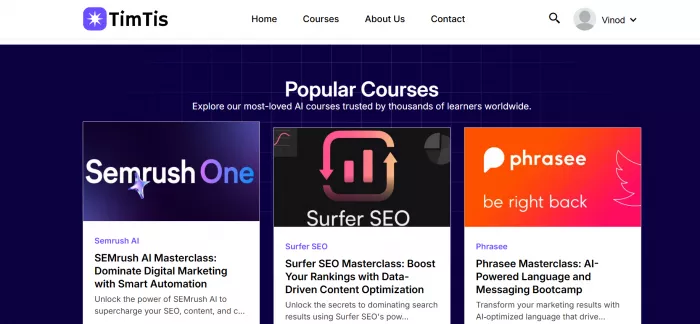
TimTis starts where most working professionals actually need help: mastering specific AI tools that show up in real work. ChatGPT, Claude, Midjourney, Cursor, GitHub Copilot, HubSpot AI, Salesforce Einstein, Zapier AI, and dozens more, each taught through a focused masterclass. Bilingual delivery (English and Hindi) and per-course pricing under $20 make it especially efficient for working professionals who need fast tool fluency rather than long academic programs.
Key Features
• AI-tools-first curriculum: Every masterclass focuses on one specific AI product, not abstract theory
• Bilingual delivery: Courses available in English and Hindi
• Affordable pricing: $18 per masterclass ($24 list, 25% off), roughly one-tenth the cost of comparable Western platforms
• Lifetime access plus NSDC certificate: One-time payment, no recurring subscription, Skill India aligned
What Learners Are Saying
TimTis is newer than Coursera or Udemy, so third-party review aggregation is still building up. Learner testimonials describe structured lesson plans that made tools usable in days rather than weeks of scattered tutorials, with 30% task automation gains reported after completing two courses. The 30-day money-back guarantee is the right risk hedge for first-time buyers.
| Review Source | Rating | Dominant Sentiment |
|---|---|---|
| Platform testimonials | Highly positive | Praised for tool-specific focus and bilingual delivery |
| Marketing & SEO segment | Strong positive | Workflow gains on SEMrush AI, Surfer SEO, MarketMuse |
| Third-party aggregation | Limited (new platform) | Trustpilot and G2 presence still developing |
TimTis Pricing (May 2026)
| Plan | Price | Best Suited For | Key Inclusions |
|---|---|---|---|
| Individual Masterclass | $18 ($24 list, 25% off) | One specific AI tool | 3+ hours, lifetime access, NSDC certificate |
| Coding & Programming Track | $18 per course | Developers and engineers | Cursor, GitHub Copilot, Aider, AI Git workflows |
| Marketing Tools Track | $18 per course | Marketers and SEO professionals | SEMrush AI, Surfer SEO, MarketMuse, HubSpot AI |
| Productivity Track | $18 per course | Operations and PMs | Zapier AI, Motion AI, Zoho AI, Salesforce Einstein |
| Money-Back Guarantee | Within 30 days | Risk-averse buyers | Full refund if the course does not deliver |
TimTis Pros and Cons
| Pros: What Works Well | Cons: What to Watch |
|---|---|
| Tool-specific masterclasses on AI products that show up at work (ChatGPT, Claude, Cursor, Copilot, Zapier AI, 100+ more) | Newer platform with less third-party review history than Coursera or Udemy |
| Per-course pricing at $18 is roughly one-tenth the cost of comparable Western platforms | Catalog focuses on AI tools specifically; less breadth in non-AI categories |
| Bilingual delivery (English and Hindi) closes a real gap for Indian and South Asian learners | NSDC alignment carries strongest credential recognition in India; less established globally |
| Lifetime access plus 30-day money-back guarantee makes first purchases nearly risk-free | No subscription tier yet; learners pay per course, which adds up across many tracks |
Udemy: The Marketplace That Rewards Patient Bargain Hunters

Udemy is a vast marketplace of 250,000+ independent courses. Quality varies, but the price discipline is unique: courses listed at $199 routinely sell for $9.99 to $14.99 during near-constant sales. Patience is the cheat code, and the 30-day refund policy keeps purchases nearly risk-free.
Key Features
• Catalog scale: 250,000+ courses across 13 categories, 73 million learners
• Lifetime access: Every purchased course remains permanently in the learner's library
• Frequent sales: Platform-wide promotions drop $199 courses to $9.99-$14.99 every 2-3 weeks
• Personal Plan subscription: $14-$32/month unlocks 26,000+ curated top-rated courses
What Learners Are Saying
Udemy's review profile is the most polarized on this list. Trustpilot averages 2.0-2.2 out of 5 across 1,300+ reviews, split roughly 37% five-star and 39% one-star. Mobile apps fare far better at 4.7 (iOS) and 4.3 (Android). Top instructors like Angela Yu, Colt Steele, and Jose Portilla produce industry-leading content.
| Review Source | Rating | Dominant Sentiment |
|---|---|---|
| Trustpilot | 2.0 to 2.2 / 5 | Polarized: 37% five-star, 39% one-star; service complaints |
| iOS App Store | 4.7 / 5 | 76,400+ ratings; design and offline mode praised |
| Google Play Store | 4.3 / 5 | 450,000+ ratings; large catalog and offline access |
Udemy Pricing (May 2026)
| Plan | Price | Best Suited For | Key Inclusions |
|---|---|---|---|
| Individual Course (List) | $50 to $199.99 | Before a sale | Lifetime access, certificate, 30-day refund |
| Individual Course (Sale) | $9.99 to $14.99 | Most realistic purchase point | Same as list, sales multiple times per month |
| Personal Plan Annual (US) | $156 to $200 per year | Sustained marketplace users | 26,000+ curated courses |
| Personal Plan (India) | $9 per month | Indian learners | Same Personal Plan access at regional pricing |
| Udemy Business | $24 per user per month | Teams of 2-20 users | Curated business catalog, admin reporting |
Udemy Pros and Cons
| Pros: What Works Well | Cons: What to Watch |
|---|---|
| Largest course catalog in online learning: 250,000+ across 13 categories | Quality varies dramatically because anyone can publish; learners must filter aggressively |
| Frequent sales drop $199 courses to $9.99-$14.99 every 2-3 weeks | Customer service is the most consistent complaint (Trustpilot 2.0/5) |
| Lifetime ownership on every purchased course, no subscription required | Certificates are platform-issued and not accredited |
| 30-day money-back guarantee on individual courses makes purchases nearly risk-free | Course discovery is overwhelming without strict filters (4.5+ stars, 5K+ ratings) |
5. edX: The Academic Heavyweight for Theory-First Learners
Founded by Harvard and MIT, edX is the most academically rigorous platform on this list. Content from Harvard, MIT, Berkeley, Oxford, IBM, and Microsoft sits closer to a university classroom than a marketplace masterclass. MicroBachelors and MicroMasters programs can transfer toward actual university degrees.
Key Features
• Founded by Harvard and MIT: Academic backing from two of the most respected universities globally
• Credential ladder: Free audit, verified certificate, MicroBachelors, MicroMasters, full degrees
• College credit: MicroBachelors and MicroMasters transferable toward partner degree programs
• Executive Education: Cohort programs from Harvard, MIT Sloan, Oxford for senior professionals
What Learners Are Saying
edX shows the same split Coursera does: G2 scores 4.5 out of 5 for university-backed content and credential legitimacy, while Trustpilot averages 1.4 across 1,328 reviews on customer service and certificate pricing. The platform is built for self-directed learners who treat it as an academic resource.
| Review Source | Rating | Dominant Sentiment |
|---|---|---|
| G2 | 4.5 / 5 | Praised for university partnerships, content depth, credentials |
| Sitejabber | 4.17 / 5 | 69% five-star reviews; Harvard/MIT access most cited |
| Trustpilot | 1.4 / 5 | Customer service and certificate pricing drive negatives |
edX Pricing (May 2026)
| Plan | Price | Best Suited For | Key Inclusions |
|---|---|---|---|
| Free Audit | $0 | Sampling academic content | Videos and readings, no certificate |
| Verified Certificate | $50 to $300 | Single-course credentialing | Graded assignments, verified completion certificate |
| Professional Certificate | $200 to $2,500 | Career switchers | Multi-course program from IBM, Microsoft, others |
| MicroMasters | $600 to $1,500 | Graduate-level prep | Transferable credit toward Master's at partner universities |
| Executive Education | $1,500 to $5,000+ | Senior professionals | Cohort programs from Harvard, MIT Sloan, Oxford |
edX Pros and Cons
| Pros: What Works Well | Cons: What to Watch |
|---|---|
| University-backed content from Harvard, MIT, Berkeley, Oxford gives certificates strong credibility | Customer service receives the same critique as Coursera (Trustpilot 1.4/5) |
| Free audit access on most courses lets learners sample full content before paying | Certificate pricing is the most common complaint: $50-$300 per course feels high |
| MicroBachelors and MicroMasters offer real college credit transferable to partner institutions | Professional Certificates can reach $2,500 and full degrees start at $9,000 |
| Executive Education from Harvard, MIT Sloan, Oxford holds weight in senior-leadership hiring | Less suited for fast tool-specific mastery; courses run on academic timelines (4-16 weeks) |
Quick Decision Guide
The flowchart below collapses the platform decision into a single starting question, the one most learners skip but that determines everything downstream.
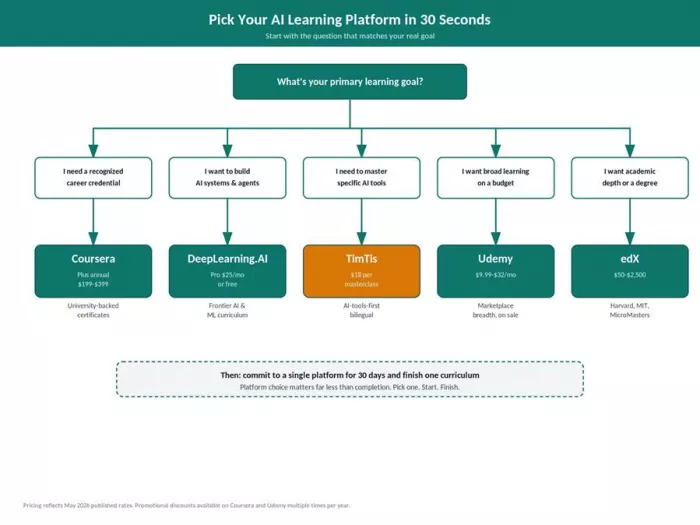
Figure 2: A platform decision tree built around the question that matters: what is the learner actually trying to do.
A 30-Day Blueprint That Works on Any Platform
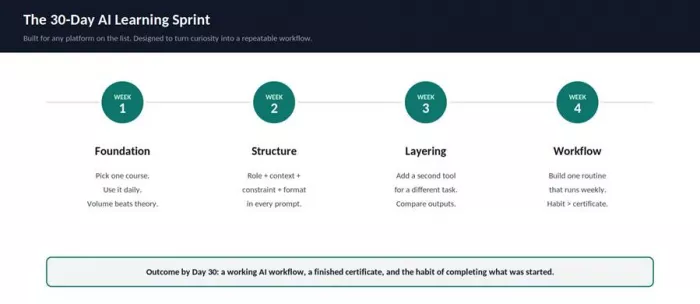
Figure 3: The four-week structure that turns a course purchase into a usable AI workflow.
Week one is volume of practice on one foundational course used daily. Week two adds structured prompting (role, context, constraint, output format) until it becomes automatic. Week three layers a second course or platform with a different purpose. Week four locks in a repeatable workflow: a weekly content routine, a meeting prep template, an automated report pipeline.
The Quiet Truth About Learning AI in 2026
The market data is unusually clear. AI skills command a 23% wage premium, AI Engineer is the fastest-growing role in the country, and demand for AI talent outpaces supply more than three to one. None of those numbers will hold forever. The wrong choice is paralysis. Any one of the five platforms reviewed here, used consistently for thirty days, beats a year of unstructured browsing. Pick the one whose price, format, and focus match the actual goal, set a 30-day timer, and let the curriculum do the heavy lifting that no random tutorial ever will.
Comments