Table of Contents
- What Muke AI Claims to Offer
- How the Platform Likely Works
- Ethical Risks Linked to Clothing Removal and Face Manipulation
- Data Privacy and Image Handling Concerns
- Output Quality and Consistency
- Pricing Structure and Monetization
- Is Muke AI Safe to Use
- Final Assessment: Capability Without Accountability
Muke AI is a browser-based image manipulation platform that has attracted attention for offering AI-powered photo transformations, including clothing removal simulations, face swaps, stylized portrait edits, and body-focused modifications. Unlike mainstream creative AI tools that position themselves around productivity or professional design, Muke AI operates in a more controversial segment of the AI image ecosystem.
While it promotes speed and simplicity, questions surrounding transparency, data handling, ownership, and consent continue to shape its public perception. This article examines what Muke AI claims to offer, how it functions, and why it has become a subject of debate within the broader AI community.
What Muke AI Claims to Offer

Across directories and listings, Muke AI is commonly described as an AI image editing tool focused on automated transformations. The platform requires no downloads and runs directly in a web browser. Users upload a photo, select a transformation mode, and receive an altered output within seconds.
Frequently listed features include:
- Clothing removal simulation or “undress” style effects
- Face swapping between images
- AI-generated stylized portraits
- Body enhancement adjustments
- Image refinement and resolution enhancement
The system appears optimized for quick processing. Many listings report outputs generated in under ten seconds. This speed contributes to its appeal among users looking for instant results rather than iterative design control.
However, beyond feature descriptions, technical documentation is limited. There are no publicly available whitepapers, dataset disclosures, or detailed explanations of the models used.
How the Platform Likely Works
Although Muke AI does not publish technical papers, its functionality suggests the use of diffusion-based or generative adversarial network models adapted for image transformation tasks. The workflow is simple:
- Upload a photo
- Select a transformation mode
- Wait for automated processing
- Download the result
Unlike professional AI design tools that allow fine-tuning, masking, or layered edits, Muke AI appears largely automated. Users trigger a transformation rather than guide it.
This design prioritizes convenience over precision. There is minimal user control once processing begins. That may suit casual experimentation, but it limits professional reliability.
Company Transparency and Ownership Questions
One of the most significant concerns surrounding Muke AI is the absence of detailed company information.
Public listings reveal:
- No clearly identified founders
- No detailed corporate background
- Limited disclosure of headquarters or legal jurisdiction
- Generic team descriptions without verifiable credentials
Domain ownership information has reportedly been hidden in WHOIS records, and there is no visible roadmap, press coverage, or enterprise partnerships.
In the AI sector, especially for platforms handling facial imagery, transparency is typically expected. Reputable tools often publish privacy policies, compliance statements, and moderation frameworks. Muke AI provides basic statements about encryption and temporary storage, but independent verification is unavailable.
Without clear ownership and governance information, users cannot fully assess accountability.
Traffic Patterns Suggest Curiosity Rather Than Institutional Adoption
Third-party analytics platforms show moderate but not massive traffic levels. As of early 2026, Muke AI reportedly receives tens of thousands of monthly visits, with strong search-driven spikes.
This pattern suggests:
- Interest driven by curiosity or viral sharing
- Limited brand loyalty
- Short-term engagement rather than recurring workflow integration
There is no evidence of enterprise usage or integration into professional creative pipelines. Most visibility appears to come from AI directories and niche listings rather than recognized technology communities.
Ethical Risks Linked to Clothing Removal and Face Manipulation
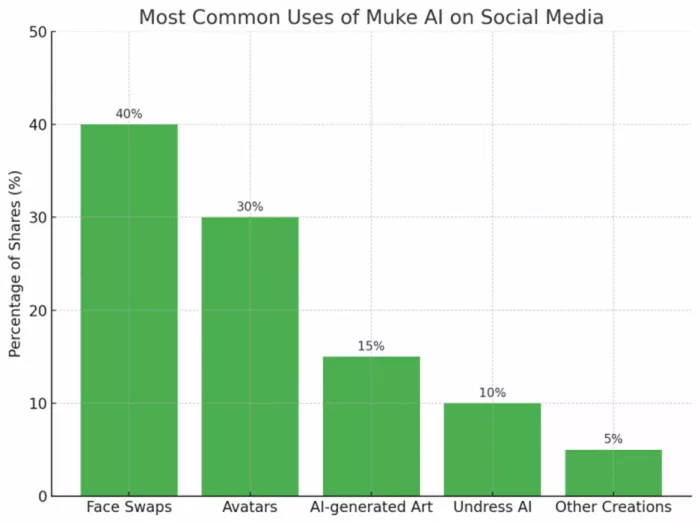
The most controversial aspect of Muke AI is its clothing removal simulation feature. These tools are often categorized alongside so-called “deepnude” applications, which have drawn global criticism for enabling non-consensual image manipulation.
Concerns associated with such tools include:
- Harassment
- Digital impersonation
- Reputation damage
- Non-consensual deepfake generation
- Privacy violations
Even when platforms include disclaimers requiring responsible use, the technical capability itself introduces risk.
Many countries are actively drafting or enforcing laws addressing AI-generated non-consensual imagery. Regulations such as the EU AI Act aim to impose accountability for high-risk AI applications, particularly those involving biometric data and human likeness.
In this regulatory climate, any tool offering automated body alteration without visible safeguards operates in a legally sensitive space.
Data Privacy and Image Handling Concerns
Muke AI states that uploaded images are processed and deleted after a limited time. However, there is no publicly available documentation explaining:
- Whether images are stored temporarily on servers
- Whether they are used for model retraining
- Whether deletion processes are independently audited
- What jurisdiction governs user data
For AI systems handling personal photos, especially facial imagery, these questions are significant.
Without verifiable transparency, users must rely solely on trust statements. In sensitive use cases, that may not be sufficient.
Users considering uploading personal or identifiable images should understand that the absence of documented compliance frameworks increases uncertainty.
Output Quality and Consistency
User commentary across directories describes mixed experiences with output quality.
Reported strengths include:
- Fast processing
- Minimal interface complexity
- Ease of use
Reported weaknesses include:
- Inconsistent realism
- Unpredictable transformations
- Limited control over results
- Occasional distortion in complex images
Because the platform emphasizes automation, there is little opportunity to refine or correct outputs.
For casual experimentation, that may be acceptable. For professional or artistic applications, it limits reliability.
Pricing Structure and Monetization
Muke AI reportedly offers a free trial with limited usage, followed by paid tiers starting around $9.99 per month.
The pricing structure appears similar to other niche AI transformation tools. However, there is limited clarity regarding:
- Usage limits per tier
- Refund policies
- Long-term subscription terms
- Data handling differences between free and paid accounts
When transparency is limited in both technical and pricing domains, users face multiple layers of uncertainty.
Comparison With Industry Standards
Mainstream AI image platforms such as Adobe Firefly, DALL·E, and Runway typically provide:
- Clear content moderation policies
- Consent-based restrictions
- Published privacy frameworks
- Corporate transparency
- Legal jurisdiction disclosure
Muke AI does not publicly demonstrate compliance with comparable governance standards.
This difference does not automatically imply wrongdoing. However, it highlights a structural gap between regulated AI providers and fringe image manipulation services.
Is Muke AI Safe to Use
Safety depends on how the platform is used and what images are uploaded.
From a technical standpoint, the platform functions and produces outputs quickly. From a governance standpoint, key questions remain unanswered.
Users cannot independently verify:
- Data retention practices
- Model training sources
- Corporate accountability
- Regulatory compliance
In contexts involving personal photos, especially of real individuals, the risks extend beyond technical performance.
The ethical implications of using AI to alter human likeness without consent remain a broader societal issue, not limited to one platform.
Final Assessment: Capability Without Accountability
Muke AI demonstrates how accessible AI image manipulation has become. It offers rapid transformation tools with minimal friction. For users seeking instant edits, it delivers speed and simplicity.
However, capability alone does not determine legitimacy.
The absence of transparent ownership, detailed technical documentation, and verified privacy practices raises important concerns. When combined with ethically sensitive features such as clothing removal simulations, these concerns become more significant.
Muke AI represents a category of AI tools that exist at the edge of regulation, curiosity-driven, technically functional, but governance-light.
Users considering such platforms should weigh convenience against transparency. In environments where personal data and human likeness are involved, clarity and accountability are not optional extras. They are essential safeguards.
In its current form, Muke AI operates more as a reactive novelty platform than a transparent, accountable AI service. Whether it evolves toward greater transparency or remains in a gray zone will determine its long-term position within the AI landscape.
Comments