Table of Contents
- The market backdrop nobody mentions in the demo
- How Synthesia stacks up
- How HeyGen stacks up
- Side-by-side at a glance
- Pricing put side by side
- Three real production scenarios, priced out
- Avatar quality and creative range
- Compliance, SCORM and LMS readiness
- Round-by-round scorecard
- When each one wins
- What reviewers keep coming back to
- The verdict
Three weeks. Two AI video platforms. The same five-minute compliance script, the same English-to-Spanish translation requirement, and the same brief: build content an L&D manager would actually ship to a 2,000-person workforce without flinching.
Marketing pages make Synthesia and HeyGen look interchangeable. Real usage at training scale tells a different story. Here is the version without the demo polish.
The short answer Synthesia is the cleaner pick for structured corporate training, compliance content and SCORM-based LMS workflows. HeyGen wins for marketing-flavoured training, multilingual rollouts and teams that prize avatar realism over governance. Both work. They earn their seats for different reasons. |
The market backdrop nobody mentions in the demo
Three numbers anchor the entire buying decision in 2026:
•$847M in 2026, $3.35B by 2034. Fortune Business Insights pegs the AI video generator category on an 18.8% CAGR through the decade. Enterprise adoption is the biggest driver, not consumer interest.
•90% of the Fortune 100 use Synthesia. Per company customer disclosures. The FTSE 100 number is 70%. HeyGen is closing the gap in the mid-market but is still rarely the choice at Fortune 500 scale.
•Zero learning-outcome gap. An ETH Zurich study with 447 participants found no statistically significant difference in exam results between learners taught by AI-generated training videos and learners taught by human-recorded videos.
•Production cost down 97% since 2020. What ran $1,500 in freelance video four years ago now renders for under $15 on either platform. The economics are no longer the argument.
The pedagogical case is settled. The economic case is settled. What is not settled is the cost spread inside the AI category itself.
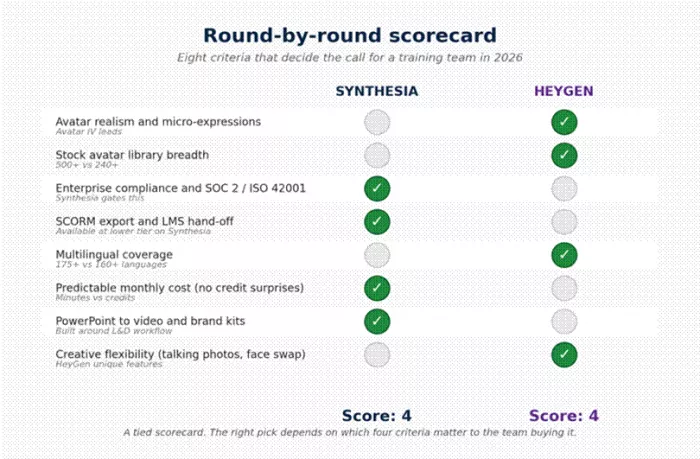
Figure 1. Twelve-month cost to build a 50-video training library across five production approaches.
The pattern hiding in the chart A five-person team on HeyGen Creator clocks in at $1,440 a year. The same team on Synthesia Enterprise runs closer to $30,000 once Brand Kits, SCORM and SSO are bundled. Both are tiny next to traditional studio production at $125,000, but the spread inside the AI category is what most buying conversations end up actually being about. |
How Synthesia stacks up
Synthesia opened the AI avatar category in 2017 and still behaves like the platform that grew up inside enterprise procurement cycles. The editor is built around scripted training content, Brand Kits enforce visual consistency, and the workflow assumes output will land in an LMS, not a TikTok queue.
| Synthesia at a glance | |
|---|---|
| Best for | Enterprise L&D, compliance, multilingual onboarding |
| Avatar library | 240+ stock avatars, Express-2 engine |
| Languages | 160+ (AI Dubbing in 30+, 1-Click to 80+ on Enterprise) |
| Pricing | Free; Starter $29/mo; Creator $89/mo; Enterprise ~$30K/yr median |
| Compliance | SOC 2 Type II, GDPR, ISO 42001 |
| Standout in 2026 | AI Playground (Veo 3.1 + Sora 2) for b-roll |
Where Synthesia earns its keep • SCORM, Brand Kit, SAML/SSO and audit logs land cleanly in enterprise procurement reviews. Most security questionnaires close in one round rather than three. • PowerPoint-to-video workflow turns existing decks into training videos in under an hour, with speaker notes auto-converted into voiceover scripts. • AI Playground (added Q1 2026) brings Veo 3.1 and Sora 2 b-roll generation into the same editor, removing the need for a separate generative-video subscription. • Teleperformance documented roughly $5,000 saved per video versus prior in-house production methods. SmartExpert LMS reported $70,000 saved across a year by switching their training library. • Predictable cost: plans sell minutes, not credits, so a monthly budget forecast actually holds. Overage charges are flat and disclosed up front. • Express-2 avatar engine and Expressive Avatars 3.0 closed most of the close-up realism gap that existed in early 2025. |
Where Synthesia loses ground • Custom Studio Avatars are a $1,000 per year add-on, per avatar. A library of five branded presenters is a $5,000 line item before any subscription cost. • Healthcare customers have reported an undisclosed $1,000 annual content-moderation surcharge that surfaces only after contracts close. Worth raising in negotiation. • Avatar realism trails HeyGen Avatar IV in close-up emotional shots and during faster speech patterns. Adequate for training, less so for marketing. • Enterprise sales cycle typically runs four to six weeks. The lag between deciding on Synthesia and producing the first video is real. • Credit-based limits below Enterprise (120 minutes per year on Starter, 360 on Creator) cap heavy producers faster than the headline pricing implies. |
How HeyGen stacks up
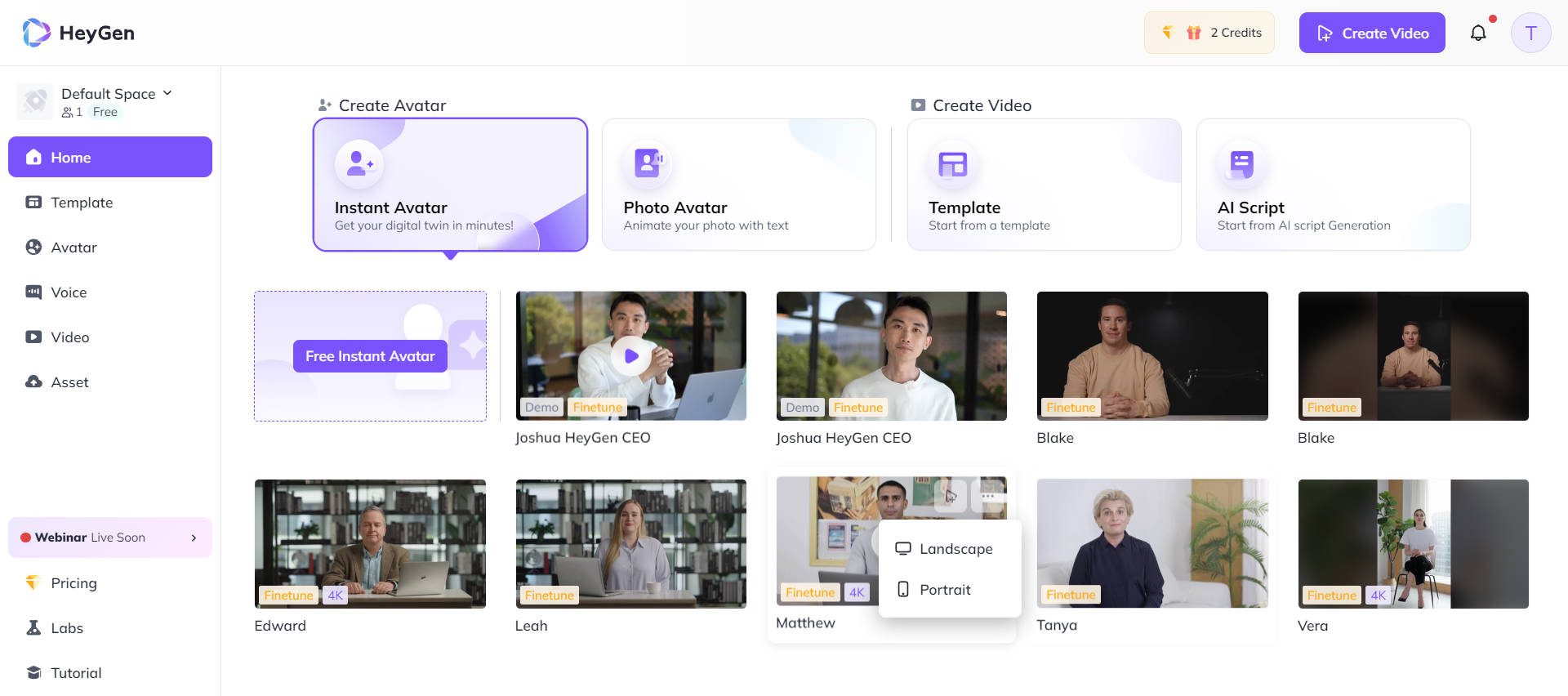
HeyGen entered the category later and built around a different premise: the avatar should look like it is trying to communicate, not just recite. Its Avatar IV feature, refined through 2025 and 2026, makes that visible in mouth tracking, micro-expressions and a noticeably larger stock library
| HeyGen at a glance | |
|---|---|
| Best for | Marketing, sales, multilingual customer-facing video |
| Avatar library | 500+ stock avatars, Avatar IV / Ultra Realistic |
| Languages | 175+ with AI Dubbing and mouth re-sync on translation |
| Pricing | Free; Creator $29/mo; Team $89/mo; Business $149/mo + $20/seat |
| Compliance | SOC 2 Type II, GDPR (ISO 42001 not published) |
| Standout in 2026 | Avatar IV realism, Talking Photos, Face Swap, Digital Twin |
Where HeyGen earns its keep • Strongest avatar realism in the comparison, particularly on Avatar IV. Lip-sync accuracy holds up at faster speech rates where Synthesia still occasionally stiffens. • Talking Photos and Face Swap unlock creative options Synthesia does not natively offer. A still photograph of a real person can be animated into a talking presenter in minutes. • SCORM ships on the Business plan, not Enterprise. Mid-market teams hit LMS-ready output for $149/mo + $20/seat instead of a five-figure annual contract. • Digital Twin clones a real employee's voice and face from a short video sample. A single CEO recording can power hundreds of personalised onboarding sessions in seven languages. • Same-day activation on Business plan via credit card. No procurement form, no four-week security review, no sales call required. • 175+ language coverage with AI Dubbing that re-syncs mouth movements rather than just swapping audio. Translated content does not look dubbed. |
Where HeyGen loses ground • Premium Credit system burns 20 credits per minute of Avatar IV video. Creator's 15 monthly credits cover under a minute of premium output before overages hit. • Add-on credits run $1.50 to $2.00 each, well above the effective plan rate. Teams that scale into add-ons routinely end up paying more than the next tier up. • ISO 42001 documentation is not published as of May 2026. Procurement teams in regulated industries flag this and increasingly negotiate it into contracts directly. • Rendering speed lags Synthesia by roughly 30 to 40 percent on Avatar IV output. Becomes noticeable during heavy revision cycles. • Brand Kit governance is thinner. Multiple creators on a team can drift visually without the central enforcement Synthesia ships with. |
Side-by-side at a glance
The feature breakdown is where the platforms diverge most clearly.
| Feature | Synthesia | HeyGen |
|---|---|---|
| Stock avatar library | 240+ | 500+ |
| Languages supported | 160+ | 175+ |
| Avatar engine | Express-2 / Expressive 3.0 | Avatar IV (Ultra Realistic) |
| Custom avatar cost | $1,000/yr per Studio Avatar | Included from Creator tier |
| SCORM export | Enterprise plan only | Available on Business plan |
| Compliance certs | SOC 2 Type II, GDPR, ISO 42001 | SOC 2 Type II, GDPR |
| AI b-roll generation | Veo 3.1 + Sora 2 (AI Playground) | Not natively integrated |
| Talking Photos / Face Swap | Not available | Available |
| PowerPoint-to-video | Native and polished | Limited |
| Brand Kit governance | Native at Enterprise | Limited |
| Free tier | 10 min/mo, watermarked | 3 videos/mo, watermarked |
Pricing put side by side
Headline subscriptions look similar. Real spend diverges fast once team size and credit consumption come into play.
| Tier | Synthesia | HeyGen |
|---|---|---|
| Free | Basic, 10 min/mo, watermarked | Free, 3 videos/mo, watermarked |
| Entry paid | Starter, $29/mo ($22 annual) | Creator, $29/mo ($24 annual) |
| Mid tier | Creator, $89/mo ($64 annual) | Team / Pro, $89-$99/mo |
| Team / Business | Bundled into Enterprise | Business, $149/mo + $20/seat |
| Enterprise | Custom, ~$30K median (Vendr) | Custom |
| Watch-out | Studio avatars $1,000/yr; healthcare moderation fee | Avatar IV burns Premium Credits fast |
Forecasting cost: the structural difference Synthesia sells minutes. HeyGen sells credits. A training team producing 100 minutes of premium avatar video per month sits in genuinely different cost territory on each platform, even on similarly priced plans. Teams that need predictable monthly spend favour the minute model. Teams with variable output favour credits. |
Three real production scenarios, priced out
Pricing tables are abstract. The same training library at three different team sizes produces wildly different totals depending on which platform absorbs the work.
Scenario one: solo instructional designer, 20 videos a year • Synthesia Starter at $22/mo annual = $264 a year. 120 minutes of output, no overages on average 5-minute videos. • HeyGen Creator at $24/mo annual = $288 a year. 15 credits a month covers around 12 minutes of premium Avatar IV content. • Verdict: HeyGen if avatar realism is the priority. Synthesia if minute predictability matters more. |
Scenario two: five-person L&D team, 50 videos a year • Synthesia Creator at $89/mo x 5 = $5,340 annual. 1,800 minutes of capacity (360 x 5) covers the workload comfortably. • HeyGen Team at $89/mo (with collaboration) or Business at $149/mo + $20 x 4 seats = $13,140 annual for full SCORM and SSO. • Verdict: Synthesia wins on raw cost. HeyGen wins if SCORM at this price point is non-negotiable. |
Scenario three: 25-seat enterprise, 200+ videos a year • Synthesia Enterprise lands around $30,000 annual median (Vendr data). Bundles SCORM, Brand Kit, SSO, audit logs, unlimited minutes. • HeyGen Business at $149/mo + $20 x 24 seats = $7,548 annual. Add credit top-ups for Avatar IV use, realistic total $10,000-$15,000. • Verdict: HeyGen is cheaper at this band. Synthesia justifies the spread only if compliance certifications close the deal. |
Avatar quality and creative range
Across roughly 50 paired test videos, HeyGen Avatar IV produced the closest-to-human output, particularly on lip-sync at faster speech rates and natural head turns. The gap is narrower than HeyGen's marketing implies, though. Synthesia avatars look credible for the audience they target, and the workflow around them is faster to iterate.
•Realism leader. HeyGen Avatar IV, by a noticeable margin in close-up shots. Reviewers across G2 and Capterra consistently rate it more natural than Synthesia equivalents.
•Rendering speed leader. Synthesia, 30 to 40 percent faster on equivalent five-minute scripts. Noticeable across a 20-revision approval cycle.
•Creative range leader. HeyGen. Talking Photos, Face Swap and Digital Twin have no native Synthesia equivalent. Synthesia would need a $1,000/yr Studio Avatar shoot to approximate.
•Brand consistency leader. Synthesia. Brand Kits enforce colours, fonts and templates across creators automatically. HeyGen relies on team discipline.
•Language coverage leader. HeyGen at 175+ with mouth re-sync on translation. Synthesia at 160+ with AI Dubbing in 30+ and 1-Click Translation to 80+ on Enterprise.
Compliance, SCORM and LMS readiness
This is the section that flips the decision for most regulated industries. The summary below is the cleanest view of where each platform sits.
| Compliance dimension | Synthesia | HeyGen |
|---|---|---|
| SOC 2 Type II | Yes | Yes |
| GDPR | Yes | Yes |
| ISO 42001 | Yes | Not published |
| SCORM export tier | Enterprise | Business |
| SAML / SSO | Enterprise | Business |
| Audit logs and content moderation | Native | Limited |
| HIPAA documentation | Not published | Not published |
| Native LMS integrations | Workday, Cornerstone, SAP, 360Learning | Via SCORM and embed |
Worth flagging on procurement Synthesia's enterprise sales cycle typically runs four to six weeks before content can be produced. HeyGen's Business plan activates the same day on a credit card. The cost of waiting six weeks for a contract has its own opportunity cost, and that calculation is quietly tilting some mid-market decisions toward HeyGen in 2026. |
Round-by-round scorecard
Eight criteria typically decide the call for a training team in 2026. The visual below is the most honest summary of the comparison.
Figure 2. Head-to-head scorecard across the eight criteria most L&D teams weight in 2026.
The split is four-four. That tie is the whole point. There is no universally better platform here, only a better fit for a defined use case, defined budget and defined LMS environment.
When each one wins
Seven of the most common buying scenarios in corporate training, mapped to the platform that handles each one more cleanly.
| Scenario | Better fit | Why it wins |
|---|---|---|
| Onboarding library for a 5,000-employee enterprise | Synthesia | SCORM, Brand Kit, SSO, predictable minutes |
| Compliance training in banking, pharma, insurance | Synthesia | ISO 42001, audit trails, content moderation |
| Multilingual product training for global teams | HeyGen | 175+ languages, AI Dubbing with mouth re-sync |
| Sales enablement with personalised intros | HeyGen | Talking Photos and Face Swap make personalisation trivial |
| Mid-market L&D team, $5K-$15K annual budget | HeyGen | Business plan delivers SCORM without an Enterprise contract |
| PowerPoint-heavy training content libraries | Synthesia | PowerPoint-to-video workflow is genuinely time-saving |
| Short-form internal comms with culture-driven tone | HeyGen | Avatar IV realism reads better on social-style content |
What reviewers keep coming back to
The patterns across G2, Capterra and Trustpilot are remarkably consistent. The themes that come up most often are below.
On Synthesia
•Praised for: Production speed at scale, brand control, and a learning curve so gentle that early adopters routinely report never opening the tutorial. Customer support gets the strongest marks in the category.
•Criticised for: Cost opacity above Creator (Enterprise pricing is not published), the occasional avatar that looks slightly stiff in close-up emotional moments, and the $1,000/yr Studio Avatar add-on.
On HeyGen
•Praised for: Avatar IV realism, language coverage at 175+, and creative flexibility most competitors do not match. Reviewers consistently call out Digital Twin as a standout.
•Criticised for: The Premium Credit system, frequently described as offering unlimited videos but not the kind teams actually want to make. The jump from Creator to Business to solve the credit problem is steep.
Capterra 2026 data has both platforms above 4.5 out of 5 across hundreds of training-focused reviews. HeyGen leads slightly on value-for-money and ease of getting started. Synthesia leads on customer support, enterprise readiness and feature depth. Neither is losing badly on overall scores. The pick comes down to which set of strengths matches the team buying it.
The verdict
Three weeks of paired testing leaves one impression that holds up. Synthesia is built for L&D managers who need to produce 50 onboarding modules and clear procurement at the same time. HeyGen is built for marketers, communicators and product teams who need video that does not look like video.
•Pick Synthesia if: The LMS will not accept content unless it ships as SCORM with brand controls, audit logs and SSO. Or if compliance certifications (ISO 42001 specifically) are a procurement gate.
•Pick HeyGen if: Avatar realism is non-negotiable, the content has to feel human in 175 languages, or the team needs to start producing same-day without waiting on a sales cycle.
•Pilot both if: The use case is genuinely mixed. Both offer free tiers that produce enough output to make a real comparison on actual scripts before any subscription is signed.
Which problem is being solved If the LMS will not accept content unless it ships as SCORM with brand controls and SSO, the answer is Synthesia. If the avatar needs to feel like a person, in 175 languages, without a single procurement form, the answer is HeyGen. Anything else is marketing. |
Both descriptions are positive. Neither is universal. The real question is which platform becomes the bottleneck six months in, and that depends entirely on whether the team buying it is solving a training problem or a video problem.
Comments