Table of Contents
- How the six tools compare at a glance
- Cursor: the AI-first IDE that crossed $2B ARR in 16 months
- GitHub Copilot: still the best value at $10 a month
- Claude Code: terminal-first autonomy with the top SWE-bench score
- Bolt.new: browser-only full-stack prototypes in WebContainers
- Lovable: the AI builder behind a $6.6B valuation
- Replit Agent: the all-in-one cloud IDE that handles Python and persistent servers
- Pricing and best-fit, side by side
- Which tool actually fits your workflow
- Verdict: there is no single winner, but there are three clear ones
Two years ago, building an app meant either learning to code or hiring someone who had. That ceiling has collapsed. Stack Overflow now puts AI tool adoption at 84% across developers, and SNS Insider sizes the AI coding tools market at $8.5 billion in 2026, growing toward $47.3 billion by 2034 at a 24% CAGR. Yet most listicles still read like stitched pricing pages. This guide treats the question the way a buyer would: what does each tool actually do, who is it for, and where does it stop being worth the money.
Six tools made the cut. Three aimed at people who write code every day (Cursor, GitHub Copilot, Claude Code) and three at people who want a working app from a sentence or two (Bolt.new, Lovable, Replit Agent). All numbers below were verified in May 2026 from official pricing pages and independent benchmarks.
BY THE NUMBERS
| 84% | 41% | $8.5B | 3.6 hrs |
| of developers use or plan to use AI tools (Stack Overflow Developer Survey) | of all code shipped in 2025 was AI-generated (Stack Overflow, Second Talent) | AI coding tools market size in 2026, projected to hit $47.3B by 2034 (SNS Insider) | saved per developer per week on average, with daily AI users at 4.1 hrs (DX Insight, 135k devs) |
Figures verified May 2026 from Stack Overflow Developer Survey 2025, SNS Insider, Second Talent, and DX Insight (135,000 developer dataset).
How the six tools compare at a glance
Pricing, output type, and whether the tool ships a working backend are the three variables that decide most purchases. The table below answers all three.
| Tool | Built for | Code output | Backend included | Entry price | Free tier |
|---|---|---|---|---|---|
| Cursor | Daily IDE work | Files you write yourself | No | $20/mo | 2,000 completions |
| GitHub Copilot | Editor autocomplete | Inline, multi-file edits | No | $10/mo | Yes, 50 chats |
| Claude Code | Terminal agent work | Diffs across full repo | No | $20/mo | No |
| Bolt.new | Browser prototypes | Full-stack JS apps | Add via Supabase | $20/mo Pro | 1M tokens/mo |
| Lovable | Non-devs shipping | React + TS + Tailwind | Yes, Supabase wired in | $25/mo Pro | 5 credits/day |
| Replit Agent | All-in-one cloud | Production code, 50+ langs | Yes, DB + auth + hosting | $25/mo Core | Trial only |
Table 1. Sources: cursor.com/pricing, github.com/features/copilot/plans, anthropic.com Claude plans, bolt.new pricing, lovable.dev/pricing, replit.com/pricing. Verified May 2026.
Cursor: the AI-first IDE that crossed $2B ARR in 16 months
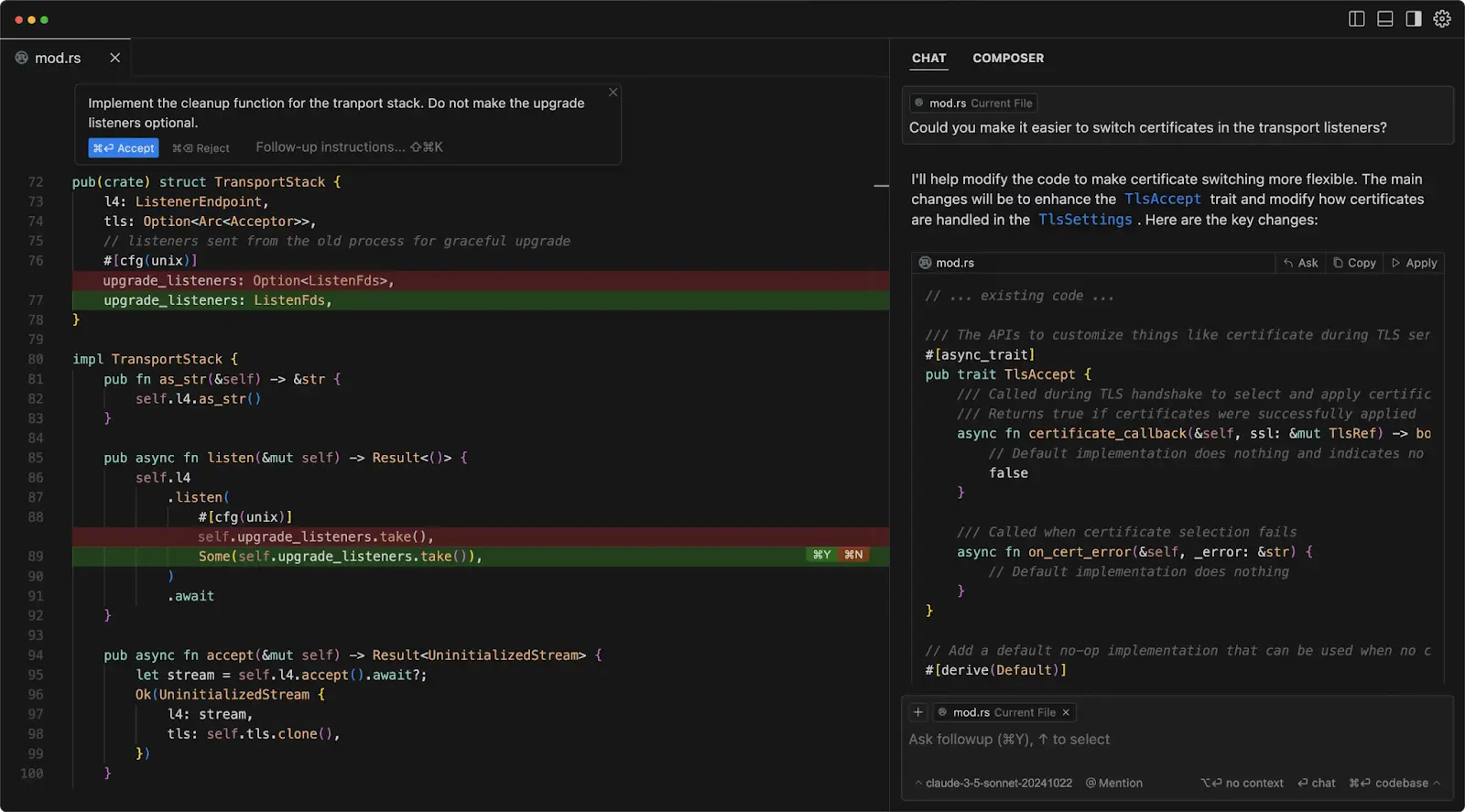
Cursor is a fork of VS Code rebuilt so the AI is not a side panel but the editor itself. Composer handles multi-file edits, Agent mode runs longer background tasks, and the codebase index gives suggestions that match a project's own patterns. Per NxCode's 2026 review, Cursor crossed 1 million users and 360,000 paying customers in 16 months, and Anysphere reports $2 billion in ARR by early 2026. The June 2025 switch from request-based to credit-based billing is the platform's most divisive change and the reason power users now budget $60 to $100 a month instead of $20.
KEY SPECS
| Made by | Anysphere (originally backed by the OpenAI Startup Fund) |
| Frontier models | Claude Opus 4.7, Sonnet 4.6, GPT-5, Gemini 3 Pro, switchable mid-session |
| Pricing tiers | Free Hobby, Pro $20/mo, Pro+ $60/mo, Ultra $200/mo, Teams $40/user/mo |
| Annual discount | 20% off all paid plans (Pro effectively $16/mo) |
| Standout feature | Supermaven autocomplete with multi-line, project-wide predictions |
Best for: Full-time developers who live in their editor and need codebase-wide refactors handled in minutes, not afternoons.
WHAT WORKS
•Composer can refactor across 20+ files in one prompt with project-aware naming and imports.
•Background Agents let one task run while another is being typed, a workflow no other IDE matches in 2026.
WHERE IT STALLS
•Credit billing makes monthly cost unpredictable; Claude Sonnet burns the $20 pool in roughly 225 requests, Gemini in roughly 550.
•Standalone IDE means JetBrains and Neovim users have to leave their existing setup behind.
GitHub Copilot: still the best value at $10 a month
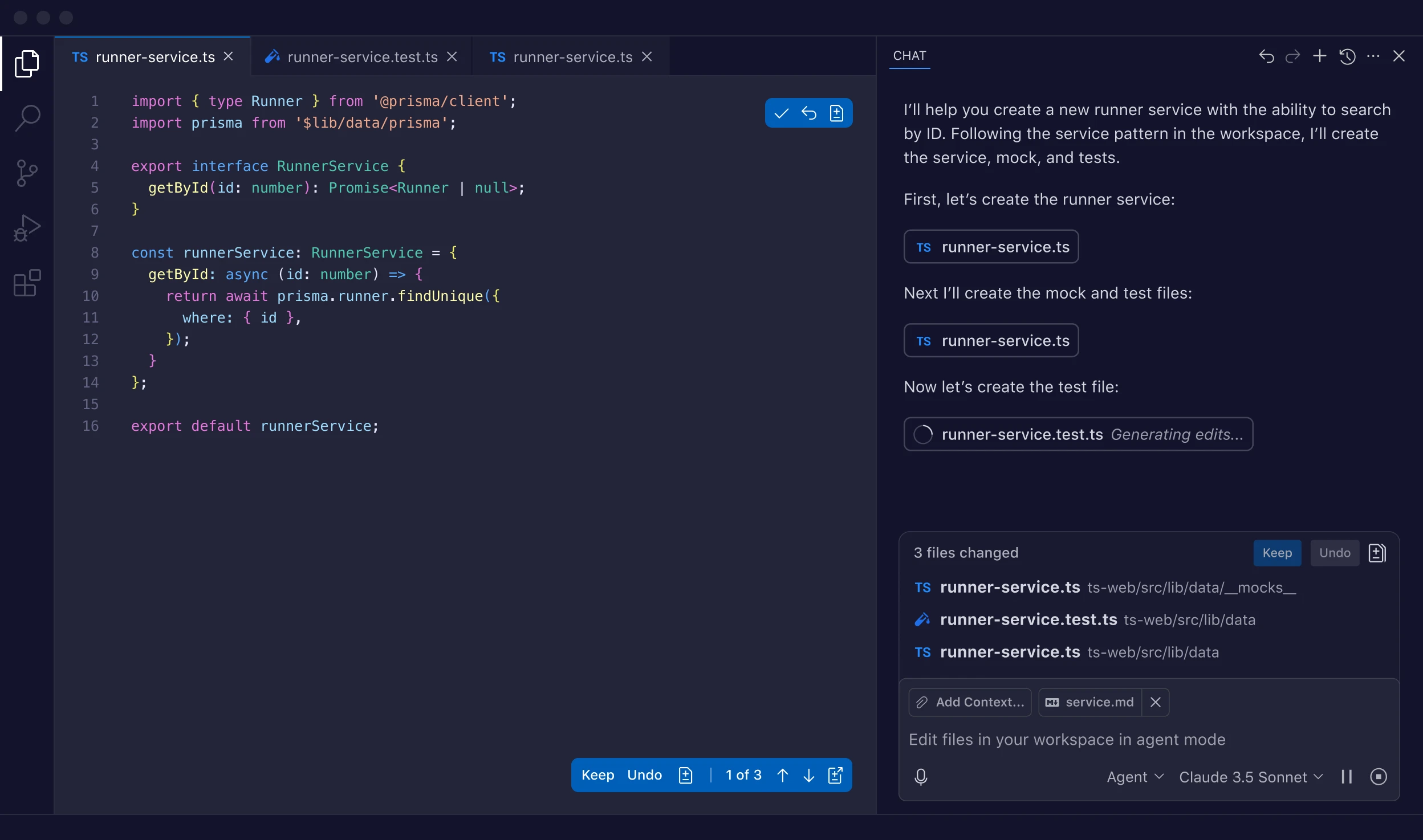
Copilot was the first AI coding tool to reach a mass market and remains the most widely deployed. Microsoft reports 4.7 million paid subscribers in 2026, up 75% year over year. Unlike Cursor, Copilot is a plugin, not an IDE, so it lives inside VS Code, Visual Studio, the JetBrains suite, Neovim, and Azure Data Studio. The 2026 lineup adds Claude Opus 4.7, Gemini 3 Pro, GPT-5 variants, and xAI Grok Code, so model choice is no longer the differentiator. At $10 per month, the price is.
KEY SPECS
| Made by | GitHub (Microsoft) |
| Editor model | Plugin for VS Code, Visual Studio, JetBrains, Neovim, Azure Data Studio |
| Frontier models | GPT-5.x, Claude Opus 4.7, Sonnet 4.6, Gemini 3 Pro/Flash, Grok Code |
| Pricing tiers | Free, Pro $10/mo, Pro+ $39/mo, Business $19/user/mo, Enterprise $39/user/mo |
| Free tier | 2,000 completions and 50 chat or agent requests per month, no credit card |
Best for: Developers who want strong autocomplete and agent mode without leaving their existing IDE, and teams already standardized on GitHub for review and CI.
WHAT WORKS
•Cheapest paid plan with real agent and code review features, including Copilot CLI which went GA in February 2026.
•Free tier is genuinely usable for evaluation, with no trial expiry on the 2,000 monthly completions.
WHERE IT STALLS
•Agent mode reportedly struggles on changes spanning more than 10 files, per developer reports collected by tech-insider.org.
•Context window typically operates in the 32K to 128K range, narrower than Claude Code's 1M token ceiling.
Claude Code: terminal-first autonomy with the top SWE-bench score
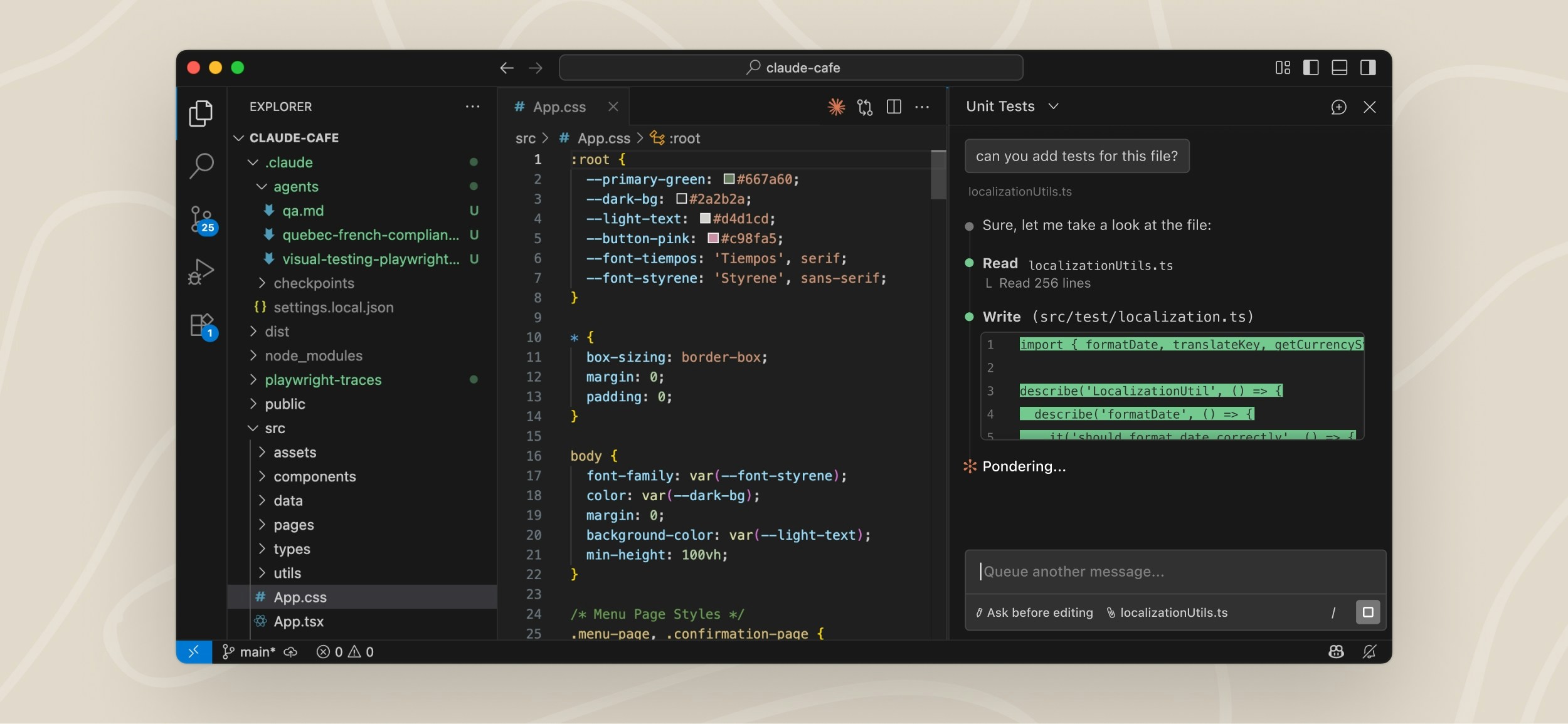
Claude Code is Anthropic's agentic coding tool. It reads the full repository, executes shell commands, runs tests, manages git operations, and ships diffs without leaving the terminal. The differentiator is depth: Claude Opus 4.7, generally available since April 2026, scores 87.6% on SWE-bench Verified (DataCamp, May 2026), and the 1 million token context window means most real codebases fit in one pass. Anthropic's case studies include a 7-hour Rakuten refactor with zero human input across 40+ files. Since April 2026, the tool is no longer terminal-only, with VS Code, JetBrains (beta), desktop, web, and iOS clients.
KEY SPECS
| Made by | Anthropic |
| Editor model | Terminal-first CLI, plus VS Code, JetBrains (beta), desktop, web, iOS |
| Frontier models | Claude Opus 4.7 (default on Max), Sonnet 4.6, Haiku 4.5 |
| Pricing tiers | Pro $20/mo, Max 5x $100/mo, Max 20x $200/mo, Teams $25/seat (monthly) or $20/seat (annual) |
| Standout feature | Model Context Protocol with 300+ integrations (GitHub, Slack, PostgreSQL, Sentry, Linear) |
Best for: Senior engineers and platform teams running multi-file refactors, framework migrations, and async tasks where the agent works while a developer does something else.
WHAT WORKS
•Best published SWE-bench Verified score at 87.6% (Opus 4.7), versus Copilot's effective range depending on the selected model.
•MCP integrations make it the most extensible option; the agent can pull live data from databases, ticketing tools, and incident systems.
WHERE IT STALLS
•Pro at $20/mo is rate-limited; active developers consistently report hitting caps within 5-hour windows and graduating to Max 5x at $100/mo.
•No inline autocomplete, which means Copilot or Cursor still has a role for fast in-editor suggestions.
Bolt.new: browser-only full-stack prototypes in WebContainers
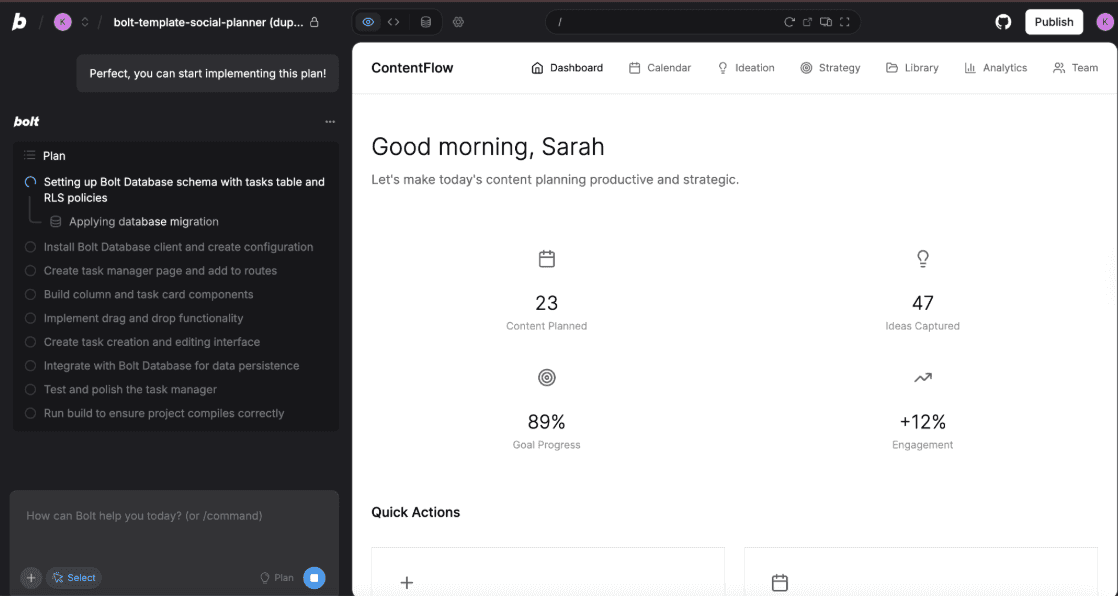
Bolt.new, built by StackBlitz, runs entirely in the browser using WebContainers, a Node.js runtime inside a tab. Describe an app, watch it scaffold, hit one-click deploy to Netlify, and the demo is live. The free tier ships 1 million tokens per month with a 300,000 daily cap, roughly 3 to 8 meaningful prompts a day before throttling. Bolt V2 added chat-based image editing, Figma import, and two-way GitHub sync, so the prototype is portable from day one. Speed is the strength; production polish is not.
KEY SPECS
| Made by | StackBlitz |
| Editor model | Browser-based, WebContainer runtime, zero local setup |
| Pricing tiers | Free (1M tokens/mo, 300K daily cap), Pro $20/mo (10M tokens), higher business tiers |
| Stack defaults | React, Node.js, PostgreSQL, with Netlify deploy and optional Supabase |
| Standout feature | Two-way GitHub sync so code is never locked inside Bolt |
Best for: Founders and product designers who need a clickable, deployable demo for a customer call or pitch by the end of the day.
WHAT WORKS
•Fastest tested time from prompt to deployed URL in the NxCode 2026 benchmark, with Bolt.new at 52 minutes for a habit tracker.
•WebContainer setup means no local environment, no Docker, no install pain, just a browser tab.
WHERE IT STALLS
•Some npm packages do not work inside the browser sandbox; performance overhead is real compared to native dev.
•Token burn on iteration is fast; a serious build can blow through the Pro tier's 10M tokens in days.
Lovable: the AI builder behind a $6.6B valuation
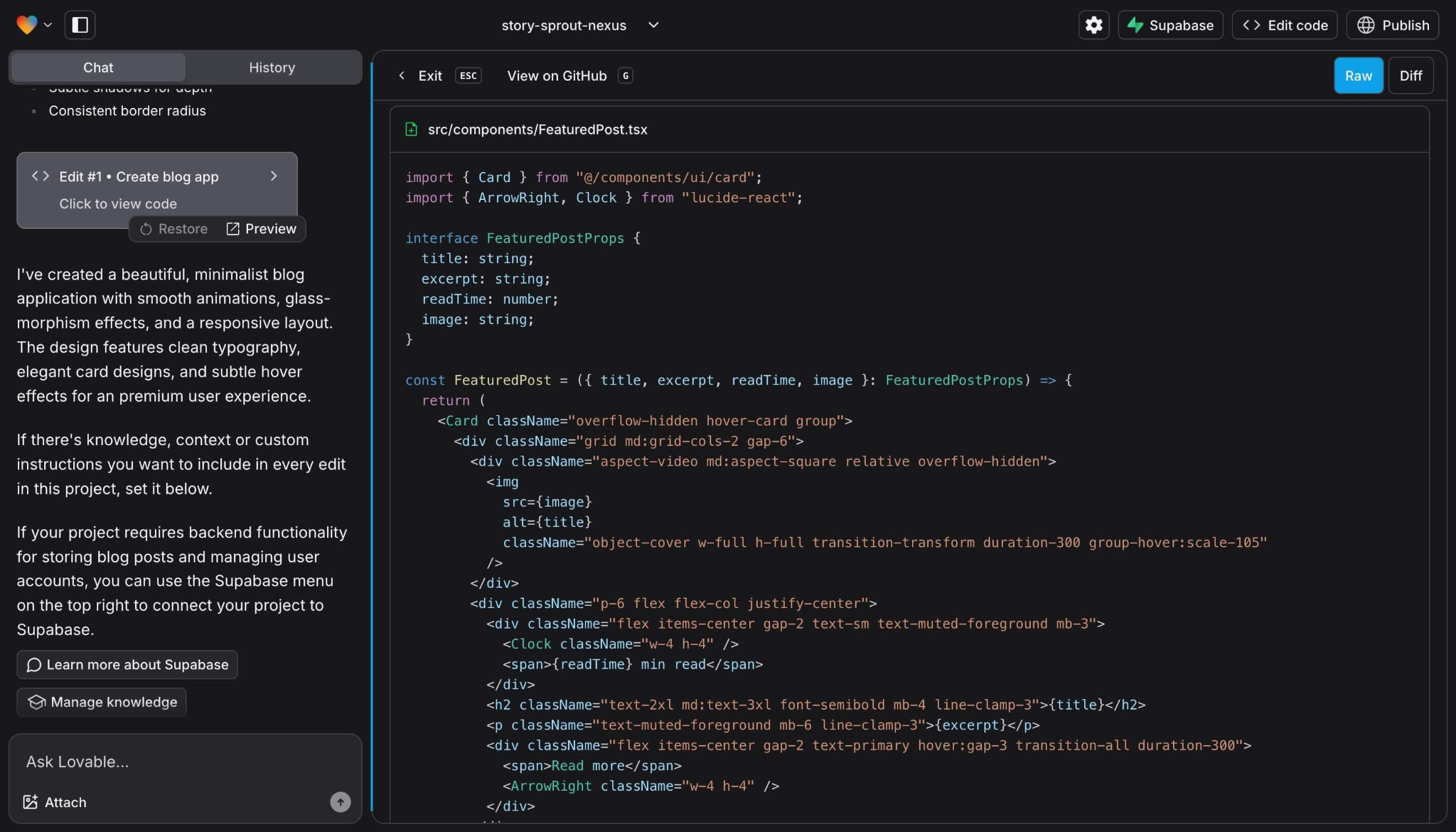
Lovable went from launch to a $330 million Series B at a $6.6 billion valuation in late 2025, and Banani's 2026 review counts roughly 8 million users on the platform. The product takes a sentence and ships a full-stack React app with TypeScript, Tailwind CSS, shadcn/ui components, and a Supabase backend wired in for auth, database, edge functions, and file storage. Lovable closed the gap Bolt.new and v0 still leave open: a non-developer can ship a real product without configuring a backend. The trade-off is credit-based billing, where a complex prompt can quietly consume 1 to 2 credits.
KEY SPECS
| Made by | Lovable.dev |
| Output stack | React, TypeScript, Tailwind CSS, shadcn/ui, Supabase backend |
| Pricing tiers | Free (5 credits/day, 30/mo cap), Pro $25/mo (100 credits), Business $50/mo (SSO, audit), Enterprise custom |
| Credit cost guide | Simple style change about 0.5 credits, complex feature like authentication about 1.2 credits |
| Standout feature | Two-way GitHub sync and code ownership, so a developer can take over later |
Best for: Non-technical founders and product managers who need a production-grade SaaS app with auth, database, and payments without hiring a developer first.
WHAT WORKS
•One non-developer reportedly scaled a Lovable-built virtual try-on tool to over $800K ARR in 9 months (Lovable case studies).
•Built-in Supabase integration removes the most common technical cliff that stalls Bolt.new and v0 users.
WHERE IT STALLS
•Credit costs scale with complexity, not volume, so an unclear prompt that triggers iterations can drain credits faster than expected.
•Lovable Cloud is a separate usage-based fee for runtime compute, so the all-in monthly bill can exceed the headline plan price.
Replit Agent: the all-in-one cloud IDE that handles Python and persistent servers
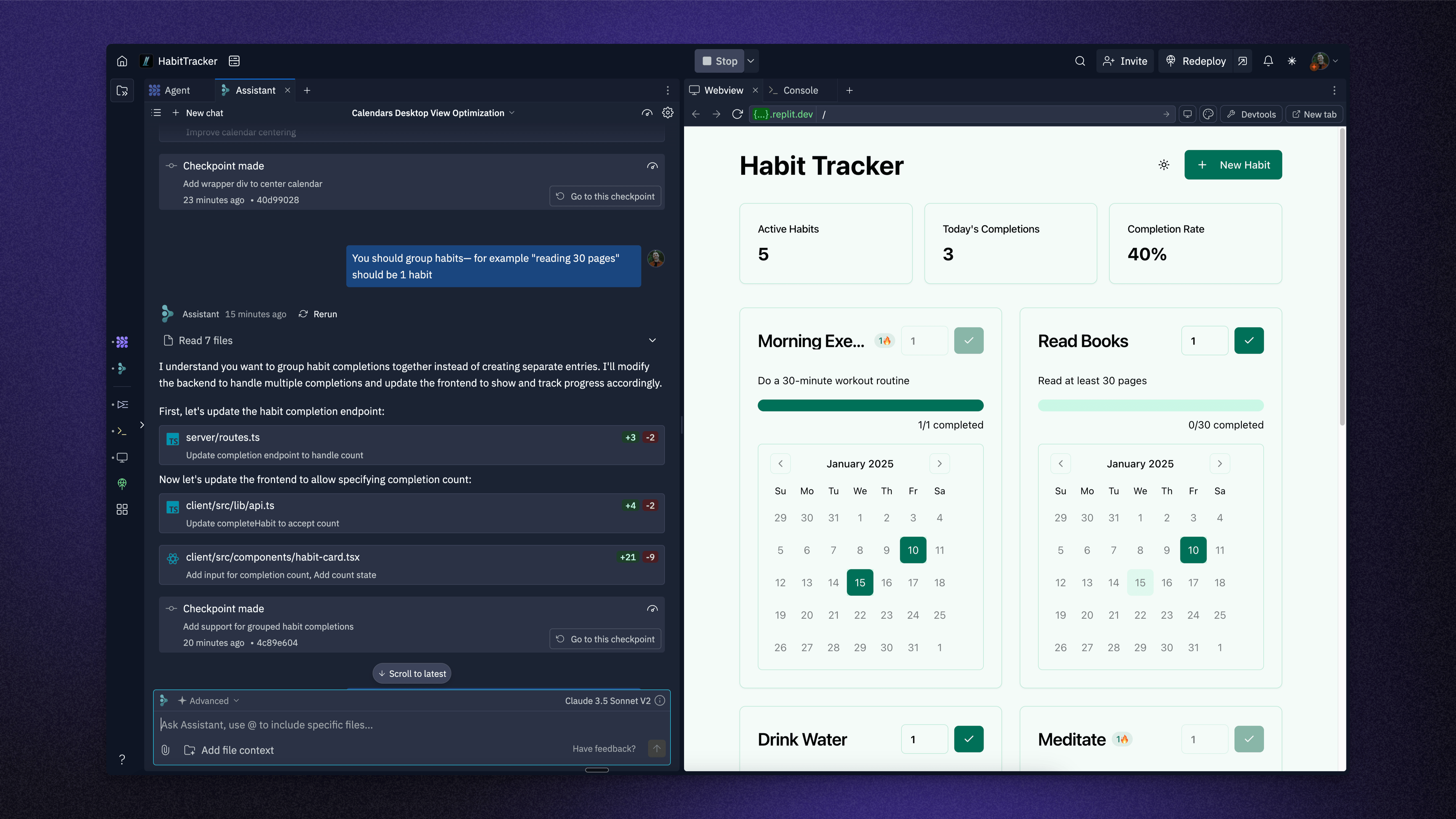
Replit grew from $10M to $100M ARR in nine months (Whichaiisbest.com, 2026) and Agent 4 launched in March 2026 with autonomous long builds, parallel task execution, Design Mode mockups, and checkpoint-based rollback. What separates Replit from Lovable and Bolt.new is runtime depth: 50+ programming languages, terminal access, direct file editing, Git integrations, plus built-in database, auth, secrets, and hosting. For regulated industries, Replit's SOC 2 Type II certification is a posture neither Bolt.new nor Lovable has publicly matched as of early 2026.
KEY SPECS
| Made by | Replit |
| Languages | 50+ programming languages, including Python, JavaScript, Rust, Go, Java |
| Pricing tiers | Free (trial), Core $25/mo with $25 usage credits, Pro tier with higher Agent intelligence |
| Compliance | SOC 2 Type II certified |
| Standout feature | Real-time multiplayer (Google Docs style) with shared environments and version control |
Best for: Anyone who needs real server-side logic (Slack bots, webhook processors, Python data tools), or a regulated team that needs a compliance posture out of the box.
WHAT WORKS
•Only tool in this guide that bundles IDE, runtime, DB, auth, secrets, and hosting into one subscription.
•Agent 3 (September 2025) and Agent 4 (March 2026) handle browser testing and background task automation that other vibe coding tools route through external services.
WHERE IT STALLS
•Effort-based pricing means heavy users routinely report $100 to $300/mo bills on top of the Core plan, per Dyad's free tier comparison.
•Vendor lock-in is real; while code exports work, hosting and DB are tightly coupled to Replit's environment.
Pricing and best-fit, side by side
Annual billing offers meaningful savings on Cursor (20%), GitHub Copilot ($100/year), and Lovable (about 17%). Claude Code's annual savings show up at the Teams tier.
| Tool | Free tier | Entry paid | Power tier | Annual discount | Best ROI for |
|---|---|---|---|---|---|
| GitHub Copilot | 2,000 completions/mo | $10/mo Pro | $39/mo Pro+ | Yes, ~$8.33/mo | Daily coders, any IDE |
| Cursor | Hobby (2K completions) | $20/mo Pro | $60/mo Pro+ | 20% off, ~$16/mo Pro | VS Code refactor pros |
| Claude Code | None | $20/mo (Claude Pro) | $100/mo Max 5x | Teams $20/seat annual | Senior engineers, async |
| Bolt.new | 1M tokens/mo | $20/mo Pro | Business tiers | Varies | Speed-to-demo founders |
| Lovable | 5 credits/day, 30/mo | $25/mo Pro | $50/mo Business | About 17% off annual | Non-dev SaaS shippers |
| Replit Agent | Trial only | $25/mo Core | Pro / Teams | Yes, varies | All-in-one cloud apps |
Table 2. Pricing verified May 2026 from official pricing pages. Power user costs on Cursor and Claude Code commonly run higher than headline numbers once credit overages are factored in.
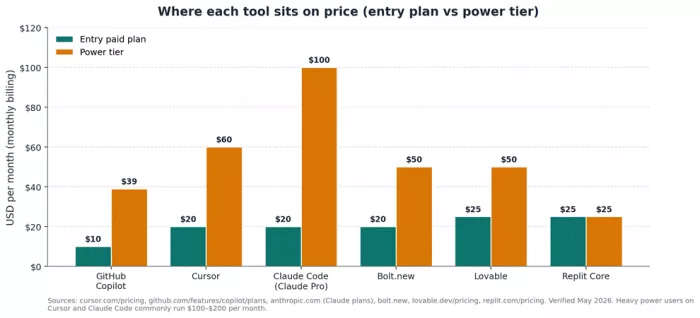
Figure 2. Same numbers, plotted. The gap between Copilot Pro at $10 and the rest of the field is the clearest in the chart.
Which tool actually fits your workflow
Picking by feature list rarely works. Picking by job to be done does. The flow below maps the most common decisions one branch at a time.
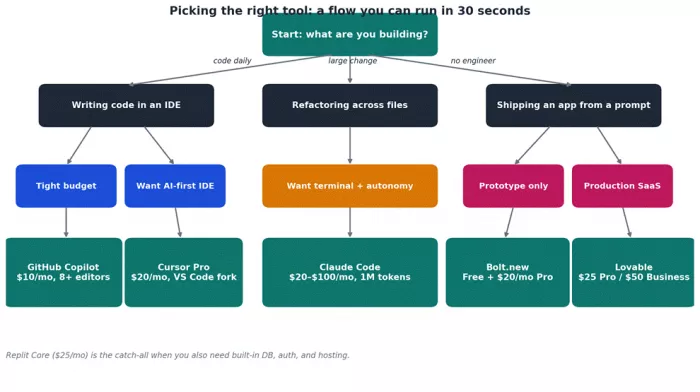
Figure 3. A 30-second decision flow; the catch-all when built-in DB, auth, and hosting all matter is Replit Core at $25/mo.
The pattern most professional teams now adopt is two tools, not one. GitHub Copilot Pro at $10/mo handles inline autocomplete and quick agent tasks; Claude Code Max 5x at $100/mo handles the autonomous, multi-file work. Combined cost is $110/mo, and developer surveys from Codegen and DataCamp report this as the most common setup among high-output engineers. For non-developers, the same logic applies a tier down: Bolt.new for the throwaway prototype, Lovable for the production app.
Verdict: there is no single winner, but there are three clear ones
After working through pricing pages, benchmark data, and developer reports across all six tools, the conclusion is unflattering to the listicle format: there is no single best AI tool for app development in 2026. There are three best tools, one for each of the three jobs that matter.
For developers coding daily inside an IDE, GitHub Copilot Pro is the value pick at $10/mo. It is the only paid plan in this guide priced below $20, and its broad editor support means no muscle memory has to die. Cursor Pro wins on depth, but Copilot wins on math.
For senior engineers running real refactors and migrations, Claude Code is the most capable autonomous agent, and Opus 4.7's 87.6% SWE-bench Verified score is not close. Budget for Max 5x at $100/mo rather than Pro at $20/mo, because the rate limits on Pro will define how the tool feels.
For non-developers shipping a real product, Lovable is the one to start with. Bolt.new still wins on speed to prototype, but Lovable's Supabase integration is the difference between a demo and a SaaS that takes a payment. The $25 Pro plan is the right entry point.
The honest answer to "which AI tool should you use?" is to pick the job first. Every tool here is strong at the thing it was built for and mediocre at the things it was not. The teams getting the most out of AI in 2026 matched the tool to the job, and kept reviewing the output. CodeRabbit's 2025 report found 1.7 times more issues in AI-coauthored PRs. The shortcut is real. It also still needs a second pair of eyes.
Comments