Table of Contents
- Quick Comparison Table
- How We Evaluated These Tools
- 1. Hypotenuse AI: Best for Large Catalogs & Bulk Generation
- 2. Jasper: Best for Brand Voice & Cross-Channel Marketing
- 3. Describely: Best for Data Enrichment on Thin Catalogs
- 4. Shopify Magic: Best Free, Built-In Option for Shopify Stores
- 5. Copy.ai: Best for Teams Already Using It for Go-to-Market Workflows
- 6. Writesonic: Best for SEO- and AI-Search-Focused Sellers
- 7. Rytr: Best Budget Option for Small Catalogs
- Which One Should You Actually Pick?
Writing product descriptions is one of those jobs that's easy to put off, especially when you have dozens - or even thousands - of products to publish. It takes time to write a unique copy for every item, and doing it at scale can quickly become overwhelming.
That's where AI can help. The right tool can turn basic product information into descriptions that are clear, engaging, and optimized for search. But not every platform is built for the same type of business. Some are designed for large product catalogs, others focus on keeping your brand voice consistent, and a few go a step further by filling in missing product details before generating a copy.
To help you narrow down the options, we've compared seven of the most popular AI product description tools available today. We looked at their pricing, features, bulk generation capabilities, integrations, and overall value to see where each one stands. Whether you're running a small Shopify store or managing a large e-commerce catalog, this guide will help you find the tool that's the best fit for your workflow.
Quick Comparison Table
| Tool | Best For | Starting Price | Bulk / Catalog Tools | Data Enrichment | Free Option |
| Hypotenuse AI | Large catalogs, bulk generation | ~$29–$150+/mo | Yes | Limited | Trial only |
| Jasper | Cross-channel brand voice | ~$59–$69/mo/seat | Limited | No | Trial only |
| Describely | Fixing incomplete product data | ~$0.75/product | Yes | Yes (native) | No |
| Shopify Magic | Free, built-in Shopify use | $0 (included) | Basic | No | Yes, always free |
| Copy.ai | Go-to-market automation | ~$29–$1,000+/mo | Via workflows | No | Limited free tier |
| Writesonic | SEO & AI-search visibility | ~$39–$49/mo | Moderate | No | Free trial |
| Rytr | Budget-friendly, small catalogs | Free–$9/mo | No | No | Yes, always free |
Pricing reflects and may vary by billing cycle, region, or negotiated enterprise terms. Always confirm current pricing on the vendor's site.
How We Evaluated These Tools
To keep this list useful rather than promotional, each tool was assessed against the same five criteria:
- Catalog fit: Can it handle a handful of products or thousands of SKUs?
- Data enrichment: Does it need complete product data, or can it fill gaps itself?
- Brand voice control: Can output stay consistent across a whole catalog?
- Integrations: Does it connect to Shopify, WooCommerce, or your PIM?
- Real-world pricing: What does it actually cost once you're past the entry tier?
Prices, plan features, free-tier limits, and billing options may vary by region, platform, promotional offer, and billing cycle. Providers can change their pricing at any time, so always verify the latest details on the tool’s official website or in-app subscription page before purchasing.
1. Hypotenuse AI: Best for Large Catalogs & Bulk Generation
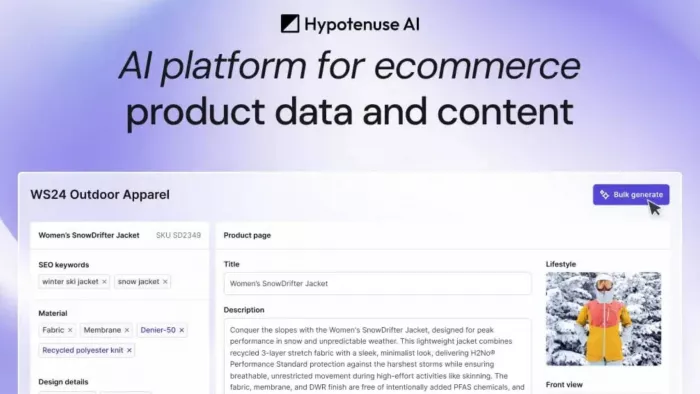
Hypotenuse AI is built for e-commerce brands that need to turn spreadsheets of raw product data into hundreds or thousands of unique, SEO-optimized descriptions in one pass. It's used by a large base of online retailers, including several recognizable consumer brands. Pricing splits into two tracks: one for general marketing content, one specifically for e-commerce catalogs.
Key features:
- Spreadsheet-to-catalog workflow: Upload a CSV containing product names, specifications, keywords, and attributes, then generate hundreds of descriptions without manually creating prompts for each SKU.
- Product-aware content generation: Uses product attributes as inputs instead of producing generic marketing copy, making it better suited for apparel, electronics, beauty, and retail catalogs with many similar items.
- Brand consistency controls: Lets teams define writing rules, preferred vocabulary, tone, and formatting so different product categories don't sound like they were written by different people.
- Bulk editing capabilities: Merchants can rewrite whole groups of products at once, regenerating sections or adjusting tone without editing descriptions individually.
- E-commerce workflow support: Designed around catalog managers rather than individual writers, with integrations aimed at stores handling frequent product updates.
Pricing:
Hypotenuse runs two separate pricing tracks. The Marketing & SEO plan starts around $29/month. The dedicated E-commerce plan, the one built for bulk catalog work, starts around $150/month (billed annually), with custom quotes for larger catalogs and PIM integrations.
Pros and Cons:
| Pros | Cons |
| Handles large product catalogs with bulk generation capabilities, making it suitable for hundreds or thousands of SKUs. | Pricing is impractical for small stores with limited product ranges. |
| Maintains consistent brand tone and formatting across multiple product categories. | Requires accurate product information to avoid generating incorrect descriptions. |
| Built around e-commerce workflows instead of general-purpose content creation. | Less useful for businesses needing wider marketing content such as ads or blogs. |
| Saves significant manual effort when creating or updating product descriptions at scale. | Smaller merchants won't use enough features to justify the investment. |
Best for: Mid-size to large online stores with catalogs in the hundreds or thousands of SKUs that need consistent, bulk-generated copy.
2. Jasper: Best for Brand Voice & Cross-Channel Marketing
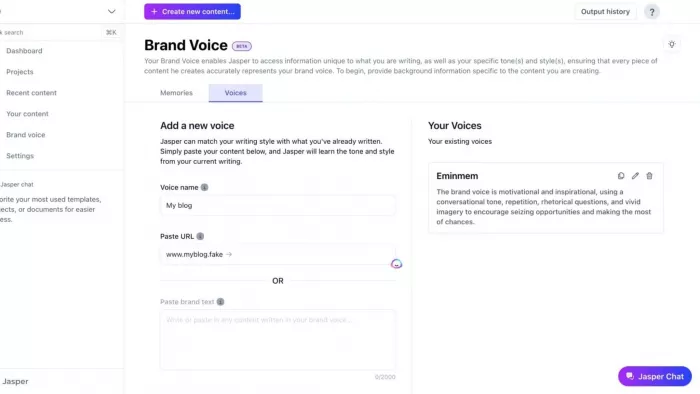
Jasper isn't an e-commerce-only tool. It's a broader AI marketing platform, but its Brand Voice feature and template library make it a strong pick for teams that want product descriptions to sound identical to their ads, emails, and landing pages.
Key features:
- Marketing-trained writing style: Creates product descriptions that can match existing campaigns, ads, emails, and website messaging rather than treating each description as isolated content.
- Brand knowledge system: Stores company information, product positioning, customer profiles, and messaging guidelines to reduce off-brand output.
- Multi-channel content workflows: Useful when product descriptions need to become ad copy, email campaigns, social posts, and landing-page content.
- Collaborative editing environment: Built for marketing teams where writers, managers, and brand reviewers need to approve and refine AI-generated content.
- Reusable templates: Helps teams maintain consistent formats for product launches, seasonal campaigns, and collections.
Pricing:
Jasper's Pro plan starts at roughly $59–$69/month (billed annually vs. monthly) for a single seat, with a limited number of Brand Voices and Knowledge Assets. Teams that need multiple seats, more brand voices, or SSO move to the custom-quoted Business plan, which can run well into the hundreds or low thousands per month depending on team size.
Pros and Cons:
| Pros | Cons |
| Creates product descriptions that match a brand's existing voice and messaging style. | Not specifically designed for managing large e-commerce catalogs. |
| Helps maintain consistency across product pages, emails, ads, and campaigns. | Cannot automatically fix incomplete product data or missing specifications. |
| Strong collaboration features make it useful for marketing teams. | Higher pricing compared with dedicated product description generators. |
| Works well for brands that prioritize storytelling and premium positioning. | Requires brand training and setup before producing consistent results. |
Best for: Marketing teams that want one AI tool to unify product pages, ads, and email copy under a single brand voice.
3. Describely: Best for Data Enrichment on Thin Catalogs
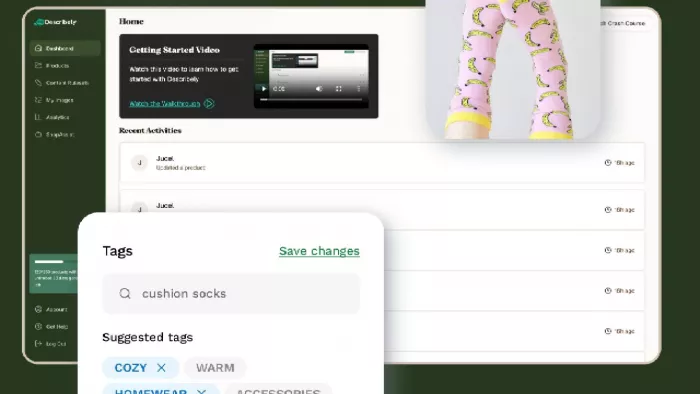
Describely is a purpose-built product-content platform, and its standout feature is data enrichment. Give it just a SKU or product title, and it automatically sources missing specs, dimensions, and materials from manufacturer and trusted third-party sources before writing the description. That matters because most "bad" AI product copy traces back to missing data, not weak writing.
Key features:
- Missing-information recovery: Helps fill gaps when supplier feeds contain incomplete descriptions, missing specifications, or inconsistent product attributes.
- Product data improvement before writing: Fixes the input problem first instead of simply rewriting weak product copy.
- Catalog optimization workflow: Generates descriptions, titles, bullet points, and metadata from improved product information.
- Source-backed enrichment: Shows where additional product details come from, which helps reduce unsupported claims.
- Marketplace-ready content: Useful for merchants selling across multiple channels where each listing requires structured information.
Pricing:
Describely uses usage-based pricing starting around $0.75 per product for generation, with data enrichment billed separately (around $0.55/credit). There's no permanent free plan, but costs scale with catalog size rather than a flat monthly fee.
Pros and Cons:
| Pros | Cons |
| Helps improve incomplete product information before generating descriptions. | Less useful for businesses that already have complete product databases. |
| Useful for supplier catalogs with missing attributes, specifications, or details. | Not designed for broader marketing content like blogs or advertising copy. |
| Designed specifically for e-commerce product content workflows. | Usage-based pricing climbs for frequently updated catalogs. |
| Generates product descriptions, titles, bullet points, and marketplace-ready content. | Small stores with few products won't need its advanced enrichment features. |
Best for: Stores with messy, incomplete, or supplier-fed product data that needs cleaning up before it's publish-ready.
4. Shopify Magic: Best Free, Built-In Option for Shopify Stores
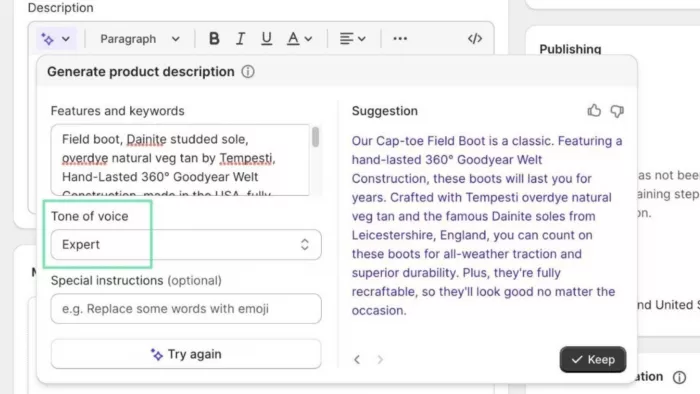
If you're already selling on Shopify, Magic is worth trying before you pay for anything else. It's included free on every plan, with no app install required, and it generates product descriptions directly inside the admin using your store's existing data and a settable "Brand Tone."
Key features:
- Instant product-page assistance: Generates descriptions directly inside Shopify's product editor without moving data between platforms.
- Shopify-native context: Uses existing product details, titles, and store information instead of requiring separate uploads.
- Quick rewriting options: Useful for changing tone, shortening descriptions, or creating alternative versions during product setup.
- Built-in merchant workflow: Designed for everyday store owners rather than content specialists.
- Zero learning curve: Anyone managing a Shopify store can start generating copy immediately.
Pricing:
Free, bundled into every Shopify subscription tier.
Pros and Cons:
| Pros | Cons |
| Available free for Shopify merchants without an additional subscription. | Provides fewer customization options than dedicated AI content tools. |
| Works directly inside Shopify's product editor for faster publishing. | Not designed for managing thousands of product descriptions. |
| Requires minimal setup and is easy for beginners to use. | Lacks advanced features like product data enrichment and bulk optimization. |
| Useful for quickly creating first drafts during product uploads. | Only available to merchants using the Shopify platform. |
Best for: Shopify merchants, especially smaller stores, who want solid AI-written descriptions without paying for a separate subscription.
5. Copy.ai: Best for Teams Already Using It for Go-to-Market Workflows
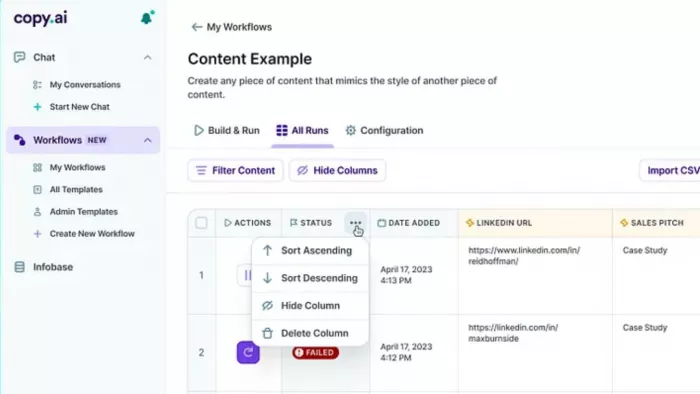
Copy.ai has shifted significantly since its early days as a copywriting template tool. It now positions itself as a broader "AI-native go-to-market platform," combining chat, automated workflows, and AI agents for sales and marketing teams. Product description generation is one use case among many rather than the core focus.
Key features:
- Workflow-based content creation: Can connect product information with broader marketing processes instead of only generating standalone descriptions.
- AI agents for repetitive tasks: Useful for teams building automated workflows around product launches, campaigns, and sales processes.
- Knowledge database: Stores company information so generated copy follows internal messaging rules.
- Team collaboration features: Supports marketing departments managing multiple content projects.
- Integration-focused approach: Works better when product descriptions are part of a larger automation system.
Pricing:
Entry-level access (Chat plan) starts around $29–$49/month for a handful of seats. The workflow-and-agent tiers built for real automation jump sharply: the Growth tier starts at roughly $1,000/month and scales into custom Enterprise pricing.
Pros and Cons:
| Pros | Cons |
| Connects product content creation with broader marketing workflows. | Too advanced for sellers who only need product descriptions. |
| Useful for automating repetitive content processes across teams. | Product descriptions are not the platform's main specialization. |
| Stores brand knowledge to improve consistency in generated content. | Advanced automation features require higher-priced plans. |
| Supports collaboration between marketing, sales, and content teams. | Small businesses won't use enough features to justify the cost. |
Best for: Larger marketing or sales teams that want product copy generation bundled inside a wider automation platform, not solo sellers or small stores.
6. Writesonic: Best for SEO- and AI-Search-Focused Sellers
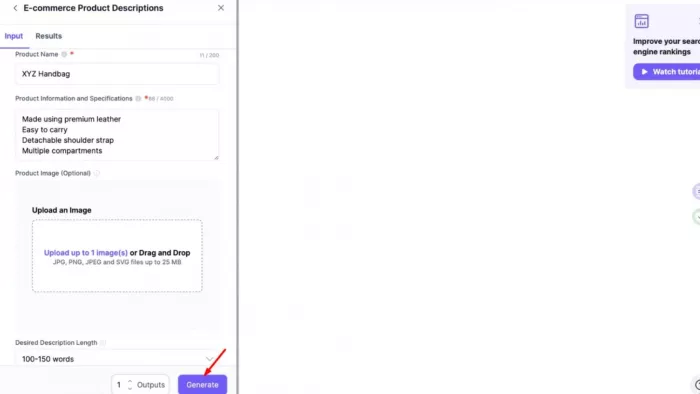
Writesonic has also repositioned itself in 2026, moving from a pure copywriting tool toward "AI-search visibility." That means tracking how your brand and products appear across ChatGPT, Perplexity, Gemini, and Google AI Overviews, on top of its original content generation templates.
Key features:
- Search-focused product writing: Creates descriptions with keyword placement and search visibility in mind.
- AI discovery optimization: Helps brands understand how their content appears in AI-powered search environments.
- Competitive content analysis: Provides insights into how competing pages are structured and optimized.
- Mixed content production: Useful for stores that need product pages plus blogs, buying guides, and SEO articles.
- Brand customization: Allows merchants to maintain consistent messaging across different content formats.
Pricing:
Plans typically start around $39–$49/month (billed annually) for entry access, scaling through Standard, Professional, and Advanced tiers as article, GEO-tracking, and site-audit quotas increase, with custom Enterprise pricing above that.
Pros and Cons:
| Pros | Cons |
| Creates product content with SEO and search visibility in mind. | Product description generation is only one part of the platform. |
| Supports product pages along with blogs, landing pages, and other content formats. | Very large catalogs will need additional tools to manage. |
| Useful for brands focused on Google search and AI search visibility. | Some SEO-focused features won't benefit marketplace-only sellers. |
| Provides tools for improving keyword usage and content structure. | Usage limits become restrictive for high-volume content creation. |
Best for: Sellers who care as much about how their products rank in AI search assistants as they do about the description copy itself.
7. Rytr: Best Budget Option for Small Catalogs
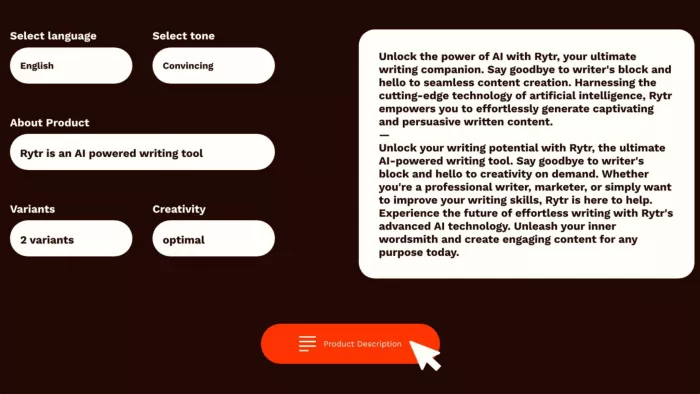
Rytr is the cheapest tool on this list by a wide margin. It's built for speed on short-form content rather than depth, and for a small catalog or a solo seller who needs quick, serviceable drafts, it's hard to beat on price.
Key features:
- Fast product copy generation: Creates basic descriptions quickly without complex setup.
- Multiple writing styles: Lets sellers experiment with different tones such as premium, friendly, technical, or persuasive.
- Simple editing workflow: Designed for users who need quick drafts rather than full catalog management.
- Multi-language support: Useful for small sellers targeting different markets.
- Affordable experimentation: Provides a low-cost way to test AI-generated product copy.
Pricing:
Rytr offers a free plan (around 10,000 characters/month), an Unlimited plan around $7.50–$9/month, and a Premium plan around $24–$29/month for multi-language support and higher plagiarism-check limits. That's the most affordable structure of any tool here.
Pros and Cons:
| Pros | Cons |
| One of the most affordable AI tools for creating product descriptions. | Output quality becomes repetitive across large product catalogs. |
| Simple interface suitable for beginners and small businesses. | Requires more manual editing compared with specialized e-commerce tools. |
| Generates quick drafts for small product collections. | Does not support advanced catalog workflows or bulk product imports. |
| Offers multiple tones and languages for basic content needs. | Limited features for product data enrichment and optimization. |
Best for: Solo sellers, small Etsy or Shopify stores, or anyone testing whether AI-written product copy is worth adopting before committing to a bigger budget.
Which One Should You Actually Pick?
There's no single "best" tool here. The right choice depends on catalog size, budget, and how usable your existing product data already is.
Just starting out on Shopify? Try Shopify Magic first. It's free, it's already inside your admin, and for many small stores it's good enough.
Describely solves a problem none of the others touch, because it enriches your data before writing. That's the pick if your product information is incomplete or messy, with missing specs, dimensions, or materials.
For a large, established catalog that needs thousands of consistent, on-brand descriptions fast, Hypotenuse AI is the strongest purpose-built option.
Jasper earns its higher price tag when product copy has to match your ads, emails, and landing pages under one voice.
Solo sellers and small shops on a tight budget should look at Rytr. It gets you usable drafts for next to nothing, and the free plan costs nothing to try.
Copy.ai can fold product description generation into a broader marketing automation setup if your team already runs one. It isn't worth adopting for that purpose alone.
Writesonic's GEO tracking is the most relevant feature set here if you care how your products show up in ChatGPT or AI Overviews, not just Google.
Whichever tool you choose, the single biggest quality lever isn't the AI model, it's your source data. Clean, complete product information (materials, dimensions, use cases, differentiators) produces better output than any prompt trick, so audit your catalog before you generate a single description at scale.
Comments