The homepage opens with a line that leaves little room for hedging: the most secure infrastructure from training to inference. Pinned under the logo are three words that set the tone for everything else, your data, your weights, your prompts. That framing is aimed squarely at teams that run their own models and cannot hand their weights and prompts to shared, opaque infrastructure.
This review is written from the standpoint of someone arriving cold, with no account and no sales call booked, because that is how most people meet a product for the first time. The notes below are based on what Blackbox AI puts in front of a prospective user and how the platform is built to be reached, not on a benchmark run against its GPUs. One reason for that caveat shows up within the first thirty seconds, and it is covered in full further down.
The verdict at a glance
4.0/ 5★★★★☆ REASONED, NOT BENCHMARKED A sharp, security-first platform with a coherent story and a deliberately narrow front door. The basis for this score is set out below. BEST FOR Regulated teams and serious ML groups running their own models STANDS OUT Security agents that aim to fix issues, not just flag them KEEP IN MIND No self-serve access, no public pricing, sales-led onboarding NOT FOR Solo developers or students wanting to spin something up tonight |
What Blackbox AI actually is
Strip away the headline and Blackbox AI is a secure GPU cloud with an operations and security layer built on top. The navigation splits the product into four areas, security, compute, training, and inference, which together describe the full path a model takes from a dataset to a live endpoint. The promise is that each stage runs on hardware the platform monitors and protects, rather than on general-purpose cloud instances that treat an AI workload like any other process.
Everything is operated through a single GPU Console, described on the sign-in page as one place for your GPU machines, the models you run, and the models you train. Access to the machines themselves is familiar to anyone who has used a cloud GPU before: standard SSH into an Ubuntu host, with tools like nvidia-smi available and logins approved centrally in the console. In other words, the control plane is proprietary and security-focused, but the day-to-day developer experience stays close to a normal Linux box.
| Product type | Secure GPU infrastructure covering training, inference, and the security around both |
| Who it targets | Companies and teams running proprietary models, not individual consumers |
| Access method | GPU Console with SSH to Ubuntu hosts; passwordless login by one-time email code |
| Hardware on show | NVIDIA GB300 machines (host naming such as gb300-nvl172-07, four GB300 per machine shown) |
| Go-to-market | Sales-led, with "Talk to sales" and "Get a demo" as the primary calls to action |
| Core promise | Your data, your weights, and your prompts stay yours and stay protected end to end |
The access barrier every new user hits first
This is the detail that shapes how the rest of the platform can be judged, and it is worth being plain about. Blackbox AI is closed to casual sign-up. The login flow asks for a work email and sends a one-time code, with no password involved. A personal address does not get through. Entering a Gmail address returns a clear, immediate rejection asking for a work email and pointing to a support form for account help.
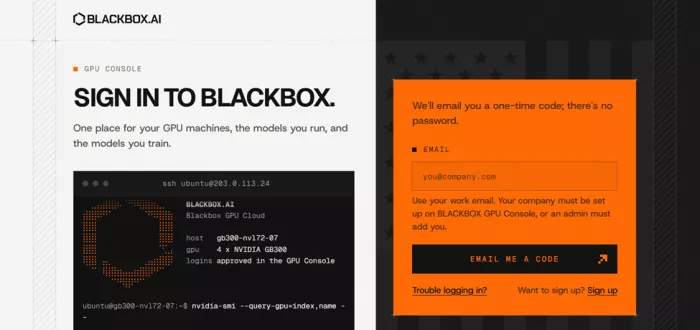
The sign-in page spells out the rule in full: the email has to belong to a company that is already set up on the Blackbox GPU Console, or an administrator has to add the person first. For a regulated enterprise with a provisioned account, that is exactly the kind of control you would want. For a solo developer, a student, or anyone evaluating tools on a personal account, it means the running product cannot be tried at all without an organisation behind it and, realistically, a conversation with sales.
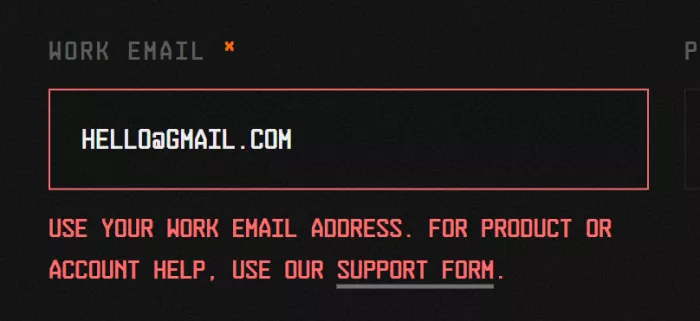
That barrier is the reason the sections that follow describe what Blackbox AI states it does, matched against normal expectations for this category, rather than hands-on results. It is a meaningful limitation for most individual readers, and it is also a fair signal of who the product is really for.
The four pieces of the platform
The product organises itself around four promises. Each one maps to a part of the model lifecycle, and together they explain why the pitch keeps returning to the idea of security at every stage.
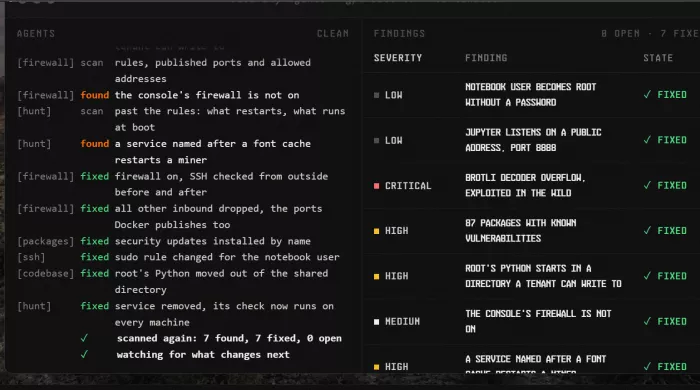
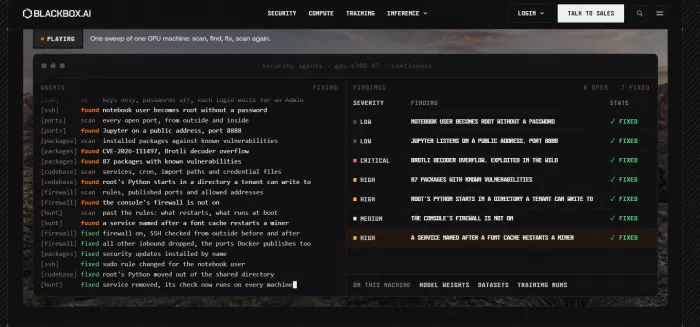
AI security agents Agents are described as watching every GPU machine your models run on and fixing what they find. The demo shows a continuous loop, scan, find, fix, then scan again, with a findings counter and a clean status per machine. closes issues, not just alerts |
Encrypted inference Prompts are said to stay encrypted from your app all the way to the GPU. That aligns with confidential-computing approaches, where sensitive input is protected even while it is being processed, not only in transit or at rest. app to GPU, kept private |
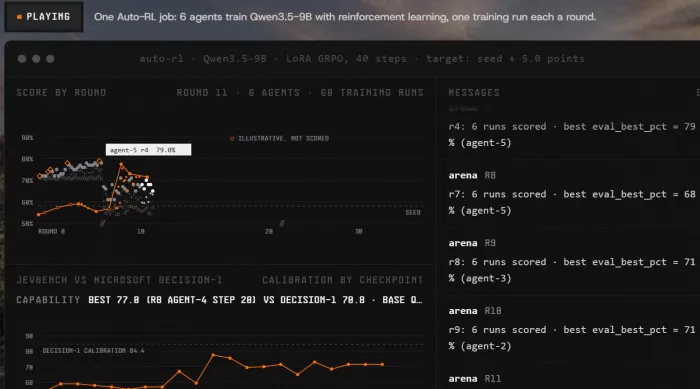
Training agents Training agents are positioned to keep improving your models against benchmarks you set. The framing is a continuous optimisation loop tied to targets you define, rather than a one-off training job you babysit by hand. benchmark-driven tuning |
GPU Console A single console for machines, running models, and training runs, with direct SSH to Ubuntu hosts and central login approval. Passwordless, one-time-code sign-in replaces passwords with a phishing-resistant flow. one pane, real SSH access |
The security agents are the most distinctive part. Plenty of platforms will tell you about a problem; the claim here is that the agents remediate what they detect and then re-scan to confirm, which is a higher bar than monitoring alone. The confidential-inference promise is the second notable piece, because keeping prompts encrypted right up to the GPU is exactly the assurance that makes regulated teams comfortable putting private data near a model.
The hardware underneath
The machines on show are built on NVIDIA GB300, the company's current-generation Grace Blackwell Ultra platform designed for large-scale training and high-throughput inference. The host names visible in the console (for example gb300-nvl172-07) and the "four GB300 per machine" detail point to serious, rack-class capacity rather than entry-level GPU instances. For buyers whose workloads justify this tier, the pairing of top-end silicon with a dedicated security layer is the main argument the platform is making.
Why the hardware choice matters Current-gen NVIDIA GB300 Grace Blackwell Ultra class Built for training and inference Rack-scale, not entry-level Running on the newest accelerators is table stakes for a premium AI cloud. The differentiator Blackbox AI leans on is not the chip alone, but wrapping that chip in continuous security and confidential inference so the performance does not come at the cost of control. |
Who it fits, and who it does not
Built for these users
|
Likely to bounce off
|
Strengths and trade-offs
Strengths
|
Trade-offs
|
Pricing and how to get in
There is no public price list, which is normal for a product that combines high-end GPU capacity with a managed security layer and sells through enterprise sales. The two routes offered are a demo request and a direct line to sales, and actually using the platform requires a company that is already provisioned on the GPU Console or an administrator who adds you. Prospective buyers should expect a custom quote shaped by GPU allocation, usage, and support tier, and should treat the demo as the real evaluation step, since that is where the specifics behind the marketing become available.
How this score was reached
A single number is only useful if the thinking behind it is visible, so here is the full basis. This rating is a reasoned judgment from a prospective user's standpoint, not a lab result. It is built from three distinct inputs, weighted by how much each one can actually be trusted from outside the product.
How the weighting works: observable factors (access, login, console, hardware) carry the most weight because they can be confirmed on the spot. Capability claims are scored more cautiously and treated as provisional until they can be tested inside a real account. The result is a platform that scores high on coherence, focus, and hardware, and is held back for general readers mainly by closed access and thin public detail, not by any observed failure. That balance is what lands it at 4.0 rather than higher or lower. |
Scorecard
Each row below ties a rating to the reasoning above. Numbers are judgments, not measurements, and the confidence behind each one follows directly from which of the three inputs it rests on.
| Area | Rating | Why |
|---|---|---|
| Security model and scope | 4.5 / 5 | Coherent full-lifecycle story; remediation claim stands out |
| Confidential inference | 4.0 / 5 | Strong promise; exact mechanism is not public yet |
| Hardware (GB300) | 4.5 / 5 | Current-generation, serious capacity, directly shown |
| Console and developer access | 4.0 / 5 | Clean console, real SSH, passwordless login |
| Transparency and public docs | 2.5 / 5 | Thin detail available before a sales conversation |
| Access for individuals | 1.5 / 5 | Effectively closed without a provisioned org |
| Enterprise fit and focus | 4.5 / 5 | Clear about the buyer it is built for |
| Overall (for its target buyer) | 4.0 / 5 | Excellent for the right company, closed for everyone else |
Final verdict
Blackbox AI reads like infrastructure built for one kind of customer and entirely unafraid to say so. The security-across-the-lifecycle framing, the claim that agents repair issues rather than just report them, and the promise that prompts stay encrypted up to the GPU add up to a clear, consistent story for teams that cannot put their weights and prompts on shared, opaque hardware. Paired with current-generation GB300 machines and a console that keeps normal SSH access intact, the package is easy to understand and hard to confuse with a general-purpose cloud.
| The wall at sign-in is not an accident. It is the product telling everyone who it is for. A regulated enterprise will read it as a feature; a weekend tinkerer will read it as a closed door. |
For a regulated enterprise or a serious ML team with a provisioned account, the promises are strong enough and specific enough to justify booking the demo. For an individual developer on a personal account, there is simply no way in. The remaining questions, how the automated fixes behave under real change control, what the audit trail looks like, and where pricing lands, can only be answered inside a live account once the sales conversation begins. On what the platform shows and how clearly it knows its audience, it earns a solid score, with the honest asterisk that most casual readers will never get to test it.
4.0/5 Bottom line: A focused, security-first GPU platform that delivers for the enterprise it targets. Powerful on paper, closed to personal accounts, and best judged through its demo. |
Comments