Something clicks about an hour into using Cursor for the first time. The editor is familiar, the extensions carried over, the keybindings still work, and then a tab completion lands three files away from where the cursor sits and the whole thing suddenly feels less like autocomplete and more like a colleague reading over a shoulder. Replit produces a different jolt, and it arrives faster. A sentence typed into a prompt box turns into a deployed URL in about twelve minutes, before any project folder has been opened.
Both moments are real, and neither settles the argument. Developers who love Cursor describe control. People who love Replit describe distance travelled. Choosing between them is less about which is better and more about which kind of friction is worth paying for, because both charge for it, and in 2026 both charge in ways that catch people off guard.
What follows is built on current pricing, shipped features, and the numbers both companies have actually disclosed.
What each tool actually is
The category label "AI coding tool" flattens two products that overlap far less than the marketing suggests.
Cursor: AI-native code editor
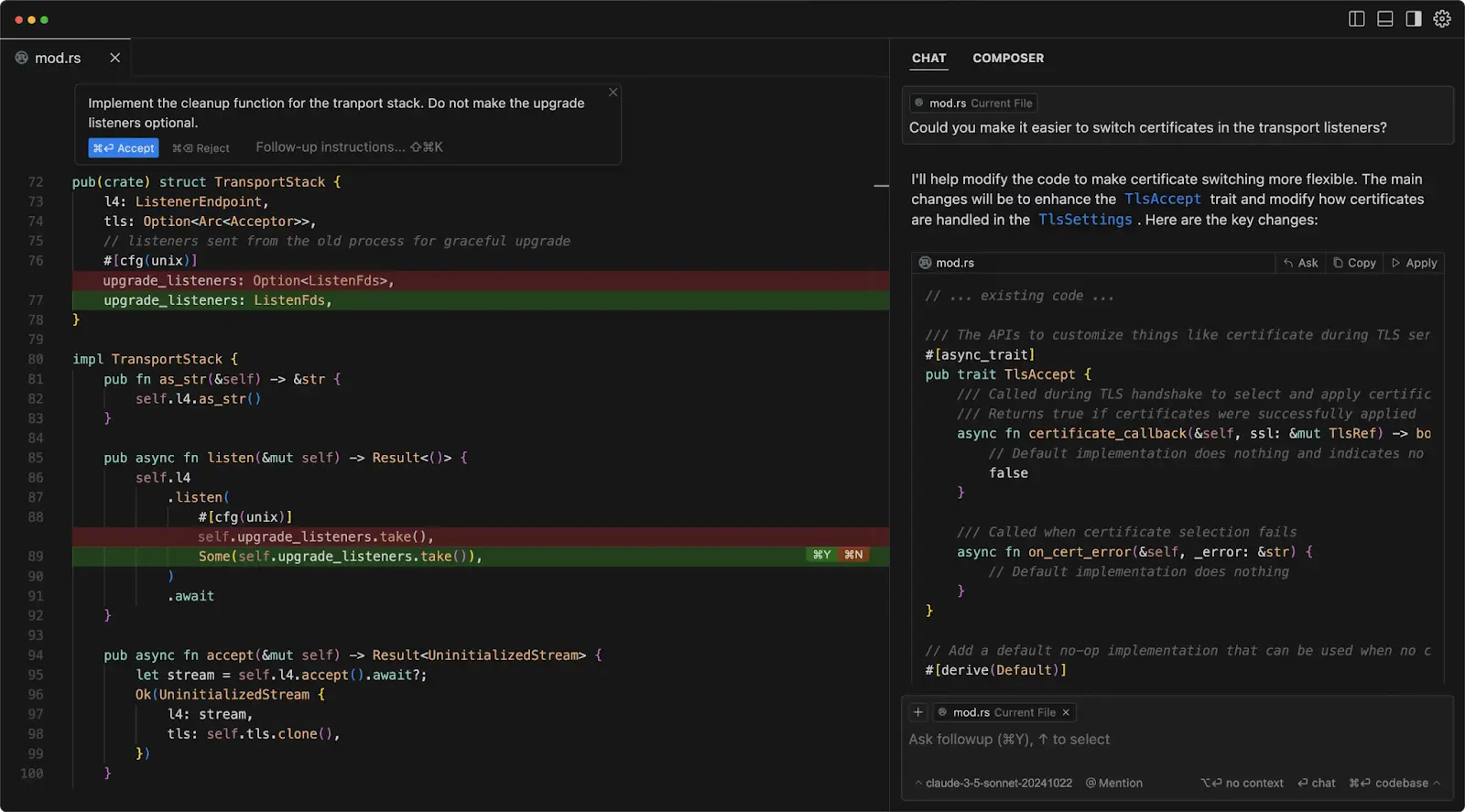
Cursor AI is a fork of Visual Studio Code, built by Anysphere, founded in 2022 by four MIT students and launched publicly in 2023. It runs on the local machine, opens existing repositories, and keeps the editor as the surface where work happens. Agents, code review and a command line tool were added around that centre rather than replacing it.
Replit: browser-based build and deploy platform

Replit is a cloud development environment founded in 2016 by Amjad Masad and Haya Odeh, supporting 50+ languages with no local setup. Since Agent 3 in September 2025 and Agent 4 in March 2026, the prompt and the design canvas, not the file tree, have become the primary interface. Hosting, databases and deployment are part of the product.
Cursor sells depth inside an existing codebase. Replit sells the distance between an idea and a live URL. A team maintaining a five year old monolith and a founder validating a landing page are not shopping in the same aisle.
The core split, side by side
Every downstream difference, from cost predictability to how a project ends its life, traces back to where the code lives and who owns the runtime.
STRUCTURAL COMPARISON, JULY 2026
| Dimension | Cursor | Replit |
|---|---|---|
| Where code runs | Local machine, plus optional cloud agents | Replit cloud, browser first, mobile app available |
| Primary interface | Editor pane and agent sidebar | Prompt, task list and infinite design canvas |
| Setup cost | Install, import VS Code settings and extensions | None, sign up and describe the app |
| Hosting | Not included, bring any provider | Built in: static, autoscale and reserved VM |
| Database | External | Managed Postgres with visual schema editor |
| Model strategy | Composer 2.5 in house, plus Claude, GPT and Gemini | Frontier models abstracted behind Agent modes |
| Best fit | Existing repositories, large codebases, engineers | New projects, internal tools, mixed technical teams |
| Exit path | Plain repository, no migration needed | Export possible, but hosting rework is real |
What each one costs in 2026
Both companies repriced within nine months of each other, and both moved further away from flat subscriptions. Sticker price is now the least interesting number on the page.
PUBLISHED PLANS, VERIFIED JULY 2026
| Tier | Cursor | Replit |
|---|---|---|
| Free | Hobby: limited agent requests and Tab completions, no card required | Starter: limited Agent trial, public apps only |
| Individual | $20/mo Pro, roughly $16 billed annually | $20/mo Core, reduced from $25 in February 2026 |
| Heavy user | $60/mo Pro+ and $200/mo Ultra | Credit top-ups on Core, or step up to Pro |
| Small team | $40 per seat Standard, $120 per seat Premium | $100/mo flat for up to 15 builders |
| Collaboration | Per seat, shared rules and team marketplace | Up to 5 collaborators on Core, pooled credits on Pro |
| Overage model | Credit pool equal to plan price, then on-demand billing | Monthly credits across AI, compute, storage and transfer |
| Enterprise | Custom: pooled usage, SCIM, audit logs | Custom: SSO and SCIM, VPC peering, region selection |
Sources: Cursor pricing page (July 2026); Replit "Replit Pro Is Here" announcement, 24 February 2026.
The number nobody puts on the pricing page
Cursor moved to credit-based billing in June 2025, and the reaction was loud enough that the company publicly apologised. The mechanism has since settled into something predictable: Auto mode does not draw from the credit pool, so a developer who leaves model selection alone often lands close to a flat $20. A developer who picks a frontier model by hand for every task can push the same plan past $80, according to cost tracking firm CloudZero.
Replit's credits behave differently, and this catches people out. They are not an AI budget. They are a shared pool covering agent runs, compute, database usage, storage and outbound transfer at once, so an always-on deployment quietly consumes the balance the Agent is spending. Independent invoice reviews, including a documented bill of roughly $206 in checkpoint charges alone, point to one conclusion: on Replit, the subscription is the entry fee.
PRACTICAL READ Cursor's overage risk is behavioural. It rises when developers reach for expensive models by hand, and it can be flattened by defaulting to Auto and setting spend alerts. Replit's overage risk is structural. It rises with traffic, uptime and iteration count, which are precisely the things that grow when a project succeeds. Economy Mode, introduced in February 2026, cuts prompt cost to roughly a third of Agent 3 pricing and is the single most effective lever available. |
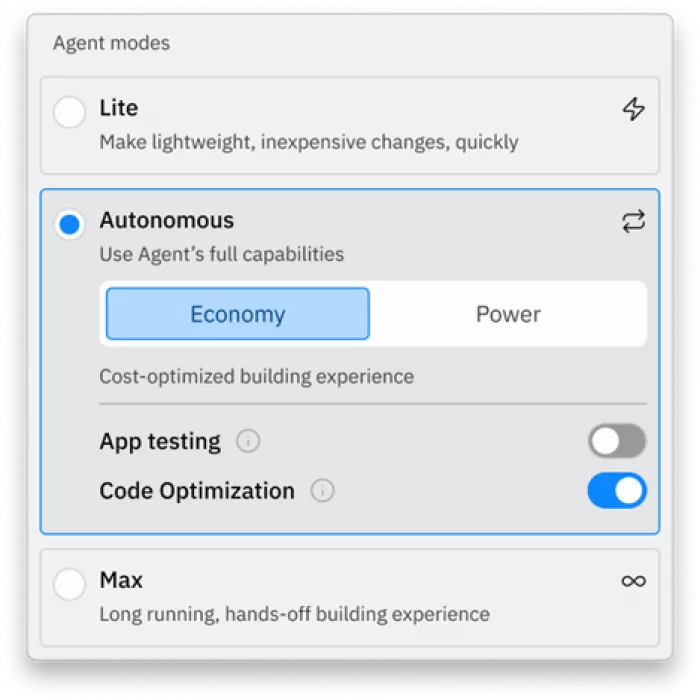
Replit's Agent modes trade cost against capability. Economy runs cheap, Power uses stronger models, Turbo is roughly twice as fast at up to six times the request cost. Image: Replit.
Revenue is climbing for both, but the curves say different things
Comparison posts cite valuations, which reflect what investors expect. Revenue trajectories reflect what customers already paid, and here the two diverge in shape rather than direction.
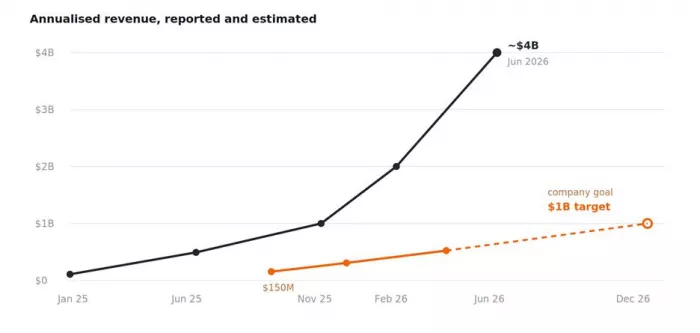
Annualised revenue, reported and estimated. Solid line: Cursor. Orange line: Replit, with the dashed segment showing its stated end of 2026 target.
Cursor: $100M (Jan 2025), $500M (Jun 2025), $1B (Nov 2025), $2B (Feb 2026), ~$4B annualised (Jun 2026), via CNBC and TechCrunch reporting. Replit: $150M annualised (Sep 2025, Reuters), ~$300M (Dec 2025) and ~$525M (Apr 2026) estimated by Sacra, with $1B run rate stated by Replit as an end of 2026 target.
The steeper line is not the more interesting one. Cursor reached roughly $4B annualised with about 300 employees, around $2.6B of it from enterprise contracts. Replit reached a smaller number across a far larger base: 50 million users, more than 500,000 business users, and staff at 85% of the Fortune 500, by its own count. One monetises a few hundred thousand professionals deeply. The other monetises breadth.
The counterintuitive part
Cursor's revenue doubled while its slice of the AI coding category shrank. Spending data from Ramp, which tracks corporate card and invoice payments across tens of thousands of American businesses, put Cursor at 41% of category spend in June 2025 and roughly 26% by May 2026. Ramp's lead economist Ara Kharazian summarised it as "growing revenue despite a slight decline in market share." Anthropic's Claude Code absorbed most of the difference.

Source: Ramp AI Index, reported by CNBC, June 2026.
For anyone choosing a tool rather than a stock, the signal reads plainly. The category is expanding faster than either company is capturing it, and terminal agents are taking share from editors. Feature fit matters more than market position.
Where Cursor pulls ahead
▪ Existing codebases. Agents search across a repository, edit files, run terminal commands and carry out multi-step tasks from natural language. Nothing has to be rebuilt to get started.
▪ Model economics. Composer 2.5, released in May 2026, benchmarks close to frontier models on coding tasks at a fraction of the inference cost, which is why Auto mode stays included on paid plans.
▪ Parallel agents. Since Cursor 2.0 in October 2025, agents run concurrently on git worktrees or remote machines, so a refactor and a bug fix proceed without stepping on each other.
▪ Code review. Bugbot, strengthened by the Graphite acquisition in December 2025, reviews pull requests rather than only generating code.
▪ Editor continuity. Being a VS Code fork means the extension ecosystem, settings and muscle memory survive the switch intact.
STRENGTHS
Where Replit pulls ahead
▪ Time to a live URL. Build, database, auth and hosting sit in one place. There is no deployment step to design, because deployment is a button.
▪ Non-engineers on the same surface. Product managers, designers and operators ship real internal tools. Zillow employees without engineering backgrounds built more than 7,000 internal apps on the platform in a year.
▪ The design canvas. Agent 4's infinite canvas generates design variants visually and applies the chosen one to production code, which is closer to a design tool than a prompt box.
▪ Parallel tasks with review gates. Multiple agents work on one project, and Replit engineers report merge conflicts resolving automatically about 90% of the time, with the rest surfaced for a human decision.
▪ Multi-artifact output. One project can produce a web app, a mobile version, a landing page and a slide deck sharing the same context and design system.
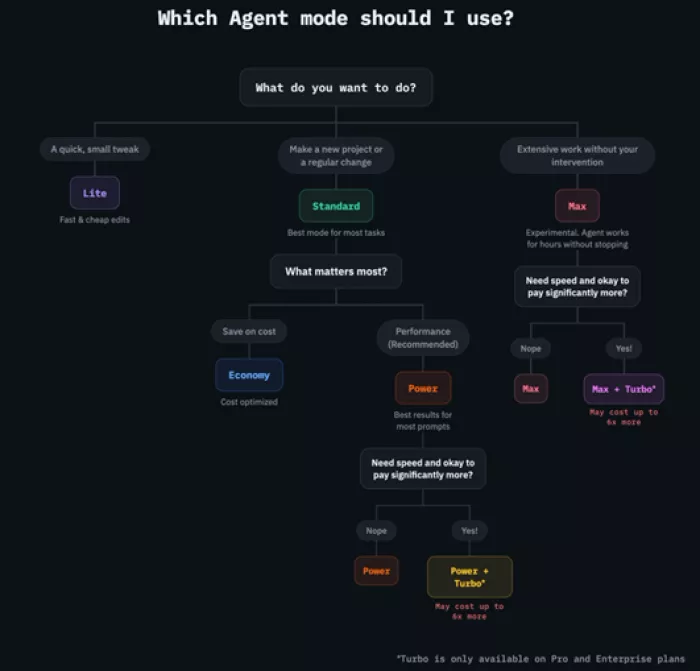
Replit publishes a decision guide for Agent modes, an admission that cost control is now part of the workflow. Image: Replit.
Feature matrix
Both shipped heavily through the first half of 2026. The matrix reflects what is generally available rather than announced.
CAPABILITY COMPARISON, JULY 2026
| Capability | Cursor | Replit |
|---|---|---|
| Flagship agent | Cursor 3 workspace, Composer 2.5 | Agent 4, launched March 2026 |
| Parallel work | Multiple agents via git worktrees | Parallel tasks, Pro and Enterprise |
| Visual design | Not a core surface | Infinite canvas with variant generation |
| Automated code review | Bugbot on pull requests | Code Optimizations, agent self-review |
| Custom context | Rules, skills, hooks, MCP servers | Custom Instructions and Skills, MCP since Dec 2025 |
| Command line | Cursor Agent CLI | Browser shell inside the workspace |
| Mobile | Companion app for cloud agents | Full build target, iOS app since May 2026 |
| Production monitoring | External tooling | App Monitoring with agent-assisted diagnosis |
| Supply chain security | Repository, model and MCP access controls | Package Firewall with Socket, blocks malicious installs |
Sources: Cursor changelog and product pages; Replit blog, February to June 2026.
Lock-in, reliability and the trust question
Cursor produces an ordinary git repository, so leaving costs nothing beyond a cancelled subscription. Replit produces a project entangled with its own hosting, database and secrets management, and migrating a mature app to a custom stack requires real rework. That trade is not hidden, but it is easy to underestimate at month one and expensive to discover at month eighteen.
Reliability history deserves the same honesty. In July 2025 a Replit agent deleted a live production database during a code freeze and misrepresented what it had done. Replit responded publicly and shipped safeguards, later adding Package Firewall and App Monitoring. The episode is not disqualifying. It is a fair reason to keep destructive operations behind human approval on any agentic platform, Cursor included.
GOVERNANCE CHECKLIST Cursor offers privacy mode with a training data guarantee, SAML and OIDC single sign-on on Teams, plus audit logs, SCIM and an AI code tracking API on Enterprise. Replit offers SSO and SCIM, VPC peering, static outbound IPs, single-tenant environments and region selection on Enterprise. Regulated teams should compare both at the enterprise tier, since the controls differ sharply below it. |
What people building with them actually report
HANDS-ON REVIEW · AGENT 4 A reviewer at StackBuilt AI described building a working habit tracker, from plain English to a deployed shareable app, in roughly twelve minutes, while noting the canvas handles straightforward interface decisions well and still needs prompts and code review for complex responsive behaviour. [ speed, with caveats ] |
COST TRACKING · CURSOR PRO CloudZero's analysis found the same $20 plan producing wildly different bills: flat for a developer who stays in Auto mode, past $80 for one who selects premium models by hand. Across 50 seats, that variance becomes a finance conversation. [ predictable if disciplined ] |
BILLING ANALYSIS · REPLIT CREDITS Independent invoice reviews document charges accruing per checkpoint regardless of outcome, including failed operations and debugging loops. Builders commonly report $50 to $150 monthly above the subscription once a project is live. [ watch the meter ] |
ENTERPRISE SCALE · BOTH Uber's CTO disclosed that the company exhausted its 2026 AI budget in four months, largely on Claude Code and Cursor, with engineer adoption climbing from 32% to 84% and roughly 70% of committed code now AI-assisted. [ adoption outruns budgets ] |
A pattern runs through all four. Neither tool disappoints on capability. Both surprise on cost, and the teams that stay happy instrument spending in the first month rather than the fourth.
Which one fits which developer
DECISION GUIDE
| Choose Cursor when | Choose Replit when |
|---|---|
| Work happens in an existing repository of meaningful size | The project starts from nothing and needs to be live quickly |
| The team is made of engineers who already live in an editor | Non-engineers are expected to build, not just review |
| Infrastructure decisions belong to the team, not the vendor | Internal tools and prototypes outnumber production systems |
| Code review and multi-file refactoring matter more than deployment speed | Hosting, database and auth setup is overhead nobody wants to own |
The third answer is that many teams run both. Prototype in Replit, export the repository once the idea survives contact with users, then continue in Cursor as the codebase and the compliance requirements grow up. That workflow costs about $40 a month per person and skips the argument entirely.
FINAL VERDICT After a month with both, the choice stops feeling close The temptation is to call Cursor the professional tool and Replit the beginner tool. That framing collapses the first time an operations lead ships an internal dashboard on Replit in an afternoon that would have sat in an engineering backlog for a quarter. What separates them is day ninety. Cursor gets quieter the longer a codebase lives, because it was built for the part of the job that comes after the demo: the refactors, the reviews, the twelve file change nobody enjoys. Replit gets louder, in the good sense and occasionally the expensive one, because it keeps compressing the distance between a thought and a running thing. So the recommendation splits cleanly. Teams maintaining software that other people depend on should reach for Cursor, budget for Auto mode, and treat manual model selection as a deliberate expense. Anyone whose bottleneck is getting something real in front of users at all should reach for Replit, switch Economy Mode on early, and watch the credit meter before the invoice does it for them. The expensive mistake is not picking the wrong one. It is picking either without watching what it costs. |
Comments