The evening I called the bluff
There is a folder on my laptop called ideas I will absolutely build one day. Three years old, zero things shipped. So when my feed filled with claims that Replit Agent turns a paragraph of English into a working website, I gave up an evening, made a fresh account, and called the bluff.
The rules were strict: free plan only, one detailed prompt for a premium ticket booking website, touch nothing, judge whatever came out, broken bits included.
What came out was Ticketly, a dark, violet-accented events platform with eight listed events, working ticket selectors, category filters and a publish button that put it on the live internet. One image refused to load, and I will show you which one. But I have paid real money for worse.
MY VERDICT 4.3 / 5 ★★★★★ FIRST PREVIEW Under 10 minutes AGENT WORK 15 minutes logged MY COST $0 on Starter OUTPUT Published live FLAWS FOUND 1 broken image, 2 nitpicks BEST FOR Prototypes and MVPs Genuinely impressive for landing pages, prototypes and simple products. Watch the credit meter before anything heavy; that is where most complaints live. |
Replit Agent Explained
Replit began in 2016 as a browser-based coding environment and now serves millions of builders. Replit Agent is the newer layer on top: describe an app in plain language and an AI plans the work, writes the code, wires up a database, tests its own output and deploys the result. No installs, no setup, no local environment.
| Product tested | Replit Agent, the AI app builder in Replit |
| Plan used | Starter, the free tier |
| Project built | Ticketly, a premium ticket booking website |
| Tested | July 2026, zero code written by me |
My Experience With Replit
Sign up: painless, one small hoop
The account modal is generous: Google, email, GitHub, X and Apple sign-in, with a toggle for more. I took the slowest route on purpose, plain email, the path most casual users take.
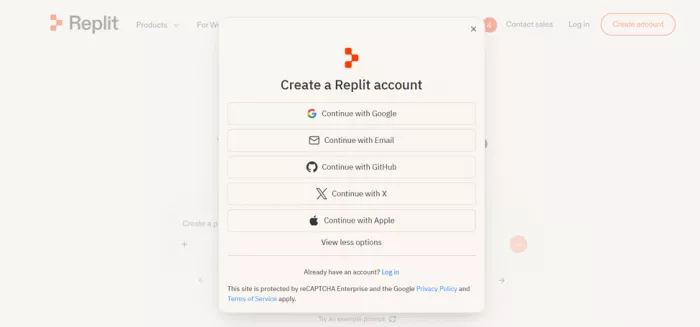
Five sign-in routes, more behind a toggle. Email was the slowest, most honest test.
1. Pick a method; I chose Continue with Email and set a password.
2. A verification email arrives; mine took under a minute.
3. One click opens the workspace, no card details asked.
4. The home screen greets you by name: what do you want to make?
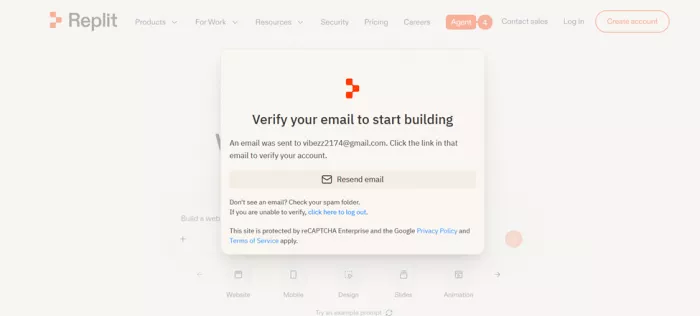
The workspace is calm: a sidebar with projects and two free-plan meters, Agent and Cloud credits, both at zero, plus prompt chips for websites, apps, designs, data visualizations and documents. It teaches you what the tool can do before you type a word.
The prompt: one careful paragraph
I did not want to lob a lazy make me a ticket website and then blame the tool. One deliberate paragraph went in, default Economy mode on, Plan toggle off.
THE EXACT PROMPT I USED Design a stunning, modern, premium ticket booking website with a sleek UI inspired by Apple, Stripe, Linear, Airbnb, and Eventbrite. The aesthetic should feel luxurious, minimal, and highly polished with smooth animations and excellent spacing. The interface should be clean, intuitive, and conversion-focused while maintaining a professional, trustworthy appearance. |
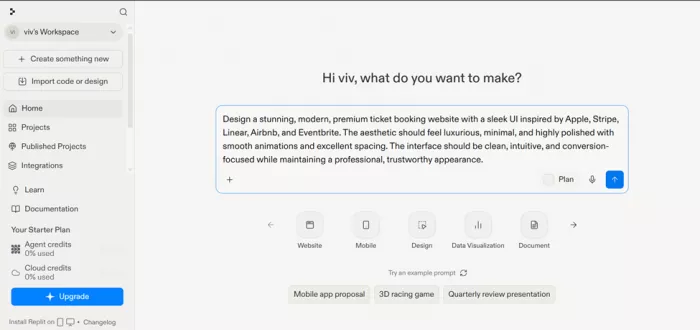
The moment before takeoff. Send button lit, credits untouched.
Three choices did the heavy lifting; I would repeat them on any build:
• Name real style references. Apple, Stripe, Linear, Airbnb and Eventbrite gave the agent a visual target instead of adjective soup.
• Describe the feeling, not the features. Luxurious, minimal and polished shaped every layout decision.
• State the business goal. Conversion-focused and trustworthy put a Get Tickets link on every card.
Fifteen quiet minutes of building
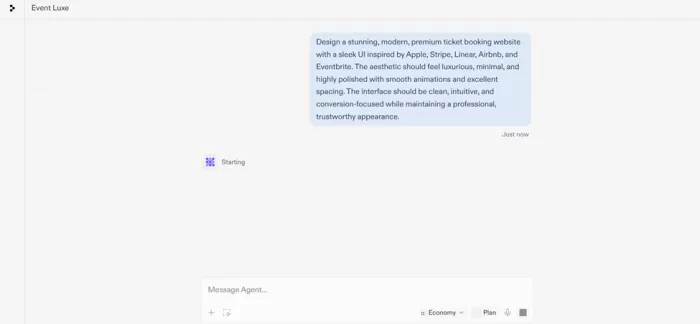
What happens next feels less like a loading bar, more like a contractor narrating their work. The agent drafted a plan, scaffolded the project and checked its own output. It even named things for me: Event Luxe for the project, Ticketly for the site. My contractor keeps separate names for the job and the invoice.
| TIME | BUILD SESSION · EVENT LUXE → TICKETLY |
| 00:00 | Prompt submitted. Agent drafts a plan and picks a stack. |
| ~02:00 | Project scaffolded as Event Luxe. Pages and seed data appear. |
| ~08:00 | First live preview: a dark, violet-accented homepage branded Ticketly. |
| 15:00 | Checkpoint saved. Agent logs 15 minutes of work, status “complete and running cleanly”. |
By the end, the usage meter by the project name read 71 percent, a reminder that free credits are finite. Unprompted, it had also opened a Publish panel, subdomain checked and available.
By the end, the usage meter by the project name read 71 percent, a reminder that free credits are finite. Unprompted, it had also opened a Publish panel, subdomain checked and available.
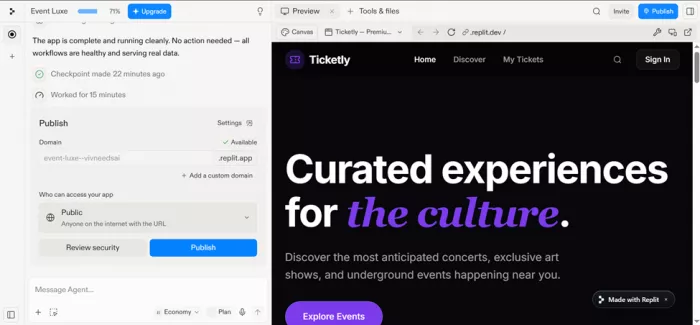
Build complete. Health confirmed, publish panel ready with a free subdomain.
Touring Ticketly: what one prompt produced
The homepage opens on a near-black canvas with a confident headline, Curated experiences for the culture, the last two words in italic violet. Below it: a one-line pitch about concerts, art shows and underground events, then one Explore Events button. Closer to the Apple and Eventbrite references than I expected from a machine.

The hero the agent designed. Nobody told it to do any of this.
Scroll down and the site keeps going, even though the prompt never listed a single page. Here is what the agent decided a ticketing product needs:
| SECTION | WHAT THE AGENT BUILT | STANDOUT DETAIL |
| Navigation | Home, Discover, My Tickets, search and Sign In | Product structure, not just a landing page |
| Trending Now | Eight event cards with photos, categories and dates | Believable prices, $75 to $350, each with a Get Tickets link |
| Event pages | Hero image, date, venue and an About this event section | Every card links to a dedicated page |
| Ticket selection | Tiered pricing with working quantity steppers | General Admission $125, Reserved Floor $225, plus a Premium tier |
| Categories | Category chips with live counts | Music, Sports, Arts, Food & Drink and Comedy, all filterable |
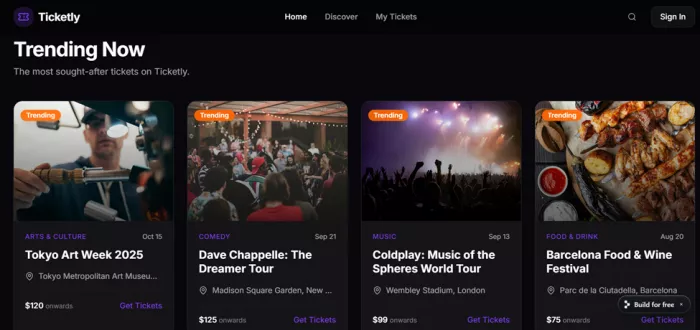
The Trending Now grid. Categories, dates, venues and prices on every card.
The seed data deserves a mention. The agent invented a plausible catalog: a Tokyo art week, a comedy night at Madison Square Garden, a Wembley stadium concert, a Barcelona food festival and marquee sports listings, priced from $75 to $350. One caveat: the placeholder data borrows real artist and league names, fine in a demo, first thing to replace before going commercial.
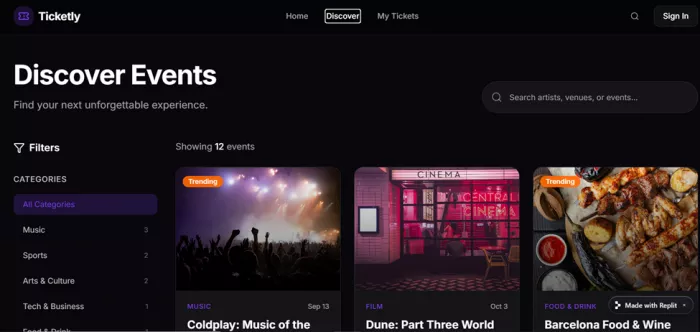
A full event page. Three ticket tiers with quantity steppers that actually work.
The one thing that broke
I promised honesty. On the trending grid, the Formula 1 Monaco Grand Prix card shipped a dead image: raw alt text on an empty tile where every other card shows a photo. A small wound, but on a brief demanding premium and polished, it is the detail that undoes the illusion.
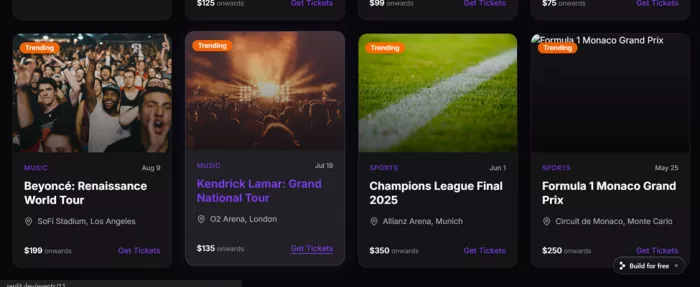
Spot the odd one out. Far right: alt text where the Monaco photo should be.
Everything I found wrong after clicking every page:
REAL FLAW One broken event image
The Monaco photo never loaded. A one-line follow-up prompt fixes it, but the agent's own testing should have caught it.
NITPICK An odd showtime
One headline event is scheduled for 1:30 AM on a Sunday. Technically valid, humanly unlikely; generated data still needs a proofread.
NITPICK Placeholder names are real names
Demo events borrow real artists and leagues. Fine for a prototype, replace before commercial use.
NOT A FLAW Everything else held up
Navigation, filters, event pages and ticket steppers all worked first try. I hunted for more breakage and found none.
Publishing: two clicks to the internet
The publish flow is the most confident part of the product. The panel had already verified my free replit.app subdomain, offered a custom domain field, let me set access to public, and included a Review security check. One click on Publish and Ticketly was a real URL I could text to friends.
Free-tier footnotes: a small Made with Replit badge stays, and Starter allows one published project, live for roughly 30 days before a republish. Paid plans remove both limits.
| Want to see it live? Ticketly is up right now at https://event-luxe--vivneedsai.replit.app. Click around, and go find the Monaco card. |
What I liked, what could be better
WHERE IT WON ME OVER • Zero setup: from email verification to building in two minutes • Design taste that honored the style references in my prompt • Sensible product decisions I never asked for, like event pages and categories • Checkpoints and a plain-language build log you can actually follow | WHERE IT NEEDS WORK • Its self-testing pass missed an obvious broken image • Credit consumption is opaque; effort-based billing is hard to predict • Free plan limits arrive quickly once you iterate • Complex, multi-feature apps demand more steering than the demos suggest |
Replit pricing in 2026
My test cost nothing. Past the free tier, Replit bills by effort: every Agent request consumes credits in proportion to the work performed, and the same pool covers hosting, storage and databases once your app is live.
PLANS AS LISTED ON REPLIT.COM, JULY 2026
| PLAN | PRICE | INCLUDED CREDITS | HIGHLIGHTS |
| Starter | Free | Free daily Agent credits | Built-in database, publish 1 project, Made with Replit badge stays |
| Replit Core | $25/mo ($20/mo annual) | $25 per month | Up to 5 collaborators, 2 parallel agents, unlimited workspaces, badge removed |
| Replit Pro | $100/mo ($95/mo annual) | $100 per month | Up to 15 collaborators, one-month credit rollover, 10 parallel agents, priority support |
| Enterprise | Custom | Custom | SSO, compliance controls and dedicated support |
The fine print: Core credits expire monthly, Pro credits roll over one month, and an empty balance can shift to pay-as-you-go billing. Set the built-in spending limits; after a few hundred reviews, that is step one of any paid plan.
Ratings across platforms
One evening is a data point, not a dataset, so I pulled Replit's standing across the big review sites. The spread tells its own story.
CHECKED JULY 2026; LIVE FIGURES SHIFT
| PLATFORM | RATING | VOLUME | PREVAILING MOOD |
| G2 | 4.5 / 5 | 357 reviews | Ease of use and speed lead praise; cost and credit burn lead complaints |
| Capterra | 4.6 / 5 | Smaller pool | Beloved by beginners shipping first MVPs; token model called confusing |
| Trustpilot | 3.0 / 5 | ~1,500 reviews | Sharply split: five-star success stories against one-star billing disputes |
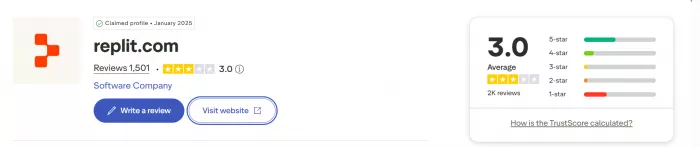
The 4.5 on G2 and the 3.0 on Trustpilot are not a contradiction. They are the same product measured at two moments: the thrill of the first build, and the bill after a heavy month.
What users say, site by site
I read recent reviews on each platform so you do not have to. These cards paraphrase recurring themes, because patterns beat cherry-picked quotes.
RECURRING THEMES PER PLATFORM
| PLATFORM | MOOD | WHAT REVIEWERS SAY |
| G2 | MOSTLY POSITIVE | Reviewers rank ease of use as the defining strength, describing prototypes built in hours, not weeks. The most-tagged weaknesses are expense and the credit system, with long posts warning that annual plans issue credits monthly, not as a yearly pool. |
| Capterra | MOSTLY POSITIVE | The dominant storyline is non-coders finally shipping ideas shelved for years. Frustrations center on the token model: the agent sometimes builds a full solution when reviewers only wanted advice, quietly spending credits; a few report slow billing support. |
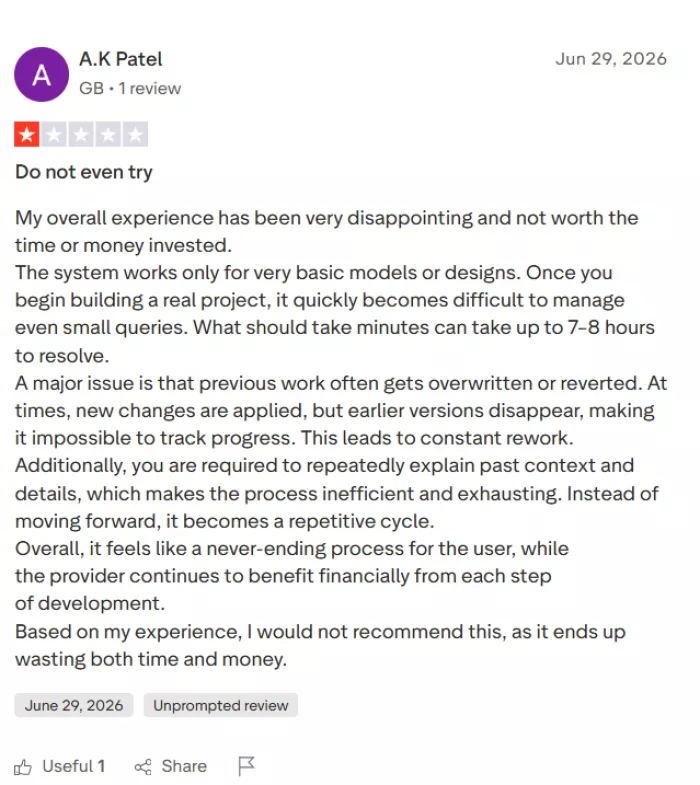
| Trustpilot | POLARIZED | The page reads like two different products. Enthusiastic reviewers describe learning to build as the agent explains each step. Angry ones describe credits vanishing within hours, surprise overage charges, and slow-moving support tickets. |
| Product Hunt | IMPRESSED BUT WARY | The community calls the Agent one of the most impressive AI demos of its generation, praising how fast an idea becomes a shareable link. The caveat is depth: makers note it shines on simple builds and gets buggy as complexity grows, and free-tier limits draw grumbles. |
| PRACTICAL AND BLUNT | Threads swing between show-and-tell victories and cautionary tales of credit burn, including modest plans turning into triple-digit bills in heavy debugging weeks. The playbook: specific prompts, checkpoints, daily glances at the usage meter, and a hard budget cap before serious sessions. |
Who should use Replit Agent
A GREAT FIT IF YOU ARE • A founder who needs a convincing MVP before hiring anyone • A designer or marketer who wants real, clickable prototypes • A developer who wants scaffolding and boilerplate handled • A student or hobbyist learning how products come together | LOOK ELSEWHERE IF YOU • Need strictly predictable costs on heavy builds • Are shipping complex production apps with compliance needs • Expect AI output to need zero human review • Already live happily in a local editor with AI tooling |
My final take, after the dust settled
A week on, Ticketly is still live at its replit.app address, and I keep opening it the way you check on a plant you did not expect to survive. A site I described in five sentences, built in fifteen minutes, with one broken image and a suspicious 1:30 AM showtime, and it still looks better than projects I once spent whole weekends on.
My scorecard lands at 4.3 out of 5, and the missing 0.7 is earned: the agent's own testing should have caught that dead image, generated data still needs human eyes, and the pricing model rewards fine-print readers. Going past a prototype, I would upgrade to Core, switch on a spending cap the same minute, and treat every vague prompt as money left on the table.
But I keep coming back to that folder on my laptop, three years of unbuilt ideas. For the first time, the distance between any of them and a live URL is one paragraph and one free evening. You will not find that on a pricing page, and it is the real reason this review exists.
One of those folder ideas is next. I suggest you bring one of yours.
Comments