Table of Contents
- ElevenLabs vs PlayHT at a Glance
- What Makes an AI Voice Natural?
- ElevenLabs Voice Quality
- PlayHT Voice Quality
- Naturalness vs Consistency
- Voice Cloning
- Long-Form Narration
- Conversational AI
- Languages and Accents
- Control and Workflow
- API and Developer Use
- Pricing in 2026
- Commercial Use and Voice Rights
- Where ElevenLabs Is Better
- Where PlayHT Is Better
- Best Choice by Use Case
- Which Sounds More Natural?
ElevenLabs and PlayHT can both produce AI speech that sounds convincing in a short demo. The bigger differences appear once the script becomes difficult: long paragraphs, emotional shifts, unusual names, multiple speakers, another language, or a live conversation where even a small delay makes the exchange feel artificial.
That is why the better question in 2026 is not simply which platform has the most human-sounding voice. It is which one stays natural, controllable, and consistent for the type of audio you actually need to produce.
ElevenLabs vs PlayHT at a Glance
Both platforms now offer several voice models aimed at different workloads. ElevenLabs separates its expressive Eleven v3 model from Multilingual v2 for more stable production and Flash v2.5 for lower-latency applications. PlayHT follows a similar approach with PlayDialog for emotive conversational speech and Play 3.0 Mini for faster multilingual generation.
| Area | ElevenLabs | PlayHT |
| Naturalness strength | Expressive, polished speech | Conversational and context-aware delivery |
| Main expressive model | Eleven v3 | PlayDialog |
| Faster model | Flash v2.5 | Play 3.0 Mini |
| Voice cloning | Instant + Professional Voice Cloning | Fast voice cloning |
| Long-form production | Particularly strong | Good, especially for streaming workflows |
| Real-time applications | Strong with Flash models | Strong with Play 3.0 Mini |
| Best suited to | Narration, storytelling, production, creators | Conversational apps, developers, rapid cloning |
The important point is that neither platform has one fixed sound. Comparing ElevenLabs with PlayHT without naming the model can produce a misleading result because each model makes different compromises between expression, speed, and consistency.
What Makes an AI Voice Natural?
Naturalness is more than having a pleasant voice. A useful comparison needs to examine how the model behaves when the text stops being easy.
Pronunciation is one obvious test. Names, abbreviations, percentages, currencies, technical terms, and mixed-language sentences quickly expose weaknesses that a carefully written demo script can hide. Prosody matters just as much because a voice can pronounce every word correctly while still emphasizing the wrong part of the sentence.
Pacing becomes increasingly important in longer content. Some AI voices sound excellent for twenty seconds but begin repeating the same rhythm after several minutes. Similar pauses, identical sentence endings, and predictable rises in pitch eventually make the model noticeable.
Emotion needs the same scrutiny. A voice does not sound genuinely excited simply because its pitch rises. Convincing emotional delivery changes the pace, intensity, pauses, and emphasis together.
There is also a less obvious test: listener fatigue. A highly dramatic voice may impress immediately but become tiring over an audiobook or one-hour training course. For long-form work, a restrained and consistent voice can sound more natural precisely because it draws less attention to itself.
ElevenLabs Voice Quality
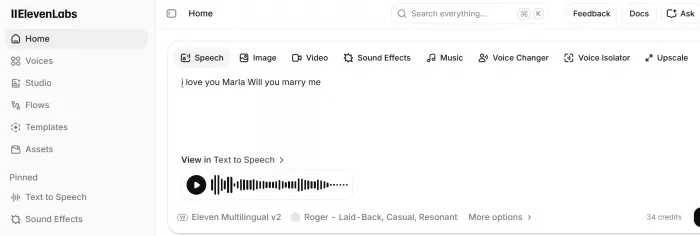
ElevenLabs remains particularly strong when the script needs performance rather than simple narration. Eleven v3 is built around expressive delivery, supporting emotional variation, multiple speakers, and performance cues such as whispers, laughter, or stronger reactions. That makes it a good fit for character dialogue, advertising, fiction, storytelling, and narration that needs obvious shifts in tone.
The benefit is range. A script can move from restrained explanation into a more dramatic section without sounding as though every paragraph was read with the same emotional setting.
The trade-off is that greater interpretation can also introduce more variation between generations. For creative work that may be desirable because users can choose the strongest take. In structured corporate production, however, having to regenerate lines until the delivery matches surrounding audio can add unnecessary editing work.
Multilingual v2 Still Has a Role
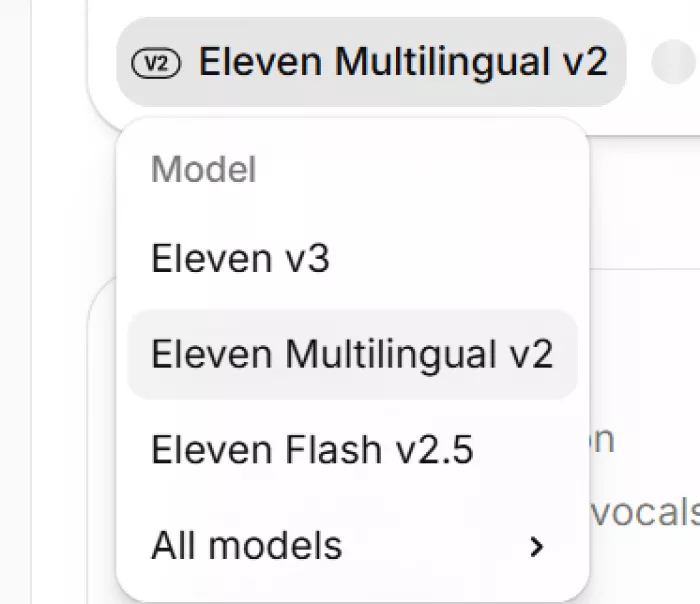
Eleven v3 may be the more advanced expressive model, but Multilingual v2 remains relevant because long-form content often values predictability over dramatic range.
For training material, documentaries, instructional videos, and other projects where the same narrator has to sound stable across many sections, consistency matters more than the ability to insert a laugh or sudden emotional shift.
This is an important distinction because newer does not automatically mean better for every production workflow. A voice model that offers more creative interpretation may actually create more work when hundreds of clips need to match.
Flash v2.5 for Real-Time Use
Flash v2.5 addresses a different problem: response speed.
ElevenLabs reports roughly 75 ms of model inference latency for Flash v2.5, although actual user-perceived delay also depends on the network, application, language model, and playback system.
That makes Flash much more suitable for voice agents, games, interactive applications, and other situations where the listener is waiting for an immediate response.
For those use cases, a slightly less expressive voice can still feel more natural because conversational timing is part of naturalness. A rich voice that consistently arrives late can make an AI assistant feel less human than a faster model with slightly simpler delivery.
PlayHT Voice Quality
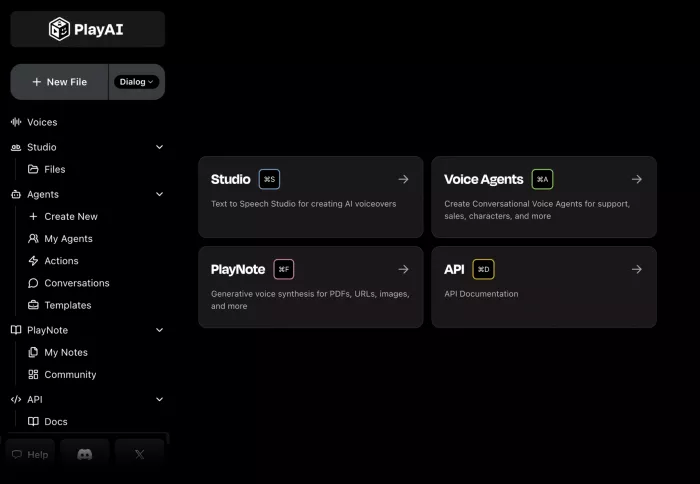
PlayHT becomes especially interesting when speech is part of a conversation rather than a finished narration.
PlayDialog is designed around expressive, context-aware speech. It can use conversational history to influence pacing, intonation, and emotional delivery, which matters because dialogue is rarely understood correctly one sentence at a time.
Consider the line: “I thought you already sent it.”
Depending on what happened before, that sentence could sound surprised, annoyed, confused, or defensive. A model that considers conversational context has more information available when deciding how the line should be delivered.
That makes PlayDialog well suited to conversational agents, multi-speaker experiences, character interactions, and dialogue-heavy content.
Play 3.0 Mini Prioritizes Speed
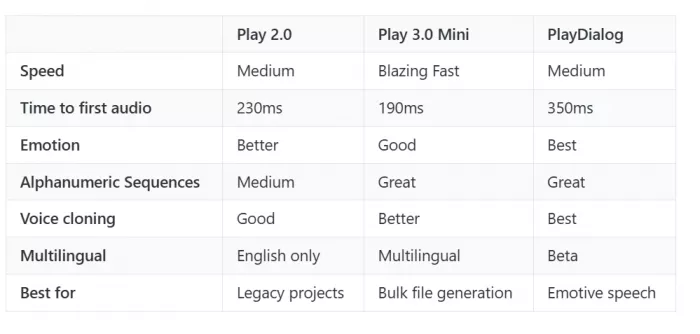
Play 3.0 Mini shifts the focus toward faster generation, streaming, and multilingual workloads. PlayHT reports a time to first audio of around 190 ms, making it the more practical choice inside the PlayHT family when responsiveness matters more than maximum emotional depth.
This creates an important split similar to ElevenLabs.
PlayDialog is the stronger option when the question is, “How expressive can this conversation sound?” Play 3.0 Mini makes more sense when the question becomes, “How quickly can I deliver reliable speech inside a live product?”
Naturalness vs Consistency
One of the biggest mistakes in AI voice comparisons is judging quality from the best sample each platform can produce.
Professional users care just as much about how often the system produces usable audio on the first attempt.
Imagine generating a 30-minute documentary. If one platform creates a spectacular voice but requires several regenerations whenever emphasis lands incorrectly, its real cost includes both additional credits and editing time. Another platform may sound slightly less dramatic at its best but produce far more usable first takes.
Long-form naturalness therefore depends on three things working together:
● The voice should retain the same identity and energy across separately generated sections instead of drifting noticeably over time.
● Sentence rhythm should remain varied enough to avoid sounding mechanical without becoming so unpredictable that adjacent clips feel mismatched.
● Pronunciation and emphasis should remain repeatable, especially when the same names or technical terms appear throughout a project.
This is where consistency starts to matter as much as raw voice realism.
Voice Cloning
Both platforms support voice cloning, but they approach the problem differently.
ElevenLabs offers Instant Voice Cloning for fast setup and Professional Voice Cloning for users who need a more faithful synthetic version of their own voice. Instant cloning works from relatively short recordings, while the professional option uses substantially more source material and is designed for higher fidelity.
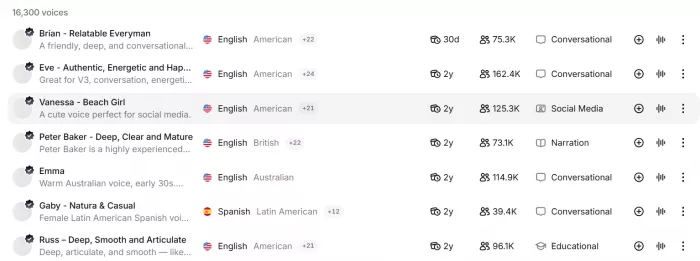
Figure: Elevenlabs Voice Explore section
Professional Voice Cloning is particularly relevant for creators, executives, educators, and public-facing professionals who want to maintain one recognizable synthetic voice across many projects.
PlayHT places more emphasis on reducing the setup barrier. Its recent cloning workflow can work from a comparatively short voice sample, making it useful for users who want to create and test voices quickly.
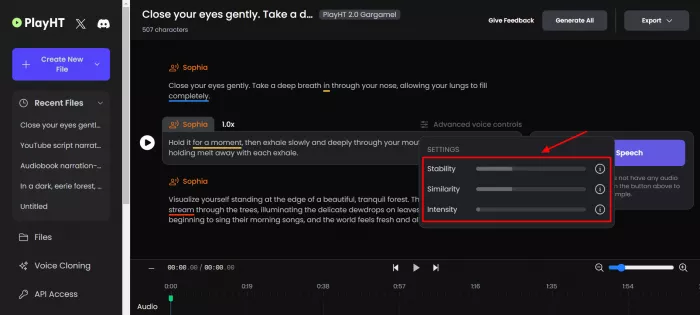
The better cloning comparison is not simply which output sounds closest during one sentence. A useful clone should preserve accent, pacing, vocal character, and identity even when the script changes.
It should also remain recognizable when the speaker becomes more emotional or moves into another supported language. Some clones sound accurate only when reading text similar to the original recording. That limitation becomes obvious once the synthetic voice is pushed outside its source material.
Where ElevenLabs Has an Edge
ElevenLabs' Professional Voice Cloning gives it the stronger proposition when fidelity and long-term voice consistency matter more than setup time.
Where PlayHT Has an Edge
PlayHT is appealing when fast cloning and experimentation matter more than building a deeply trained permanent voice.
Long-Form Narration
For audiobooks, documentaries, YouTube narration, and educational material, ElevenLabs has the stronger overall production position.
The biggest reason is flexibility. Eleven v3 gives creators access to richer emotional delivery, while Multilingual v2 offers a safer option when consistency matters more. Users are not forced to make one model handle every style of narration.
This matters because long-form content rarely needs maximum expression from beginning to end. A documentary may contain a dramatic opening, neutral explanatory sections, quoted dialogue, and a restrained conclusion. Having different model options allows the producer to decide how much interpretation the voice should provide.
PlayHT can still handle long-form speech effectively, particularly with Play 3.0 Mini, but its strongest differentiation appears more clearly in streaming and conversational workflows.
For either platform, large scripts should be generated in manageable sections. Breaking a chapter into sensible units makes it easier to fix one pronunciation or awkward sentence without regenerating several minutes of usable audio.
Conversational AI
The comparison becomes much closer for voice agents and interactive applications. A natural AI conversation depends on more than speech quality. The full experience includes speech recognition, language-model processing, TTS generation, network delay, and playback. Each stage contributes to how quickly the user hears a response.
That makes latency part of the voice experience rather than a purely technical metric.
ElevenLabs Flash models are built specifically for this type of workload, while PlayHT's Play 3.0 Mini similarly emphasizes streaming and responsiveness. PlayDialog adds another advantage when conversational context and emotional delivery matter.
The most sensible way to choose between them for an AI agent is therefore not to listen to static samples on each website. Build the same short conversational workflow with both and measure how quickly the first audible response arrives under your actual network conditions.
For conversational products, the voice that sounds best in an exported MP3 is not automatically the voice that feels most natural in a live exchange.
Languages and Accents
Language support has expanded substantially on both platforms, but headline language counts should not determine the choice by themselves.
Eleven v3 supports more than 70 languages, while other ElevenLabs models support smaller sets depending on their design. PlayHT's Play 3.0 Mini supports dozens of languages and is positioned for multilingual workloads.
The more useful question is how well each platform handles the specific language and accent you need.
A technically correct Spanish reading can still sound noticeably American if the underlying voice identity was trained around American English. The same issue appears with regional English accents, place names, and code-switching between languages.
For multilingual projects, test:
● Local names and place names rather than only generic sentences because pronunciation differences become far easier to hear.
● Numbers, dates, currencies, and abbreviations because formatting conventions vary significantly between languages.
● Mixed-language sentences if your audience regularly switches languages within the same conversation.
● The same cloned voice across languages to see whether the speaker's identity remains believable instead of changing dramatically.
A platform supporting more languages is only an advantage if the languages you actually need sound natural enough for publication.
Control and Workflow
Model quality gets most of the attention, but production workflow often determines which platform users prefer after several weeks.
PlayHT offers API controls for areas such as speech speed, output quality, sample rate, and supported style or voice guidance. That level of parameter control is useful for developers who want consistent settings stored inside an application.
ElevenLabs increasingly combines conventional settings with prompt-based performance direction, particularly through Eleven v3. Audio tags and contextual instructions can make creative direction feel more intuitive for writers and producers.
The important question is not which platform has the longest settings menu. It is how quickly you can repair one bad sentence without disrupting the rest of the project.
For regular content production, regeneration speed, voice history, project organization, pronunciation correction, and the ability to replace individual lines can matter more than adding another hundred voices to the library.
API and Developer Use
Both services have matured well beyond simple browser-based voice generators.
ElevenLabs provides APIs across text-to-speech, transcription, dubbing, voice changing, agents, and related audio tools. Different models also have different concurrency characteristics, which becomes relevant once an application has many simultaneous users.
PlayHT supports streaming through HTTP and WebSockets along with Python and Node.js tooling. Its positioning remains particularly attractive for developers building speech directly into products.
For a prototype, almost any modern TTS API can appear fast enough. At production scale, developers should compare four things more carefully: actual latency from the regions where users live, concurrency limits, cost at expected usage volume, and whether the preferred voice still sounds acceptable when a faster model is used.
Pricing in 2026
Pricing is fairly straightforward once you ignore the raw credit numbers, which are calculated differently by each platform.
| Plan | ElevenLabs | PlayHT |
| Free | $0, 10,000 credits | $0, 10,000 credits |
| Entry paid plan | Starter: $6/month, 30,000 credits | Creator: $9.99/month, 1 million credits |
| Mid-tier | Creator: $22/month, 121,000 credits | Studio: $34.99/month, 3.5 million credits |
| Higher-volume | Pro: $99/month, 600,000 credits | Scale: Custom pricing |
| Business | Scale: $299/month, 1.8M credits; Business: $990/month, 6M credits | Custom enterprise pricing |
ElevenLabs is cheaper to enter, with its $6 Starter plan, while the $22 Creator plan is the more practical option for regular users because it adds a larger allowance and Professional Voice Cloning. PlayHT starts higher at $9.99 for Creator, while its $34.99 Studio plan is aimed at heavier users and includes API access.
If you are unsure whether 10,000 free credits will be enough, the answer depends heavily on how much audio you generate and which models you use. Is ElevenLabs worth paying for? becomes a more relevant question once regular narration, repeated generations, or commercial projects start eating into the free allowance.
PlayHT appears to offer far more credits on paper, but the two platforms do not calculate credits in the same way, so those totals should not be compared directly. The better value depends on how much usable audio you generate, how often you need to regenerate lines, and whether you need features such as professional cloning or API access.
Note : Pricing checked August 2026 and may change in future.
Commercial Use and Voice Rights
Commercial users also need to consider licensing and voice consent.
ElevenLabs provides commercial usage rights for eligible content created under paid plans, while its free tier has stricter commercial limitations. Its Professional Voice Cloning process is also tightly controlled and designed around verified ownership of the cloned voice.
PlayHT similarly requires users to have permission to clone a voice and places consent requirements around voice replication.
For individual creators, these rules are usually manageable. Agencies, publishers, and companies should be more systematic because voice cloning deals with a person's recognizable identity.
Written consent, clear rights ownership, and internal records should be established before production begins rather than after synthetic audio has already been published.
Where ElevenLabs Is Better
ElevenLabs is the stronger choice when production quality and creative range are the priority.
● Its model selection gives creators more flexibility across different types of narration instead of forcing one voice engine to handle everything from live agents to dramatic storytelling.
● Eleven v3 provides a wider expressive palette for character work, advertising, fiction, and emotionally varied narration.
● Professional Voice Cloning gives serious users a deeper option when reproducing their own voice accurately matters more than quick setup.
● Its broader audio ecosystem makes sense for teams that need more than TTS, including dubbing, transcription, agents, and other production workflows.
The main compromise is that maximum expressiveness can require more supervision and occasional regeneration.
Where PlayHT Is Better
PlayHT makes a stronger argument when speech is being embedded into an application rather than exported as finished narration.
● PlayDialog's conversational focus gives it a natural role in multi-turn dialogue where previous sentences affect how the next line should sound.
● Play 3.0 Mini provides a practical low-latency option for streaming, multilingual products, and large-scale generation.
● Voice cloning has a low setup barrier, which makes PlayHT attractive for rapid prototyping and experimentation.
● Developer-facing controls make it easier to tune delivery programmatically inside products that need repeatable settings.
For users whose priority is polished standalone narration, ElevenLabs still offers the broader creative proposition.
Best Choice by Use Case
| Use Case | Better Starting Point | Reason |
| YouTube narration | ElevenLabs | Strong combination of expression and long-form consistency |
| Audiobooks | ElevenLabs | Better choice between dramatic and stable models |
| Ads and trailers | ElevenLabs | Greater expressive control |
| Character dialogue | Close | Eleven v3 is expressive; PlayDialog benefits from conversational context |
| AI voice agents | Close | Both have strong low-latency models |
| Fast voice cloning | PlayHT | Lower setup barrier |
| High-fidelity personal clone | ElevenLabs | Professional Voice Cloning is built for deeper fidelity |
| E-learning | ElevenLabs | Stable long-form production is a strong fit |
| Multilingual applications | Close | Quality depends heavily on the exact language and accent |
| Developer products | PlayHT / ElevenLabs | Final choice depends on latency, scale, API requirements, and cost |
Which Sounds More Natural?
For polished narration, storytelling, ads, audiobooks, and creator-focused production, ElevenLabs has the stronger overall naturalness advantage in 2026. Eleven v3 provides more expressive range, while Multilingual v2 gives users a more controlled option when long-form stability matters.
PlayHT becomes more competitive once the use case shifts toward conversational products. PlayDialog's context-aware approach is well suited to dialogue, while Play 3.0 Mini gives developers a faster model for streaming and live applications. Its cloning workflow is also appealing when users want to create and test voices quickly.
For most creators producing finished audio, I would start with ElevenLabs. For developers building voice directly into an interactive product, PlayHT deserves an equally serious test alongside ElevenLabs Flash.
The better platform ultimately depends on what “natural” means for the project. In short-form creative work, it may mean emotional richness. In an audiobook, it may mean maintaining the same rhythm and personality for hours. In a voice agent, it may simply mean answering quickly enough that the listener never notices the machinery behind the conversation. That is a more useful standard than judging either platform from its best ten-second demo.
Comments