Table of Contents
- A word on where these numbers come from
- Credits: the part that decides everything else
- The free plan, in detail
- The licence cliff, which is the real product
- What each paid tier is actually selling
- Overages and the point where staying put costs more
- The question the pricing page can't answer: compared to what?
- The part that costs more than the subscription
- Verdict
- How to check any of this in ninety seconds
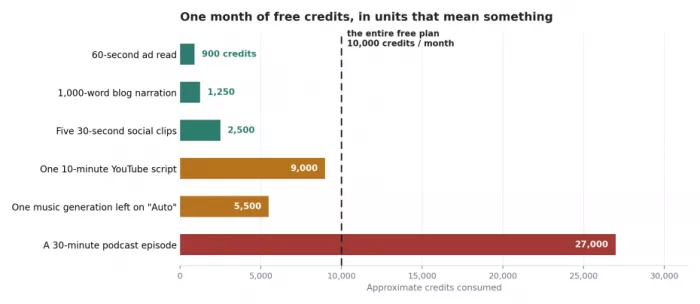
A ten-minute YouTube script runs to about 9,000 characters. The ElevenLabs free plan gives you 10,000 credits a month, and one credit is one character on the standard model. So the free plan is one script. Not one script a week one script, and then you wait until your billing date.
That's the honest starting point for this question, and it's usually buried on page four of guides that lead with a feature table. What follows is the rest of it: how credits are actually spent, where the paid tiers stop being about features and start being about volume, what the $5 step really buys you, and whether any of it is worth the money when a competent alternative charges a fraction as much per character.
A word on where these numbers come from
ElevenLabs pricing is unusually badly documented on the open web, and not because it's complicated but because it moves. Cross-referencing a dozen guides published between March and August 2026 produced flat contradictions on basic facts:
| Detail | One source says | Another says |
| Starter price | $5/month | $6/month |
| Creator credits | 100,000 | 121,000 |
| Pro credits | 500,000 | 600,000 |
| Scale price | $299/month | $330/month |
| Business price | $990/month | $1,320/month |
| Voice cloning on free | Not available, Starter required | Available verified 8 June 2026 |
All of those articles are confidently written, most were updated recently, and a large share carry affiliate links to the plan they recommend. That combination is worth holding in mind whenever an AI pricing guide arrives at a clean answer.
So: treat every figure below as a well-sourced approximation with a date on it, not gospel. The structural claims how credits burn, where the licence sits, what each tier unlocks have been stable for months and are the part worth learning. The exact dollar amounts should be confirmed on the official pricing page before you enter a card. There's a ninety-second verification routine at the end of this article.
Credits: the part that decides everything else
Almost every guide flattens this to "one credit equals one character" and moves on. That's true of one model, on one product, and it's why people's cost estimates come out wrong.
There are two multipliers stacked on top of each other.
Layer one: which model you pick
• Multilingual v2 and Eleven v3 burn at roughly one credit per character. These are the expressive models the reason people choose ElevenLabs at all and they are the expensive setting.
• Flash and Turbo burn at around half a credit per character. ElevenLabs' own pricing page describes this as a range rather than a fixed number, which means your actual rate varies by tier. In practice, drafting on Flash and rendering finals on Multilingual roughly doubles what a month of credits is worth.
As a working conversion: about 1,000 credits produces roughly one minute of speech on the standard model. Hold that number, because it's the only one you need for most estimates.
Layer two: which product you're using
This is the part that catches people. Text-to-speech, speech-to-text, dubbing, sound effects, music and conversational agents all draw from the same credit pool, at wildly different rates. Speech-to-text and dubbing cost far more per minute of output than plain narration. Music is the outlier one tester reported that leaving generation length on "Auto" can burn more than 5,000 credits on a single experiment, which is half a free month evaporating on one click.
"How far does the free plan go" has no single answer. It goes about ten minutes if you only do text-to-speech, or roughly two clicks if you go exploring in Music.
The free plan, in detail
It's a real plan, not a trial. It doesn't expire, it doesn't ask for a card, and it refills monthly. Here is what it holds.
What you get
• 10,000 credits per month roughly 10 minutes of Multilingual v2 speech, around 20 minutes if you stay on Flash, or about 15 minutes of conversational agent time. In word terms, testers put it at 7,000–10,000 words depending on the model and how the text is formatted.
• The full voice library. This is genuinely more generous than most free tiers, which lock you into a handful of demo voices. You get the whole catalogue thousands of voices across dozens of languages which means the free plan is a completely valid way to evaluate the thing everyone actually cares about, which is whether the voices sound good.
• Three custom voice slots (against 10 on Starter and 30 on Creator), shared between designed voices and clones.
• Voice Design, sound effects and a small number of Studio projects, enough to understand the workflow without finishing anything in it.
The cloning question, which nobody agrees on
Older guides state flatly that Instant Voice Cloning requires Starter. A tester who set up a fresh free account in June 2026 reported the opposite: that the Instant Voice Clone flow opened with no paywall, needing about ten seconds of source audio, with only Professional Voice Cloning still gated behind Creator.
Both can be true at different times, which is exactly the problem with this topic. If cloning your own voice is the reason you're considering ElevenLabs at all, check it on a fresh free account before you decide anything. It takes two minutes and it changes the entire calculation.
Where it stops
• Credits don't roll over. Paid plans carry unused credits for up to two months. Free credits expire on your billing date. Use them or lose them.
• No commercial rights, and an attribution requirement. This is the wall, and it deserves its own section below.
• Professional Voice Cloning is out of reach at any usage level on free.
• The upgrade nudge arrives early. Testers report the prompt appearing once you drop below roughly a quarter of your credits around 2,400 remaining. That's a designed funnel, not a bug, and it's worth recognising it as one.
What the free plan is actually for It is an evaluation tool, and an unusually good one. You can hear every voice, test your own script, compare models, and form a real opinion about quality which is the only question the free plan needs to answer. It is not a production tier and was never meant to be. Treat it as a demo you can keep, decide within a week, and don't try to build a publishing schedule on it. |
The licence cliff, which is the real product
Here is the single most important sentence in this article: free-tier audio cannot legally be used in monetised content, client work, or anything you sell, and content published from the free plan is expected to credit ElevenLabs.
That means no YouTube monetisation, no paid podcast, no client deliverable, no app you charge for. The audio is fine for a personal project, a demo, an internal test. The moment money is attached to it, you need a paid plan.
And the paid plan you need is the cheapest one. Commercial rights arrive at Starter five or six dollars, depending on which source and which month and every tier above carries the same licence forward. Once you've cleared that first paywall, licensing is no longer a reason to upgrade. Only volume and features are.
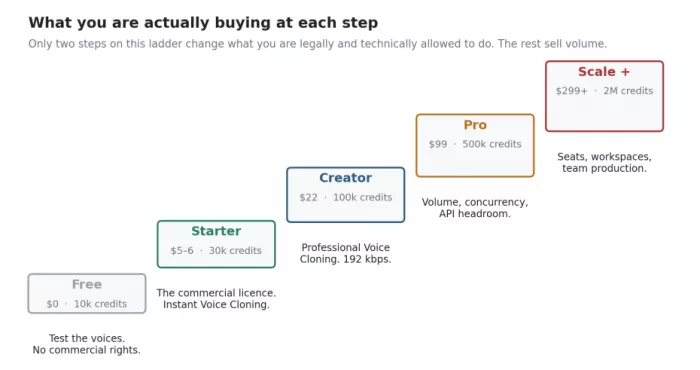
That reframes the whole pricing page. The gap between free and $5 is a legal gap, and it's enormous. The gaps between $5, $22 and $99 are commercial gaps about how much you produce. Most people agonise over the second set of decisions when the first one is the only one that carries real risk.
Worth knowing alongside it: on paid plans you own the audio you generate and can use it commercially, which is not universal among AI tools. The trade is that ElevenLabs holds a perpetual licence to create derivatives from voice material for model improvement. If you're cloning a client's voice under contract, that clause belongs in the conversation before you upload anything.
What each paid tier is actually selling
| Plan | Price | Credits | What it unlocks that the tier below doesn't |
| Free | $0 | 10,000 | Nothing. This is the evaluation tier |
| Starter | ~$5–6 | 30,000 | Commercial licence, Instant Voice Cloning, Dubbing Studio, ~20 Studio projects |
| Creator | $22 | ~100,000 | Professional Voice Cloning, 192 kbps audio, 30 voice slots |
| Pro | $99 | ~500,000 | Volume, higher concurrency, better API headroom, higher-fidelity output |
| Scale | ~$299–330 | ~2,000,000 | Multiple workspace seats, team collaboration |
| Business | ~$990–1,320 | 6–11 million | Organisation-wide clone capability, higher support tier |
| Enterprise | Custom | Negotiated | SSO, SLAs, compliance commitments, volume discounts |
Read down that last column and the shape is obvious. Two rows change what you're permitted or able to do. Everything below the Creator is buying quantity, seats and support. That's not a criticism quantity is a real need but it means the upgrade question above $22 is a spreadsheet question, not a judgement call.
The tier most people should look at hardest
Creator at $22 is marked popular on the pricing page, and it's the tier where the recommendation industry converges. It earns that for one reason: Professional Voice Cloning. If you're building a channel around a cloned version of your own voice that appears in every video, PVC's higher fidelity is the difference between something that holds up over an hour and something listeners notice.
But if you aren't cloning a voice, if you're picking a library voice and narrating with it Creator's advantage over Starter is credits and audio bitrate. That's a volume decision. Around 100 minutes a month versus around 30. Work out your actual monthly minutes before paying four times as much for a feature you won't turn on.
Overages and the point where staying put costs more
Exceed your credits and ElevenLabs bills the excess rather than cutting you off. The per-unit rate falls as you go up the tiers, which produces a crossover point that's easy to miss.
The rule of thumb that circulates among heavier users is a good one: once your overage regularly reaches 30–50% of the next plan's price, upgrading is cheaper than staying where you are. A worked example: a Creator subscriber running about 150 minutes a month lands near $37 all-in once overage is counted, against a $22 base. Two more months like that and the maths starts pointing at Pro.
Three related costs that don't appear on the pricing page:
• Rollover has a cliff. Unused credits carry for up to two months on paid plans, and rollover ends immediately if you downgrade or cancel. Banking credits ahead of a big month works; banking them and then dropping a tier doesn't.
• Concurrency is a separate limit from credits. Plans cap how many generations or sessions can run at once. Agencies report traffic spikes hitting concurrency throttling mid-campaign while nowhere near their credit ceiling. If you're running anything real-time, plan for the peak hour rather than the monthly total.
• Tax is on top, and annual billing is a real discount. A $22 plan is closer to $26 for an EU buyer once VAT lands. Annual billing runs about 17% off roughly two months free which is the single easiest saving available if you already know you'll stay a year.
The question the pricing page can't answer: compared to what?
Nobody asks whether ElevenLabs is worth paying for in a vacuum. They ask it while holding a budget. So here's the uncomfortable number.
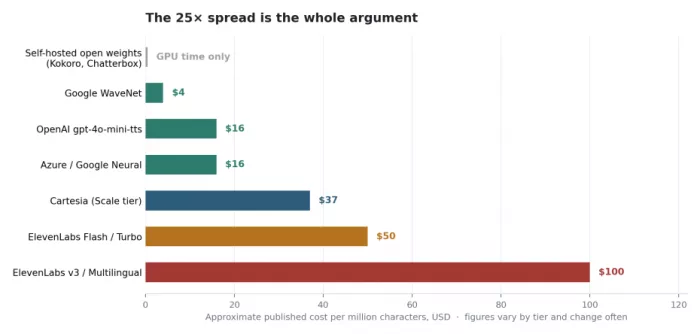
Google's WaveNet voices sit around $4 per million characters. OpenAI's small TTS model and the mainstream Azure and Google neural voices cluster near $16. Cartesia built for low-latency voice agents, and reported by some users as comparable in quality for non-English work lands near $37. ElevenLabs' expressive models sit around $100. Self-hosted open-weight models like Kokoro or Chatterbox cost GPU time and nothing else, running perhaps $20–80 a month on rented hardware for volumes that would cost thousands through a managed API.
That's up to a 25× spread for the same nominal task. At the volumes a solo creator works with, 25× of a small number is still a small number and the argument doesn't bite. At production scale it is the entire decision.
What the extra money genuinely buys
This cuts both ways, and the case for paying the premium is real:
• Expressiveness. On blind listener-preference leaderboards, ElevenLabs' expressive models consistently rank at or near the top for naturalness, emotional range and pacing. For long-form narration audiobooks, hour-long podcasts that difference compounds over the listening session in a way a 30-second sample doesn't reveal.
• Non-English performance. The quality gap over cheaper providers is wider outside English than inside it, which matters enormously if that's your market.
• The dubbing pipeline. Feeding in a finished video and getting back a multilingual dub that preserves the original speaker's voice is a capability competitors approximate rather than match. If that's your workflow, the per-character comparison is beside the point you're buying a product, not a rate.
• Breadth. TTS, cloning, dubbing, sound effects, music and agents under one subscription and one credit pool. Assembling that from cheaper parts means running four vendors and the integration work between them.
The framing that survives contact with reality is per-job, not per-vendor. An audiobook chapter, a real-time support agent, a podcast intro and a dubbing pass have different correct answers, and a team that picks one provider and stops thinking is overpaying on three of those four.
The part that costs more than the subscription
A paid plan unlocks the clone button. It does not grant you the right to clone anyone.
ElevenLabs' terms require that you own the voice or hold explicit consent for it, and accounts have been suspended for impersonation. Independently of the terms, at least a dozen US states Tennessee's ELVIS Act among the most prominent, alongside California, New York and Illinois now treat unauthorised cloning of a real, identifiable voice as a civil and in some cases criminal matter. Celebrity voices are available only through officially licensed versions with their own restrictions; recreating one yourself is not a grey area.
The safe operating rule is narrow and easy to follow: clone your own voice, or a voice for which you hold written, use-specific consent from the person it belongs to. Get it in writing before the upload, not after the client asks. This is general background rather than legal advice, and anything contentious belongs with a lawyer in your jurisdiction but the gap between a $22 subscription and a statutory claim is large enough to be worth the two minutes.
Verdict
Yes, it's worth paying for but the amount most people should pay is far less than the amount they're pointed at.
| If you are… | Pay | Because |
| Evaluating quality | $0 | The free plan gives you the full voice library. It answers the only question you have |
| Publishing one monetised thing a month | ~$5 Starter | You are buying the licence, not the credits. Cheapest legal path to publish |
| Producing regularly with a cloned voice | $22 Creator | Professional Voice Cloning is the one feature genuinely worth a tier jump |
| Producing regularly with a library voice | Do the minutes first | You may be paying 4× for credits you don't use and a feature you won't enable |
| Building a product at volume | Model it per million characters | The managed-API spread is wide enough to change your unit economics |
| High volume, quality-tolerant | Look elsewhere first | At scale you are paying a large premium for expressiveness you may not need |
The strongest argument for ElevenLabs isn't the price and never was it's that the voices are better, most audibly on long-form and non-English work, and that everything sits under one subscription. The strongest argument against it is that a lot of work doesn't need a premium voice, and the cheaper end of the market got genuinely good while everyone was looking at the leaderboard.
What should be uncontroversial is the free plan's role. It is one script long. That's enough to decide, and not enough to ship which, if you think about it, is exactly what it was designed to be.
How to check any of this in ninety seconds
Given how fast this moves, the most useful thing this article can leave you with is a routine rather than a number.
1. Open the official pricing page and read the tier you're considering, not a blog's summary of it. Note the date.
2. Toggle monthly to annual and read both prices. The discount is real and frequently unmentioned.
3. Sign up free and open the voice creation flow. Whether Instant Voice Cloning is gated changes, and it's the fastest thing to verify yourself.
4. Paste a real script yours, not a demo sentence and generate once. Watch the credit counter before and after. That single number tells you your true monthly cost better than any table.
5. Repeat it on Flash. The difference between the two readings is your drafting budget.
Sourcing and freshness Figures in this article were compiled in August 2026 from published pricing guides dated March–August 2026, cross-referenced against each other, with disagreements flagged in the text rather than resolved silently. Prices, credit allocations and feature gating on ElevenLabs change several times a year. Confirm current figures on the official pricing page before subscribing. |
Comments