Table of Contents
- The verdict up front
- What happened to Windsurf, in eight dates
- My test session, screen by screen
- Step 02: Verification, and the last Windsurf-styled screen
- What the editor offers once you find it
- Pricing in July 2026
- What people are actually saying
- Pros and cons that actually matter
- How it stacks against Cursor and Copilot
- Final verdict after a session that went sideways
I set aside an afternoon to test Windsurf for this review. The checklist was ready: create an account, point the agent at a small repo, lean on the autocomplete until it cracked, then write up what held. The plan died at step one, and the reason it died turned out to be the real story.
My freshly verified account never showed me an editor. It dropped me into Devin's cloud dashboard, put a pricing screen in front of me before a single feature, and then refused to run anything until I connected a Git provider. The editor I came to test now lives behind a separate desktop download, under a different name.
So this review does two jobs. It walks through exactly what a new user sees in July 2026, with screenshots from my own session, then lays out what Windsurf, now called Devin Desktop, actually offers once you know where the product went. No filler, no recycled 2024 feature lists.
The verdict up front
3.5 / 5 | ONE-LINE SUMMARY Genuinely strong agentic engineering wrapped in the most confusing onboarding I have run into this year. PICK IT IF You want supervised multi-agent workflows, you live in JetBrains or Vim as much as VS Code, or your team already runs Devin. SKIP IT IF You want a two-minute browser trial, predictable usage limits, or you just lost Cascade workflows you depended on. |
| Category | Score | Why |
|---|---|---|
| Onboarding and first run | 2.0 | Signup funnels new users into Devin's cloud app; the editor is a separate, unexplained download |
| Editor capability | 4.5 | Built-in agent, strong autocomplete, Codemaps, and a multi-agent command center |
| Model speed and cost | 4.0 | SWE-1.7 serves near 1,000 tokens per second and comes bundled, not metered per token |
| Pricing transparency | 2.5 | Daily and weekly quotas exist, but the actual ceilings are not published anywhere |
| Integrations | 4.5 | Plugins for 40+ editors plus GitHub, GitLab, Bitbucket, Slack, Linear, and MCP |
| Community trust | 3.0 | 4.2 out of 5 on G2 against a steady stream of Trustpilot quota complaints |
| Overall | 3.5 | Excellent machinery, rough wrapper, and a brand transition that punishes newcomers |
| CURRENT NAME | OWNER | ENTRY PRICE | FLAGSHIP MODEL | EDITOR BASE |
| Devin Desktop | Cognition | Free / $20 Pro | SWE-1.7 | VS Code fork |
What happened to Windsurf, in eight dates
You cannot review this product in 2026 without the backstory, because it explains every strange screen in my signup flow. Windsurf just lived through one of the wildest stretches any developer tool has ever had.
| NOV 2024 | Codeium ships the Windsurf Editor, a VS Code fork built around Cascade, its codebase-aware agent. |
| SPRING 2025 | OpenAI reportedly agrees to buy Windsurf for around 3 billion dollars. The deal never closes. |
| JUL 11, 2025 | Google pays roughly 2.4 billion dollars to license Windsurf tech and hire CEO Varun Mohan, co-founder Douglas Chen, and part of the research team. |
| JUL 14, 2025 | Cognition, maker of the Devin agent, acquires what remains: product, brand, IP, and staff. Windsurf reports 82 million dollars in annual revenue and over 350 enterprise customers at the time. |
| MAR 2026 | Cognition scraps credits for daily and weekly usage quotas and raises Pro from 15 to 20 dollars a month. Longtime users are not thrilled. |
| JUN 2, 2026 | An over-the-air update renames the editor Devin Desktop. The bundled agent becomes Devin Local, and windsurf.com starts redirecting to devin.ai. |
| JUL 1, 2026 | Cascade reaches end of life after a one-month migration window. Devin Local is now the only built-in agent. |
| JUL 8, 2026 | SWE-1.7 launches as the flagship model, built on Moonshot's Kimi K2.7 Code and served at roughly 1,000 tokens per second. |
One more data point: Cognition raised over a billion dollars at a 26 billion dollar valuation in May 2026. Whatever you think of the rename, the company behind this editor is not going anywhere.
My test session, screen by screen
This is the part I can speak to first hand. Every screenshot comes from one signup session I ran in July 2026. I went in expecting an editor trial and got a guided tour of an acquisition instead.
Step 01: The signup page still wears the old brand
The form at windsurf.com carries everything you would expect from 2025: the wave logo, the mint button, and a Garry Tan endorsement claiming a day with the tool leaves engineers feeling “like they strapped on rocket boosters.” One detail gives the game away. The third sign-in option reads Sign up with Devin for Enterprise. That button does not belong to the product this page is dressed as.
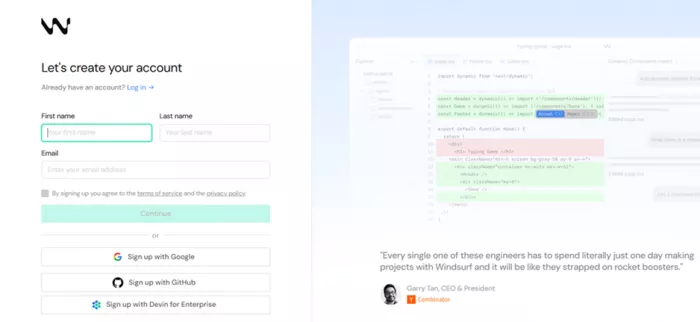
FIG 1. Windsurf branding on the outside, a Devin sign-in option hiding in plain sight.
Step 02: Verification, and the last Windsurf-styled screen
A standard six-digit code arrived within seconds, no complaints. I note it because this cream-and-mint screen was the last moment my session looked anything like the product I signed up for.
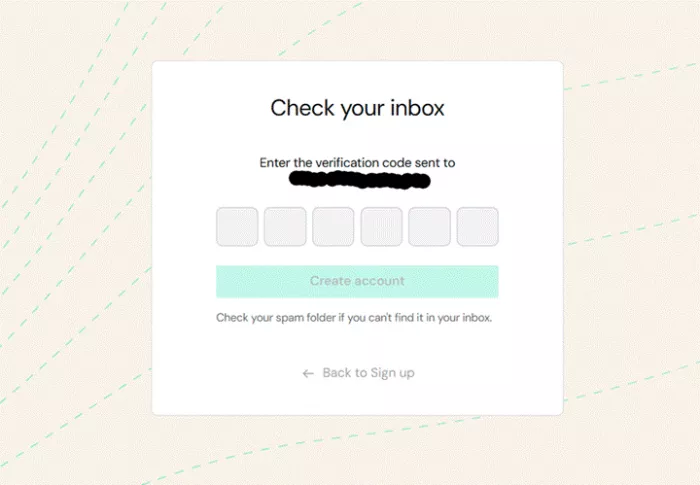
FIG 2. Six digits, one click, and the Windsurf styling ends here.
Step 03: A pricing wall before any product
Before seeing a single feature, I got this: Unlock the full power of Devin. Not Windsurf. Devin. Pro at 20 dollars a month, Max at 200, Teams at 80 per user, and a Pro bullet promising SWE-1.7 access. The escape hatch is a small Continue with free link under the cards. Asking a brand-new user to pick a paid tier before showing them anything is a choice I would not defend.
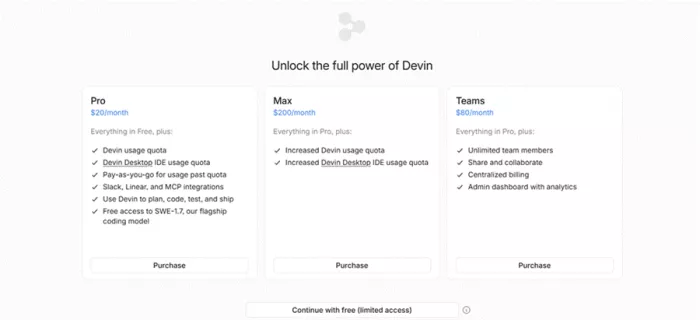
FIG 3. The first screen after verification is a paywall for a different product name.
Step 04: The dashboard that would not let me test
Free tier selected, I landed inside Devin's web app, where the center of the screen demands a GitHub, GitLab, or Bitbucket connection before anything runs. No sample repo, no sandbox, no demo mode. A promo tile in the corner points at Install Desktop and Install CLI, where the actual editor now lives. Here my test plan collapsed: the browser product will not start without repo access, and the editor is a separate download the flow never explains.
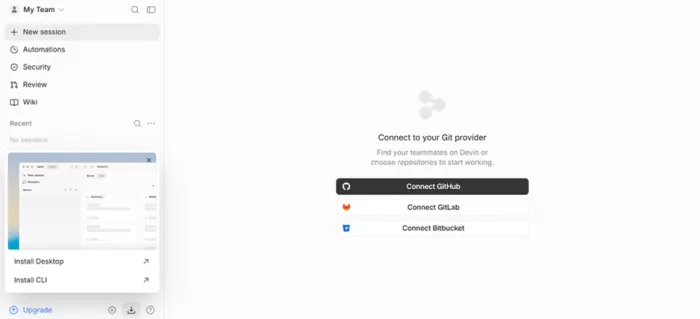
FIG 4. No Git provider, no session. The editor hides behind the small Install Desktop link.
Step 05: The plans page confirms it
Settings removed any remaining doubt. My “Windsurf” account is a Devin account on a Free plan that includes limited Devin usage, Devin Review, and DeepWiki. The word Windsurf appears nowhere in my own settings. The Pro column matches the paywall from step three, so the pricing is at least consistent.
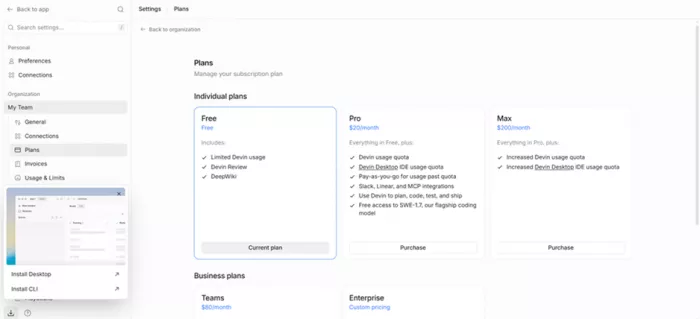
STRAIGHT ANSWER ON WHAT I COULD AND COULD NOT TEST I could not reach the editor itself through this flow, and I am not going to invent hands-on impressions I never had. Everything below about features comes from Cognition's documentation, verified reporting, and paying users on record. The onboarding score of 2 out of 5 reflects my actual session. |
What the editor offers once you find it
Strip away the naming chaos and the product underneath holds up well. These six capabilities are where documentation and user reports agree.
AGENT
Devin Local
The built-in agent that replaced Cascade on July 1, 2026. It plans multi-file edits, runs terminal commands, and iterates until a task lands. G2 reviewers consistently name the agent workflow as the reason they stay.
ORCHESTRATION
Agent Command Center
A single panel that supervises local and cloud agents at once. You can hand a refactor to a background Devin agent, keep coding in your tab, and merge the result later.
COMPREHENSION
Codemaps
Visual maps of a codebase showing entry points and data flow, with generated explanations per node. Built for legacy code and onboarding. Neither Cursor nor Copilot ships an equivalent.
COMPLETION
Tab autocomplete
Fill-in-the-middle, multi-line suggestions with terminal context awareness. The one feature every rename left untouched, working across the editor and plugins.
OPEN PROTOCOL
ACP support
The editor speaks the Agent Client Protocol, an open Apache 2.0 standard, so third-party agents such as Codex, Claude Agent, and Gemini CLI run inside it as first-class citizens.
REACH
Plugins for 40+ editors
JetBrains, Vim, Neovim, and Xcode plugins still ship alongside the main editor, and the JetBrains plugin even keeps the Windsurf name.
Pricing in July 2026
These figures match both the in-app plans page from my own session and Cognition's published tiers on the same day. That matters, because plenty of older articles still list the 15 dollar Pro price that died in March 2026.
| Plan | Price | What you get |
|---|---|---|
| Free | $0 | Limited Devin usage, Devin Review, and DeepWiki. Enough to look around, not enough to work. |
| Pro | $20/mo | Devin usage quota, Devin Desktop IDE quota, pay-as-you-go past the quota, Slack, Linear and MCP integrations, and SWE-1.7 access. |
| Max | $200/mo | Everything in Pro with substantially raised Devin and IDE quotas for heavy daily use. |
| Teams | $80/mo | Pro features plus unlimited members, collaboration, centralized billing, and an admin analytics dashboard. |
| Enterprise | Custom | Custom pricing under business plans, with the compliance certifications Windsurf was already known for. |
The catch: since March 2026, usage runs on daily and weekly quotas rather than visible credits, and Cognition does not publish the ceilings. That opacity, more than price, fuels most of the angry reviews. Budgeting for a team means guessing.
What people are actually saying
Sentiment below comes from sources that verify reviewers or sign their rankings, summarized as a pattern, not one hand-picked mood.
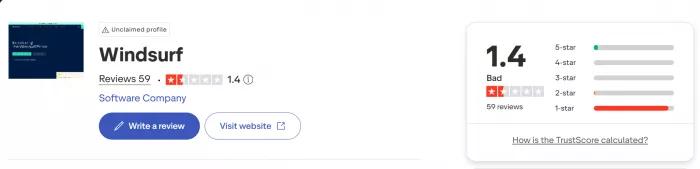
REVIEW PLATFORM G2: 4.2 / 5 Reviewers repeatedly praise how little setup the editor demands and how the agent maps a plan before touching code. The most common complaint is thin documentation for advanced features. G2 verified reviews, checked July 2026 |
CONSUMER REVIEWS Trustpilot: quota anger The negative pattern here is quotas, not code quality. One reviewer reports a single short task exhausting an entire daily allowance; another describes billing support as unresponsive. Free-tier users call the fallback model painfully slow. Trustpilot reviews, 2026 |
INDUSTRY RANKING LogRocket: ranked #1 LogRocket's AI Dev Tool Power Rankings placed Windsurf first in February 2026, ahead of Cursor and GitHub Copilot, with agent capability and speed as the separators. LogRocket Power Rankings, Feb 2026 |
COMMUNITY Reddit: split on the rename The June rebrand divided longtime users. Most report the update itself was painless, with plans, settings, and keybindings intact. The real grief is Cascade workflows dying on a 30-day clock, felt hardest by teams with custom setups. Developer community threads, June 2026 |
Pros and cons that actually matter
| WHERE IT WINS | WHERE IT HURTS |
|---|---|
• The only mainstream IDE with a supervised multi-agent panel built into the editor • SWE-1.7 serves near 1,000 tokens per second, so agent runs feel immediate • Real plugins for JetBrains, Vim, Neovim, and Xcode, a category where Cursor offers nothing • Open ACP support lets Codex, Claude Agent, and Gemini CLI run inside the same editor • The free tier bundles Devin Review and DeepWiki, both genuinely useful on their own | • Signup routes new users into Devin's cloud app with zero explanation of where the editor went • The web app runs nothing until you connect GitHub, GitLab, or Bitbucket, with no sandbox offered • Daily and weekly usage ceilings exist but are unpublished, so cost planning is guesswork • Cascade workflows died on July 1, 2026 after only a one-month migration window • Documentation is split between Windsurf leftovers and Devin Docs, and the two disagree in places |
How it stacks against Cursor and Copilot
| Devin Desktop | Cursor | GitHub Copilot | |
|---|---|---|---|
| Entry price | Free, Pro $20/mo | Free, Pro $20/mo | Free, Pro $10/mo |
| Where it lives | Own VS Code fork plus 40+ editor plugins | Its own editor only | Extension inside VS Code, JetBrains, and more |
| Agent story | Local plus cloud agents in one command center | Parallel background agents | Coding agent that works from GitHub issues |
| In-house model | SWE-1.7, bundled with paid plans | Composer models | Uses partner frontier models |
| Best fit | Agent-heavy workflows, mixed-IDE teams | Editor polish and fast iteration | Cheapest entry, staying in your current setup |
The honest framing: Cursor wins on day-one polish, Copilot wins on price, and Devin Desktop wins the moment you want several agents working at once or refuse to leave JetBrains.
Final verdict after a session that went sideways
Here is where I landed after an afternoon of screenshots and a week of cross-checking claims. The engineering underneath deserves better packaging than it gets. A supervised multi-agent command center, a model serving at four-digit token speeds, visual codebase maps, and an open protocol for rival agents: that is a serious toolkit, and it explains why LogRocket ranked it above Cursor and Copilot this year.
But I came to this review the way any new user would, through the front door, and the front door is broken. The page says Windsurf, the account says Devin, the browser app demands repo access before showing anything, and the editor itself hides behind a corner link labeled Install Desktop. If I had not been writing this article, I would have closed the tab at the pricing wall and gone back to whatever I was using before.
So my score is 3.5 out of 5, and my advice is specific. Skip the browser signup entirely. Go straight to the desktop download, sign in once inside the app, and stay on the free tier until you have watched the agent handle one real task in your own repo. If the quota system fits how you work, the 20 dollar Pro plan buys more capability per dollar than almost anything else in the category. Just know that you are buying Devin now. Windsurf is a memory with a redirect on it.
Comments