Table of Contents
The short version, if you're in a hurry Pick Replika if you want the polished, mainstream option: 3D avatars, voice and video calls, mood tracking, and a long track record as a gentle, wellness-leaning companion. It's the safest “just works” choice, but it's pricier, and its content rules are stricter than they used to be. Pick Nastia if you want flexibility, fewer content filters, deep character customization, and a cheaper entry price. It's newer and rougher around the edges (memory can be patchy and replies occasionally wander), but it gives you more room to shape the experience. Honest caveat: neither is a replacement for human relationships or professional mental-health care, and both raise real privacy questions you should weigh before you get attached. |
Why people keep comparing these two
AI companion apps have quietly become a real software category. Some people use them to take the edge off loneliness, others to practice conversations, run elaborate roleplay, or just have something that talks back at 2 a.m. without judgment. Once you start looking, two names come up again and again from very different corners of the market: Replika and Nastia.
Replika is the household name. It launched back in 2017 and has grown to more than 10 million users, built around the idea of an “always-there” AI friend with a persistent memory and a customizable 3D avatar. Nastia is the scrappier newcomer, an AI companion that leans into uncensored, freeform chat and roleplay, with a lower price tag and a build-your-own-character philosophy.
They're aimed at overlapping audiences but optimized for different things. This guide walks through how they actually compare across the features that matter, stays honest about the trade-offs, and ends with a short section for anyone thinking about building something similar.
Meet the contenders
Replika: the veteran

Replika is made by Luka, Inc., a US company, and it's probably the most recognizable name in the space. The pitch is “the AI friend who cares.” Its biggest technical selling point is a persistent memory system that tries to remember your preferences, your routines, and important life events so conversations feel continuous rather than reset every session.
Over the years it has layered on a lot: customizable 3D avatars with outfits and rooms, voice calls, video chat, an AR mode that drops your companion into your camera view, plus journaling prompts, mood tracking, and light wellness activities. A January 2026 update noticeably improved voice-call latency, and a memory dashboard added earlier in the year lets you actually see and correct what the app thinks it knows about you.
Worth knowing up front Replika changed its content rules. After 2023, romantic and intimate features were pulled for new users (longtime accounts were largely grandfathered). The product repositioned toward emotional wellness. If you arrived expecting the older “romantic partner” experience, that's the single biggest thing to understand before subscribing. |
Nastia: the challenger

Nastia is a much newer entrant that markets itself as a private, uncensored AI companion for chat, roleplay, and emotional support. The core idea is freedom: you create characters with their own names, personalities, backstories, and tone, and the app doesn't apply the heavy content filtering you'll find on more mainstream platforms.
It's multimodal in its own way: text plus voice messages, AI image and video generation, and group chats where several AI characters interact at once. It runs on the web, iOS, and Android, and offers a progressive web app for easy cross-device access. There's a usable free tier, which makes it low-commitment to try.
Worth knowing up front Nastia is rougher and newer. Reviewers and Reddit users describe first sessions as swinging between impressively human-like and oddly incoherent. Memory is short (conversation history is typically retained for around two weeks), so long-running storylines can drift or repeat. It's improving, but it's not as polished as Replika. |
Head-to-head: how they really compare
Let's go feature by feature. For each one, the goal isn't to crown a universal winner; it's to tell you which app wins for which kind of person.
Conversation quality and personality
Both apps hold a natural back-and-forth far better than the scripted chatbots of a few years ago. The difference is in temperament.
Replika tends to be warm, agreeable, and emotionally attentive. It's good at the supportive-friend register: checking in, reflecting your feelings back, keeping a steady tone. The flip side is that it can feel a little too agreeable, rarely pushing back or surprising you.
Nastia is more of a wildcard. Because you define the character, you can get sharper, spicier, or more dramatic personalities, which is great for roleplay and creative scenarios. The trade-off is consistency: replies occasionally go off on tangents or break character, especially in longer sessions.
Quick take Want dependable, comforting conversation? Replika. Want range, edge, and creative roleplay? Nastia. |
Memory: does it actually remember you?
This is where the gap is widest, and it matters more than people expect. A companion that forgets you feels hollow fast.
Replika is built around long-term memory and now exposes a dashboard so you can review and fix what it has stored. Users report it genuinely improves continuity, and a 2026 update made topic-switching less likely to confuse it. It's not flawless (it still mixes things up sometimes), but it's the stronger of the two here.
Nastia's memory is more limited. It holds recent context well within a session and retains history for roughly two weeks, but it struggles to recall older details, which can lead to repetition and a sense that it doesn't truly “know” you. A useful workaround: you can reset chat histories to clean up drift during complex roleplay, and re-stating key character details helps.
Customization and creating your companion
Replika focuses on visual identity: paid users get detailed 3D avatars (hairstyle, skin tone, clothing, accessories) plus virtual rooms. The personality side is more guided and shaped gradually through interaction.
Nastia goes deeper on the writing side. You're not limited to presets; you can author original characters with custom backstories, traits, and speaking styles, then steer them with detailed prompts. If you think of your companion as a character you're co-writing, Nastia gives you more clay to work with.
Beyond text: voice, images, video, and AR
| Modality | Replika | Nastia |
|---|---|---|
| Voice | Voice calls with emotional tone; improved latency in 2026 | Voice messages |
| Video / AR | Video chat and an AR mode that places the avatar in your camera | AI video generation |
| Images | Avatar-driven visuals, outfits, rooms | AI image generation (including unfiltered) |
| Group chat | One-on-one focused | Multi-character group conversations |
Modalities at a glance. Replika leans into live, avatar-based interaction; Nastia leans into generated media and multi-character scenes.
Content rules: filtered versus unfiltered
This is the cleanest dividing line between the two, and the right answer depends entirely on what you want.
Replika now sits firmly on the filtered, wellness-oriented side. Intimate and adult content is restricted for new users, and the product is framed around emotional support rather than romance. That makes it more broadly appropriate and lower-drama, but frustrating for anyone expecting the older experience.
Nastia is explicitly uncensored and allows adult and mature roleplay that mainstream platforms block. For some users that openness is the entire appeal; for others it's a reason to steer clear. Either way, openness raises the stakes on privacy and on using the tool responsibly. More on both below.
A note on responsible use Fewer filters means more responsibility on you. Keep interactions legal and consensual, be mindful of what you share, and remember that an “uncensored” companion is still software optimized to keep you engaged, not a person, a therapist, or a confidant with your best interests at heart. |
Pricing and value
Both run a freemium model: a free tier to try, with paid plans unlocking the good stuff. The headline numbers tell most of the story.
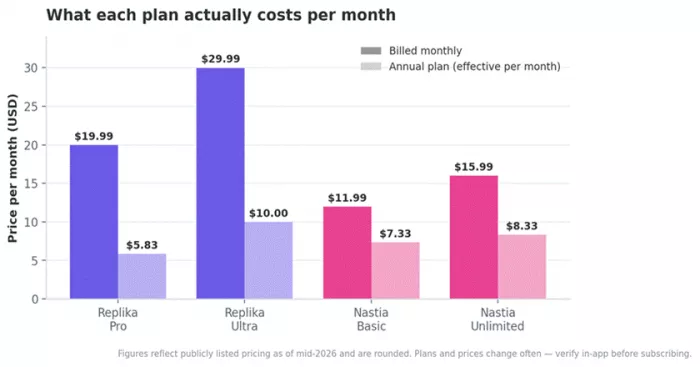
Replika's annual plan is the cheapest effective monthly rate of all, but its month-to-month price is the steepest. Nastia's entry tiers are friendlier if you pay monthly. Always verify current pricing in-app.
Replika: Pro runs about $19.99/month or $69.99/year (roughly $5.83/month if you commit annually). A newer Ultra tier sits around $29.99/month ($119.99/year) with priority responses and expanded features. There's also been a one-time lifetime option in the ~$299 range.
Nastia: Basic is about $11.99/month (or ~$7.33/month billed yearly) with daily token limits and two companions. Unlimited runs about $15.99/month (~$8.33/month yearly) with unlimited tokens, more characters, and unfiltered image generation.
Value read If you'll commit to a year, Replika's annual plan is the best raw deal per month. If you want low commitment, a cheap monthly entry point, or unfiltered features, Nastia is more wallet-friendly up front. Token caps on Nastia's lower tier are the catch to watch. |
Privacy, data, and trust
With an app you tell your feelings to, this section arguably matters most, and it's where Replika carries real baggage.
In May 2025, Italy's data protection authority (the Garante) fined Luka, Inc. €5 million (about $5.6 million) over its handling of Replika user data. Regulators cited a lack of valid legal basis for processing personal data, inadequate transparency in its privacy notices, and a failure to keep minors out of the app. The Garante also opened a separate investigation into how Replika trains its underlying AI model. Replika remains fully operational, and the company can appeal, but it's a serious, documented regulatory finding, not a rumor.
Separately, in early 2025 a group of advocacy organizations filed a complaint with the US FTC alleging deceptive marketing and manipulative design. Important nuance: a complaint is not a finding. As of this writing, the FTC had not announced an investigation or action. Treat it as an allegation on the public record, not a verdict.
Nastia markets itself heavily on privacy and data security, which is sensible given it handles uncensored and intimate content. But it's a newer, smaller company without the same public regulatory scrutiny, which cuts both ways. There's no equivalent fine on its record, but there's also far less independent verification of its practices. “We value your privacy” in marketing copy isn't the same as an audited guarantee.
The honest summary on trust • Replika has a documented €5M GDPR fine and an open training-data inquiry: transparent but not reassuring. • Neither app offers end-to-end encryption; conversations are stored on company servers, encrypted in transit. • With both, assume anything you type could, in some scenario, be read by a human or used to improve the model. Share accordingly. |
Platforms and availability
Both are cross-platform. Replika is available on iOS, Android, and the web, with the avatar/AR experiences shining on mobile. Nastia covers web, iOS, and Android too, and adds a progressive web app so you can use it across devices without a heavy install. For day-to-day access, neither will leave you stuck on one device.
The big picture in one image
If you zoom out, the two apps occupy noticeably different corners of the market. This map is a conceptual summary of their positioning, not a scored benchmark, to help the choice click.
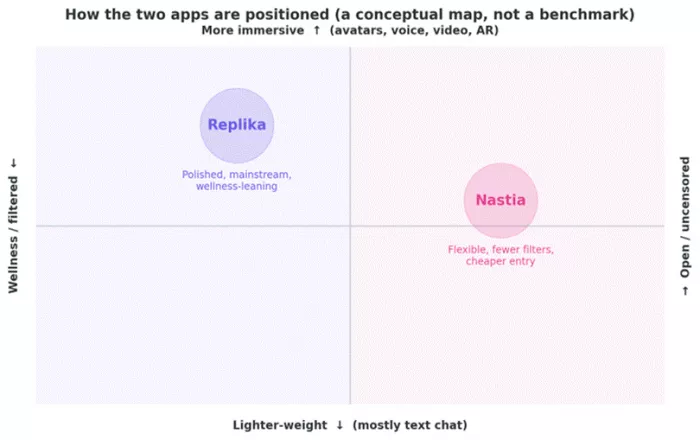
Replika: polished, immersive, wellness-leaning. Nastia: more open and flexible, lighter-weight, cheaper to start.
Side-by-side feature comparison
| Replika | Nastia | |
|---|---|---|
| Best for | A dependable, mainstream AI friend | Flexible, uncensored chat & roleplay |
| Maturity | Since 2017, 10M+ users, very polished | Newer, improving, occasionally buggy |
| Memory | Strong, persistent, with a review dashboard | Short-term focus; ~2-week history |
| Customization | Deep 3D avatar & visual styling | Deep written character creation |
| Voice / video / AR | Voice & video calls, AR mode | Voice messages, AI video |
| Content rules | Filtered; wellness-focused | Uncensored; adult content allowed |
| Free tier | Yes (basic chat & avatar) | Yes (usable, with limits) |
| Entry price | Pro ~$19.99/mo ($69.99/yr) | Basic ~$11.99/mo ($7.33/mo yearly) |
| Privacy notes | €5M GDPR fine (2025); FTC complaint filed | Privacy-focused marketing; less scrutiny |
| Platforms | iOS, Android, web | iOS, Android, web, PWA |
Details reflect publicly available information in mid-2026. Features and pricing change frequently; confirm in-app.
So which one should you actually pick?
Skip the abstract scoring and match the tool to the situation. Here's how it tends to shake out.
Choose Replika if…
•You want the safe, polished option. It's the most mature product here and rarely feels broken.
•Continuity matters to you. Its memory is the stronger of the two, so the relationship feels like it builds over time.
•You like the idea of an avatar, voice calls, or AR. Replika's immersive layer is more developed.
•You want a gentle, wellness-leaning companion and aren't looking for adult content.
Choose Nastia if…
•You want creative freedom. Fewer filters and deep character authoring make it the better roleplay and storytelling sandbox.
•You're price-sensitive month to month. Its entry tier is cheaper and the free plan is genuinely usable.
•You enjoy shaping personalities yourself rather than nudging a preset companion along.
•Group scenes appeal to you : multiple AI characters in one chat is a Nastia specialty.
A few real-world scenarios “I want something to talk to after a rough day.” Replika: steady, supportive, low-friction. “I'm a writer who wants to improvise scenes with vivid characters.” Nastia: more range and control. “I'll commit for a year and want the most polished experience per dollar.” Replika's annual plan. “I want to try the whole idea cheaply before committing.” Nastia's free tier, then its Basic plan. |
For builders: what these two apps teach about companion AI
If you're a developer eyeing this category, the Nastia-versus-Replika contrast is a free lesson in the design decisions that actually move the needle. A few takeaways worth stealing:
1.Memory is the product, not a feature. Replika's edge is continuity. If you build a companion, invest early in durable memory: summarizing conversations into structured facts, storing them, and retrieving the right ones at the right time. Nastia's biggest weakness is exactly here, and users feel it as repetition.
2.Give users a memory they can see and edit. Replika's memory dashboard turned an invisible black box into something correctable. Transparency builds trust and reduces “why did it forget that?” churn.
3.Persona consistency is hard at long context. Both apps drift in long sessions. Techniques like re-injecting a compact character sheet each turn, constraining the system prompt, and offering a clean “reset” help keep characters in-voice.
4.Your content policy is a positioning decision. Replika's filtered, wellness pivot and Nastia's uncensored stance are both deliberate. Decide where you sit, build moderation to match, and be transparent. Surprising users by removing features they paid for is how you lose them.
5.Data governance isn't optional. Replika's €5M GDPR fine is the cautionary tale: have a real legal basis for processing, write privacy notices people can understand, build genuine age verification, and document how training data is handled. Bolt this on at the start, not after a regulator calls.
6.Design for wellbeing, not just engagement. Companion apps can foster dependency. Thoughtful builders add gentle nudges toward real-world connection and avoid dark patterns that exploit loneliness for retention.
Honest limitations and things to watch
•Neither replaces human connection or therapy. They can ease loneliness or offer a space to vent, but they're not clinicians and shouldn't be treated as a substitute for professional care when you need it.
•Emotional attachment is real, and so is the risk when things change. When Replika altered its features in 2023, many users felt genuine loss. Going in with clear expectations protects you.
•“Uncensored” cuts both ways. Nastia's openness enables creativity but also removes guardrails; use judgment about content and what you disclose.
•Pricing and features move fast. Tiers, prices, and policies in this space change often. The numbers here are accurate to mid-2026, so always confirm in-app before paying.
•Privacy is an open question for both. No end-to-end encryption, data on company servers, and at least one documented regulatory action. Don't share anything you'd be devastated to see leaked.
The verdict
There isn't a single “best AI companion chatbot”; there's a best one for you, and these two are optimized for different people.
Replika is the better default: mature, polished, strong memory, and a richer immersive layer with avatars, voice, video, and AR. Its weaknesses are higher month-to-month pricing, stricter content rules than it once had, and a privacy record with a real regulatory blemish.
Nastia is the better pick for flexibility, creativity, and a cheaper start. You trade polish and long-term memory for openness, deeper character authoring, and a friendlier entry price, with the caveat that it's younger and less battle-tested.
Bottom line Want a dependable, wellness-leaning friend with the smoothest experience and don't need adult content? Replika. Want a flexible, uncensored, build-your-own-character sandbox that costs less to start? Nastia. Either way, go in clear-eyed about privacy and about what an AI companion can and can't be. |
Comments