First impressions after signing up
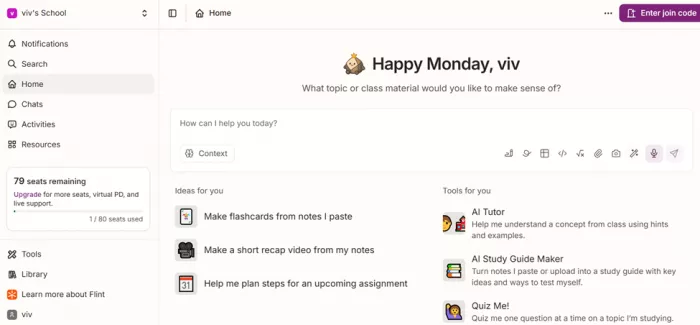
The signup took under two minutes. Flint pushes Google and Microsoft sign-in first, which matters because most schools run on one of those two ecosystems, and the email field nudges toward a school address so the workspace can be tailored to a specific institution. After confirming by email, the landing screen greeted the account by name and offered ready-made prompts like making flashcards from pasted notes, building a recap video, or planning steps for an assignment.
What stands out immediately is that the free workspace opens with 79 of 80 seats remaining, no credit card, no trial countdown. That single detail explains a lot of Flint's classroom adoption: a teacher can test the whole thing on a personal account before anyone in the district signs a contract.
QUICK VERDICT A genuinely classroom-first AI platform, not a repackaged chatbot
|
Flint review scorecard
Each category below was scored from hands-on use plus the patterns in 230 verified reviews aggregated across four platforms. The weighting leans toward what a working teacher actually feels day to day.
| Category | Score | What stood out |
| Ease of setup | 4.7 | Under two minutes, Google and Microsoft sign-in, no card |
| Content quality | 4.5 | Output stayed grounded in the notes that were pasted in |
| Teacher controls | 4.8 | Full chat visibility, adjustable help level, content flagging |
| Student safety and privacy | 4.6 | Guardrails, grade-level controls, no training on student data |
| Value for money | 4.3 | Free for 80 users, but paid pricing is quoted, not published |
| Integrations and media | 3.8 | LMS links on paid tiers, but no YouTube video support |
| 4.4 / 5 Overall: a polished, safety-first classroom tool held back mainly by quoted pricing and the missing video support. |
What is Flint, Explained
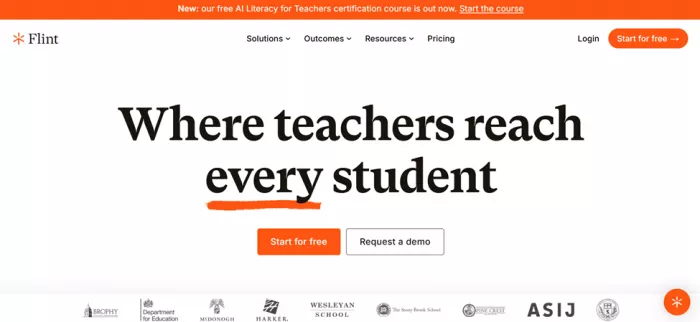
Flint is an AI-powered learning platform built specifically for K-12 schools, founded in 2023 by CEO Sohan Choudhury and CTO Jinseo Park, and launched through Y Combinator's Summer 2023 batch. It is headquartered in New York. Rather than giving students raw access to a general chatbot, Flint lets teachers design AI tutors and activities tied to their own curriculum, then watch the conversations unfold.
The product is anchored by Sparky, an AI teaching assistant and tutor that students and teachers chat with for real-time support, feedback, and guidance. Teachers can upload source material such as worksheets, rubrics, and lessons, and define exactly how much help the AI is allowed to give, from gentle hints to direct answers. Admins and teachers can view full interaction histories, with automatic flagging of inappropriate content.
In November 2025, Flint raised a $15M Series A co-led by Basis Set Ventures and Patron, bringing total funding to roughly $16.7M. Around the same time it partnered with Cognita, one of the world's largest school organizations, to deploy Flint to 95,000 students across 110 schools. This is not a weekend side project; it is a funded company with real district-scale deployments.
Core features at a glance
Custom AI tutors Build a tutor for any subject and set how much it helps, from hints only to full answers. | Activity builder Generate worksheets, quizzes, handouts, and activities in seconds with auto-grading and deadlines. |
Teacher visibility Read every student-AI conversation, with inappropriate content flagged automatically. | Differentiation Activities auto-scale to each student's level, so one assignment fits a mixed-ability class. |
Guardrails and privacy Customizable moderation, grade-level controls, and no use of student data to train models. | Multi-subject, multi-language Math, English, science, and world languages, with spoken practice teachers can listen back to. |
Hands-on testing, step by step
To see how Flint behaves with real content, the make-flashcards-from-pasted-notes prompt was the starting point. Here is exactly what happened, in order.
| 1 | Created a free account cold Signed up with an email, set a password and full name, confirmed through the verification email, and landed in a fresh workspace showing 79 of 80 seats remaining. No card, no trial timer. 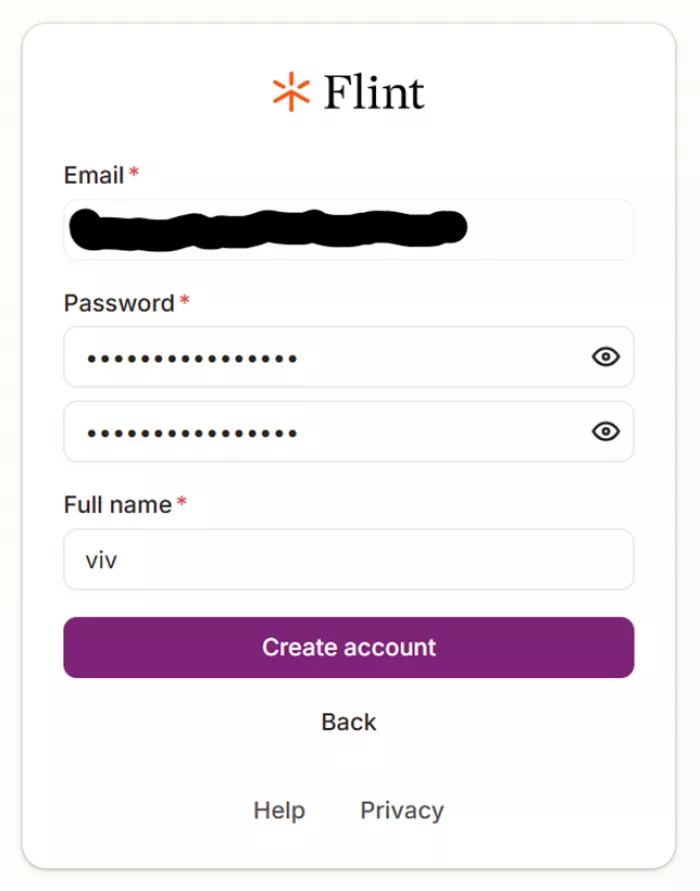
|
| 2 | Tried a YouTube link first Pasted a Java course YouTube URL to see if Flint could pull from video. It rejected the link cleanly with a tooltip reading "YouTube videos are currently not supported." No crash, just an honest limitation stated up front. 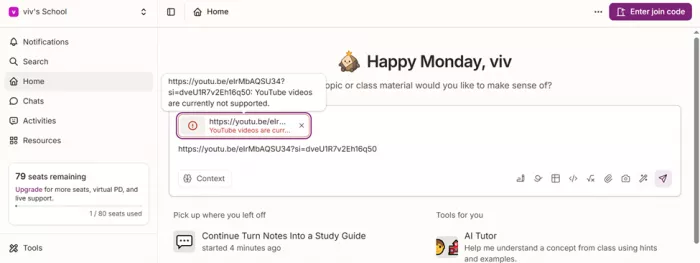 |
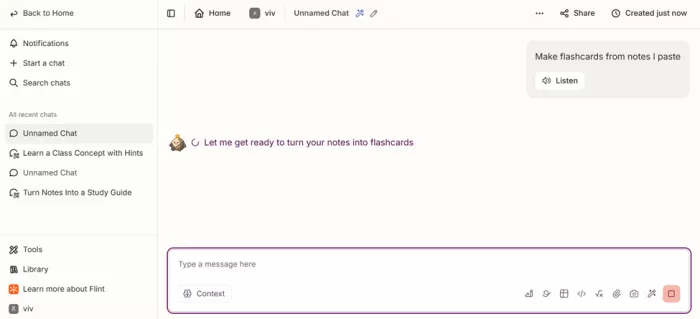
| 3 | Pasted raw Java notes instead Dropped in a block of Java fundamentals covering what Java is, platform independence, the JVM, syntax, and a Hello World example. Flint opened a chat and said it would get ready to turn the notes into flashcards, then began working. 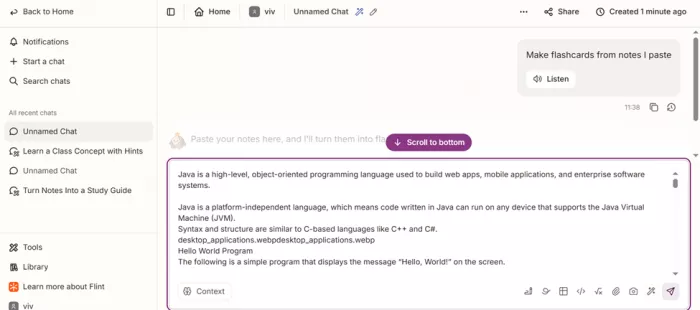 |
| 4 | Watched it ground the output Before generating anything, Flint showed that it was retrieving the complete notes first so every flashcard stays grounded in them. It was working from the source, not inventing content. 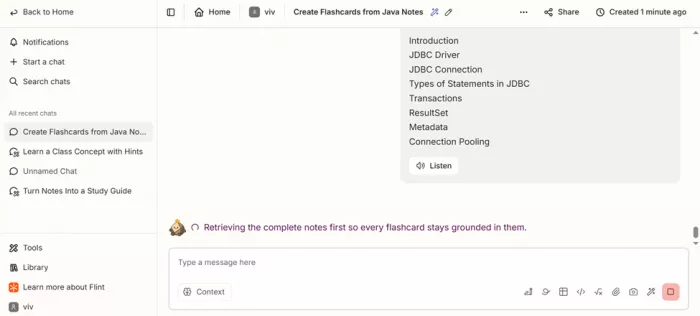 |
| 5 | Reviewed the finished deck Out came a 21-card deck titled "Java Fundamentals: Study Flashcards." Card 1 asked what Java is and what it can build. Card 2's answer pulled the JVM fact straight from the notes. Reveal, Next Card, a progress bar, and Restart made it a finished study tool. 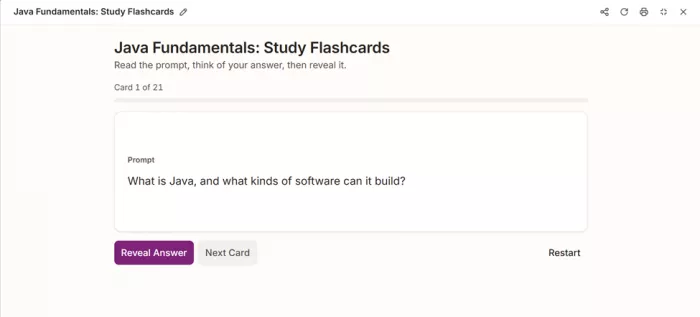 |
TESTING TAKEAWAY Flint did the boring part well. It respected the source material, produced a usable study artifact in one pass, and surfaced its limitations rather than faking a result. The flashcard interface was polished enough to hand to a student as-is. The one rough edge was the video support gap, a real constraint for anyone whose lessons live on YouTube. |
Pricing: honest and school-friendly
Flint's pricing is refreshingly simple to start, though exact paid figures are quoted per school rather than published as a flat price. The free tier is the headline, and it is unusually generous.
| Plan | Who it fits | What you get | Cost |
| Free | Individual teachers, small pilots | Up to 80 users (teachers or students), full teacher and student tools | $0 |
| Paid (school) | Whole schools | Everything in Free, plus LMS/SIS integration, advanced analytics, virtual PD, live support | Quoted per seat |
| Custom (500+) | Large schools and districts | Everything in paid, lower per-seat pricing, tailored onboarding | Custom |
Two details are worth flagging. First, a user can be a teacher or a student, so a single class of 25 students plus a teacher only uses 26 of the 80 free seats. Second, Flint can be used by students under 13, unlike consumer ChatGPT, though most schools roll it out in grade 3 and up. Schools can also explore paying through Title IV funding and running early-adopter pilots before committing.
The honest ledger: strengths and limits
Pulled from hands-on testing plus 230 verified reviews aggregated across four platforms, here is where Flint shines and where it frustrates.
What works well
| Where it falls short
|
What educators are actually saying
These are drawn from named teachers and published case studies, not anonymous star ratings. The pattern across them is consistent: time saved on prep, and support for students who usually fall through the cracks.
"Flint empowers my quicker students to design their own next steps, while others receive tailored AI support." Oliver Bernabe, Middle School Math Teacher, Shanghai American School | "The feedback that Flint gives is really helpful to enhance my writing in English class." Student, The Kinkaid School, via The Buzz Magazines |
"I have seen Flint impact learning in a positive way, especially for students who struggle with learning differences." Christa Forster, Upper School English Teacher, Kinkaid | "Our IT department was happy with the privacy controls, and teachers actually use it because it saves them hours of grading." Verified reviewer, via Tooliverse review aggregation |
| Review sources: Flint's published case studies and testimonials, The Buzz Magazines coverage of The Kinkaid School, and a Tooliverse consensus drawn from 230 verified reviews across four platforms. G2 currently lists Flint with no numeric rating yet. |
How Flint compares to other classroom AI tools
| Factor | Flint | SchoolAI | Khanmigo |
| Free plan | Yes, up to 80 users | Yes | Yes |
| Needs school-wide adoption | No, teachers can explore solo | No | Often yes |
| Subject coverage | Subject-agnostic, all subjects | All subjects | Broad |
| Spoken language practice | Yes, teachers can listen back | Limited | Limited |
| Teacher visibility into chats | Full transcript access | Admin message view | Yes |
The distinction that keeps coming up is that Flint does not require a whole school to buy in before a single teacher can use every feature. That lowers the barrier to a classroom trial more than most competitors manage. Its strongest differentiators are the subject-agnostic design and the ability to listen back to spoken language practice, which language teachers single out as hard to find elsewhere.
Who Flint is genuinely for
A strong fit Teachers who want differentiated support for mixed-ability classes, schools that need visibility and guardrails before allowing student AI use, and language teachers who value spoken practice. | A weaker fit Lessons built heavily around YouTube video, very small budgets that cannot stretch past the free tier, and anyone needing a published flat price without a sales conversation. |
Final verdict
After building an account cold and running real notes through it, Flint reads less like an AI novelty and more like software that has spent time in actual classrooms. The flashcard test was the tell: it retrieved the source first, stayed faithful to it, produced a finished 21-card study tool in one pass, and was upfront about the YouTube gap instead of faking its way through. That restraint, grounding output in real material and admitting limits, is exactly what a teacher needs from a tool students will use unsupervised.
The reservations are fair and worth stating plainly. The AI can still be wrong, so no teacher should treat its output as final without a glance. Paid pricing is quoted rather than published, which means budgeting requires a call. And older LMS setups can be rocky at first. None of these are dealbreakers, but they are the kind of thing a reviewer who actually used the product would want flagged before a school commits.
Bottom line Flint is one of the few AI education tools that earns the built-for-schools label rather than borrowing it. The free tier is generous enough to test with a full class, the guardrails and visibility are real, and the output stayed honest under testing. For most K-12 teachers curious about classroom AI, starting on the free plan is close to a no-risk decision. The only homework is checking whether the paid pricing fits the budget before scaling up. |
Comments