AI tool fluency has quietly become one of the most marketable skills of the decade. Companies have bought subscriptions to ChatGPT, Claude, Midjourney, and Perplexity but cannot translate that access into output. That gap is a viable freelance income for anyone willing to package what they already know. The numbers, categories, and workflows below show how operators are doing it in 2026, with current pricing and channels that actually convert.
$40–150 Hourly range across AI freelance specialties in 2026. | 6 Service categories that absorb most paid AI work today. | ~$80 Monthly cost of a working AI stack at entry tier. | 38% Of AI freelancers now bill flat retainers over hourly rates. |
The 2026 AI freelance market at a glance
The AI freelance market has matured from a curiosity into a defined services economy. Marketplaces report sustained double-digit growth in AI-related job categories. Retainer-based work has overtaken hourly engagements as the dominant billing model among established operators. Combined monthly cost of running a serious AI stack remains lower than a single hour of senior consulting time, which means margins on well-priced services stay unusually high.
Six recognisable categories absorb most paid AI work today. Each has a distinct buyer profile, a typical hourly bracket, and standard deliverables. The table below maps them at a glance, with the rate chart below showing how the brackets compare.
| CATEGORY | HOURLY RATE | TYPICAL BUYER | EXAMPLE DELIVERABLE |
|---|---|---|---|
| Content production | $40–160 | SaaS, agencies, coaches | Monthly blog and newsletter retainer |
| Visual production | $50–180 | Brand teams, e-commerce | 20-image brand pack per month |
| Research & intelligence | $70–200 | Consultants, analysts | Weekly competitor briefing |
| Prompt engineering | $80–220 | Marketing teams, ops leads | Reusable prompt library and templates |
| Workflow & automation | $90–260 | Small agencies, operators | Custom GPT or Claude Project build |
| AI consulting & training | $150–400 | Leadership, professional firms | Strategy workshop and adoption plan |
Hourly rate ranges by service category
Bars span the typical low and high end of each bracket on a $0 to $400 scale.
| AI consulting & training | $150–400 |
| Workflow & automation | $90–260 |
| Prompt engineering | $80–220 |
| Research & intelligence | $70–200 |
| Visual production | $50–180 |
| Content production | $40–160 |
Source · Composite of public freelance marketplaces and productized service listings, May 2026.
Most successful freelancers anchor in one or two categories rather than offering a vague AI generalist menu. Specificity sells, even when toolsets overlap heavily across categories.
The freelance workflow that consistently converts
The freelancers earning the most in 2026 are not always the most technically skilled. They are the most disciplined about process. A consistent five-stage workflow separates operators running a sustainable practice from those scrambling for the next gig.
STEP 01 | Niche selection Pick a specific buyer persona before picking tools. Early-stage SaaS founders, real estate teams, or DTC brands in a single category. Narrow positioning compounds across every other stage because outreach gets sharper, referrals stay relevant, and case studies build authority faster. |
STEP 02 | List building Compile 50 to 150 decision-makers in that niche with role, company, and a personal hook. LinkedIn Sales Navigator, Apollo, and manual research produce the highest quality lists. Avoid bought databases; the conversion penalty is severe and recovery from a flagged sender reputation is slow. |
STEP 03 | Outreach and pitch Personalised messages offering a specific outcome, not a generic introduction. The most effective format is short, references something specific about the prospect's recent work or stated problem, and ends with one clear ask. Follow up twice with restraint, then stop until something changes. |
STEP 04 | Scoped delivery Use a fixed-scope productized offer with a clear deliverable, format, revision policy, and price. Document the work as a case study while the project is live, not after, capturing specific metrics the client mentioned mattering to them. This is how the next sale gets measurably easier. |
STEP 05 | Referral and renewal Ask for referrals at the moment of highest client satisfaction, usually right after a strong deliverable lands. Convert satisfied clients into monthly retainers where possible. Retainers stabilise income faster than chasing new logos and create the cash-flow predictability that makes pricing power possible. |
What separates top operators at each stage
●They commit to a single niche for at least six months before expanding, which makes outreach faster, referrals more relevant, and case studies measurably more compelling.
●They run lightweight CRM hygiene, even if it is just a Notion table or Airtable base, tracking outreach status, follow-up dates, and conversion source.
●They write engagement letters covering AI usage, confidentiality, output ownership, and revision rounds before invoicing, which separates careful operators from the rest.
●They publish at least one piece of work per week on a single platform (usually LinkedIn) so prospective clients can pre-qualify them before any conversation happens.
Where clients actually come from
Marketplaces matter less than the reputation built outside them. Upwork and Contra still produce volume in writing, prompt engineering, and Midjourney design, but rates are compressed and competition is fierce. The data below shows where established AI freelancers report their best clients originate, weighted by retainer size rather than raw deal count.
Where AI freelancers source their best clients
Self-reported primary client source, weighted by retainer size. Higher percentages indicate stronger sourcing of high-value work.
| Referrals from past clients | 34% |
| LinkedIn outbound (personalised) | 24% |
| Niche communities (Slack, Discord) | 17% |
| Marketplaces (Upwork, Contra) | 14% |
| Newsletter and content inbound | 8% |
| Cold email outreach | 3% |
Source · Composite estimate from freelance community surveys, 2025 to 2026.
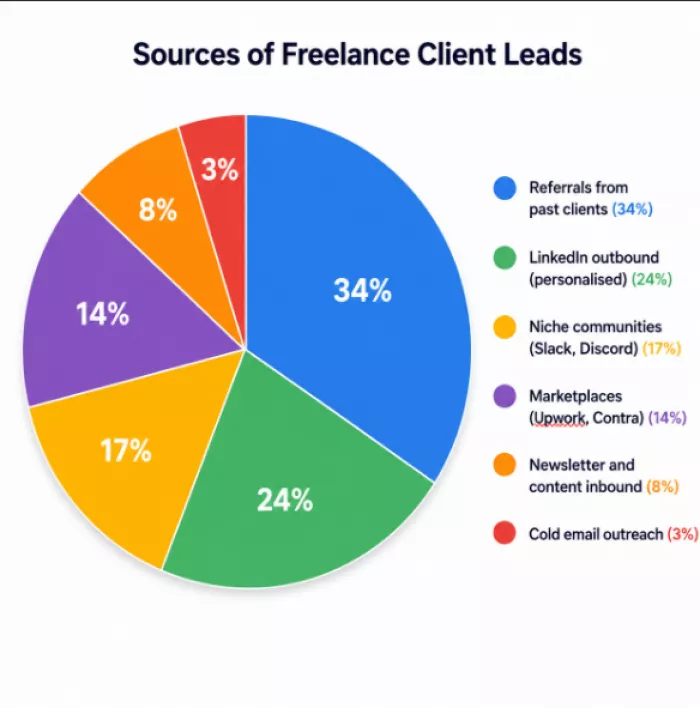
The pattern is consistent across geographies and specialties. Referrals dominate, LinkedIn outbound holds a strong second position, and niche communities (Slack groups for SaaS founders, Discord servers for indie hackers, trade-specific forums) outperform broad marketplaces over time. Cold email rarely justifies the effort relative to LinkedIn outreach at the same scale.
Tool stack and what it actually costs
Choosing a primary toolkit matters more than collecting every new release. ChatGPT and Claude cover most language work, with Claude leaning toward longer documents and ChatGPT offering broader integrations including image generation, voice mode, and Codex. Midjourney remains the default for high-quality visual output. Perplexity dominates research workflows because of its citation discipline and live web access.
The table below consolidates the working tiers across all four tools. Pricing reflects publicly listed plans as of May 2026 and excludes API costs, which are billed separately and rarely apply to subscription-based service work.
| TOOL | ENTRY TIER | POWER TIER | BUILT FOR |
|---|---|---|---|
| ChatGPT (OpenAI) | $20 / month (Plus) | $200 / month (Pro) | Language, multimodal, agents |
| Claude (Anthropic) | $20 / month (Pro) | $200 / month (Max 20×) | Long-form, reasoning, coding |
| Midjourney | $30 / month (Standard) | $120 / month (Mega) | Visual, brand, editorial |
| Perplexity | $20 / month (Pro) | $200 / month (Max) | Research, citations, web |
COST BENCHMARK Roughly $80 per month covers entry tiers across all four tools. That stack supports most service offerings up to about $6,000 in monthly client revenue before tier upgrades become necessary. |
Pricing your services without underselling
The strongest AI freelancers stop billing time and start billing outcomes. Hourly pricing penalises efficiency: as a freelancer becomes faster, it literally pays less for better work. A productized offer reverses that incentive. A LinkedIn ghostwriting package at $1,200 per month for eight posts delivers the same revenue whether it takes five hours or fifteen, and clients almost always prefer the predictability.
Common productized offer brackets
Realistic monthly revenue ranges by package type. Bar length reflects the upper end of typical pricing.
| Workflow audit & prompt library | $2,000–8,000 |
| Custom GPT or Claude Project build | $1,500–7,500 |
| Long-form content retainer | $1,500–6,000 |
| LinkedIn ghostwriting (monthly) | $1,200–4,500 |
| Weekly competitor briefings | $800–3,000 |
| Brand image packs (20–50 images) | $400–2,500 |
Source · Productized service listings on Contra, Storefront, and direct freelance reports, 2025 to 2026.
Pricing principles that hold up in client conversations
●Anchor pricing against the cost of the alternative (a junior staff hire, an agency retainer, a lost weekend), not against generic freelance rates.
●Quote a fixed scope and fixed price tied to the deliverable, with revisions explicitly capped, so faster delivery rewards the operator rather than the client.
●Offer two or three options at different price points instead of a single quote, which reframes the decision from "yes or no" to "which one."
●Convert satisfied project clients into monthly retainers as quickly as possible, because predictable revenue compounds faster than perpetual new-logo hunting.
Mistakes that quietly stall growth
The first mistake is selling tools instead of outcomes. Nobody hires a freelancer because they know Midjourney; they hire someone who delivers brand-consistent visuals on a predictable schedule. The earlier this distinction is internalised, the easier sales conversations become.
The second is chasing every new model release. The AI landscape produces a notable update almost every week. Operators who try to master each rarely deepen expertise in any. Lock in a core stack for at least six months, develop genuine fluency, and only audit alternatives when client outcomes plateau.
The third is invisibility. Operators who refuse to publish, network, or build a profile invariably plateau, regardless of skill. AI freelance work remains relationship-driven, and obscurity is the most expensive marketing channel of all.
The fourth is ignoring the legal and ethical layer. Clients increasingly expect disclosure about AI use, clear ownership of outputs, and basic data hygiene around what gets pasted into models. A short engagement letter covering AI usage, confidentiality, output ownership, and revision rounds protects both sides and signals professionalism that already separates careful operators from the rest of the market.
Bottom line
The market for AI freelance services in 2026 favours operators who translate fluency into structured offers, not those with the longest list of tools on their LinkedIn header. Tooling will keep changing. Subscription tiers will reshuffle. New models will appear, retire, and reappear under different names by next quarter.
The freelancers who thrive will treat AI as a medium for solving specific business problems, not as an industry to belong to. The barrier to entry is low, the ceiling unusually high, and operators who move now with discipline lock in the relationships and reputation that make the next several years considerably easier than the last three.
Comments