Table of Contents
- The toolkit at a glance
- Why an empty resume changes the math
- Stage 1: Build the resume from nothing
- Stage 2: Clear the ATS filter
- Stage 3: Fix the LinkedIn gap
- Stage 4: Practice the interview before it happens
- The gap no tool fixes: proof you can do the work
- A realistic two-week plan
- The verdict after two weeks inside these tools
Applying for a first job with a blank resume used to feel like shouting into a hallway. Send the same document to forty listings, hear back from none, repeat. That pattern has shifted. Spend two weeks running a genuine search through the current wave of AI career tools and one thing surfaces quickly: the candidates getting callbacks are rarely the ones with more experience. They are the ones presenting the little they have in the exact shape a hiring system expects to read.
The tools below were put through a full cycle, from a thin first draft to mock interviews, with attention to what a no-experience applicant actually needs rather than what each product markets. Pricing is current as of late 2026, and every tool here earns its place for a specific reason, not because it shows up on every list.
| 78% of job seekers already use AI in their search or would consider it (Resume Genius, 2026) | 44% now use AI specifically to prepare for interviews (Enhancv survey, April 2026) |
The toolkit at a glance
Seven tools cover the full journey. No single product does all of it well, so most first-time applicants end up running two or three together.

| Tool | Best for the no-experience candidate | Free tier | Paid from |
| Claude / ChatGPT | Turning coursework and projects into resume bullet points and cover letters | Yes | $20 / mo |
| Rezi | Building a clean, ATS-ready resume from a blank page | Limited | ~$29 / mo |
| Jobscan | Matching each resume to the job description before applying | ~10 apps / mo | ~$20 / mo |
| Careerflow | Rewriting a thin or empty LinkedIn profile | Yes | Varies |
| LinkedIn Premium Career | AI job-match scoring and drafted outreach | 7-day trial | $19.99 / mo |
| Yoodli | Speaking practice with pace and filler-word feedback | 5 sessions / mo | ~$15 / mo |
| Final Round AI | Role-specific mock interviews and answer structure | Yes | $25 / mo |
Why an empty resume changes the math
A candidate with ten years of history can afford a sloppy application, because the track record carries it. A first-timer cannot. With no job titles to lean on, every word has to pull weight, and most of the early rejections come from two invisible gatekeepers: the applicant tracking system that filters resumes before a human sees them, and the thirty seconds a recruiter spends scanning the ones that pass.
AI tools help most precisely because they fix the parts a beginner has no way to judge alone. Nobody with zero experience knows which keywords a software role screens for, or whether a cover letter reads as confident or desperate. These tools make that feedback instant and specific. The catch worth stating plainly: their output is a strong first draft, never a finished one. Hiring managers can spot generic AI phrasing from the first line, so the real skill is editing what the tool produces back into a human voice.
Stage 1: Build the resume from nothing
Claude and ChatGPTGeneral AI assistants / Free or around $20 per month  For a blank-slate applicant, a general assistant is the most useful single tool, because the hardest part of a first resume is not formatting, it is translation. Coursework, a side project, a volunteer shift and a part-time job rarely sound like professional achievements, and these models are good at converting them. Paste in a job description and a short list of what you have actually done, and ask for three to five resume bullet points that mirror the language of the posting. Cover lettersBullet pointsCompany research Strong at: flexible drafting with no rigid template, and tailoring each application in minutes. Watch for: bland, interchangeable phrasing if the draft is submitted untouched. Feed it specifics and rewrite in your own words. |
ReziAI resume builder / Limited free tier, Pro around $29 per month 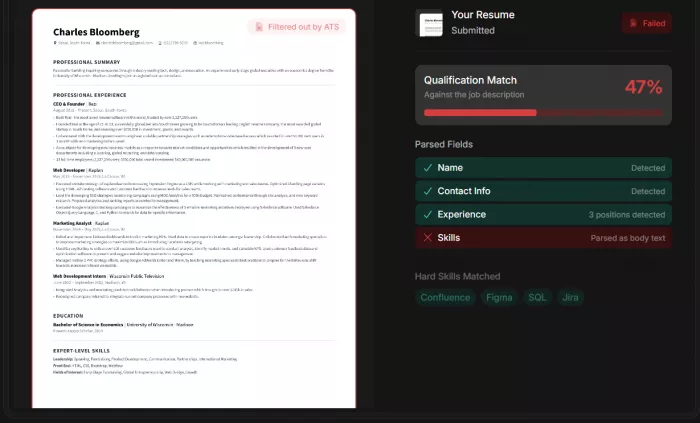 Where a general assistant helps with words, Rezi handles structure. It builds an ATS-friendly resume from the ground up, which matters for a beginner who has no old resume to start from. The layout stays parseable by filtering software, and its real-time content checks flag weak lines while you write rather than after you have applied. From-scratch resumesATS-safe layout Strong at: giving a first resume a professional skeleton without design guesswork. Watch for: templated results if the generated content is kept word for word. Treat it as the frame, not the finished piece. |
Stage 2: Clear the ATS filter
JobscanATS match optimisation / Free plan (about 10 applications a month), paid from ~$20 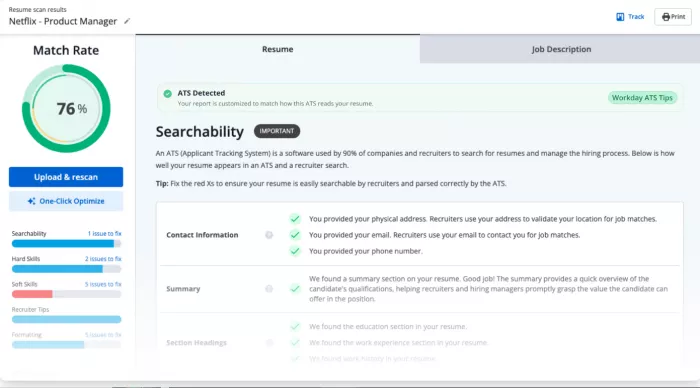 This is the tool that closes the gap between a decent resume and one that actually reaches a human. Jobscan compares a resume against a specific job description, scores the likely match, and names the exact keywords and skills that are missing. For a first-time applicant who does not yet know that a posting for "junior analyst" quietly expects the phrase "data visualisation," that score is the difference between the pile and the shortlist. Keyword matchingMatch-rate score Strong at: the single most mechanical, winnable part of the early search. Watch for: keyword stuffing. Add missing terms only where they are honestly true, then weave them into real sentences. |
| A timely note. Google quietly retired its free Interview Warmup tool in April 2026, which had been a go-to no-cost practice option. Its traffic now points toward Gemini and other products, so the free interview-practice slot has shifted to the tools covered further down. |
Stage 3: Fix the LinkedIn gap
Recruiters check a profile before replying, and for an entry-level candidate a half-empty LinkedIn can undo a good resume. Two tools help here, and they do different jobs.
| Tool | What it does | Best moment to use it |
| Careerflow | Scores and rewrites a LinkedIn profile section by section, and keeps the resume and profile aligned | Before any recruiter is likely to look, early in the search |
| LinkedIn Premium Career | Gives an AI match score against specific listings and drafts outreach to recruiters and alumni | Once applications are going out and warm intros start to matter |
A free Careerflow pass is usually enough to lift a bare profile to something credible. Premium Career is worth a trial month when the search gets serious, since a warm introduction through an alum beats a cold application for a first role almost every time.
Stage 4: Practice the interview before it happens
Getting the interview is half the battle. For someone who has never sat in one, the freeze and the ramble are the real enemies, and both respond well to repetition. Two tools cover this, and the right choice depends on the specific problem.
Yoodli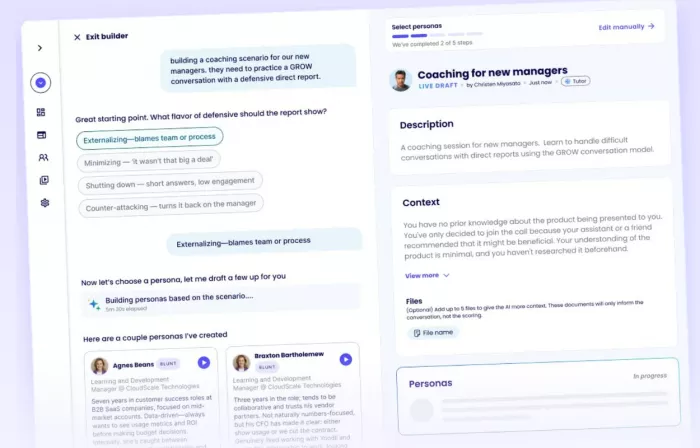 Speech coaching / Free (5 sessions a month), paid from ~$15 Yoodli listens to spoken answers and reports back on pace, filler words and clarity. It is built to train the exact delivery habits that AI-assisted screening now flags as weak. For a nervous first-timer, the private, repeatable rehearsal matters as much as the feedback, because confidence here is mostly reps. Delivery feedbackFiller-word tracking Best when: the problem is nerves, pacing or rambling rather than content. |
Final Round AIMock interviews / Free plan, paid from $25 per month Final Round AI runs role-specific mock interviews, builds a question bank around your target job, and gives structured feedback on how answers are framed. Upload a resume, paste the job description, and the practice session reflects the actual role. For technical first jobs it leans into coding and system-design style prompts, which a general chat tool handles less reliably. Role-specific questionsAnswer structure Best when: the problem is what to say and how to organise it under pressure. |
The gap no tool fixes: proof you can do the work
Here is the honest limit of every tool above. They sharpen how experience is presented, but none of them create it. A perfectly optimised resume for a role you cannot do yet still falls apart in the interview. For a no-experience candidate, the strongest move is to manufacture a small piece of real, demonstrable proof: a deployed website, a working app, an automated workflow, a published writing sample. That is what turns "no experience" into "here is something I built."

This is where a focused, project-based AI course earns back its cost faster than almost anything else in the search. A short, tool-specific bootcamp on a specialist AI and tech course platform gives two things at once: a skill that matches real job listings, and a finished artifact to show for it. The table below maps common entry-level targets to the kind of proof that beats an empty resume, and the course path that produces it.
| Entry-level target | Proof that beats "no experience" | Course path to get there |
| Junior front-end / web | A live, deployed site in your portfolio | A v0 by Vercel bootcamp, or a Framer AI masterclass for interactive prototypes |
| Junior developer | A working app or agent on your GitHub | A Replit Agent masterclass, or a Lovable app-building bootcamp |
| AI / LLM developer | A small retrieval or chat app you can demo | A LangChain bootcamp, paired with a Mistral AI masterclass on open models |
| Product / UX design | A clickable, well-presented prototype | A Figma AI masterclass covering AI-assisted design workflows |
| Operations / no-code | An automation that visibly saves hours | A Make.com mastery bootcamp on building automated workflows |
| Freelance writing / content | Published samples and a repeatable pitch system | A content-writing masterclass focused on landing paid work online |
The categories on these platforms, spanning coding and programming, productivity tools, and content, image and video generation, map closely to where entry-level hiring is actually growing. A candidate who shows up with one finished project from a bootcamp like these is no longer competing as a beginner with nothing to point at.
A realistic two-week plan
Tools only help when used in order. Running interview prep before the resume works wastes the practice. This sequence front-loads the quick wins and leaves proof-building to run in the background.
| Days | Focus | Tools in play |
| 1 to 3 | Draft the resume and translate projects into achievements | Claude / ChatGPT, Rezi |
| 4 to 5 | Match and score against five real listings, then fix gaps | Jobscan |
| 6 to 7 | Rebuild the LinkedIn profile and line up warm intros | Careerflow, LinkedIn Premium Career |
| 8 to 11 | Build one portfolio project through a short course | A project-based AI bootcamp |
| 12 to 14 | Run daily mock interviews until answers feel natural | Yoodli, Final Round AI |
Mistakes that quietly sink first-time applicants
Four habits worth avoiding
|
The verdict after two weeks inside these tools
Run the full set and a clear hierarchy emerges. A general assistant like Claude or ChatGPT is the one tool nobody should skip, because it touches every stage for free or close to it. Jobscan is the highest-value paid add-on for a beginner, since it fixes the most mechanical reason early applications vanish. For interviews, the choice is simple: reach for Yoodli when nerves are the problem and Final Round AI when the words are.
The sharpest lesson from the search, though, is the one the tools cannot deliver on their own. The applicants who broke out of the no-experience trap did it by pairing the toolkit with a single finished project, usually from a short, focused course, that gave them something concrete to show. The tools get the resume read. The proof gets the offer. Build one real thing, present it well with the tools above, and "no experience" stops being the sentence that ends the conversation.
Comments