Picture a Tuesday at 10:45 at night. The dishes are drying, the apartment has gone quiet, and the only light in the room comes from a laptop screen. That is when a surprising amount of coursework actually gets done in an asynchronous class. Not during a fixed lecture slot, but in the pockets of time that open up once the rest of the day has emptied out. No professor is waiting on a video call, and no attendance bar is ticking down. The material sits ready, and the learner decides when to press play.

That single shift, deciding when, is the heart of what an asynchronous class means. It swaps the shared classroom clock for a personal one. For some people, that freedom is the reason they can finish a degree at all. For others, it quietly becomes the reason a course slips away. Knowing how the format works, and what it quietly asks of a learner, is usually the difference between those two outcomes.
The short answerAn asynchronous class is a course where teaching and learning happen at different times for different people. Students move through recorded lectures, readings, and assignments on their own schedule, within set deadlines, instead of meeting live at a fixed hour. Contact with the instructor and classmates still happens, just on a delay, through discussion boards, messages, and feedback on submitted work rather than real-time conversation. |
Where the word comes from
The term is built from two Greek roots. Chronos means time, and the prefix a- means not or without. Put them together and asynchronous means "not at the same time." Its opposite, synchronous, uses syn- for together, so synchronous learning means learning together in real time. The vocabulary is older than online education, but it fits the format almost perfectly: the teaching and the learning are unhooked from the same moment on the clock.
How an asynchronous class actually works
Strip the format down to its parts and the same building blocks tend to show up, whatever the subject or platform.
Recorded lectures Pre-recorded video or narrated slides that can be paused, rewound, and replayed. Many platforms track how much of each video a student has watched. | A learning platform A central hub such as Canvas, Moodle, Blackboard, or Google Classroom that holds the schedule, materials, grades, and submission links in one place. |
Readings and resources PDFs, articles, slide decks, and links that stand in for the live explanation a lecturer would normally give in the room. | Discussion boards Written threads where students post responses and reply to classmates. This is where most of the back-and-forth of an async class takes place. |
Assignments with deadlines Quizzes, essays, problem sets, and projects due on specific dates. The flexibility is in when work gets done, not whether deadlines exist. | Delayed feedback Grades and comments arrive after submission rather than in the moment. Instructors usually hold virtual office hours or answer questions by message. |
Asynchronous vs synchronous learning
The clearest way to understand an asynchronous class is to set it beside its live counterpart. Synchronous learning means everyone shows up at the same time, usually on a video call, and moves through the material together. Asynchronous learning hands that timing to the individual.
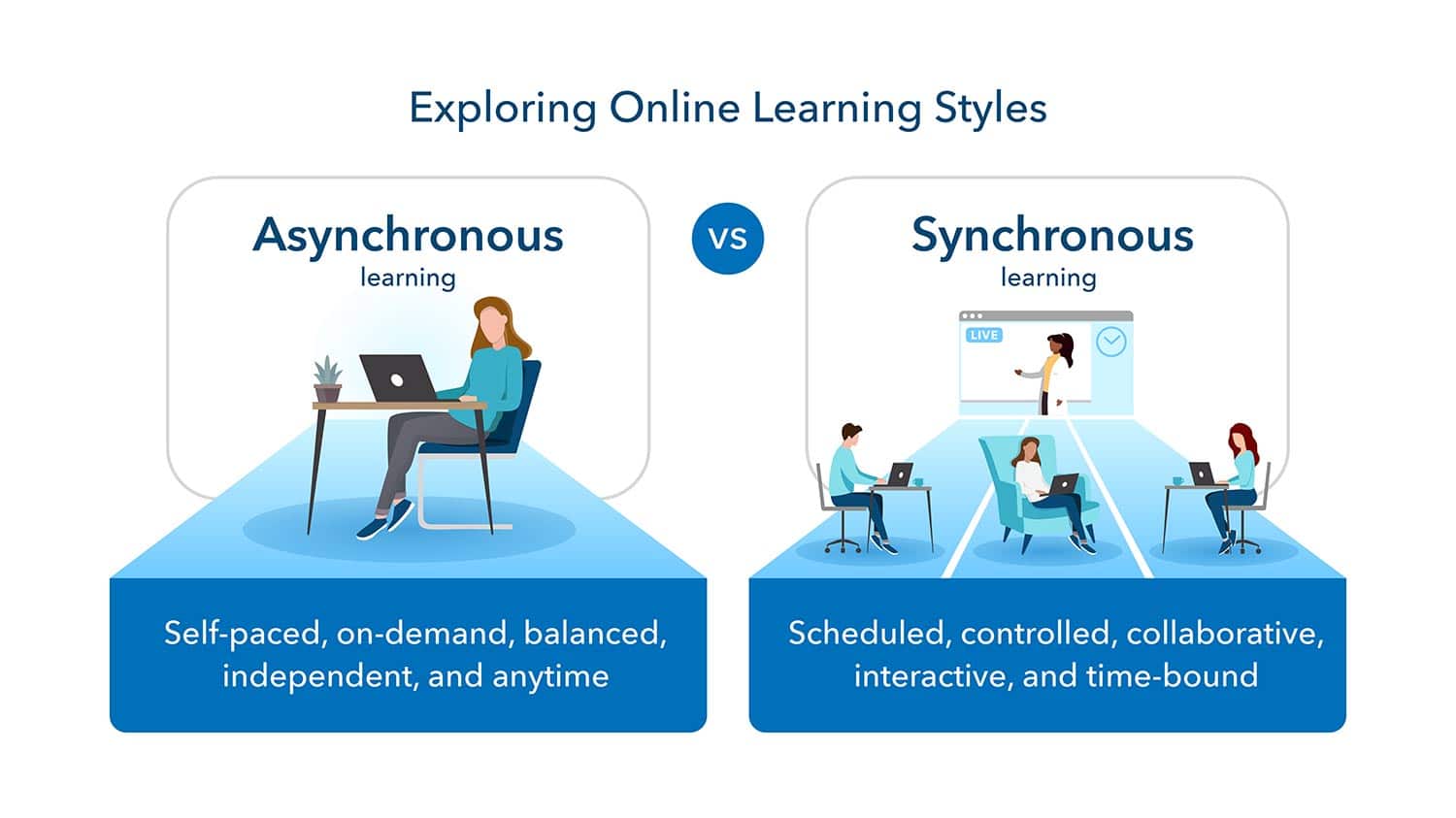
| Feature | Asynchronous | Synchronous |
|---|---|---|
| Schedule | Set by the learner within deadlines | Fixed, everyone attends at once |
| Format | Recorded lectures, readings, boards | Live video sessions, real-time chat |
| Interaction | Delayed and mostly written | Immediate and spoken |
| Pace | Self-directed inside a window | Group pace set by the instructor |
| Suits | Working students, caregivers, mixed time zones | Learners who want structure and live discussion |
| Main risk | Isolation and procrastination | Scheduling clashes and little flexibility |
Most courses today are not purely one or the other. A hybrid or blended course mixes the two, for example a weekly live session paired with recorded material and board posts done on the learner's own time. Plenty of fully online programs lean asynchronous for the bulk of the work and add a few live checkpoints on top.
What a typical async week looks like
Flexibility does not mean there is no rhythm. A well-run asynchronous week usually has a quiet structure underneath it, even when no two students follow it at the same hour.
| When | What usually happens |
|---|---|
| Monday | A new module unlocks. Videos, readings, and the week's tasks are posted. |
| Tue to Wed | Watch lectures and work through readings at whatever times fit around work or family. |
| Thursday | Post a first response on the discussion board so classmates have something to reply to. |
| Fri to Sat | Reply to peers, draft the main assignment, message the instructor with any questions. |
| Sunday | Assignment and quiz due, often late evening. The cycle resets the next morning. |
Who it fits, and who it fights
Works well for
| Struggles for
|
The real benefits
The appeal is not only convenience, though that is the headline. A handful of advantages hold up across most honest accounts of the format.
Genuine flexibility Coursework fits around shifts, childcare, and other classes. For many learners, this is the reason they can study at all. | Replay on demand A confusing explanation can be paused and rewatched as many times as needed, something a live lecture never allows. |
Time to think Written discussion gives quieter students room to compose a considered answer instead of racing to speak first. | Wider access Geography stops mattering. A learner in a small town can take a course taught from another country. |
A built-in record Every lecture, post, and resource stays available, which makes review before an exam far easier than relying on notes. | Lower daily friction No commute and no fixed start time removes the small obstacles that derail attendance in a traditional class. |
The honest challenges
The format has real weaknesses, and pretending otherwise helps no one. The same freedom that makes it work is also what makes it fail for a lot of people.
It leans on self-discipline With no class to show up to, work is easy to postpone. Completion is a known problem: a 2025 review of Virginia's community colleges found students passed asynchronous courses about 73% of the time, below the rate for in-person and live online classes. | It can feel isolating Written threads are not the same as a room full of people. Without real effort from the instructor, an async class can feel like studying alone next to strangers. |
Answers take time A question asked on Tuesday night might not get a reply until Thursday. When a single concept blocks everything after it, that wait is costly. | Weak design shows fast A course that is just uploaded slides and a reading list, with no real interaction, drains motivation quickly. Good async teaching takes deliberate work to build. |
Not right for every subject Skills that need live coaching or supervision, from lab work to clinical practice, do not translate cleanly to a screen on the learner's own schedule. | Easy to drift Nobody notices a quiet student falling behind until the grades land, by which point catching up is often no longer realistic. |
How to actually do well in one
Students who thrive in asynchronous courses tend to behave in similar ways. None of it is complicated, but all of it has to be deliberate.
Build a fake timetable Block specific hours each week for the course and treat them like a live class that cannot be skipped. | Finish a day early Aim to submit ahead of the deadline. The format offers no buffer when a laptop dies or life interferes at the last minute. |
Post early on the boards Early posts attract more replies and pull a student into the real conversation instead of the final-hour scramble. | Ask questions fast Message the instructor the moment something is unclear, since the answer will take time to come back. |
Protect your setup A consistent, low-distraction place to study matters more when nothing external is forcing focus. | Track every due date Put deadlines in one calendar with reminders. In an async course, a missed date is almost always a forgotten one. |
The format in numbers
A few figures put asynchronous learning in context.
50%+ Share of US college students taking at least one online course as of 2024, per the National Center for Education Statistics. | ~$204B Projected size of the global online learning market in 2025. |
~80% Online students who are also employed, which explains much of the demand for flexible scheduling. | 73% Pass rate for asynchronous courses in a 2025 study of Virginia's community colleges, below in-person and live online rates. |
Final verdictSo, is it worth it?After enough semesters built around recorded lectures and Sunday-night deadlines, the pattern is hard to miss. An asynchronous class is not a lighter version of a real class. It is a trade. The commute, the fixed hour, and the pressure of a room full of classmates all disappear, and in their place comes a single demand: manage yourself. For a parent studying after bedtime, a nurse rotating through night shifts, or anyone whose week refuses to fit a timetable, that trade is often the only thing that makes finishing possible, and it earns back every late night. The learners who struggle are rarely the ones who find the material hard. They are the ones who assumed flexibility meant less work and discovered, around week six, that the deadlines never moved. Treat an asynchronous class like a standing appointment with yourself, guard the hours, and stay a step ahead of the due dates, and the format gives back more freedom than any live schedule can. Drift, and it will happily let you, right up until it is too late to recover. Deciding which of those two learners you intend to be, before the first module ever unlocks, is most of the battle. |
Comments