Table of Contents
- What Matters Over Eight Hours
- 1. ElevenLabs : Best Overall for Expressive Audiobooks
- 2. Speechify Studio : Best for Getting Started Quickly
- 3. Murf AI : Best for Nonfiction
- 4. LOVO Genny : Best for Multilingual Projects
- 5. NaturalReader Commercial : Best for Straightforward Production
- 6. Descript : Best for Human + AI Narration
- Where Human Narrators Still Win
- Match the Tool to the Book
- Final Verdict
An AI voice can sound remarkably convincing for thirty seconds. An audiobook asks much more of it. The real challenge is keeping a listener engaged for five, eight, or fifteen hours while handling dialogue, difficult names, quiet passages, emotional turns, and hundreds of small changes in pacing. I compared the leading AI voice tools from that perspective rather than simply looking for the largest voice library.
The result is less about finding one “most human” voice and more about choosing the right production workflow for the book you are making.
What Matters Over Eight Hours
Audiobook narration exposes weaknesses that are easy to hide in short voiceovers. A slightly mechanical rhythm may barely register during a 45-second video, but after three chapters it becomes tiring. The same applies to exaggerated emotion, identical sentence endings, unnatural pauses, and characters whose voices subtly change between scenes.
As I worked through the options, I kept coming back to five questions:
● Does the narrator remain comfortable to listen to over long passages? Short samples tell you surprisingly little about listener fatigue.
● Can I direct the performance rather than merely select a voice? Pacing, emphasis, pauses, and emotion matter more in a book than they do in basic TTS.
● How painful are revisions? Fixing one mispronounced surname should not mean rebuilding half a chapter.
● Can the same character remain recognizable across a long manuscript? Consistency becomes particularly important in fiction.
● Can I legally publish the finished audio? Personal text-to-speech access and commercially licensed audiobook production are not always the same product.
Research on automated audiobook systems points to the same difficult areas. Even newer systems built specifically around expressive audiobook generation focus heavily on emotional transitions, consistent speaker prosody, and alignment with human listening preferences rather than speech intelligibility alone.
Here is where the six tools fit before getting into each one.
| Tool | Best for | Strongest reason to use it | Main compromise |
| ElevenLabs | Fiction and memoir | Expressive long-form narration | Good results still need direction |
| Speechify Studio | Fast production | Simple route into polished voiceover | Free plan is restrictive for publishing |
| Murf AI | Nonfiction | Controlled, clear narration | Less convincing for dramatic acting |
| LOVO Genny | Multilingual books | Large voice and language selection | Voice casting takes more work |
| NaturalReader Commercial | Straightforward audiobook production | Practical commercial workflow | Less focused on dramatic performance |
| Descript | Human + AI production | Repairing real narration with AI | Not the best choice for generating an entire novel |
1. ElevenLabs : Best Overall for Expressive Audiobooks
Best for: Fiction, memoirs, and books where the narrator's delivery matters as much as voice quality.
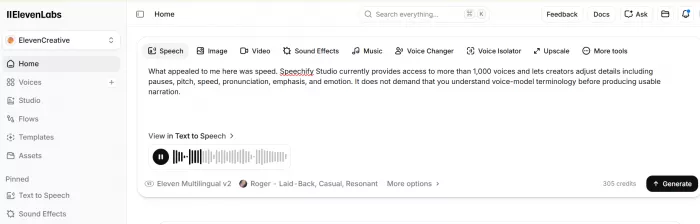
ElevenLabs is where I would start if I were producing a novel. Its position has become stronger in 2026 because ElevenCreative now includes a dedicated Audiobooks workflow designed to take a manuscript through narration and toward publishable audio rather than treating the book as an oversized voiceover script. ElevenLabs introduced that workflow in February 2026 with support for long-form narration, character voices, and audiobook production inside the same environment.
Where It Works Well
Its biggest advantage is directability. ElevenLabs' speech models are built around contextual delivery, and the platform provides voice selection, cloning, and tools for shaping the way a passage is spoken. That becomes valuable when a chapter moves from calm description into confrontation without changing narrator.
For fiction, I would still resist giving every character a dramatically different voice. A traditional narrator often differentiates people through smaller changes in rhythm, pitch, and attitude. Making every conversation sound like a cast recording can pull attention away from the writing.
Where a Human Still Wins
ElevenLabs can produce anger, hesitation, excitement, and other expressive deliveries. The difficult part is deciding when those changes belong.
A narrator may realize that “I'm fine” needs to sound exhausted rather than reassuring because of something that happened two chapters earlier. AI can perform that direction well once it receives it. A skilled human is still better at developing that interpretation while reading the whole story.
Pricing and Plans
ElevenLabs offers 10,000 credits on Free, while Starter is $6/month, Creator $22/month, and Pro $99/month. The company currently estimates roughly 10, 30, 121, and 600 minutes of UI text-to-speech respectively, depending on the plan and model used.
My Take
For a book that needs an actual performance rather than clean reading, ElevenLabs is my strongest overall AI choice.
2. Speechify Studio : Best for Getting Started Quickly
Best for: Authors who want a straightforward route from manuscript text to polished narration.
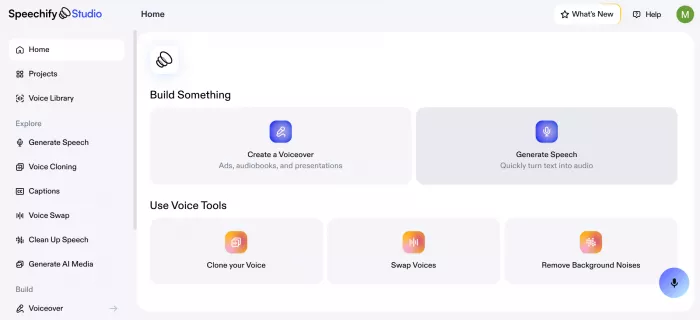
Speechify is easier to understand if you separate its reader product from Speechify Studio. The regular Speechify experience is primarily designed to read documents and books aloud. Studio is the creation product for producing voiceovers, including audiobooks, with editing, voice selection, dubbing, and commercial-use options.
Where It Works Well
What appealed to me here was speed. Speechify Studio currently provides access to more than 1,000 voices and lets creators adjust details including pauses, pitch, speed, pronunciation, emphasis, and emotion. It does not demand that you understand voice-model terminology before producing usable narration.
That makes it a particularly sensible option for nonfiction authors, independent publishers, and creators who care more about moving a manuscript through production efficiently than experimenting with dozens of model settings.
Where a Human Still Wins
Ease of generation does not remove the need for editorial listening. An AI narrator may pronounce every word correctly and still place emphasis on the wrong part of an argument.
That matters in memoir and nonfiction too. A human understands which sentence carries the real point of a paragraph and which sentence should deliberately pass without emphasis.
Pricing and Plans
Speechify Studio's Free plan includes 600 Studio credits, but it does not include voice cloning or commercial usage rights. Studio Starter costs $100/year, while Studio Creator costs $300/year and comes with a much larger credit allowance.
My Take
Speechify is one of the easiest choices here for an author who wants to spend less time learning the software and more time producing the book.
3. Murf AI : Best for Nonfiction
Best for: Business books, instructional material, guides, and educational audiobooks.
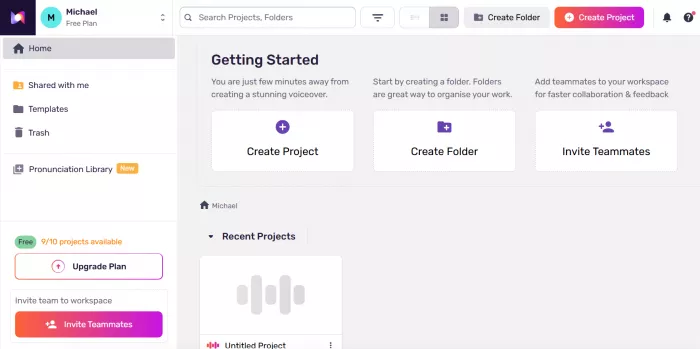
Murf is less interesting to me as an acting tool than as a controlled narration tool, and that is not a criticism. Many audiobooks do not need theatrical performance.
Murf currently offers more than 200 voices and supports over 35 languages, with its text-to-speech product explicitly accommodating books and audiobook-style narration.
Where It Works Well
For nonfiction, consistency matters enormously. A business book can contain statistics, headings, quotations, lists, acronyms, and technical terminology in the space of a few pages. The voice needs to stay clear without turning every sentence into an announcement.
Murf's controlled voiceover workflow fits that job well. I would consider it before some more theatrical tools for training material or practical nonfiction because the objective is often comprehension rather than character acting.
Where a Human Still Wins
Human narrators are better at recognizing the intellectual hierarchy of a passage.
They understand that one sentence is the argument, the next is supporting evidence, and the third is a throwaway example. AI can give all three similar vocal importance unless the production is carefully directed.
Pricing and Plans
Murf has a Free plan with 10 minutes of voice generation, but downloads and commercial rights are restricted. Its Creator plan starts at $19/month when billed annually and includes access to its 200+ voices, commercial rights, and substantially more generation time.
My Take
For a practical nonfiction audiobook, Murf's restraint can be more useful than a voice that constantly tries to sound impressive.
4. LOVO Genny : Best for Multilingual Projects
Best for: Books being produced in several languages or projects requiring a large range of narrator profiles.
LOVO's strength is casting. Genny provides voices across more than 100 languages, which gives a publisher much more room to think about narrator age, accent, vocal weight, and regional fit rather than simply choosing “male” or “female.”
Where It Works Well
This becomes particularly useful when a book needs multiple editions. A translated audiobook creates a casting problem as much as a translation problem. The English narrator may be perfect for the original but completely wrong for the Spanish, Japanese, or Hindi edition. A broad multilingual voice library gives you more options to find a voice that suits the material rather than forcing the same vocal identity everywhere.
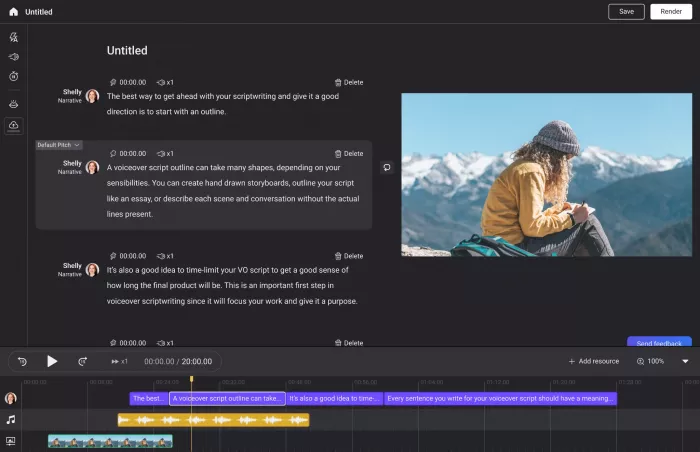
Genny also supports longer multi-block projects and multiple speakers, which is more appropriate for audiobook production than its short voiceover mode.
Where a Human Still Wins
Language support is not the same as cultural fluency.
Names, regional expressions, historical terms, jokes, and code-switching can all sound technically correct while still feeling wrong to a native listener. I would always have a fluent human review a localized audiobook before publication.
Pricing and Plans
LOVO provides a free plan after its trial period. Its paid tiers include Basic with two voice-generation hours per month, Pro with five hours, and Pro+ with 20 hours; LOVO's published pricing materials list these at roughly $24, $48, and $75 per month respectively.
My Take
LOVO makes the most sense when casting variety and multilingual publishing are central to the project, not merely nice extras.
5. NaturalReader Commercial : Best for Straightforward Production
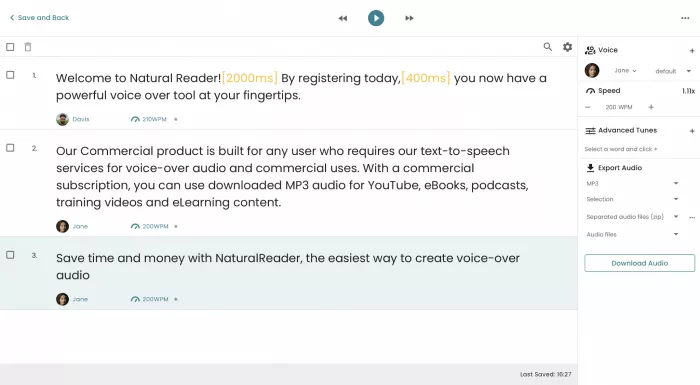
Best for: Independent authors who want a practical commercial text-to-audio workflow without a complicated production environment.
NaturalReader needs one important distinction up front. Its Personal product is for private listening. If you intend to distribute or sell the resulting audiobook, NaturalReader directs creators toward its separate Commercial AI Voice Generator.
That distinction alone makes it useful for authors who do not want to discover licensing restrictions after finishing a book.
Where It Works Well
NaturalReader Commercial currently offers more than 200 audiobook-oriented voices along with pronunciation editing, revisions, voice styles, multilingual voices, voice cloning, and controls for pacing and emotional delivery. Its newer customization tools can also apply speech prompts and inline voice tags to individual passages.
I like it most for straightforward narration where the production goal is consistency rather than elaborate character acting.
Where a Human Still Wins
The weakness appears when a manuscript requires interpretation rather than correction.
It is relatively easy to tell software that a sentence should be slower. A narrator may realize that slowing it down would actually ruin the scene and that the better choice is to rush the first half before leaving silence at the end.
Those are performance decisions, not settings.
Pricing and Plans
NaturalReader Commercial's Starter plan is $29/month or $198/year, with 500,000 monthly credits. Creator costs $49/month or $297/year and increases the allowance to two million credits per month.
My Take
NaturalReader is a strong choice when you want a commercially usable audiobook workflow without turning production into a technical project.
6. Descript : Best for Human + AI Narration
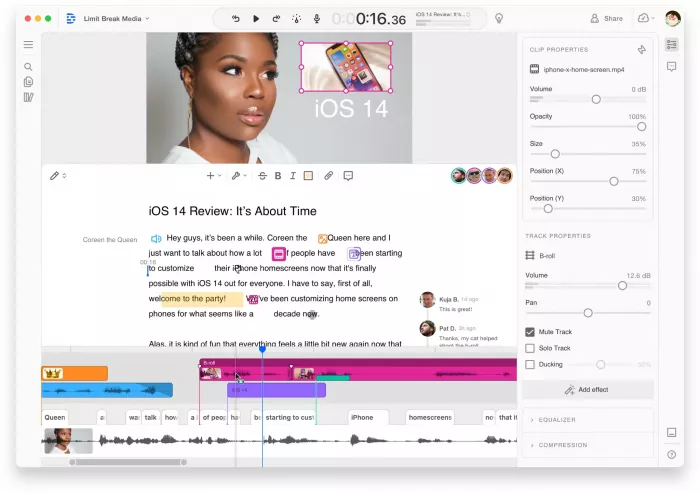
Best for: Authors who want to narrate the book themselves and use AI to fix the difficult parts.
Descript is my deliberately different pick. I would not choose it first to synthesize an entire novel from scratch. Its advantage appears when there is already a human recording.
Descript's editing system treats recorded audio much like a document. Its AI Speech and voice-cloning tools can generate replacement words or sentences, while Regenerate is designed to repair sections so they blend into surrounding speech.
Where It Works Well
Imagine recording your own nonfiction audiobook and discovering three days later that you misread a statistic in Chapter 6.
The traditional answer is to get the microphone, room, voice level, microphone distance, and vocal delivery close enough to the original recording to perform a pickup.
With a trained voice clone, a small correction can instead be generated and inserted into the edit. That is a much smarter use of AI than replacing the narrator entirely.
Where a Human Still Wins
Here, the human already has the advantage: the performance is real.
Breathing, hesitation, changing energy, and the slight imperfections of a long recording can make the voice feel personal. AI becomes the production assistant rather than the performer.
Pricing and Plans
Descript has a Free tier with limited AI Speech. Paid plans currently include Hobbyist at $24/month or $16/month annually and Creator at $35/month or $24/month annually, with higher AI and editing allowances.
My Take
If the author has a good speaking voice and is willing to record, Descript may produce the most human audiobook on this list precisely because AI is doing less of the narration.
Where Human Narrators Still Win
After comparing these tools, I do not think the useful debate is whether AI can “sound human” anymore.
It often can. The more difficult question is whether AI can read a book as an interpretation rather than a sequence of sentences.
Subtext Is More Than Emotion
Consider a simple line:
“That's wonderful.”
An AI system can be instructed to make it cheerful, sarcastic, angry, hesitant, or sad.
But a narrator has to decide which one is appropriate. Perhaps the character genuinely means it in Chapter 2. By Chapter 17, the same sentence has become an insult between two people who no longer trust one another.
The words have not changed. Their history has. That is where human narration remains difficult to reduce to an emotion control.
Characters Need Memory
Good character narration also accumulates. A narrator may establish that one character talks rapidly whenever nervous, another avoids eye contact through long pauses, and an older character becomes physically weaker as the novel progresses.
Those choices need to survive hundreds of pages. Modern audiobook research is explicitly trying to improve consistent speaker prosody and emotion across longer narration, which tells you where the technical challenge now sits.
AI can maintain a cloned voice. Maintaining a character arc inside that voice is harder.
Comedy Needs Judgment
A pause is not automatically funny because it lasts 0.8 seconds. Comedy depends on what the audience expects to hear next. Sometimes the narrator delays a word. Sometimes the joke works because the line arrives too quickly. Sometimes the funniest delivery is completely flat.
A human performer can alter timing after understanding the joke. AI still benefits greatly from someone directing that timing.
Emotion Can Be Too Perfect
One unexpected weakness of synthetic narration is that more expressiveness does not always produce a better audiobook.
Grief does not always sound like grief. A person receiving terrible news might become unusually calm. Someone who is terrified may start talking too much. A character trying not to cry can be more convincing than a voice explicitly instructed to “sound sad.”
Human actors understand that emotional restraint can carry more weight than obvious performance.
Long Listening Changes Everything
Finally, audiobook quality should be measured in hours, not demos. A polished voice can still become tiring if sentence endings repeat, pauses fall into patterns, or every paragraph receives the same carefully produced rise and fall.
This is where I would always listen to at least one complete chapter before committing a narrator to an entire manuscript.
| Narration task | AI is already strong at | Human advantage |
| Straight nonfiction | Consistency and speed | Meaningful emphasis |
| Pronunciation fixes | Fast regeneration | Contextual judgment |
| Character voices | Easy differentiation | Character continuity |
| Emotional passages | Directed emotion | Subtext and restraint |
| Multilingual production | Scale and voice choice | Cultural nuance |
| Corrections | Cheap, quick pickups | Natural improvisation |
| Comedy | Repeatable pacing | Timing and intention |
| Full novels | Consistent vocal identity | Long-form interpretation |
Match the Tool to the Book
If I were choosing today, I would start with the manuscript rather than the software.
Fiction and memoir usually need more emotional range, character distinction, and control over delivery, which makes ElevenLabs the strongest starting point.
Murf fits business books, guides, textbooks, and training material better. In these formats, steady pacing and clarity usually matter more than dramatic performance.
Authors who care most about speed and simplicity may find Speechify Studio easier to work with because it keeps the production process relatively straightforward.
LOVO becomes more appealing when the same book needs to be produced in several languages. Its broad voice selection gives publishers more flexibility when casting different editions, although native-speaker review is still important.
NaturalReader Commercial sits somewhere in the middle. It suits authors who want clear commercial licensing and a practical production workflow without having to manage a complicated set of audio tools.
Anyone comfortable recording their own narration should also consider Descript. Recording the performance yourself and using AI mainly for corrections preserves the author's natural connection to the material while avoiding repeated studio pickups.
Final Verdict
If I had to choose one AI tool for making an audiobook in 2026, ElevenLabs would be my overall pick, particularly for fiction and narrative nonfiction. Its dedicated audiobook workflow and increasingly expressive voices make it the closest of these six to an end-to-end AI narration environment.
But I would not automatically use AI for every book.
AI has become very good at solving the expensive mechanical parts of audiobook production: generating clean speech, keeping a voice consistent, correcting a paragraph, changing pronunciation, and creating additional language versions.
A talented human narrator contributes something else. They decide what a sentence means before deciding how it should sound.
For straightforward nonfiction, back-catalog conversion, accessibility editions, low-budget publishing, and frequently updated books, that trade-off may increasingly favor AI. For literary fiction, comedy, emotionally complicated memoir, and books built around distinctive characters, the human performance can still be part of the work itself.
The most interesting approach in 2026 may therefore be neither “AI narration” nor “human narration.” It is a production where humans make interpretive decisions and AI removes the repetitive work around them.
Comments