Table of Contents
- How the Tools Compare
- 1. Jasper : Best for Brand Control
- 2. Writesonic : Best for Complete Production
- 3. Frase : Best for Research and Briefs
- 4. Surfer : Best for Content Optimization
- 5. KoalaWriter : Best for Publishing Volume
- 6. Rytr : Best Budget Assistant
- Match the Right Tool
- Human Editing Still Matters
AI writing software is no longer differentiated by whether it can produce a 2,000-word draft. Nearly every serious platform can do that. The useful distinction is what happens before and after generation: whether the tool can find a defensible angle, build a useful brief, preserve the brand’s language, support factual claims, optimize without flattening the writing and move the finished article into a publishing system.
That is also why there is no single winner for every blog team. A brand managing several writers needs different controls from a solo publisher producing affiliate content. An SEO strategist may value competitor research more than generation, while an editor may care most about reducing cleanup.
The six tools below were selected for the distinct role each can play in a professional blog workflow.
How the Tools Compare
The comparison focuses on research, outline control, drafting, voice consistency, SEO support, editing effort and publishing. Pricing is shown in US dollars and reflects publicly listed rates available in July 2026.
| Tool | Best for | Strongest capability | Starting paid price | Main trade-off |
| Jasper | Brands and content teams | Reusable brand, audience and knowledge controls | $69 monthly or $59 annually | Too expensive and elaborate for occasional blogging |
| Writesonic | Search-led content operations | Research-to-publish article production with citations and CMS export | $79 per month billed annually | Its current platform is priced around broader AI-search work |
| Frase | SEO writers and strategists | SERP research, briefs and live SEO/GEO scoring | $49 monthly or $39 annually | Data-led briefs still need an original editorial angle |
| Surfer | Teams optimizing for search | Detailed competitive guidelines and live content scoring | $49 per month billed annually | Chasing the score can make articles formulaic |
| KoalaWriter | High-volume publishers | Fast long-form generation with direct CMS publishing | $9 per month | Speed can encourage thin editorial review |
| Rytr | Freelancers on a budget | Affordable short-form drafting and rewriting | $7.50 per month | Less capable as a complete long-form research system |
1. Jasper : Best for Brand Control
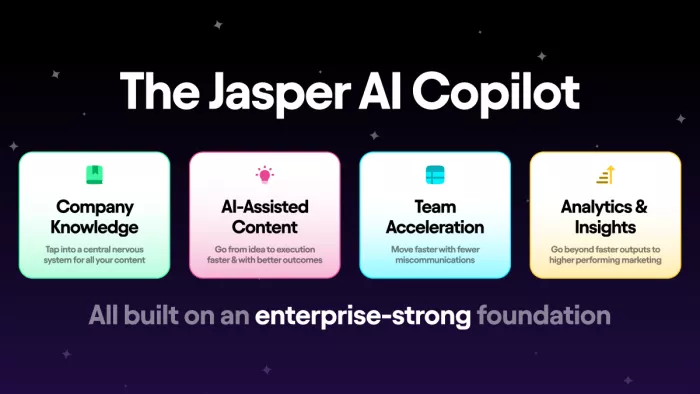
Jasper is the strongest option here for organizations that need many contributors to sound as though they work from the same editorial playbook. Its value is not the blank-page generator. It is the reusable context placed around that generator.
On the Pro plan, Jasper currently includes Canvas, core marketing agents, two Brand Voices, five Knowledge assets and three Audience profiles. Business expands those controls and adds advanced agents, Grid, governance, API access and unlimited IQ customization.
Best for: Established brands, agencies and in-house teams producing regular content across several products or audiences.
Standout Features
● Brand Voice gives the model examples and rules drawn from approved writing, reducing the need to restate tone instructions in every brief.
● Knowledge assets hold product details, company information and source material that should inform the draft.
● Audience profiles let a team frame the same subject differently for technical users, buyers or senior decision-makers.
● Canvas and marketing agents support structured drafting and revision rather than forcing every article through a single chat response.
Advantages and Limitations
| Advantages | Limitations |
| Reusable context reduces repeated setup across articles and contributors | Preparing strong voice, knowledge and audience assets takes real editorial work |
| Better suited to multi-brand and multi-audience production than a simple generator | The Pro plan includes only one seat, so expanding a team leads toward custom Business pricing |
| Can support related campaign content beyond the original blog post | It does not remove the need for research verification or structural editing |
| Governance options become useful when content passes through several reviewers | Solo bloggers may pay for controls they rarely use |
Pricing
Jasper Pro costs $69 per month on monthly billing or $59 per month when billed annually. Business uses custom pricing, and Jasper offers a seven-day Pro trial.
Practical Take
Choose Jasper when inconsistency is the expensive problem. If editors repeatedly correct terminology, positioning and tone across several writers, its reusable controls can reduce that work. It is less persuasive when one writer already knows the brand well and only needs help producing occasional outlines or first drafts.
2. Writesonic : Best for Complete Production
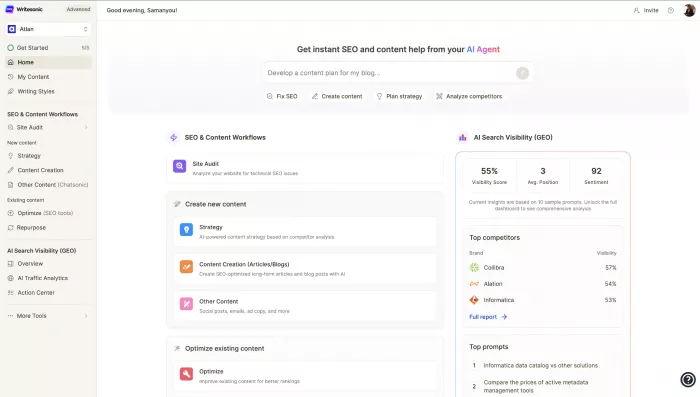
Writesonic has moved beyond being a straightforward AI writer. Its current article system is designed as a research-to-publishing pipeline that can produce long-form pieces, build citations, add internal and external links, apply brand and author voices, generate images and export to major content-management systems.
The Article Writer supports 3,000- to 8,000-word content and exports to WordPress, Sanity, Contentful, Webflow and Ghost. It also emphasizes first-party sourcing, citation verification, schema, internal links and a second review pass. “Ready to publish” should still be treated as a product promise rather than permission to skip editorial review.
Best for: SEO and content teams that want research, generation, links, visuals and publishing inside one system.
Standout Features
● Research-led article generation creates section-level drafts with citations instead of producing unsupported prose from one broad prompt.
● Brand and author profiles help separate the company voice from the individual expert credited on the article.
● Internal-link and source support reduces the manual assembly work that often follows a long-form draft.
● CMS export and image generation move the platform closer to a production tool than a standalone writing assistant.
Advantages and Limitations
| Advantages | Limitations |
| Covers more of the article lifecycle than most dedicated generators | The expanding feature set can feel excessive for a writer who only needs drafting help |
| Strong emphasis on sources, citations and long-form structure | Citations and claims still require human checking against the original source |
| Built-in publishing options reduce copying and reformatting | Automated FAQs, schema and images may not suit every editorial format |
| Useful for teams also working on SEO and AI-search visibility | Current pricing is aimed at broader search operations, not low-cost blogging |
Pricing
The Starter plan begins at $79 per month billed annually and includes 15 AI articles per month, one project and one user. Basic rises to $199 per month billed annually with 25 AI articles and two users.
Practical Take
Writesonic is most convincing when a team wants to consolidate several steps that are currently spread across research, writing, linking and CMS tools. For a solo blogger, the entry price is difficult to justify unless the broader SEO and AI-visibility features are also being used.
3. Frase : Best for Research and Briefs

Frase is at its best before the first paragraph is written. It reads the search results for a target query, breaks down the structure and depth of ranking pages, surfaces questions, identifies gaps and turns that information into an editable brief. This makes it particularly useful when the article will be written by another person and the brief needs to carry the strategy clearly.
Its current platform also drafts content, scores it for SEO and GEO, tracks AI visibility and can publish to WordPress, Webflow, Sanity and Wix. Its research layer exposes competitor structures, questions and missing coverage so the editor can decide where to follow the market and where to depart from it.
Best for: SEO strategists, freelance writers and content managers who need stronger research and writer-ready briefs.
Standout Features
● SERP analysis brings competitor headings, length, subjects and sources into one research panel.
● Question discovery collects queries from search and discussion sources, which is useful for identifying reader concerns that keyword lists miss.
● Editable content briefs turn research into a handoff document rather than leaving the writer with raw data.
● SEO and GEO scores show where a draft may be weak for traditional search or difficult for answer engines to extract and reference.
Advantages and Limitations
| Advantages | Limitations |
| Strong bridge between SEO strategy and the person writing the article | Competitor-derived recommendations can encourage imitation if the editor does not add a fresh angle |
| Research, briefing, drafting and scoring remain connected | A high optimization score does not prove that the article is insightful or persuasive |
| Useful for both new content and planned refreshes | The platform now contains more features than writers seeking only briefs may need |
| Publishing integrations reduce handoff friction | Teams still need a separate standard for factual sourcing and editorial quality |
Pricing
Starter costs $49 per month or $39 per month billed annually. Professional is listed at $129 monthly or about $103 per month on annual billing, while Scale costs $299 monthly or $239 annually. A seven-day trial is available without a credit card.
Practical Take
Frase is the best fit when weak research is causing weak drafts. It gives editors a clearer basis for deciding what the page must cover, but it should be used to discover the competitive baseline, not reproduce it. The final article still needs a position, examples and evidence that do not come from reading the same ten ranking pages as everyone else.
4. Surfer : Best for Content Optimization
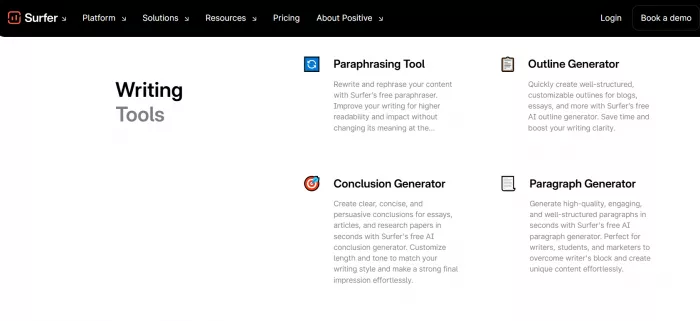
Surfer is the most specialized optimization tool in the group. Its Content Editor analyses competing pages and provides live guidance on terms, topics, questions, structure and coverage. Writers can create a document manually with those guidelines or let Surfer AI generate the content.
The redesigned editor also brings Brand Knowledge, custom voice, templates and instructions into the setup stage. It tracks Content Score, SEO Score and AI Search Score, while pre-publish tools cover readability, plagiarism, internal linking and export.
Best for: SEO teams that already have writers but need a consistent process for optimizing new and existing pages.
Standout Features
● Competitor selection lets editors remove irrelevant results before those pages influence the recommendations.
● Live content guidance shows missing entities, questions and coverage while the article is being written.
● Auto-Optimize and internal linking can accelerate mechanical revision after the editorial draft is complete.
● Brand Knowledge and custom instructions add context that older keyword-scoring workflows often lacked.
Advantages and Limitations
| Advantages | Limitations |
| Makes the basis of many recommendations visible inside the editor | The score can become a distraction if writers treat every suggested term as mandatory |
| Useful for refreshing existing pages as well as writing new ones | Similarity to ranking competitors does not guarantee a differentiated article |
| Supports manual writing and AI generation in the same environment | Pricing rises quickly when teams need tracking, multiple brands or advanced analysis |
| Integrates with WordPress, Google Docs, Contentful and Zapier | It is an optimization platform first, not the strongest choice for original research |
Pricing
Discovery starts at $49 per month billed annually and includes 120 documents. Standard costs $99 per month billed annually, while Pro is $182 per month billed annually. New accounts receive a seven-day Pro trial.
Practical Take
Surfer is valuable after the article already has a reason to exist. Use it to catch missing coverage, weak internal linking and structural gaps. Do not let the target score decide the argument, sentence rhythm or final length. The strongest article is not always the one that resembles the current search results most closely.
5. KoalaWriter : Best for Publishing Volume
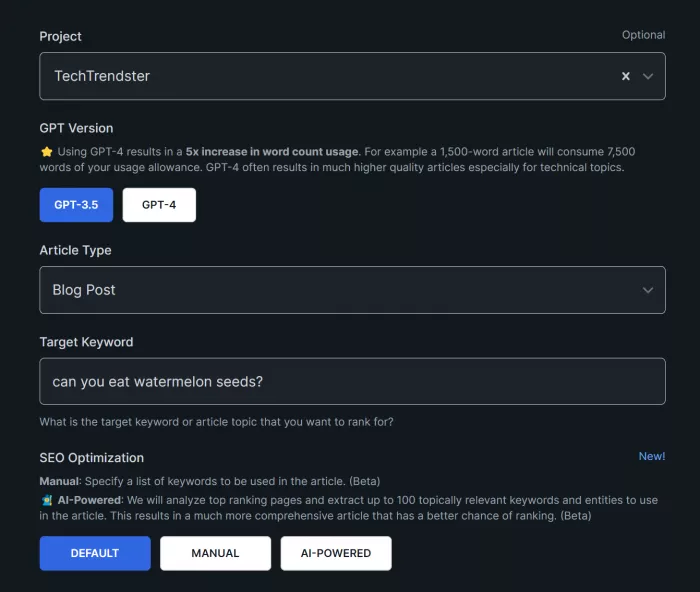
KoalaWriter is built for publishers who want to move quickly from a keyword or outline to a formatted long-form article. Its feature set includes SERP-based optimization, customizable outlines, real-time factual data, AI images, bulk creation and direct publishing integrations.
Koala supports WordPress, Shopify, Webflow and Ghost, while its WordPress plugin can preserve formatting, control post status, assign categories and handle images. Professional plans add Deep Research, automatic internal linking and an AI editing feature called Polish.
Best for: Niche-site owners, affiliate publishers and teams producing a large number of structured articles.
Standout Features
● Customizable outlines give the editor a chance to fix the structure before consuming the full article allowance.
● Bulk writing supports scheduled or high-volume production rather than one document at a time.
● Automatic internal linking can reduce a repetitive publishing task on established sites.
● Direct CMS integrations preserve more of the article’s structure than a copy-and-paste workflow.
Advantages and Limitations
| Advantages | Limitations |
| One of the lowest entry prices among dedicated long-form tools | Low-cost generation can encourage publishing before the draft has been properly challenged |
| Particularly efficient for repeatable article types | Less suitable for highly original thought leadership or interview-led reporting |
| Strong WordPress and multi-CMS publishing support | Advanced research, editing and internal-link features require Professional or higher |
| Word allowances scale to very high production volumes | Usage varies by selected model, with premium models consuming allowances faster |
Pricing
Essentials costs $9 per month for 15,000 KoalaWriter words. Professional costs $49 per month for 100,000 words and adds Deep Research, automatic internal linking and advanced editing. A free account currently includes 5,000 trial words.
Practical Take
KoalaWriter is a practical production engine when the team already has a reliable content standard and needs to execute it repeatedly. It is a poor substitute for that standard. The faster the publishing workflow becomes, the more important it is to maintain separate checks for originality, source quality, product accuracy and search intent.
6. Rytr : Best Budget Assistant
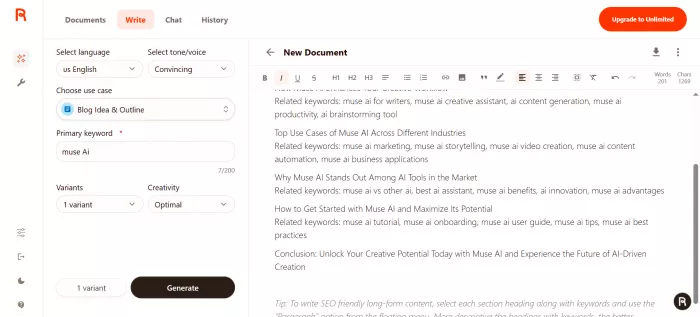
Rytr is the lightest tool in this list. It is better understood as an affordable writing and rewriting assistant than as a complete SEO content platform. Writers can create outlines and sections, continue existing text, shorten or expand passages, change tone and work through a browser extension.
Its voice-matching feature can learn from a sample, while the blog tools support more than 30 languages and over 20 preset tones. Paid plans also add plagiarism checks, with the checker powered by Copyscape.
Best for: Freelancers, small businesses and occasional bloggers who need inexpensive help with ideation, rewriting and short sections.
Standout Features
● Tone and voice controls are useful when adapting one draft for different clients or formats.
● Inline editing commands help expand, shorten, rephrase or continue selected text without regenerating the whole article.
● A browser extension keeps basic writing assistance available in common web-based editors.
● A permanent free plan makes it possible to assess the output before paying.
Advantages and Limitations
| Advantages | Limitations |
| Considerably cheaper than full SEO content platforms | Research, briefing and optimization are not as deep as Frase or Surfer |
| Simple enough for occasional writers to learn quickly | Long articles are usually better assembled section by section |
| Useful for rewriting and polishing existing human drafts | Output can become repetitive when asked to carry an entire complex article |
| Premium supports several languages and multiple voice matches | It offers less workflow control for larger editorial teams |
Pricing
The free plan includes 10,000 characters per month. Unlimited costs $7.50 per month and Premium costs $24.16 per month, with Premium adding multiple voice matches, more plagiarism checks and support for more than 35 languages.
Practical Take
Rytr is the sensible choice when the budget is small and the writer remains responsible for research, structure and final editing. It can remove friction from headlines, outlines, transitions and rewrites. It should not be expected to replace the research and optimization systems offered by the more expensive tools.
Match the Right Tool
For most teams, the decision becomes simpler once the problem is stated precisely.
Choose Jasper when the main cost is keeping several writers, products or campaigns aligned with the same brand rules. Choose Writesonic when the goal is to consolidate research, generation, citations, linking, visuals and CMS delivery. Choose Frase when writers are receiving weak briefs or spending too much time opening competitor pages. Choose Surfer when the team already writes competently but needs a repeatable optimization and refresh process.
KoalaWriter makes the most sense when output volume and publishing speed matter, particularly for structured niche, affiliate or commerce content. Rytr is the practical entry point for writers who need modest assistance without committing to an SEO platform.
Avoid buying two tools that solve the same problem. Frase and Surfer overlap around SERP-led optimization, while Jasper and Writesonic both cover brand context and generation. Koala is built for complete articles; Rytr is more comfortable assisting a human-written draft.
Human Editing Still Matters
No platform in this list can determine whether a blog contains a genuinely useful idea. It can identify common questions, summarize existing sources and imitate a defined voice, but original value usually comes from material the tool cannot infer: internal data, product experience, interviews, expert judgement, tested examples and a clear editorial position.
Before publishing, confirm that factual claims match their sources and that every section contributes something new. Remove repeated explanations, replace generic examples with evidence from the business or subject, and reject optimization suggestions that damage clarity.
The best tool is therefore the one that leaves the editor with less mechanical work and more time for judgement. For brand-led teams, Jasper offers the strongest control. Writesonic provides the broadest end-to-end production system. Frase is the most useful research and briefing partner, while Surfer remains the clearest choice for detailed optimization. KoalaWriter serves high-volume publishers, and Rytr covers the budget end without pretending to be a complete content operation. AI can accelerate blog production. It cannot decide what is worth publishing.
Comments