Table of Contents
It is 11 p.m., the midterm is nine hours away, and a 120-page lecture PDF still reads like a foreign language. That scene, equal parts caffeine and quiet panic, repeats every exam season.
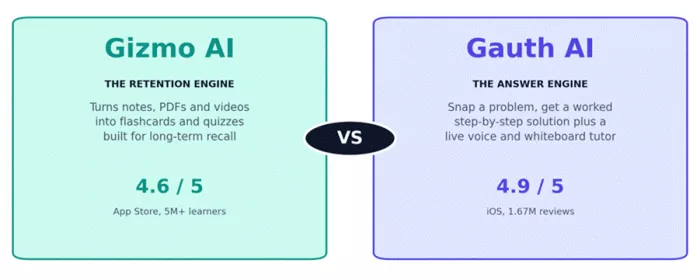
It is also the exact moment two popular apps step in with very different promises. Gizmo AI turns a pile of notes, slides, and videos into flashcards the brain can hold. Gauth AI points a camera at the one problem blocking progress and returns a full worked solution in seconds.
Both carry millions of students and glowing app store ratings, yet treating them as interchangeable is the fastest way to pick the wrong one. After a full term of daily use with each, the divide is clear, and it comes down to one question: which job actually needs doing? The answer reshapes how the rest of a study routine should be built.
The short answer
For readers short on time, the whole comparison collapses into a single table.
| At a glance | Gizmo AI | Gauth AI |
|---|---|---|
| Best for | Locking material into long-term memory | Getting unstuck on a problem fast |
| Standout strength | Auto-built flashcards and spaced repetition | Photo solver plus a live voice tutor |
| Main drawback | Hearts system interrupts the free tier | Aggressive trial and cancellation friction |
| In one line | The better learning tool | The better emergency tool |
Two apps, two different jobs
The most useful thing to grasp first is that these two are not really rivals. They sit in adjacent lanes of the same highway.
Gizmo, built by a team of Cambridge alumni, is a retention tool: feed it a chapter or a lecture, and it builds active-recall practice, then schedules reviews so the material lasts. Gauth, formerly Gauthmath and now part of ByteDance, is an answer engine: snap a question and a step-by-step solution explains the route to it. One builds memory over weeks. The other clears a roadblock in two minutes.
The day-to-day flow makes that difference concrete.
| Step | Gizmo AI | Gauth AI |
|---|---|---|
| 1 | Import notes, slides, a PDF, or a lecture video | Snap a photo of the stuck problem |
| 2 | AI auto-builds flashcards and quizzes | AI reads it and solves it step by step |
| 3 | Review on a spaced-repetition schedule | Ask the live tutor to unpack any step |
Read that way, the apps almost finish each other's sentences. Gauth handles the moment of confusion; Gizmo handles everything that has to be remembered afterward.
Gizmo AI in brief

Gizmo's whole reputation rests on Magic Import, which converts a PDF, slide deck, or 40-minute YouTube lecture into a full flashcard set in seconds, with reported accuracy around 90 percent. Spaced repetition then resurfaces weak cards more often than mastered ones.
| Developer | Cambridge alumni team |
| Category | Active-recall study tool |
| Best for | Memorizing large bodies of material |
| Standout feature | Magic Import (notes, PDFs, video to flashcards) |
| Learning method | Flashcards, quizzes, spaced repetition |
| Extras | AI tutor plus a topic-by-topic analytics dashboard |
| Platforms | iOS, Android, web |
| Offline use | Limited; AI features need a connection |
| Free tier | Yes, limited by a hearts system |
| Rating | 4.6 / 5 (App Store, 5M+ users) |
| Cheapest paid route | Student annual, about 2.99 dollars a week |
| Strengths | Watch-outs |
|---|---|
• Builds decks from almost any material in seconds • Spaced repetition keeps knowledge from fading • Streaks and leaderboards make daily study a habit • Clean, approachable interface that stays out of the way • Imports from Quizlet, Anki, Drive, OneNote, Classroom | • Hearts system locks the free tier after wrong answers • Ad interruptions on the free plan • Occasional sync bugs reported by users • Pricing can feel confusing across tiers • Ultra tier near 20 dollars a month feels steep |
Gauth AI in brief

Gauth wins on speed. Point a phone at a printed or handwritten problem and it crops the question and answers in seconds, with the reasoning laid out step by step. Coverage has grown from pure math into physics, chemistry, and biology, and the newer AI Live Tutor adds spoken questions with a real-time whiteboard.
| Developer | GauthTech (ByteDance) |
| Origin | Launched in 2019 as Gauthmath |
| Category | Homework answer engine |
| Best for | Solving specific problems instantly |
| Standout feature | Snap-to-solve camera plus AI Live Tutor |
| Method | Photo scan, step-by-step solutions |
| Accuracy | About 95 percent on standard problems |
| Platforms | iOS, Android, web |
| Reach | 50M+ installs; about 16.7M monthly site visits |
| Free tier | Yes, ad-supported |
| Rating | 4.9 / 5 iOS (1.67M reviews); 2.1 / 5 Trustpilot |
| Cheapest paid route | Annual, about 8.33 dollars a month |
| Strengths | Watch-outs |
|---|---|
• Returns worked, step-by-step answers in seconds • Covers math, physics, chemistry, and biology • AI Live Tutor adds voice and a live whiteboard • Optional access to real human tutors • Huge, active base of student users • Free solver is genuinely usable (50M+ installs) | • Heavy, often unskippable ads on the free tier • Three-day trial requires a card up front • Charges before trial ends and failed cancellations reported • Some users report wrong answers nudging an upgrade • Accuracy slips on advanced topics • ByteDance ties have triggered U.S. availability scares |
Accuracy and using these tools honestly
Neither app is infallible. Gauth solves roughly 95 percent of standard problems correctly, but the error rate climbs on advanced material, and a student who copies an answer without checking it sometimes finds the mistake only after a grade comes back. Gizmo's auto-generated cards land near 90 percent accuracy, so a quick scan for the occasional odd card is still worth the minute it takes.
There is an honesty dimension too. Most teachers treat unauthorized AI use during graded work as cheating, and both apps work best as study aids rather than shortcuts. The safest habit is using Gauth to understand how a problem is solved, then rebuilding the steps unaided, and using Gizmo to turn that understanding into recall that lasts past the exam.
How students are really using AI in 2026
This choice matters more than it looks, because AI homework help is no longer a fringe habit. It has quietly become the default.
RAND's nationally representative American Youth Panel, a December 2025 survey of more than 1,200 students aged 12 to 29, shows how fast it happened: AI homework use among students from middle school upward jumped from 48 percent in May to 62 percent by December.
Middle schoolers drove much of that surge, climbing from 30 to 46 percent, while high schoolers rose from 49 to 63 percent over the same seven months.
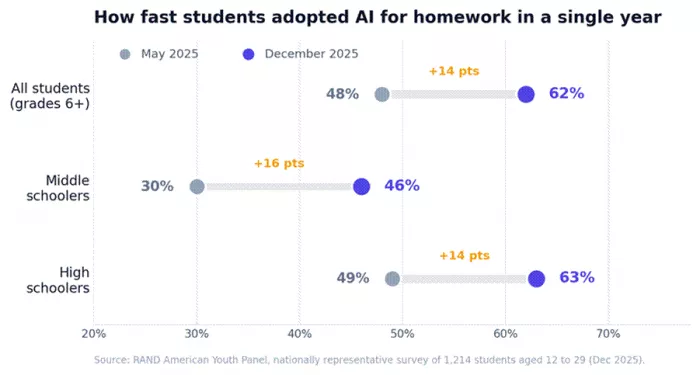
Figure 1. AI homework use climbed sharply through 2025. Source: RAND American Youth Panel.
What students actually reach for AI to do maps neatly onto the Gizmo-versus-Gauth split. Explaining and looking things up is Gauth territory; turning that into durable memory is where Gizmo lives.
| What students use AI for | Share |
|---|---|
| Getting better explanations of assignments | 38% |
| Brainstorming ideas | 35% |
| Looking up facts | 33% |
| Drafting or revising writing | 33% |
One caveat sits underneath those numbers: by December, 67 percent of students agreed that leaning on AI too heavily harms critical thinking, up from 54 percent. That worry is the strongest argument for picking a tool that reinforces learning rather than one that simply hands over answers, and it ages better the longer a course runs.
Features side by side
Lined up by capability, the contrast is sharp. Almost nothing overlaps cleanly.
| Capability | Gizmo AI | Gauth AI |
|---|---|---|
| Primary purpose | Memorization and long-term recall | Instant homework problem-solving |
| Core method | Flashcards, quizzes, spaced repetition | Photo scan, step-by-step solutions |
| Content it accepts | PDFs, slides, notes, YouTube, audio | Photos, typed questions, PDFs |
| Live help | AI tutor (text) | AI Live Tutor (voice + whiteboard) plus humans |
| Subject strength | Any material the user uploads | Strongest in math; also science subjects |
| Progress analytics | Detailed dashboard by topic | Limited |
| Gamification | Strong: XP, streaks, leaderboards | Minimal |
| Offline use | Limited; AI needs a connection | Needs a connection |
| User base | 5M+ users | 50M+ installs |
| Integrations | Quizlet, Anki, Drive, OneNote, Classroom | Mostly standalone |
The split is hard to miss: Gizmo owns memory, repetition, and progress tracking, while Gauth owns instant answers and live, human-style help. That is why the better question is which task is at hand, not which brand is better.
What each one costs
Both are free to start, but the routes to unlimited access differ, and one hides a trap. Viewed on a level monthly basis, the annual plans land close together while Gizmo's weekly plan is the priciest way to use either tool. Region and platform shift the exact figures, so the in-app price is always the one to trust.
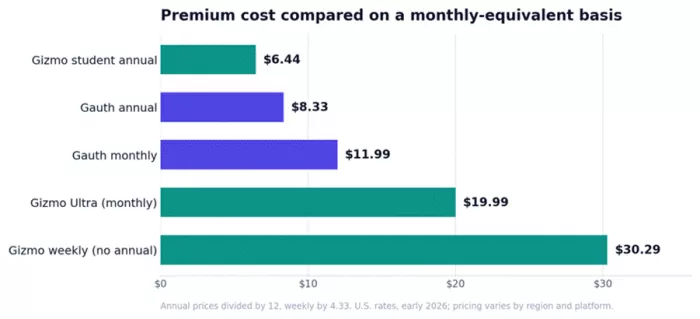
Figure 2. Premium plans on a monthly-equivalent basis. U.S. rates, early 2026; prices vary by region.
| Plan type | Gizmo AI | Gauth AI |
|---|---|---|
| Free tier | Yes, limited by hearts system | Yes, ad-supported |
| Cheapest per month | Student annual, about 2.99 dollars a week | Annual, about 8.33 dollars a month |
| Monthly or short-term | Weekly ~6.99; Ultra ~19.99 | Monthly ~11.99; quarterly ~31.99 (dollars) |
| Live human tutoring | Not offered | Add-on, about 19.99 dollars a month |
| Commitment risk | Hearts lockouts on the free tier | Trial needs a card; cancellation complaints |
The takeaway is simple: on either platform, an annual plan is the only sensible route for a regular user, and the short auto-renewing options are where students quietly overpay.
Ratings, reviews, and the fine print
App store scores make both look flawless, and that is exactly where a careful student slows down. Gizmo holds about 4.6 out of 5 from more than five million users, and Gauth posts an even higher 4.9 on iOS across 1.67 million reviews.
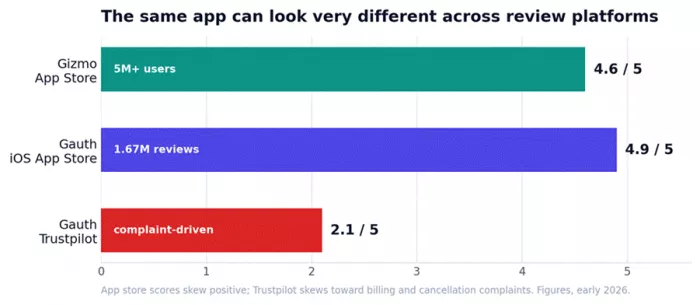
Figure 3. Headline app store scores next to independent Trustpilot data.
The picture shifts on independent platforms. Gauth's Trustpilot score sits near 2.1 out of 5, driven almost entirely by billing and cancellation complaints rather than the quality of its math help. App store reviews capture the moment a tool solves a problem; Trustpilot captures the moment a subscription goes wrong. One verified reviewer reported being billed for 27 straight months after every cancellation attempt returned an error.
Gizmo's independent footprint is thinner and more middle-of-the-road, read less as a red flag than as a sign of a younger product still building its reputation. For either app, reading the cancellation terms before entering a card number is worth more than any star rating.
Which student should pick which
The right choice falls out of the calendar and the kind of struggle involved. A learner memorizing a heavy body of material leans toward Gizmo, while a learner stuck on individual problems, especially in math and science, leans toward Gauth.
| If the goal is | Better pick | Why it wins |
|---|---|---|
| Memorizing large amounts of material | Gizmo AI | Spaced repetition plus auto-built flashcards |
| Solving a tough math problem right now | Gauth AI | Photo scan with worked, step-by-step answers |
| Preparing weeks ahead for a big exam | Gizmo AI | Schedules review so material truly sticks |
| Understanding why an answer is wrong | Gauth AI | Explains the method, not just the result |
| Building a daily study habit | Gizmo AI | Streaks, XP, and leaderboards drive consistency |
| Getting occasional live human help | Gauth AI | Optional access to real human tutors |
| Studying on a very tight budget | Either | Both ship genuinely usable free plans |
For many students the honest answer is both, used differently: Gauth to crack a tricky problem in the moment, Gizmo to lock that understanding into memory before the exam. They are complements far more than rivals.
The final verdict
After a full term with both apps in rotation, the takeaway is less a trophy than a sorting rule.
Gauth AI is the better emergency tool. When a problem set refuses to budge at midnight, its camera and step-by-step solutions feel close to magic, and the live tutor fills the gap a static answer leaves behind. The one hesitation is the wallet: the trial mechanics are aggressive enough that card details should wait until the free version has earned trust. For occasional, in-the-moment help, that free version alone often does the job.
Gizmo AI is the better learning tool, full stop. Turning a chaotic stack of notes into a structured deck, then being nudged to review it until it sticks, is the difference between cramming and actually knowing the material. The hearts system is an irritant, but active recall and spaced repetition are exactly what learning science has backed for decades. For anyone with weeks of material to hold onto, it is the closest thing to a study habit packed into an app.
So the verdict splits cleanly. For getting unstuck fast, reach for Gauth. For genuinely remembering what was studied, reach for Gizmo. And for the student willing to run both, the smartest move of all is letting Gauth explain the hard problem and letting Gizmo make sure it is never forgotten. Either way, the winning habit is treating AI as scaffolding for understanding rather than a substitute for it.
Comments