Table of Contents
- What you are actually checking for
- How do AI detectors work, and why the score is not proof
- How to tell if a paper was written by AI: the five-step check
- What AI checker do teachers use and what can a tutor actually access?
- The conversation matters more than the score
- Four mistakes that make the check less reliable
- Questions tutors keep asking
- The honest verdict
A student sends you an assignment that sounds nothing like the work you normally see in your sessions. Smoother. The argument is tidier, and the vocabulary is sharper. None of that is proof of anything. An AI checker for teachers will hand you a percentage in about four seconds, and that percentage does not answer the question you actually have: did this student do the thinking? Here is a check that does, it takes about seven minutes.
What you are actually checking for
The useful question is not “Did AI touch this?” It is “Does the student own the work?”
AI use is not a simple yes-or-no category. One student may use a chatbot to fix spelling. Another may ask it for an outline and then write independently. A third may submit generated paragraphs with light edits. Those are different learning situations, even if an academic AI detector reacts to all of them.
Set the rules before suspicion appears. Tell the student what kind of AI help is acceptable for the work you review, and follow any stricter school policy that applies.
So when you ask how to tell if a paper was written by AI, you are really checking whether the student's level, process, and understanding match the work in front of you.
How do AI detectors work, and why the score is not proof
AI detectors look for patterns that are more common in machine-generated text. One common concept is perplexity, which roughly measures how predictable a sequence of words is to a language model. Some tools also examine variation in sentence length and structure, sometimes described as burstiness. Modern commercial systems can use many other learned signals, and their exact models are often proprietary.
The result is still an estimate. A detector cannot reconstruct how a document was produced.
Human writing can also look statistically predictable. A 2023 Stanford study published in Patterns tested seven GPT detectors on 91 human-written TOEFL essays. They misclassified the essays at an average false-positive rate of 61.3%, and all seven unanimously flagged 19.8% as AI-authored. Although this was a test of 2023 detectors, not a universal error rate for current tools, it still shows why tutors should be careful with multilingual students.
Turnitin makes the same broader point in its current guidance: its AI model can misidentify human-written, AI-generated, and AI-paraphrased text, and should not be used as the sole basis for adverse action against a student. It also refuses to display any score between 1% and 19% at all, because false positives are more common in that range.
What detector numbers actually tell you
| What you see | What it actually tells you |
| Overall AI percentage | A model estimate, not proof of authorship |
| Highlighted sentences | Passages worth reviewing more closely |
| A low score | Not proof that no AI was used |
| A high score | A reason to check further, not accuse |
How to tell if a paper was written by AI: the five-step check
You will not always have every type of evidence. A new tutor may have no previous writing to compare, while some students will not have drafts or version history. Use the checks that are available, but avoid relying on the detector alone. When possible, start with the text itself before looking at an AI score.
Step 1. Use a baseline if you have one, or create one for next time
If this is your first assignment with the student, you may not have a baseline yet. Skip the comparison for now, but create one during an early session: ask the student to write independently for 10 to 15 minutes on a familiar topic.
Keep it as a reference for sentence length, vocabulary, grammar patterns, organization, and the level of detail they normally produce independently. Repeat the exercise occasionally if their writing improves quickly.
A baseline is a reference point, not a permanent measure of ability. Students improve.
Step 2. Scan for patterns, not one “AI word”
Before you run a detector, read the paper for patterns that commonly appear in AI-generated writing. These change as models improve, so there is no permanent list of “AI words.” Still, several signals appearing together can justify a closer look.
Common examples include:
- stock phrases such as “it is important to note,” “plays a crucial role,” “in today’s rapidly evolving world,” or “delve into”;
- paragraphs that follow the same length and rhythm from beginning to end;
- frequent transitions such as “Furthermore,” “Moreover,” and “In conclusion,” even when the argument does not need them;
- polished but vague claims supported by generic examples;
- repeated sentence structures or overly balanced lists of three;
- unusually frequent em dashes, colons, or other punctuation patterns compared with the rest of the paper;
- confident references to sources, facts, or quotations that are difficult to verify.
One em dash or the word “delve” tells you almost nothing. A paper containing several of these patterns, especially alongside vague reasoning or questionable citations, gives you a better reason to investigate.
If you already know the student’s writing, add one more check: does this paper suddenly sound different from their usual work?
However, your intuition can be wrong too. A cleaner paper may reflect editing, extra time, or genuine improvement.
Step 3. Run one detector, then inspect the passages it flags
Now use an AI detector for teachers as a second opinion. Look past the headline score. Which passages were flagged? Do those same passages differ from the student's baseline? Do the sources, vocabulary, or reasoning suddenly change there?
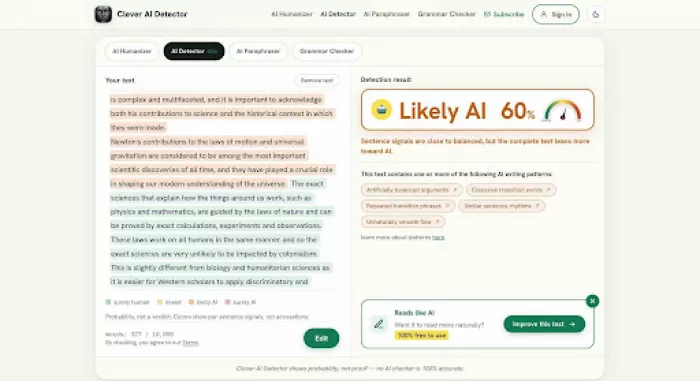
This is where a detector can save time: it points you towards text worth reviewing.
But if the detector is the only thing that looks suspicious, stop there. You have a score, not proof.
Step 4. Ask for the process
Instead of asking, “Did you use ChatGPT?”, ask, “Can you walk me through how you put this together?” A student may have an outline, handwritten notes, earlier drafts, source tabs, or version history. You are looking for a plausible path from idea to finished assignment.
Missing process evidence is not proof either. Not every student drafts in Google Docs or keeps neat notes. If they wrote directly in Word or another app with little history, move to the next step.
Step 5. Use the two-minute explain-back test
Choose one unusual passage and ask: “What is the main point here in your own words?”, “Why did you choose this example or source?”, and “If I disagreed, how would you defend or change this point?”
You are testing ownership of the reasoning. If the student cannot explain a key argument, rebuild that section together. That gives you useful information without turning the lesson into an interrogation.
The seven-minute check
For routine assignments, the process can stay short.
| Check | Time | What you are looking for |
| Compare with a baseline, if you have one | 1 minute | Sudden changes in vocabulary, structure, or writing level |
| Scan for common AI patterns | 1 minute | Several signals appearing together: stock phrases, repetitive transitions, uniform paragraphs, generic examples, unusual punctuation patterns |
| Check sources and specifics | 1 minute | Citations, facts, or examples that are vague, incorrect, or difficult to verify |
| Run one detector | 1–2 minutes | Passages worth a closer look |
| Ask for process evidence | 1 minute | Notes, drafts, or version history if available |
| Use explain-back | 2 minutes | Whether the student can explain the argument, examples, and choices in their own words |
You may not have every signal available. With a new student, there may be no baseline or version history yet. In that case, start with the writing itself: look for clusters of common AI patterns, verify sources, and use a detector as a second signal. Several independent signals pointing in the same direction give you a stronger reason to look closer.
What AI checker do teachers use and what can a tutor actually access?
Search what AI checker do teachers use and Turnitin appears everywhere. That makes sense inside schools and universities, but private tutors face an access problem: Turnitin says its subscriptions are designed for educational institutions and are not sold directly to individuals.
A solo tutor therefore needs to separate institutional products from tools they can actually use themselves.
| Tool | Solo tutor access | Free entry? | Practical note |
| Turnitin | No, institutions only | No | Built for institutional workflows |
| GPTZero | Yes | Yes | Free and paid plans available |
| Copyleaks | Yes | Limited | Individual and education plans |
| Originality.ai | Yes | Limited | Small free detection tier |
| Pangram | Yes | Limited | Free plan currently allows 2,000 words per day |
| Clever AI Detector | Yes | Yes | Free standalone check with sentence-level signals |
So what is the best free AI detector for teachers? There is no tool that turns detection into proof. The useful question is whether it fits your workflow and helps you inspect the text instead of reacting to one percentage. The same rule applies to any AI detector that teachers use: use it for triage, then verify with the student.
The conversation matters more than the score
Private tutoring runs on trust. A false accusation can damage the lesson and the client relationship at the same time.
Go to the student first, and open with the work rather than the verdict: “This section is quite different from the writing I normally see from you. Can you talk me through how you built it?”
Maybe the student used AI within rules you had already agreed. Maybe a parent edited the paper. Maybe they copied a model answer. Maybe they simply spent much longer on this assignment. You want the process before the verdict.
If the student admits they outsourced a section to AI, keep the response tied to learning. Ask them to rewrite it from their notes, explain the argument without the generated text, or rebuild the outline during the session.
Parents need the same care. Instead of “an AI detector says your child cheated,” say: “I noticed a mismatch between this assignment and the work we normally do together. We reviewed how it was produced, and I want to rebuild that part independently in our next session.”
That is factual without turning an uncertain detector result into a trust problem.
Four mistakes that make the check less reliable
1. Treating a percentage as proof. A high score still comes from a classifier. Use it to decide what to review, not what to accuse.
2. Treating polished English as suspicious. Second-language writing is more uniform by nature, which is exactly what detectors read as machine-like. Give more weight to the student's baseline, process, and explanation.
3. Uploading identifiable student work without checking the service. Before pasting a minor's assignment into an AI content detector, remove names, school details, email addresses, student numbers, and other unnecessary identifiers. Check the service's retention and data-use terms too.
4. Making the rules after you become suspicious. If AI use was never discussed, a detector score should not become a retroactive policy. Set expectations early and apply the same process to everyone.
Questions tutors keep asking
What AI checker do teachers use?
Schools and universities often use Turnitin because it fits institutional assessment systems. Individual tutors have easier access to tools such as GPTZero, Copyleaks, Originality.ai, Pangram, and standalone detectors.
Is there a free AI detector for teachers?
Yes. Several AI detectors for teachers have free checks or limited free plans. Free access is useful for screening, but it does not make the result conclusive.
Can an AI detector prove that a student used ChatGPT?
No. It estimates whether text resembles patterns associated with generated writing. Even Turnitin tells educators not to use its AI report as the sole basis for action against a student.
What if English is not the student's first language?
Be more cautious, not more suspicious. The 2023 Stanford study found a large false-positive problem for the non-native English sample it tested. Current detectors have changed since then, but the practical lesson remains: compare the paper with that student and ask them to explain their reasoning.
The honest verdict
The best AI checker for a tutor is not a detector by itself. Keep a writing baseline, read for changes, use one detector as triage, ask to see the process, and finish with an explain-back. If several signals point in the same direction, you have something worth discussing. If only the percentage looks suspicious, you do not have enough to accuse anyone.
Comments