The moment these two platforms stop looking interchangeable arrives about ten minutes in.
Both sell the same promise: a script goes in, a photorealistic presenter comes out, no camera and no crew. Both charge roughly thirty dollars for the entry plan. Both hand over exactly 600 credits for it. Swap the logos on the two pricing pages and almost nobody would notice the difference.
Then the credits start burning, and the resemblance falls apart. On one platform, 600 credits stretch across more than three hours of avatar video. On the other, they are gone in twenty minutes.
That gap is printed on neither pricing page. It is also the whole comparison.
The Short Version
| Akool | HeyGen | |
|---|---|---|
| Built around | Face swap, live avatars, tool breadth | Talking-head video and localization |
| Entry paid plan | $30/mo, 600 credits | $29/mo, 600 credits |
| Standard avatar video | $1.50 per finished minute | $0.15 per finished minute |
| Credit rollover | No, credits expire each cycle | Yes, one cycle (monthly plans) |
| Extra team seats | Full plan price, per person | $20 per seat, shared credit pool |
| G2 score | 4.8 / 5 from 576 reviews | 4.8 / 5 from 1,885 reviews |
| Wrong choice when | Talking-head volume is the job | Face swap or real-time avatars are the job |
The one-line verdict: HeyGen is the better video factory. Akool is the better effects studio. The mistake is assuming that a near-identical entry price means near-identical value.
Meet Akool and HeyGen
Akool in brief
Akool started with face manipulation and grew outward into a full video suite. Roughly two dozen tools now sit under one login: face swap across images, video and live streams, talking avatars, talking photos, translation in 155+ languages, image generation and a real timeline editor. Seedance, Kling, Veo, Sora and Flux are all selectable inside the same interface. The result reads as a creative studio, and everything draws from a single credit balance that resets monthly.
HeyGen in brief
HeyGen does one thing and refuses to drift. A script becomes a photorealistic digital twin delivering a message, and every feature serves that job: voice cloning, lip-synced translation across 175+ languages, a scene editor, brand kits and a Video Agent that drafts from a single prompt. Cinematic generation was never the goal, which let the company train narrow models on a fraction of the data Sora needs. It is a content pipeline, priced for volume.
| Akool | HeyGen | |
|---|---|---|
| Founded / base | Palo Alto, by Jiajun (Jeff) Lu, ex-Apple Face ID and ex-Google Cloud | Los Angeles, December 2020, by Joshua Xu and Wayne Liang |
| Scale marker | #1 on the 2025 Inc. 5000 with 37,364% three-year growth | ARR passed $200M in 2026, doubling from $100M in eight months |
| Funding posture | Largely revenue-funded; roughly $40M invoiced ARR by late 2024 | $74M raised, only $25M burned, cash-flow break-even in 2026 |
| Signature work | Coca-Cola x League of Legends face swaps across 80+ countries; Qatar Airways "AI Adventure" | Used across 85% of the Fortune 100; 30M+ users and roughly 120M videos |
Pricing: What Each Plan Actually Costs
HeyGen pricing ladder
| Plan | Monthly | Credits | What unlocks |
|---|---|---|---|
| Free | $0 | None | 3 videos/mo, 1-min cap, 1 custom twin, 30+ languages |
| Creator | $29 ($24 annual) | 600 | 1080p, 30-min cap, voice cloning, 175+ languages, no watermark |
| Pro | $49 | 1,000 | 4K export, faster queue, translation script proofreading |
| Business | $149 + $20/seat | 1,500 | 60-min cap, 5 custom twins, SSO, SCORM, LMS, Zapier and Make |
| Enterprise | Custom | Flexible | No duration cap, SCIM, MFA, multi-workspace, dedicated CSM |
Worth knowing: HeyGen's Pro tier is a credit ladder, not a single price. Features are identical across every Pro tier and only the allocation moves, from 1,000 credits at $49 up to 100,000 at $4,300. More capacity does not mean buying more product.
Akool pricing ladder
| Plan | Monthly | What unlocks |
|---|---|---|
| Free (Basic) | $0 | 720p, full-screen watermark, slowest queue, 10-min avatar cap, 5GB |
| Starter | Around $15 | 1080p, watermark removed, 15-min cap, medium queue, 25GB |
| Pro | $30 (600 credits) | Up to 4K, 30-min cap, all frontier models, 6 concurrent videos, 50GB |
| Pro Max | $59 | Up to 8K, 45-min cap, API access, workspace collaboration, 500GB |
| Business | Around $249 | Up to 16K, 60-min cap, 1 fine-tuned Studio Avatar, business licence, 1TB |
| Enterprise | Custom | Credits never expire, SSO, VIP queue, dedicated success manager |
A word on those numbers. Akool's pricing page injects prices client-side, so every tier reads $0 per seat until a session loads. That quirk is why published Akool comparisons contradict each other, with Pro variously reported at $15, $21 and $30, and Business anywhere from $249 to $500. The figures above are the corroborated entry points. Each tier also behaves as a credit selector, so price climbs with the allocation. Confirming the live number at checkout is the only reliable method.
The seat rule that decides team budgets
Akool's own pricing page states the arrangement plainly: any admin or editor invited into a workspace is billed at the rate the owner already pays. A four-person Pro workspace is four separate $30 subscriptions holding four separate 600-credit balances that cannot be pooled.
HeyGen inverts it. Business runs $149 with seats at $20 each, and the whole team draws from one shared 1,500-credit pool with top-ups and auto-reload.
| Four-person team | Akool Pro | HeyGen Business |
|---|---|---|
| Monthly cost | $120 (4 x $30) | $209 ($149 + 3 x $20) |
| Credits | 2,400, split into four silos | 1,500, fully shared |
| Standard avatar video it buys | 80 minutes total, 20 min per person | 500 minutes, pooled |
| Shared workspace | Pro Max ($59/seat) and above | Included |
Akool is cheaper to staff. HeyGen is cheaper to use. At four people, HeyGen costs 74% more and returns more than six times the finished video.
The Credit Math That Nobody Prints
Credits look like a shared currency. They are not. Both vendors publish their burn rates, and setting them side by side explains more about real cost than any feature list.
| Job | Akool credits/min | HeyGen credits/min |
|---|---|---|
| Standard avatar video (1080p) | 30 | 3 (Avatar III) |
| Premium avatar video | 60 (4K) | 20 (Avatar IV / V) |
| Translation with lip-sync | 12 | 5 |
| Dubbing without lip-sync | 12 | 2 |
| Talking photo | 120 | Covered by the avatar rate |
| Face swap video | 60 | Not a metered product |
| Streaming avatar | 7.2 | Metered separately via LiveAvatar |
Both starter plans price a credit at almost exactly the same rate, at 4.8 cents on HeyGen and 5 cents on Akool. The currency is equivalent. What it purchases is not.
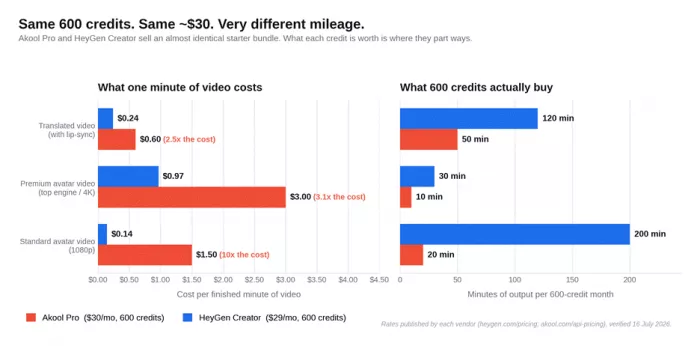
Cost per finished minute and monthly output at each vendor's entry paid tier. Calculated from published burn rates, July 2026.
Three findings, none of them visible on a pricing page:
▪ Routine talking-head video costs ten times more on Akool. A standard 1080p avatar minute runs $1.50 on Akool Pro against $0.15 on HeyGen Creator. The same monthly spend yields 20 minutes versus 200.
▪ The gap narrows sharply at the premium end. Comparing top engines rather than standard ones, Akool 4K sits at $3.00 a minute against $0.97 for HeyGen's Avatar IV and V. Still three times the cost, but no longer an order of magnitude.
▪ Akool wins outright on streaming. Live avatar sessions burn 7.2 credits a minute, roughly 36 cents, and HeyGen has no comparable rate inside its core web plans at all.
The expiry clause compounds all of this. HeyGen rolls unused credits forward one cycle on monthly plans and lets annual subscribers accumulate them to the renewal date. Akool lists non-expiring credits as an Enterprise-only feature, a polite way of saying that on every self-serve tier, whatever goes unspent by renewal day evaporates.
Feature Face-Off
| Capability | Akool | HeyGen |
|---|---|---|
| Stock avatars | All public avatars on every tier | 500+ free, 700+ on paid |
| Custom avatars | 1 instant on free, up to 10 plus 1 Studio Avatar on Business | 1 on Free through Pro, 5+ on Business, 10+ on Enterprise |
| Max avatar export | 4K | 4K |
| Max resolution elsewhere | 8K on Pro Max, 16K on Business | 4K |
| Max video length | 10 min free, 30 Pro, 45 Pro Max, 60 Business | 1 min free, 30 Creator and Pro, 60 Business, uncapped Enterprise |
| Languages | 155+ | 175+ |
| Voice cloning | 5 voices on Starter, up to 500 on Business | 1 on Free, unlimited from Creator up |
| Face swap | Core product: image, video, live, multi-face, re-age, face enhance | Not a headline capability |
| Streaming / live avatar | Sessions up to 60 min; live face swap up to 120 min | Separate LiveAvatar product |
| Translation proofreading | Pro and above | Pro and above |
| SRT / ASS upload and download | Pro Max and above | Handled in the translation editor |
| API access | Bundled from Pro Max | Sold separately from web plans |
| Team seats | Each member re-billed at full plan price | $20 per seat on Business |
| SSO / SAML | Enterprise only | Business |
| SCORM and LMS export | Not offered | Business |
| Interactive video and quizzes | Not offered | Business |
| Integrations | Adobe Premiere, Canva, Figma, Slack, Google Workspace, HubSpot | n8n, Make, HubSpot, Zapier, LMS platforms |
| Credit rollover | Enterprise only | One cycle monthly, accrues annually |
Where Akool Pulls Ahead
▪ Face swap is the product, not a checkbox. Coca-Cola benchmarked it against the field and picked Akool for a League of Legends campaign running millions of swaps across 80+ countries. Qatar Airways built "AI Adventure" on the same engine. Paid tiers accept uploads to 16K with multi-face detection, re-age and face enhance.
▪ Real-time avatars have no equivalent on the other side. Streaming sessions run to 60 minutes on Business and live face swap to 120, with lip-sync across 150+ languages. Streaming reportedly carries about half of Akool's B2B revenue. Nothing in HeyGen's core web product competes.
▪ Breadth genuinely lives under one login. Credits are not siloed per tool, so an unused translation budget can become image generation instead. Nothing in HeyGen works this way, because nothing else is there to spend on.
▪ Reviewers rate the experience higher on every axis. G2 puts Akool ahead on ease of use at 9.6 against 9.2, setup at 9.5 against 9.2, support quality at 9.3 against 9.0, and meets-requirements at 9.4 against 9.1.
▪ The timeline editor is a real editor. Akool scores 9.2 out of 10 in G2's video editing category against HeyGen's 8.7, working on an actual timeline rather than a slide-style builder.
Where HeyGen Pulls Ahead
▪ Credit efficiency is not close. Ten times more standard avatar video, two and a half times more lip-synced translation, and credits that survive renewal day. For anyone shipping weekly, this outweighs every feature difference above.
▪ Avatar quality holds up under scrutiny. G2 scores avatar quality at 9.2 from 723 reviews against Akool's 8.4 from 23. Custom avatars land at 9.1 against 8.5. On translation voice cloning, natural quality reaches 8.8 from 114 reviews against 7.7 from 11.
▪ Team economics were designed rather than inherited. Twenty-dollar seats, a shared credit pool, SSO at $149 instead of an enterprise call, plus SCORM export and LMS integrations that make it viable for learning and development teams.
▪ The price is simply published. Every tier, credit allocation and burn rate sits in plain text on one page. Akool's renders as placeholders, and the resulting confusion has propagated across most third-party comparisons.
▪ Localization depth is the deeper moat. 175+ languages against 155+, dubbing at 2 credits a minute for anyone who does not need lip-sync, a brand glossary, and proofreader seats at the enterprise tier.
What Real Users Report
Both hold an identical 4.8 out of 5 on G2, which is where the headline number stops being useful. The detail underneath is the interesting part.
| G2 metric | Akool | HeyGen |
|---|---|---|
| Overall rating | 4.8 / 5 | 4.8 / 5 |
| Total reviews | 576 | 1,885 |
| Meets requirements | 9.4 | 9.1 |
| Ease of use | 9.6 | 9.2 |
| Ease of setup | 9.5 | 9.2 |
| Quality of support | 9.3 | 9.0 |
| Product direction | 9.8 | 9.7 |
| Avatar quality | 8.4 (23 reviews) | 9.2 (723 reviews) |
| AI Video Generators category | 8.2 / 10 (73) | 8.8 / 10 (936) |
| Video Editing category | 9.2 / 10 (104) | 8.7 / 10 (159) |
| Top complaint | Slow performance (67) | Pricing issues (147) |
| Second complaint | Expensive (61) | Expensive (132) |
Four things are worth pulling out of that table:
▪ Akool leads every satisfaction axis, on a third of the evidence. 576 reviews against 1,885 is a meaningful confidence gap, and the avatar-quality figures make the point starkly: 23 reviews versus 723.
▪ The complaints are different complaints. Akool's most common grievance is speed, with reviewers reporting long waits on lower tiers. HeyGen's is price. Slow is a workflow problem. Expensive is a budget problem. Only one of those gets worse as a team grows.
▪ The categories split cleanly along the products' own logic. HeyGen leads AI Video Generators by a wide margin and on far more reviews. Akool leads Video Editing. Each platform wins the category it was actually built for.
▪ The audiences barely overlap. Akool's reviewers concentrate in marketing and advertising at 29.8% and IT services at 19.1%. HeyGen's spread across marketing at 10.7%, consulting, education management and e-learning. Campaign work against always-on content.
Picking a Side
Akool is the right call when • Face swap is the campaign mechanic, not a novelty • Live, interactive or real-time translated avatars are needed • Output is bursty and campaign-shaped rather than steady • Breadth beats volume, and one login replacing four tools is the win • Resolution headroom above 4K genuinely matters | HeyGen is the right call when • Talking-head video ships every week, not every quarter • Localization across many languages is the whole brief • More than two people touch the same workflow • SCORM, LMS or interactive quizzes are requirements • Predictable budgeting matters more than feature count |
The overlap case, and the honest answer • Plenty of teams need both jobs done, and the arithmetic rarely rewards compromising on one platform. • HeyGen Creator at $29 plus Akool Pro at $30 comes to $59 a month, which is exactly what one Akool Pro Max seat costs on its own. That $59 buys 200 minutes of avatar video plus a full face-swap and streaming suite. • The cheap plan on each beats the expensive plan on either, until seat counts or governance force the decision. |
Final Verdict
Spend a week inside both and the pattern gets hard to unsee. Akool is the more impressive product. HeyGen is the more sensible one.
Akool's dashboard dazzles on first contact, and it is the only one of the two that can put a live, face-swapped, lip-synced presenter onto a video call in 150 languages. The Coca-Cola work was not a fluke. But the credit meter runs hot, the queue drags on lower tiers, unused balances vanish at renewal, and every teammate re-bills the whole plan.
HeyGen does less and charges less for it. One job, done properly, at a tenth the cost per minute, with credits that survive the month and twenty-dollar seats. It is not the more exciting tool. It is the one that still makes sense in month six.
So the recommendation splits along the work rather than the product. Campaign-shaped work with face swap or real-time avatars at the centre belongs on Akool, and nothing else does those jobs as well. Everything else, meaning most marketing video, most training content, most localization, and anything on a weekly rhythm, belongs on HeyGen. The near-identical thirty-dollar entry price is the most misleading number here. It suggests a coin flip. The credit meter says otherwise.
Comments