Table of Contents
- Why Teams Are Moving Away from Buffer
- The 7 Best Buffer Alternatives at a Glance
- 1. Planable: Best for Content Collaboration and Approval Workflows
- 2. Hootsuite: Best for Enterprise Social Listening and Reporting
- 3. Sprout Social: Best for Enterprise CRM and Board-Level Reporting
- 4. Agorapulse: Best for Unified Social Inbox and Client Reporting
- 5. SocialBee: Best for Evergreen Content Recycling and Category-Based Scheduling
- 6. Later: Best for Visual-First Creators and Instagram-Led Brands
- 7. SocialPilot: Best for Budget-Friendly Agency Scaling
- How to Choose the Right Alternative
- A Quick Decision Checklist
- Final Thoughts: My Personal Take
Buffer earned its reputation by making social media scheduling feel effortless. For years, it was the go-to for solopreneurs and small teams who just wanted to queue a few posts and move on. That simplicity was its superpower.
But somewhere between your third brand account and your fifteenth social channel, simplicity starts feeling like a limitation. Maybe your Instagram keeps disconnecting. Maybe your bill quietly doubled when you added new profiles. Maybe getting a post approved still involves a Slack thread and a Google Doc with seventeen comment threads.
The social media landscape in 2026 demands more. Dependable multi-platform publishing. AI that saves hours, not minutes. Analytics that prove ROI to leadership. Pricing that does not punish growth. Buffer still does the basics well, but basics may no longer be enough.
This guide covers seven alternatives that solve the specific problems Buffer users face. I evaluated each against real pricing at scale, approval workflows, publishing reliability, and hundreds of G2 and Capterra reviews.
Why Teams Are Moving Away from Buffer
Based on user reviews across G2 and Reddit, the frustrations cluster around five themes:
Per-channel pricing that compounds quickly. An agency managing five clients with four channels each pays for twenty channels. The bill grows with every new account.
Approval workflows that barely exist. Buffer was built for solo scheduling. If a client or legal team needs to review posts, you are cobbling the process together with Slack and Google Docs.
Silent publishing failures. Posts that fail without notification are among the most common complaints in Buffer review threads.
Analytics that lack depth. Campaign-level reporting and competitor benchmarking are the baseline now. Engagement and reach numbers alone do not cut it.
Limited specialization. Buffer tries to serve everyone, which means it ends up being the strongest fit for no one in particular.
These five criteria form the lens through which I evaluated every tool below.
The 7 Best Buffer Alternatives at a Glance
| Tool | Best For | Starting Price | G2 Rating | Approval Workflow | Multi-Account |
| Planable | Agencies & multi-brand teams | $33/workspace/month | 4.6/5 | Multi-step (internal + client) | Yes |
| Hootsuite | Enterprise listening & reporting | $99/user/month | 4.3/5 | Yes | Yes |
| Sprout Social | Enterprise CRM & analytics | $249/user/month | 4.4/5 | Yes | Yes |
| Agorapulse | Social inbox & engagement | $69/user/month | 4.7/5 | Yes | Yes |
| SocialBee | Evergreen content recycling | $29/month | 4.7/5 | Yes | Yes |
| Later | Visual-first creators & DTC brands | $25/month | 4.5/5 | Basic | Limited |
| SocialPilot | Budget-friendly agencies | $30/month | 4.5/5 | Yes | Yes |
1. Planable: Best for Content Collaboration and Approval Workflows
Best for: Agencies and multi-brand teams that need client sign-off before anything goes live
Pricing: From $33/workspace/month, with a free tier (50 posts, no time limit)
Buffer treats scheduling as the core function. Planable inverts that. Collaboration and approval are the central pillar; scheduling is the final step.
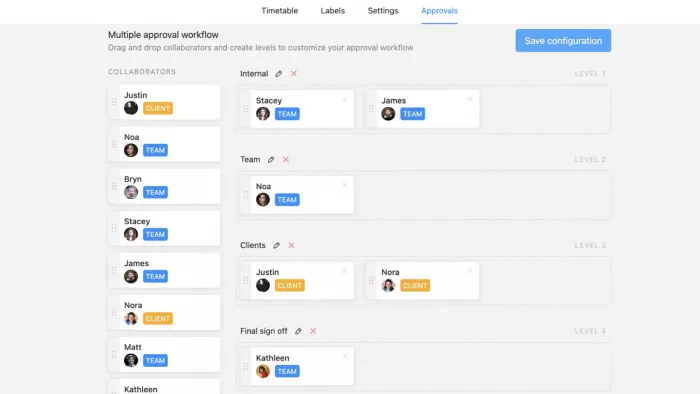
You create a post with pixel-accurate previews for every platform (Instagram Reels, Stories, LinkedIn carousels, TikTok) and route it through a multi-step approval chain. Approval levels range from none to multi-level. Crucially, clients can be invited as approvers without becoming paying tool users, which saves agencies enormous onboarding friction.
The workspace structure is where Planable shines for Heads of Marketing. Each brand or client gets its own calendar and asset library with a separate approval flow, but everything rolls up into a unified view at the top. Through Universal Content, you can plan blogs, newsletters, ad copy, and briefs in the same calendar alongside social posts. Canva and Slack integrations are native, and Zapier connects the rest.
Planable is honest about its limits: no native social listening, and advanced analytics is a paid add-on. But for teams whose primary pain is "getting content reviewed and published without chaos," it is the cleanest solution on this list.
Who should switch: Any team where more than one person needs to see a post before it ships. Agencies managing multiple clients will feel the difference immediately.
Who should look elsewhere: Solo creators who just need a simple scheduler and do not require approval workflows.
2. Hootsuite: Best for Enterprise Social Listening and Reporting
Best for: Enterprise teams with active community management and monitoring needs
Pricing: Standard $99/user/month, Advanced $249/user/month, Enterprise custom.
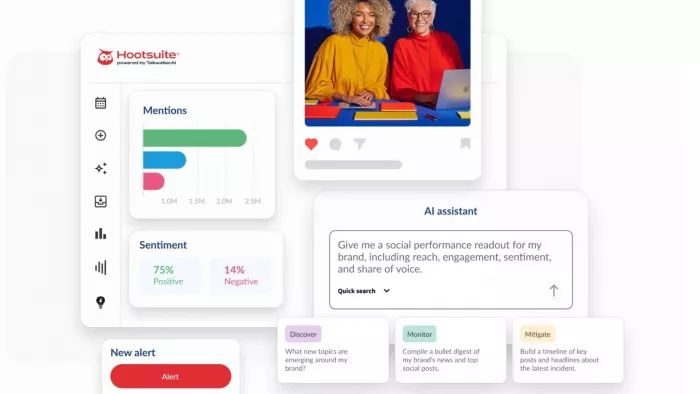
Hootsuite is the veteran of this category. No other tool on this page matches its social listening depth. If your role involves monitoring brand mentions across social platforms, news outlets, blogs, and forums while reporting to a CMO with white-labeled dashboards, Hootsuite covers more ground than anything else here.
The listening module tracks mentions, competitor activity, keywords, and sentiment across a wide range of sources. Employee advocacy and competitive benchmarking fill out an enterprise feature set Buffer simply does not attempt.
The trade-offs are well-documented. Onboarding is a project, not a tutorial. A three-person team on Standard pays $297 per month, and Advanced at $249 per user pushes a five-person team past $1,200 monthly. The free plan is gone; only a 30-day trial remains. For agencies, the product feels built around in-house workflows rather than agency-to-client review.
Who should switch: Enterprise teams where social listening and competitive monitoring are as important as publishing. If your contract includes monitoring deliverables, Hootsuite justifies the investment.
Who should look elsewhere: Agencies and small teams whose primary need is scheduling. You would be paying for capabilities you will never open.
3. Sprout Social: Best for Enterprise CRM and Board-Level Reporting
Best for: Enterprise teams tying social media directly to customer data and revenue
Pricing: Standard $249/user/month, Professional $399/user/month, Advanced $499/user/month.
Sprout Social is the premium option on this list. The interface is the most polished in the category. Analytics are board-ready out of the box, and the built-in social CRM connects an Instagram comment to a customer record in your database.
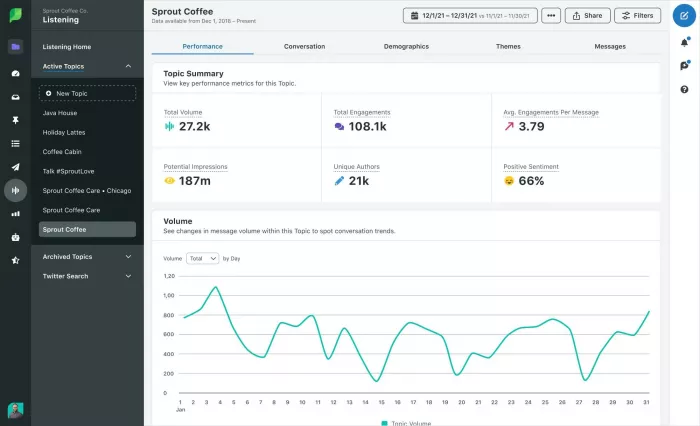
The reporting module generates presentation-ready reports with campaign-level tracking and competitor benchmarking, including TikTok. Tag-based reporting lets you slice data by campaign or business objective. The Smart Inbox unifies messages across networks with assignment rules and SLA tracking. The optional Listening module adds sentiment analysis and share-of-voice data, though it costs upward of $999 per month.
The challenge: most teams buy Sprout, then use a quarter of its features. If scheduling and basic reporting is your reality, you are spending $249 per user per month on functionality a $33 workspace plan covers. A five-person agency team on Standard is looking at nearly $15,000 annually before add-ons.
Who should switch: Enterprise brands where social is a revenue-bearing or service-critical channel and you need analytics depth to prove it to the C-suite.
Who should look elsewhere: Small to mid-size teams and agencies. Sprout is overkill at four to ten times what most Buffer refugees were paying.
4. Agorapulse: Best for Unified Social Inbox and Client Reporting
Best for: Agencies and brands with high engagement volume across multiple platforms
Pricing: Standard $69/user/month, Professional $119/user/month, Advanced $149/user/month (free plan available with 3 profiles).
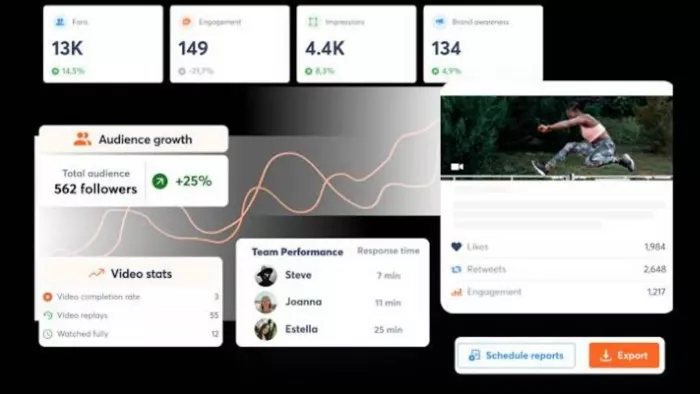
Agorapulse is a strong mid-market choice for teams that need publishing, comments, DMs, mentions, and reviews in one shared inbox. Saved replies and assignment rules make it especially useful for agencies handling large volumes of engagement. Its other major strength is client reporting. Branded, exportable reports and revenue attribution give agencies polished deliverables that go beyond Buffer’s simpler analytics.
The main drawbacks are approval workflows that feel less refined than Planable’s and pricing that rises quickly as more users are added. Social listening is also limited to higher tiers.
Who should switch: Teams where engagement volume is a primary challenge and client reporting is a contractual deliverable. If you spend as much time in your inbox as you do in your content calendar, Agorapulse is the right shape.
Who should look elsewhere: Teams whose pain point is purely scheduling or content approval. More focused tools serve those needs better.
5. SocialBee: Best for Evergreen Content Recycling and Category-Based Scheduling
Best for: Small to mid-size teams that want organized, automated content workflows
Pricing: Bootstrap $29/month (5 profiles), Accelerate $49/month (10 profiles), Pro $99/month (25 profiles).
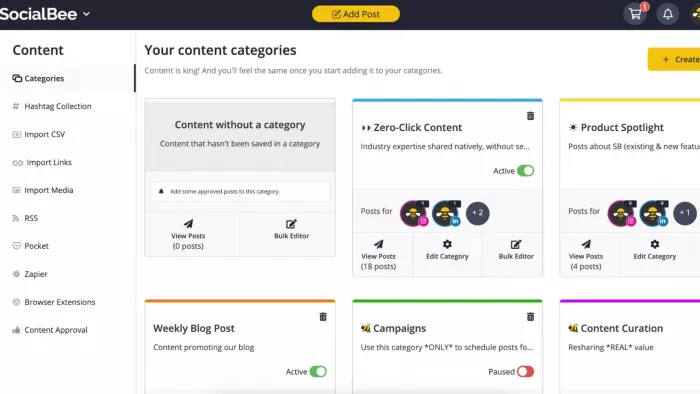
SocialBee stands out for category-based scheduling and evergreen content recycling. Teams can organize posts into themes such as educational, promotional, or curated content, then automatically rotate and reuse them on a set schedule.
This makes it especially valuable for solopreneurs and small teams that want consistent publishing without constantly creating new posts. All plans include AI caption generation, Canva integration, and a unified inbox.
The main drawbacks are a modest learning curve and limited support for external client approvals. Costs can also rise as extra profiles and users are added.
Who should switch: Content-heavy teams that want to build a library once and let automation handle the distribution. Particularly strong for solopreneurs, coaches, consultants, and small businesses running content marketing programs.
Who should look elsewhere: Agencies needing client-facing approval workflows, or teams whose primary need is real-time engagement management.
6. Later: Best for Visual-First Creators and Instagram-Led Brands
Best for: Creators and DTC brands running visual-first strategies on Instagram, TikTok, and Pinterest
Pricing: Starter $25/month, Growth $50/month, Scale $110/month (annual billing saves 25%).
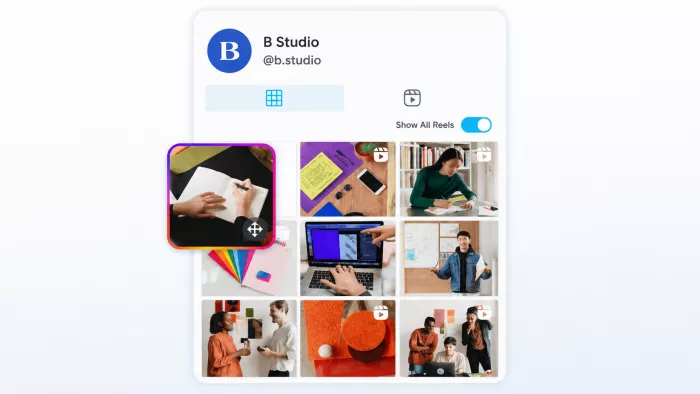
Later is one of Buffer’s closest competitors for visual-first social media teams, especially those focused on Instagram and TikTok. Its drag-and-drop calendar and Instagram feed preview make it easy to plan campaigns and see how posts will look together before publishing. Link-in-bio tools, shoppable links, caption assistance, and best-time-to-post suggestions add useful support for brands built around visual content.
The feed preview is Later’s standout feature. For businesses where a consistent Instagram grid matters, being able to rearrange posts and review the overall look before anything goes live is a real advantage. Later supports eight social networks, including Instagram, Facebook, TikTok, Threads, and LinkedIn. However, some limitations make it less suitable for larger teams. Approval tools are fairly basic, managing several accounts can feel awkward, and the social inbox only covers Instagram and TikTok. Lower plans also have posting limits, while the Starter plan includes just three months of analytics history.
Another concern is platform stability. Later removed Twitter/X scheduling after some users had already purchased annual plans that included it. Teams considering a long-term subscription should keep that history in mind, particularly if they rely on a wide mix of social networks.
Who should switch: Creators and DTC brands whose social strategy is Instagram-first or TikTok-first. If visual planning is the priority and you do not have the team-scale problem yet, Later is the cleanest upgrade from Buffer.
Who should look elsewhere: Agencies and multi-brand teams that need approval workflows or cross-channel analytics. Later carries the same solo-friendly limitations as Buffer, just on a different axis.
7. SocialPilot: Best for Budget-Friendly Agency Scaling
Best for: Mid-size agencies managing ten to thirty client accounts
Pricing: Essentials $30/month, Standard $50/month, Premium $100/month, Ultimate $200/month.
SocialPilot is the tool I recommend when an agency has clearly outgrown Buffer's per-channel pricing but is not ready for the Sprout Social or Hootsuite price tag. It is purpose-built for the segment Buffer keeps losing: agencies running ten to thirty client accounts who need bulk scheduling and white-label reporting at a price point the finance team will approve.
Bulk scheduling is where SocialPilot earns its place on this list. You can upload a CSV of hundreds of posts across dozens of accounts, and SocialPilot will queue them with channel-specific formatting. For franchise rollouts and multi-client campaign launches, that capability saves multiple hours every week.
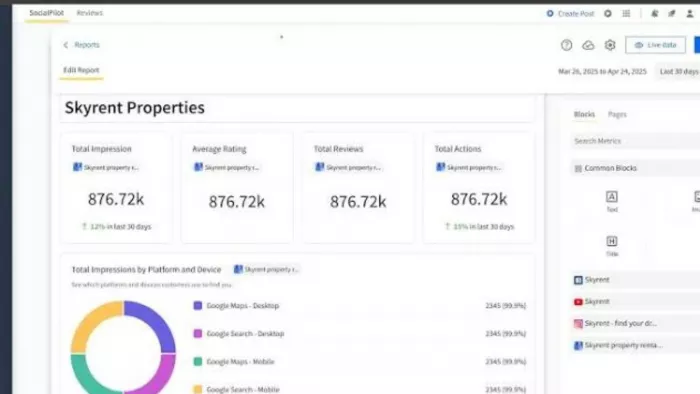
The dedicated agency client dashboard separates each client's presence. White-label reports on mid-tier plans let you deliver branded performance summaries that look like they came from your own analytics platform. Canva, Google Drive, and Dropbox integrations are all native.
Package pricing instead of per-channel billing means your costs stay predictable as you scale. The math that breaks Buffer at twenty channels becomes manageable with SocialPilot's bundled approach.
What I would flag before committing: the collaboration features and deeper analytics live on higher tiers, so the entry plan may not include the agency-specific features that make SocialPilot compelling in the first place. The UI feels a generation behind newer tools like Planable and Later. Functional, but not inspiring. The approval workflow exists but is not the polished, client-facing experience that teams managing external stakeholders need. SocialPilot rewards process and volume more than creative collaboration.
Who should switch: Agencies past ten client accounts where Buffer's per-channel billing has become a spreadsheet you actively avoid opening. The bulk scheduling and client management features earn their cost back quickly.
Who should look elsewhere: Solo creators and in-house teams without agency workflows. If approval UX is the primary concern, look at Planable instead.
How to Choose the Right Alternative
The right pick depends less on which tool has the highest G2 rating and more on which problem you are actually solving.
Content approval and collaboration → Planable. No other tool handles multi-stakeholder workflows as cleanly.
Social listening and competitive monitoring → Hootsuite. The listening depth is unmatched.
Social as a revenue or support channel → Sprout Social, provided your team will use the full feature set.
High engagement volume and client reporting → Agorapulse hits the sweet spot between capability and cost.
Content creation volume is the bottleneck → SocialBee's category system and recycling let a small team sustain consistent publishing.
Visual-first, Instagram-led strategy → Later's feed preview and planning tools are best in class.
Agency economics and bulk operations → SocialPilot offers the best cost-to-capability ratio at scale.
A Quick Decision Checklist
Ask yourself these five questions, and the answer usually points to one or two tools:
Do you send posts to external clients or stakeholders for approval before publishing? Planable.
Are you managing more than fifteen client accounts with agency-level volume? SocialPilot or Planable.
Is social listening or sentiment tracking part of your team's remit? Hootsuite or Agorapulse.
Does your leadership team expect analytics tied to revenue and competitive positioning? Sprout Social.
Is your content strategy primarily visual and centered on Instagram or TikTok? Later.
Do you need to maximize publishing output from a small content library? SocialBee.
Is predictable, budget-friendly pricing your top priority as you scale? SocialPilot or SocialBee.
Final Thoughts: My Personal Take
There is no single "best" Buffer alternative. There is almost certainly a best one for your situation.
If a friend who runs a marketing agency told me over coffee that their Buffer bill is out of control and their approval process is a mess, I would tell them to try Planable first. It solves the two most common reasons agencies leave Buffer: approval chaos and unpredictable pricing. The free tier with fifty posts gives enough runway to evaluate it properly before spending anything.
If that friend ran an in-house enterprise team and needed to prove social media ROI to their board, I would point them toward Sprout Social or Agorapulse, depending on whether CRM integration or inbox management was the bigger priority.
Solo creator focused on building a beautiful Instagram presence? Later, without hesitation.
The practical move: build a 12-month cost projection at your actual channel count, team size, and client volume. Test two options with free trials. Pay attention to how the tool feels on a Wednesday afternoon when you are scheduling fifteen posts and responding to twelve comments, not during the polished onboarding tour.
Comments