Table of Contents
- Why support bots frustrate people, and why the dashboard hides it
- Seven principles for a bot people thank you for
- The build stack, in plain terms
- Get the handoff right, or nothing else matters
- The scorecard that keeps you honest
- The pre-launch checklist
- The verdict, after building and breaking a few of these
Anyone who has spent real time on the customer side of a support bot knows the feeling: rephrasing the same sentence four different ways while a cheerful widget keeps linking to the shipping policy that was already read twice. The people who build these bots know the other side of it, sitting behind a dashboard as the count of tickets deflected climbs while the transcripts tell a very different story. That gap, between what the dashboard celebrates and what the customer feels, is the whole problem. It is also fixable, and the fix is rarely a bigger model.

Here is the number worth sitting with. In Glance's 2026 CX Trends Report, 75 percent of consumers said they hit frustration with AI-driven customer service during 2025. The reason is not what most teams assume. Verint's survey of 1,500 people found the two biggest complaints were plainer than a dislike of robots: the bot could not answer the question, and it did not understand what was being asked. People do not hate automation. They hate being trapped by it.
This guide gathers what teams tend to learn the hard way. There is no theory for its own sake. Every rule below comes from a deployment that either worked or blew up, and from the benchmarks support teams are actually tracking in 2026.
The three-minute rule Parloa's June 2026 Consumer Patience Index (1,001 US adults) found that more than half of people give an automated system about three minutes before walking away. That is roughly four exchanges. A bot's entire reputation is decided in four messages, so the first four have to earn the fifth. |
Why support bots frustrate people, and why the dashboard hides it
The trap is that the metrics most teams celebrate can rise while satisfaction falls. A conversation counts as contained whether the customer got a real answer or simply gave up. When Alhena audited 15 live AI deployments in 2026, the single most common failure was answer-only fallback: the bot replied with something plausible, the chat never escalated, containment looked healthy, and the customer left unresolved anyway.
Two things are true at the same time, and confusing them is where teams go wrong.
What the dashboard shows ● Tickets deflected went up ● Containment rate reads 72 percent ● Average handle time dropped ● Session closed, no agent needed | What the customer felt ● The question had to be typed three times ● There was no visible way to reach a person ● The order number was repeated after transfer ● Nobody actually solved the problem |

The cost of getting this wrong is not abstract. Glance found that nearly 90 percent of customers report reduced loyalty when the option to reach a human is removed, and 68 percent said a complete resolution matters more to them than raw speed. Klarna made this mistake in public. In early 2024 it announced that its AI was doing the work of 700 agents. By May 2025 its chief executive told Bloomberg the push had leaned too far toward cost-cutting and produced lower quality service, and the company began hiring people back, with a promise that customers could always reach a human. When one of the most aggressive adopters walks part of it back, that is worth reading closely.
Seven principles for a bot people thank you for
These are the rules worth checking every build against. None of them are about making the bot sound more human. They are about making it useful and honest, which turns out to be what people wanted all along.
1 Answer only from your own knowledge
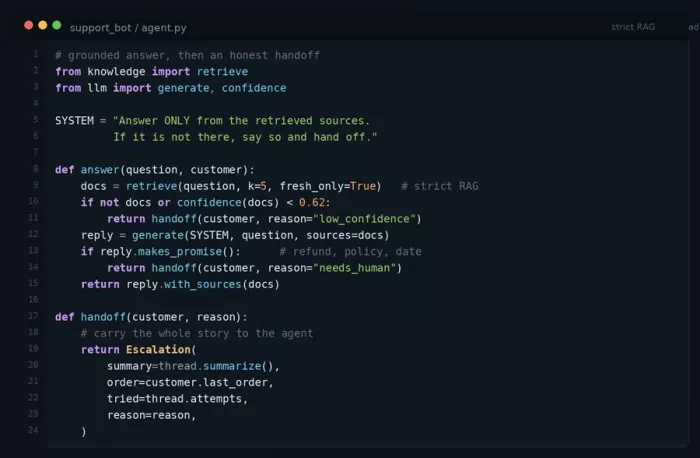
Ground every reply in the help center, docs, and resolved tickets, and instruct the model to refuse when the source is not there. This strict-retrieval pattern is what stops a bot from inventing a refund policy or promising a feature that does not exist.
Teams running mature retrieval average 55 to 65 percent containment. Rule-based scripts sit at 20 to 30 percent (Gartner 2025 Customer Service Technology Survey).
2 Make the exit obvious
A visible route to a human should sit in view at every step, not appear only after five failed loops. Hiding it inflates containment for a quarter and quietly raises refunds, chargebacks, and one-star reviews.
The customers who needed a person do not vanish. They escalate to the payment processor instead.
3 Let it say I do not know
A bot that admits a gap and routes onward beats one that confidently offers the wrong link. Confidence gating, which checks whether retrieval returned a clear and non-contradictory answer before generating a reply, is the line between honest and infuriating.
4 Never make people repeat themselves
Around 74 percent of customers say re-explaining an issue across channels or agents is a top frustration, and only 7 percent say they rarely have to. Carry identity, order, history, and prior attempts through the whole conversation and into any handoff.
5 Resolve, do not just reply
The bots people actually like do things: check a shipment, update a payment method, start a return. Wiring the bot into order, billing, and inventory systems turns a FAQ widget into something that closes the loop.
6 Escalate with the full story attached
When the bot hands off, it should pass a summary, the account and order data, and everything it already tried. Escalation without context is worse than having no bot at all, because now the customer is angry and starting over.
7 Treat it as a living system
A knowledge base decays. Review failed and escalated chats every week, fill the gaps, and expect containment to stabilise only after two to four weeks of tuning. Set-and-forget is how a good bot slowly rots.

The build stack, in plain terms
An exotic architecture is not required. Most 2026 support deployments that work land on the same shape: a retrieval layer for grounding, a language model for the conversation, an action layer for getting things done, and guardrails around the edges. Here is what each piece is for, and the one mistake that quietly kills it.
| Layer | What it does | The mistake to avoid |
|---|---|---|
| Retrieval (RAG) | Pulls the three to five most relevant, recent help articles per question so answers stay grounded in fact. | A thin or stale knowledge base. A low score after 30 days is a content gap, not a technology failure. |
| Language model | Turns the retrieved facts into a clear, on-brand reply the customer can read quickly. | Letting it answer from general knowledge instead of the sources, which is how bots invent policy. |
| Action layer | Connects to order, payment, and inventory systems so the bot can complete real tasks, not just describe them. | Building question-and-answer only, so every genuine request becomes a transfer. |
| Handoff | Detects when a human is needed and carries the full conversation across without a break. | Dropping the customer into a queue with no history and no summary. |
| Guardrails | Refuse out-of-scope questions, block risky promises, and decide when confidence is too low to answer. | No refusal rule, so the bot guesses and commits the company to things under pressure. |
Get the handoff right, or nothing else matters
If a team could keep only one rule, this would be it. The moment a bot decides it cannot help, everything the customer feels next depends on how the transfer is handled. Done badly, the handoff is the company saying not my problem and making the customer start from scratch. Done well, it is invisible, and half the time the customer does not even register that the shift happened.
A handoff that works ✓ The path to a human is visible from message one ✓ A summary, order data, and prior attempts travel across ✓ The customer keeps their place and never repeats the account number ✓ It triggers early when confidence is low or the case is sensitive | A handoff that burns trust ✕ The human option appears only after several dead ends ✕ The agent opens a blank ticket and asks for the story again ✕ The chat is contained because the customer gave up ✕ Emotional or high-stakes cases stay stuck with the bot |
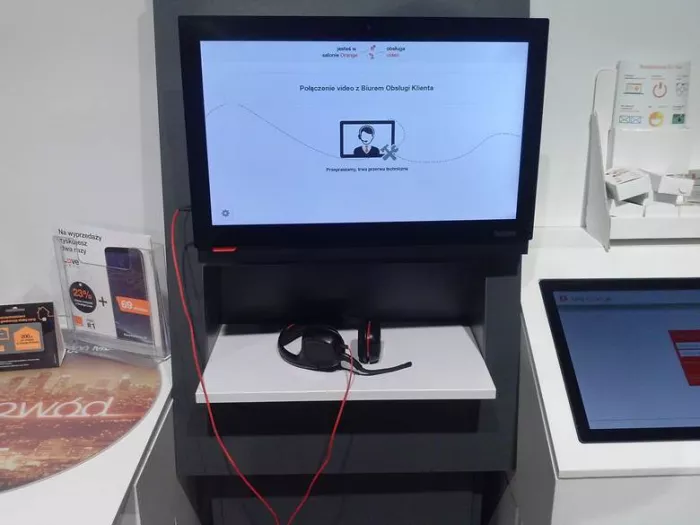
One field detail worth stealing: watch repeat-contact rate right next to containment. If both climb together, the bot is closing chats without solving them. That is the trap announcing itself, and the fix is answer quality, not more automation.
The scorecard that keeps you honest
Containment on its own is a vanity metric. The teams doing this well in 2026 track a small scorecard and never report containment alone. These are the numbers worth a place on the dashboard, with the ranges people are actually hitting.
| Metric | What it tells you | Healthy range |
|---|---|---|
| Containment rate | Share of chats fully handled without a human. | Leaders 70 to 90 percent. Mature RAG averages 55 to 65 percent. Below 30 percent after 30 days signals a content gap. |
| Deflection rate | Share of would-be tickets resolved so they never open. | 40 to 60 percent is strong. |
| CSAT on bot chats | Whether people were satisfied, not merely contained. | Within about 10 points of the human-agent CSAT. |
| Repeat-contact rate | Whether resolved chats stay resolved. | Should fall, or at least hold, as containment rises. |
| Handoff accuracy | Whether escalations reach the right place with context intact. | High. Audit the misroutes every week. |
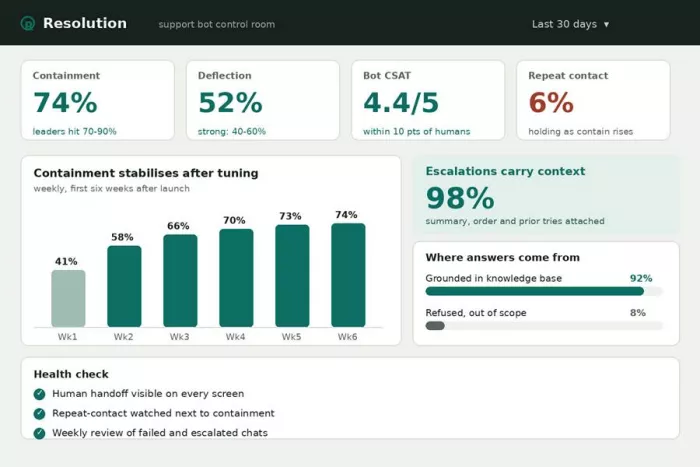
A word on the shiny forecasts. Gartner expects agentic AI to autonomously resolve about 80 percent of common requests by 2029, and to cut service costs by roughly 30 percent. The same firm expects more than 40 percent of agentic AI projects to be cancelled by the end of 2027, and predicts that none of the Fortune 500 will have fully removed human support by 2028. Read those three together and the message is clear: the ceiling is high, most of the failures will be self-inflicted, and the human never fully leaves the building.
The pre-launch checklist
Before a single customer is pointed at it, this list is worth running down. If any line is a no, what is shipping is a frustration engine.
- Grounded on the real help center, docs, and resolved tickets, with a refusal rule for anything outside them
- A visible talk-to-a-human option on every screen, not buried behind loops
- Handoff passes a summary, identity, order data, and what the bot already tried
- Context carries across channels, so nobody repeats their story
- Confidence gating that escalates instead of guessing when retrieval is weak
- Connected to at least the top one or two transactional actions, such as order status and returns
- A weekly review of failed and escalated chats that feeds straight back into the knowledge base
- A scorecard tracking containment, deflection, CSAT, repeat contacts, and handoff accuracy together
- A clear, honest note that the customer is talking to AI
The verdict, after building and breaking a few of theseA good AI support bot is not the one with the highest containment number on a slide. It is the one that answers from real facts, admits what it does not know, and hands the customer to a person the second it is out of its depth, with the whole story already attached. The bots that people do not want to throw a laptop across the room over tend to do those three things. The ones that make people furious fail at least one of them. The technology in 2026 is more than capable of the good version. What breaks it is almost never the model. It is a team optimising for deflection and forgetting to automate the exit. It is the kind of applied, unglamorous discipline that hands-on learning platforms such as timtis tend to teach faster than trial and error: build for resolution, keep the human one tap away, and measure honestly. Do that, and the result is the rare thing, a bot customers are relieved to reach instead of one they are already bracing for. |
Comments