Table of Contents
- What Counts as Coding Kata?
- How I Compared the Sites
- The 7 Sites at a Glance
- 1. Codewars: Best for Everyday Kata Practice
- 2. Exercism: Best for Learning a Language Properly
- 3. LeetCode: Best for Technical Interviews
- 4. HackerRank: Best for Broad Structured Practice
- 5. CodinGame: Best for Interactive Coding Challenges
- 6. CodeSignal: Best for Assessment-Style Practice
- 7. CodingBat: Best for Java and Python Beginners
- Coding Kata Sites Train Different Skills
- Which Site Should You Choose?
- How to Get More From Coding Katas
- Verdict: Which Coding Kata Site Is Best?
Coding kata can make you faster at writing code, but only if the practice matches the skill you are trying to build. A site designed around interview algorithms does not train you in quite the same way as one built around language fluency, refactoring, or repeated short exercises.
That distinction matters when choosing where to spend your practice time. The seven sites below cover different approaches, from traditional kata and mentor-guided exercises to interview problems, visual puzzles, and beginner drills.
What Counts as Coding Kata?
A coding kata is a small programming exercise used for deliberate practice. Instead of completing a problem once and forgetting it, the idea is to sharpen a specific skill through repetition, refinement, and comparison.
You might solve the same type of problem again using cleaner logic, a different language feature, or a more readable approach. This is why traditional kata platforms such as Codewars and Exercism feel different from interview-focused platforms such as LeetCode. Both involve solving problems, but they train different habits.
How I Compared the Sites
Rather than ranking platforms by the number of challenges they advertise, I looked at what happens during and after each exercise.
● Practice quality matters more than library size. Thousands of problems provide choice, but progression, problem design, feedback, and the ability to learn from a solution determine whether that volume is actually useful.
● The platform should make improvement visible. Difficulty levels, learning tracks, concept grouping, solution comparisons, or meaningful feedback give practice direction. Randomly solving unrelated puzzles is far less efficient.
● Different sites develop different habits. An interview platform may make you better at recognizing graph or dynamic-programming patterns, while a language-focused platform may do more for idiomatic code and syntax fluency.
● Pricing has to make sense for the core purpose. A paid tier can be worthwhile if it adds company-specific interview material, deeper feedback, or useful assessment tools, but basic coding practice should not require an expensive subscription.
The 7 Sites at a Glance
| Platform | Best for | Practice style | Free access |
| Codewars | Regular kata practice | Community coding challenges | Yes |
| Exercism | Learning a language deeply | Concept exercises + mentoring | Yes |
| LeetCode | Technical interviews | Algorithms and data structures | Yes |
| HackerRank | Broad structured practice | Topic tracks + assessment prep | Yes |
| CodinGame | Interactive problem solving | Visual puzzles and coding games | Yes |
| CodeSignal | Assessment-style preparation | Guided learning + assessment practice | Yes |
| CodingBat | Java and Python beginners | Small progressive exercises | Yes |
No single entry in that table is the right choice for everyone. The differences become much clearer once you look at how each platform expects you to practise.
1. Codewars: Best for Everyday Kata Practice
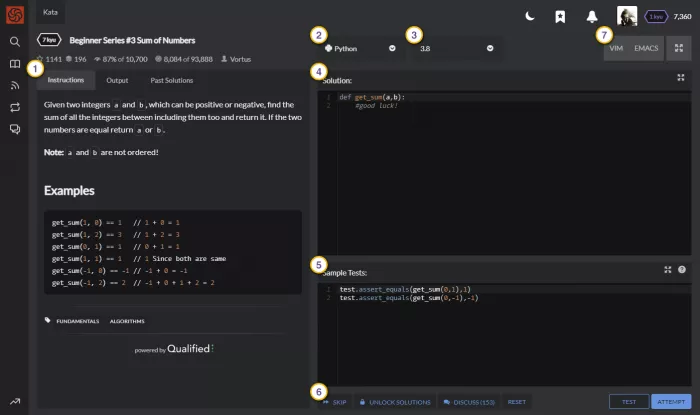
Codewars is the most natural starting point for an article about coding kata because kata are the centre of the platform rather than one feature among many. Its library contains thousands of exercises covering fundamentals, strings, algorithms, recursion, SQL, graphs, refactoring, cryptography, and language-specific problems.
Exercises are ranked from 8 kyu, the easiest level, toward 1 kyu, the hardest. Completing kata improves your rank, but the more interesting learning opportunity appears after submission. Once you solve a challenge, Codewars lets you inspect successful solutions from other users.
What Stands Out
● Comparing solutions turns one problem into several lessons. Your solution might use a conventional loop while another developer relies on a language feature you have never used. Codewars also separates voting for “Best Practices” and “Clever” solutions, which is a useful reminder that technically impressive code is not automatically maintainable code.
● Repetition is built into the experience. Codewars can return completed kata for additional practice. That is much closer to the original idea of kata than constantly chasing new exercises because it gives you a chance to revisit familiar problems and solve them more cleanly.
● Its language range is unusually broad. Alongside JavaScript, Python, Java, C++, Go, and Rust, Codewars supports numerous functional, systems, legacy, and experimental languages. Availability still varies by individual kata.
Codewars Pricing
The core kata experience is available for free. Codewars also offers an optional Red membership with additional statistics, progress comparisons, beta access, an ad-free experience, and profile extras.
| Codewars plan | Price |
| Free | $0 |
| Red Monthly | $5/month |
| Red Semi-annual | $24 every 6 months |
| Red Annual | $40/year |
For most people interested mainly in solving kata, the free version covers the important part. Red becomes more relevant if you care about deeper progress tracking and account extras.
Watch Out For
Codewars exposes you to clever solutions, but cleverness can become a distraction. A one-line implementation may teach an interesting language trick while still being harder to understand than a straightforward five-line version.
The community-built model also means exercise quality is not perfectly uniform. Treat highly voted solutions as material to examine rather than unquestionable examples of professional coding style.
Best for: Developers who know the fundamentals and want short, repeatable practice they can return to regularly.
2. Exercism: Best for Learning a Language Properly
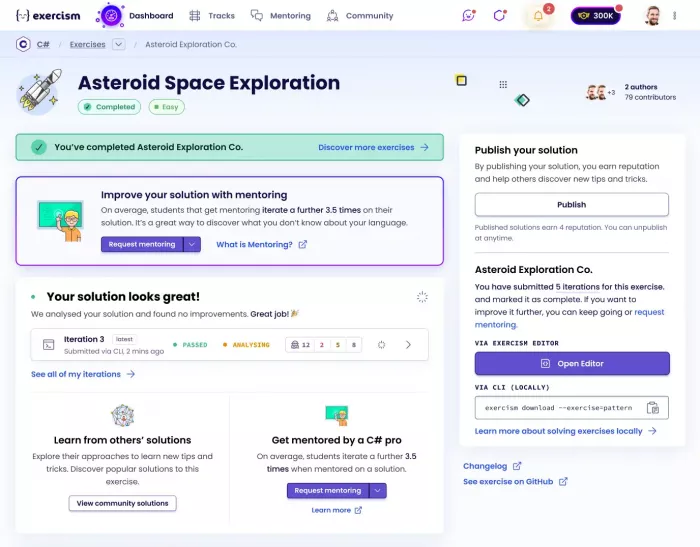
Exercism is a better fit when the goal is not simply solving increasingly difficult puzzles but becoming comfortable writing a particular programming language.
It offers thousands of exercises across dozens of language tracks and combines programming practice with concept-oriented learning and community mentoring. Instead of organizing everything around competition, Exercism places more emphasis on understanding how a language is meant to be used.
That changes the rhythm of practice. You are not only asking whether your code passes the tests. You are also paying attention to language conventions, clarity, and more idiomatic ways to express the solution.
What Stands Out
● It is particularly useful for learning a second or third language. If you already understand programming concepts but are moving from JavaScript to Go, Python to Rust, or Java to Kotlin, Exercism gives you repeated opportunities to express familiar ideas in a different language.
● The learning path has more structure than a random challenge feed. Exercises are connected to language concepts, which makes it easier to practise deliberately rather than simply solving whichever problem appears next.
● Mentoring gives it a different feedback model. Automated tests can prove that your program works, but they cannot always tell you whether your implementation fits the conventions of the language. Community feedback can help fill that gap.
Exercism Pricing
Exercism is free to use. There is no premium individual tier required to access its core language tracks and exercises.
This makes Exercism particularly attractive if you want a structured practice environment without needing to decide later whether essential material sits behind a subscription.
Watch Out For
Exercism is less attractive if your motivation comes mainly from rankings, competition, or rapidly completing interview-style problems.
Its deliberate style is a strength for learning a language properly, but someone preparing for an algorithm-heavy interview on a tight deadline would probably get more targeted value from LeetCode or HackerRank.
Best for: Developers learning a new programming language who care about writing it well, not merely getting code accepted.
3. LeetCode: Best for Technical Interviews
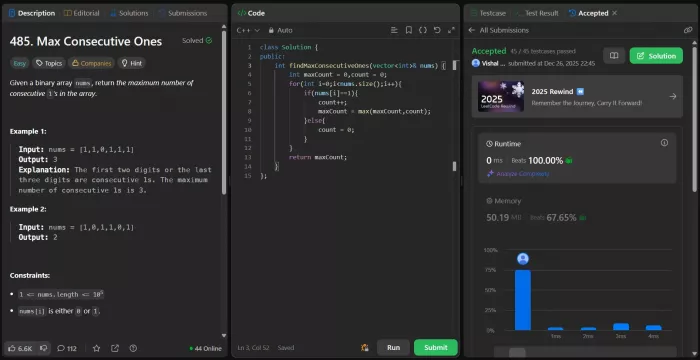
LeetCode is often grouped with coding kata sites, although its purpose is noticeably different. It is better understood as an algorithm and technical-interview training environment.
Its exercises repeatedly expose you to arrays, strings, trees, graphs, linked lists, dynamic programming, recursion, searching, and other patterns commonly tested in software-engineering interviews.
The real value is not simply accumulating solved questions. With enough deliberate practice, you start recognizing structures hidden inside unfamiliar-looking problems.
What Stands Out
● Pattern recognition is the central skill. Apparently different problems often reduce to recurring techniques such as two pointers, sliding windows, breadth-first search, binary search, backtracking, or dynamic programming. Learning to recognize those patterns can make interview problem solving much faster.
● The problem library is well suited to targeted interview preparation. You can concentrate on weak topics rather than solving random exercises, which becomes particularly useful when you already know which areas are likely to cause difficulty.
● Premium is mainly valuable for more focused preparation. Paid features include additional problems, company-specific material, interview-oriented content, and extra tools. Those additions can be useful if you are targeting specific employers, but they are not necessary for starting serious algorithm practice.
LeetCode Pricing
LeetCode has a substantial free tier alongside its Premium membership.
| LeetCode plan | Price |
| Free | $0 |
| Premium Monthly | $35/month |
| Premium Annual | $159/year |
The free version is the sensible place to begin. Premium makes more sense once company-specific preparation or access to additional editorial material becomes valuable to you.
Watch Out For
It is possible to become much better at LeetCode without becoming equally better at building software.
Real projects involve changing requirements, understanding existing code, debugging unclear failures, designing interfaces, testing, deployment, collaboration, and maintenance. An optimized graph solution says little about whether you can make a safe change inside a large production application.
Use LeetCode as targeted training, especially for interviews, rather than as a replacement for actual development work.
Best for: Developers preparing for algorithm-heavy technical interviews.
4. HackerRank: Best for Broad Structured Practice
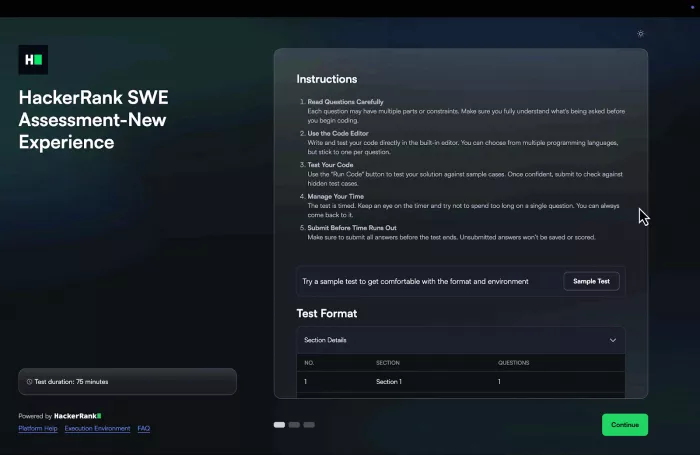
HackerRank sits between a learning platform, a coding-challenge site, and an assessment-preparation environment. That breadth is its main advantage.
Its practice material covers programming languages alongside broader topics such as algorithms, data structures, SQL, mathematics, artificial intelligence, functional programming, and regular expressions. This makes HackerRank especially useful when your weaknesses do not fit neatly into one category.
What Stands Out
● Topic-based practice is easy to direct. If you know that SQL joins, recursion, arrays, sorting, or data structures are weak points, you can work inside that area rather than relying entirely on a generic recommendation feed.
● Some exercises are designed to teach the underlying technique. Instead of every challenge behaving like a test, selected problem tracks explain concepts and build difficulty gradually, which makes them more useful for structured practice.
● It connects naturally to hiring-style preparation. HackerRank is widely associated with coding assessments, and its developer-facing practice tools reflect that. This makes it a useful bridge between ordinary coding exercises and the type of environment candidates may encounter during recruitment.
HackerRank Pricing
HackerRank provides a free Basic level for ordinary practice and also offers paid preparation tiers with expanded mock-test, interview, and tutoring features.
| HackerRank plan | Price |
| Basic | $0 |
| Plus | Around $30/month |
| Infinity | Around $60/month |
Paid plans are much more relevant to intensive job preparation than to everyday coding practice. If you primarily want challenges organized by language or topic, start with the free option.
Watch Out For
HackerRank now covers several purposes at once. That makes it versatile, but less focused than a site such as Codewars.
If all you want is a simple daily kata routine, the assessment and career-preparation layers may feel unnecessary. HackerRank becomes more compelling when you want coding practice, broader technical subjects, and hiring preparation in one place.
Best for: Learners who want broad technical practice rather than an algorithms-only routine.
5. CodinGame: Best for Interactive Coding Challenges
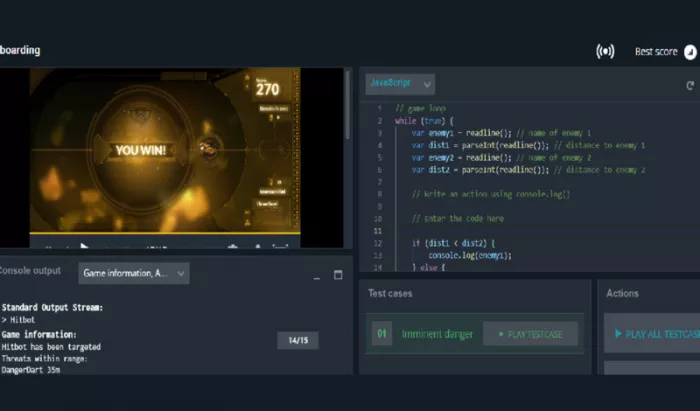
CodinGame addresses a problem that conventional kata platforms rarely acknowledge: repetitive coding drills can become boring.
Instead of presenting every task as plain text followed by an editor and test cases, CodinGame wraps many problems inside visual scenarios, games, optimization tasks, bot programming, and competitive modes. The visual feedback can make abstract logic easier to follow because you can see the consequences of the program rather than receiving only a pass-or-fail result.
What Stands Out
● Problems have more visible context. Early exercises might involve controlling a character or reacting to changing conditions. Harder challenges introduce concepts such as search algorithms, graphs, pathfinding, lists, and optimization.
● It is useful for programmers who lose interest in conventional drills. The game layer gives you a reason to keep iterating because improving the code creates a visible result instead of simply changing a test status from red to green.
● There is real algorithmic work beneath the presentation. The game-like format should not be mistaken for shallow exercises. More advanced challenges can require careful algorithm design and optimization.
CodinGame Pricing
Individual coding practice on CodinGame is free. Commercial recruitment products associated with the wider company are separate from the individual developer practice environment.
Watch Out For
Gamification only helps if it keeps you focused on the programming problem.
Someone who prefers direct instructions may find animations, competitions, and game scenarios less efficient than a conventional kata interface. CodinGame is therefore most useful when the visual layer makes you practise more consistently rather than simply adding distraction.
Best for: Developers who find ordinary problem lists dry and learn better through interactive challenges.
6. CodeSignal: Best for Assessment-Style Practice
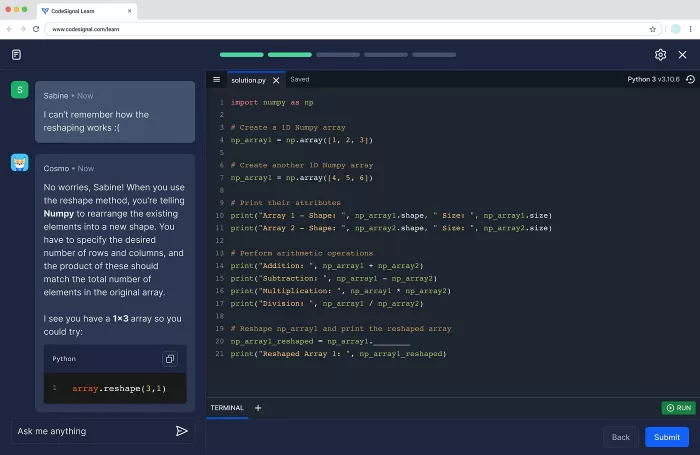
CodeSignal has moved beyond being a simple coding-challenge website. Its current focus includes both skills development and technical assessment.
For individual developers, two parts are particularly relevant. CodeSignal Learn offers structured, practice-based learning with its AI tutor Cosmo, while the assessment practice environment helps candidates become familiar with coding-question formats and the CodeSignal interface before a real technical assessment.
That makes CodeSignal less like a traditional kata library and more useful when your goal involves modern hiring assessments.
What Stands Out
● Practice closely resembles technical assessment environments. Becoming familiar with the editor, question style, and workflow can reduce unnecessary friction when you later encounter a timed hiring test.
● The learning side extends beyond isolated algorithms. CodeSignal has been building structured learning paths around specific skills, which makes the platform more relevant to users who want guidance instead of a huge unorganized problem list.
● Its AI tutor adds another type of feedback. Rather than only seeing whether tests pass, learners can use Cosmo for explanations and assistance as they work through learning material.
CodeSignal Pricing
You can begin using CodeSignal Learn for free. The optional Cosmo+ subscription expands access to its learning features.
| CodeSignal plan | Price |
| Free access | $0 |
| Cosmo+ | $24.99/month |
CodeSignal also sells separate products to employers, but those business plans are unrelated to what an individual developer needs for personal practice.
Watch Out For
CodeSignal is no longer the cleanest option if all you want is a large supply of traditional coding kata.
Its direction is increasingly centered on structured learning, AI assistance, and technical assessment. That is useful for someone preparing for hiring exercises, but Codewars or Exercism provides a more natural environment for long-term kata practice.
Best for: Developers preparing for technical assessments or wanting guided, practice-based learning.
7. CodingBat: Best for Java and Python Beginners
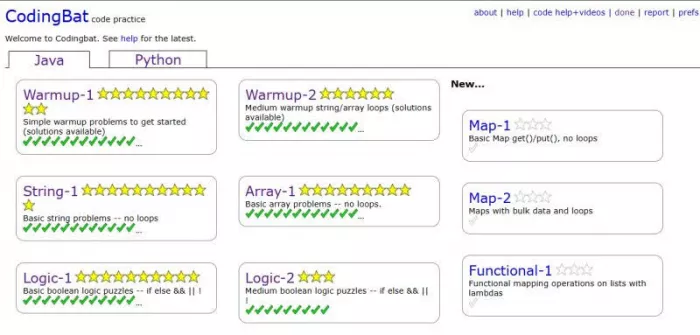
CodingBat looks extremely simple beside newer coding platforms. In this case, simplicity works in its favor.
The site provides short live coding problems for Java and Python, organized around topics such as strings, arrays or lists, boolean logic, loops, and introductory programming patterns.
You read the problem, write a small function, run it, and immediately see whether it handles the required cases. There are very few distractions around that basic loop.
What Stands Out
● The exercises isolate individual programming concepts effectively. Someone struggling with boolean logic can practise that specific skill repeatedly without also dealing with complicated algorithms, frameworks, or lengthy problem descriptions.
● Difficulty increases in small steps. Many exercises focus on one restricted concept at a time, helping beginners become comfortable with fundamental constructs before combining them into more complicated programs.
● Its minimal interface keeps attention on the code. CodingBat is a useful reminder that elaborate dashboards and gamification are not requirements for effective practice. For introductory repetition, small problems and immediate feedback can be enough.
CodingBat Pricing
CodingBat is completely free. There is no paid subscription or premium practice tier.
Watch Out For
The narrow language support is the obvious limitation. If you want JavaScript, C++, Go, Rust, or another language, CodingBat cannot become your main practice platform.
It is also intentionally basic. Once you are comfortable with fundamental Java or Python constructs, Codewars, Exercism, HackerRank, or LeetCode gives you considerably more room to progress.
Best for: Beginners who want focused repetition in Java or Python without a complicated learning environment.
Coding Kata Sites Train Different Skills
One of the easiest mistakes is treating a solved-problem count as a general measure of programming ability. It is not.
A developer who has completed hundreds of algorithm problems may become very good at recognizing patterns under time pressure. Another person may spend the same number of hours working through language exercises and become much more fluent in Rust ownership, Go conventions, or Python idioms. Someone else might improve more by repeatedly rewriting a smaller number of familiar problems.
Those are different forms of progress. Kata practice is especially useful because it narrows your attention. You can isolate recursion, practise collections, revisit sorting, work on function design, or experiment with unfamiliar language syntax without building an entire application around each concept.
What it does not reproduce particularly well is the messiness of professional software development. Real work involves understanding someone else's code, debugging failures with incomplete information, changing existing behavior safely, choosing tradeoffs, integrating APIs, reviewing code, and maintaining systems over time.
The strongest learning routine therefore combines kata with real projects rather than treating one as a substitute for the other. Modern AI tools for developers can support that project work through debugging, refactoring, testing, and working across larger codebases.
Which Site Should You Choose?
The decision becomes much easier once you start with the skill you want to improve rather than the platform with the biggest name.
| Your main goal | Best starting point |
| Build a regular kata habit | Codewars |
| Become fluent in a new language | Exercism |
| Prepare for algorithm interviews | LeetCode |
| Practise several technical topics | HackerRank |
| Make coding drills more interactive | CodinGame |
| Prepare for assessment-style coding | CodeSignal |
| Learn Java or Python fundamentals | CodingBat |
There is also no reason to use only one platform forever. Pairing two different types of practice can be more productive. The same idea applies to online learning platforms, where structured courses and projects can fill gaps that short coding exercises are not designed to cover. Someone learning Rust, for example, might use Exercism to understand language-specific concepts and Codewars to increase repetition. A developer preparing for interviews could use LeetCode for focused algorithms while keeping Codewars for shorter problems that feel less like interview rehearsal.
The less effective approach is spreading your time across four or five platforms and developing a consistent practice habit on none of them.
How to Get More From Coding Katas
The platform matters less if the practice itself becomes passive. A few habits make these exercises considerably more useful.
● Solve for correctness before trying to optimize. Begin with an implementation you can understand and explain. Once it works, inspect the logic for unnecessary complexity. Starting with code golf or premature optimization makes it harder to tell whether you genuinely understood the problem.
● Review your solution after the tests pass. Ask whether the function names are clear, whether an edge case required an awkward workaround, and whether another data structure would simplify the logic. Passing tests confirms behavior; it does not automatically confirm code quality.
● Study alternative approaches after making a serious attempt yourself. Platforms such as Codewars become far more valuable when community solutions are treated as learning material rather than shortcuts. Look for techniques or language features that you could realistically use again.
● Return to selected problems instead of solving everything once. Repeating a kata several weeks later is a useful test of whether the underlying technique stayed with you. If the second solution is clearer or arrives faster, the repetition has done its job.
● Keep real projects in the routine. Kata deliberately remove most of the surrounding complexity so you can focus on one skill. Projects put that complexity back. Both are useful if the aim is becoming a stronger developer rather than simply becoming good at coding-challenge websites.
Verdict: Which Coding Kata Site Is Best?
Codewars is the strongest overall choice for traditional coding kata. Its short exercises, difficulty system, broad language support, community solutions, and emphasis on repeatable practice closely match what kata are supposed to accomplish.
Exercism is the better option for learning a programming language deeply, particularly if structured progression and feedback matter more to you than competition. LeetCode is the strongest specialist choice for technical interviews, while HackerRank is useful for developers who want a wider mixture of languages, algorithms, SQL, and assessment preparation.
CodinGame, CodeSignal, and CodingBat are more specific choices, but that is exactly why they belong on the list. CodinGame gives visual learners a more engaging way to practise, CodeSignal is useful for assessment-style environments, and CodingBat gives Java and Python beginners something the larger platforms sometimes overlook: small exercises with very little surrounding noise. The best coding kata site is not necessarily the one with the biggest problem library. It is the one that repeatedly makes you practise the skill you currently lack, gives you enough feedback to recognize where your approach can improve, and keeps you writing code instead of simply reading about it.
Comments