Quick Verdict
Two of the most talked-about AI video tools of 2026 solve different problems, even though both promise the same headline outcome: turn text into finished video without a camera, a crew, or an editing suite. That shared pitch hides a deep split in purpose. Hypernatural is built for storytellers who need fast, stylish short-form content for social platforms. Synthesia is built for businesses that need a consistent presenter delivering scripted information across many languages. Picking the right one depends far more on the type of video being produced than on which platform is objectively better, and treating this as a straight winner-takes-all contest leads most buyers to the wrong tool.
The video boom of 2026 is the backdrop for all of this. Short clips dominate every major feed, and the old barriers of expensive gear, technical skill, and long editing cycles have pushed creators and companies toward automation. Both platforms answer that pressure, but they answer it for different people. Reading the comparison through the lens of intended audience, rather than feature counts, is the fastest way to a confident decision.
| Decision point | Pick | Why |
|---|---|---|
| Reels, Shorts, TikTok | Hypernatural | Cinematic B-roll, custom styles, and rapid script-to-video output |
| Training and onboarding | Synthesia | Avatar presenters, 160+ languages, and enterprise security |
| Tightest budget | Hypernatural | Paid plans open at $12 per month with unlimited video length |
| Global localization | Synthesia | One script translated and lip-synced across dozens of languages |
| No camera, no crew | Either | Both eliminate filming, but the on-screen result differs sharply |
Table 1. The fast answer before the full breakdown.
Platform Snapshots
Hypernatural at a Glance

Hypernatural positions itself as an end-to-end AI video editor for creators. The workflow starts from almost anything, a prompt, a blog post, a script, or a podcast, and produces a complete short-form video with synced visuals, narration, and captions. Reviewers in 2026 repeatedly highlight its speed and the fact that it does not cap clips at the short six-second windows common to many generative tools, which makes it practical for full narrative pieces rather than isolated snippets. The captioning matters too, since most social video is watched on mute, and the captions apply instantly and stay editable.
•Core idea: script, idea, or audio converted into full-length short-form video
•Standout features: consistent characters, AI B-roll, custom visual styles, AI narration, auto captions
•Best audiences: writers, influencers, marketers, podcasters, and small brands
•Output personality: cinematic, stylized, and social-first
Synthesia at a Glance
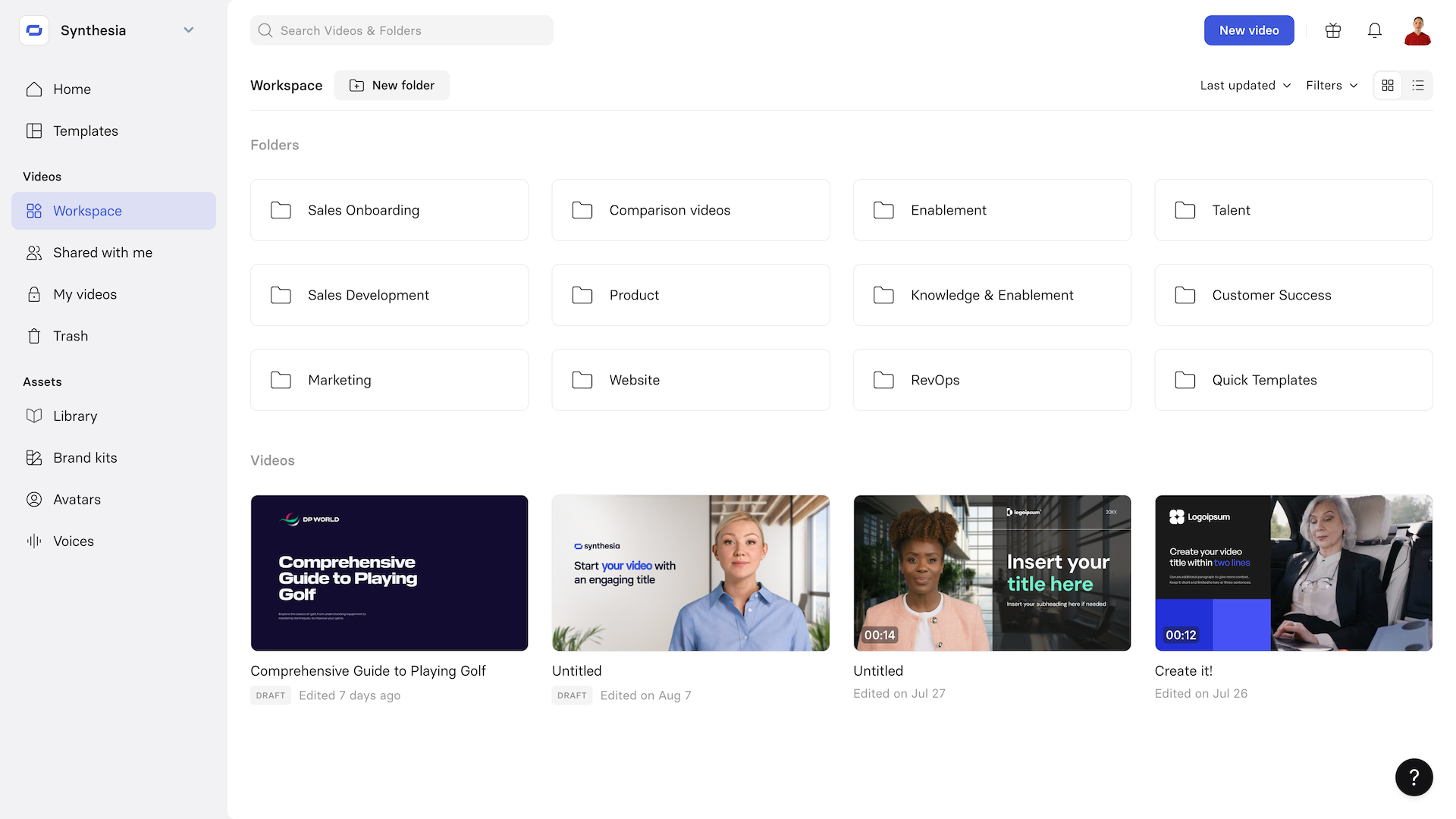
Synthesia is the established name in avatar-led video. A user types a script, selects a digital presenter, and the platform generates a polished talking-head video in minutes. Founded in London in 2017, it has grown into the default choice for corporate learning, internal communications, and multilingual content, and is used by a large share of Fortune 100 companies. Its appeal is less about visual spectacle and more about trust at scale: a single approved presenter and script can be reused across an entire training library, then translated for every region a company operates in.
•Core idea: text-to-video using realistic AI avatars and synthetic voices
•Standout features: 230+ stock avatars, 160+ languages, custom digital twins, AI dubbing
•Best audiences: L&D teams, HR, enterprise marketing, and global organizations
•Output personality: corporate, consistent, and presenter-driven
| Attribute | Hypernatural | Synthesia |
|---|---|---|
| Primary format | Short-form narrative video | Avatar presenter video |
| Founded / focus | Creator-first AI editor | Enterprise AI video (since 2017) |
| Visual engine | Generative scenes, B-roll, styles | Talking-head avatars + templates |
| Voice | 40+ AI narrators, custom voices | 400+ voices, voice cloning |
| Languages | Strong narration coverage | 160+ languages, AI dubbing |
| Watermark on free | Removable on paid | Present on free, removed on paid |
Table 2. Side-by-side identity check.
Pricing Compared
Pricing is where the two products diverge most clearly, and it is often the deciding factor once the use case is settled. Hypernatural sells creator-friendly subscriptions with generous credit pools and unlimited video length, so the cost stays flat no matter how long the videos run. Synthesia prices by video minutes through a credit system, which makes its plans predictable for fixed, repeatable workflows but expensive once monthly volume climbs. Unused credits do not roll over, so the model rewards steady, planned output rather than bursts.
Hypernatural Plans
| Plan | Price (monthly) | What it includes |
|---|---|---|
| Free | $0 | Stock-only video up to 30 seconds, 6 narrators, export to social only |
| Creator | $12 | 6,000 credits per year, 1 custom voice, 4 custom characters, unlimited length, no watermark |
| Pro | $22 | 18,000 credits per year, 2 custom voices, 12 characters, custom products and logos |
| Ultimate | $48 | 96,000 credits per year, 4 custom voices, 48 characters, brand support |
Table 3. Hypernatural pricing as listed on its official pricing page, June 2026. Annual billing advertises up to 52% savings.
Synthesia Plans
| Plan | Price (monthly) | What it includes |
|---|---|---|
| Free | $0 | About 10 minutes per month, 9 avatars, watermark and Synthesia logo |
| Starter | $29 ($18 annual) | 125+ avatars, logo removal, video download, 3 personal avatars |
| Creator | $89 ($64 annual) | 180+ avatars, 5 personal avatars, multi-avatar scenes, API access |
| Enterprise | Custom | Unlimited minutes, 230+ avatars, SAML/SSO, SCORM export, dedicated support |
Table 4. Synthesia pricing as published for Q1-Q2 2026. Plans use a credit model where roughly 120 credits equals one minute of video, and unused credits do not roll over.
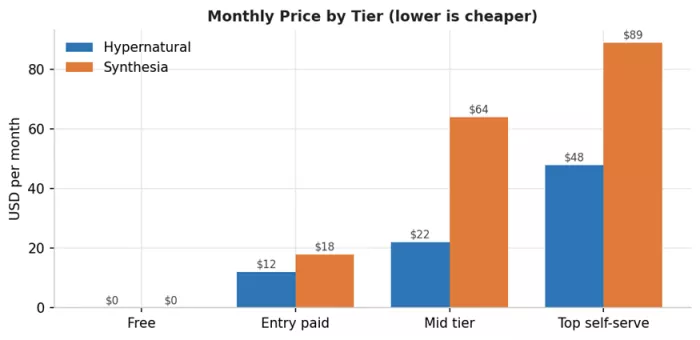
Chart 1. Monthly cost by tier. Hypernatural keeps a lower ceiling for high-volume creators; Synthesia rises steeply once avatar and minute limits expand.
The headline difference is the cost ceiling. A creator publishing dozens of clips a week stays inexpensive on Hypernatural because length is unlimited and credits are annual. A business that needs only a handful of polished avatar videos each month finds Synthesia reasonable at the Starter tier, but the per-minute model becomes the dominant cost factor at scale, and enterprise contracts frequently land in the low five figures annually.
Feature Deep Dive
The two platforms split along every major feature line. The tables below compare them area by area, from the core creation workflow through avatars, voice, localization, editing, and security, so each difference can be scanned at a glance rather than read in long form.
Creation Workflow and Output
| Feature | Hypernatural | Synthesia |
|---|---|---|
| Starting input | Prompt, script, blog post, or audio | Script, PowerPoint, or document import |
| What it builds | Montage of generated scenes, stock, and B-roll | Avatar presenter on a template background |
| Best fit | Storytelling and social marketing | Instruction, explanation, briefings |
| Editing mindset | Directing a short film | Recording a scripted briefing |
| Script handling | Full scripts with dialogue and stage directions | Speaker notes converted to narration |
Table 5. How each platform turns text into a finished video.
Avatars, Characters, and Voice
| Feature | Hypernatural | Synthesia |
|---|---|---|
| On-screen approach | Consistent stylized characters | Realistic talking-head avatars |
| Avatar library | Custom characters across scenes | 230+ stock avatars on top tiers |
| Realism | Narrative continuity over photoreal | Industry-leading, occasionally stiff |
| Recent update | Ongoing style expansion | Express-2 added fuller body motion at 1080p |
| Voices | 40+ narrators, custom voice slots | 400+ voices |
| Voice cloning | Custom voices on paid plans | Tied to personal avatars |
Table 6. Presenter and audio capabilities side by side.
Languages, Editing, and Security
| Feature | Hypernatural | Synthesia |
|---|---|---|
| Languages | Narration-driven, single-language focus | 160+ languages |
| Dubbing | Basic | Frame-accurate AI dubbing on existing video |
| Custom styles | Extensive | Template-based, limited |
| AI B-roll | Built in | Not a core feature |
| Auto captions | Instant and editable | Available |
| Video length | Unlimited on paid | Capped by minute credits |
| Enterprise security | Not targeted | SOC 2, ISO 27001/42001, GDPR, SSO |
Table 7. Localization, creative range, and compliance compared.
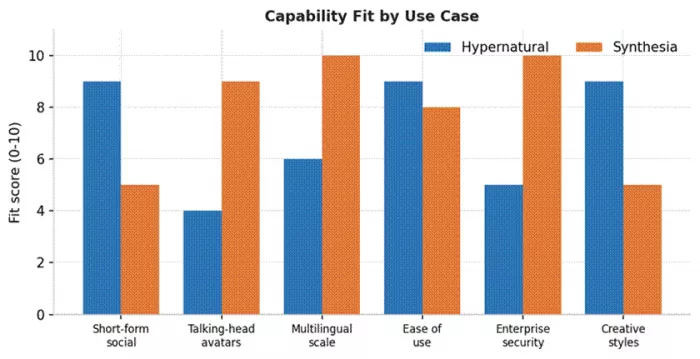
Chart 2. Fit scores by use case, scored 0 to 10. Each tool peaks in the work it was designed for.
Scale, Teams, and Automation
Volume changes the calculus for both products. Hypernatural's annual credit pools and unlimited clip length reward creators who publish constantly, since there is no per-minute meter running in the background. Higher tiers add more custom voices, characters, products, and logos, which matters for solo operators managing several brand identities at once. Synthesia, by contrast, is engineered for organizational rollout: its Creator tier opens API access for automated pipelines, and its Enterprise tier layers on SCORM export for learning management systems, bulk personalization, single sign-on, and dedicated account support. Teams localizing a training library across regions get the most leverage here, because one approved master script can fan out into dozens of language variants under central governance.
Output Quality and Hands-On Impressions
Independent 2026 reviews paint a consistent picture. Testers using Hypernatural describe producing a 45-second product demo from a short script and three photos, with smooth zooms, natural lighting, and on-brand text overlays delivered same-day. One marketer reported generating three coaching Reels in under fifteen minutes, replacing work that previously required a videographer.
Synthesia reviewers emphasize reliability over flair. The text-to-video flow is genuinely fast, and the avatars pass scrutiny in business and training contexts where good eye movement and accurate lip-sync matter more than cinematic mood. The recurring caveat is expressiveness: presenters can feel clinical for persuasive or emotional content, and the predictable corporate aesthetic that helps internal videos can work against public-facing marketing. Quality is also uneven across the full library, with some older stock avatars showing less natural movement than the flagship presenters refreshed in the Express-2 update.
Put simply, Hypernatural output looks like content made to be scrolled past and stopped on, while Synthesia output looks like a person on a corporate channel explaining something clearly. Both are valid goals, and the gap between them explains why head-to-head quality scores rarely settle the question on their own.
| Dimension | Hypernatural | Synthesia |
|---|---|---|
| Speed to first draft | Minutes | Minutes |
| Social-ready polish | High | Moderate |
| Presenter believability | N/A (stylized) | High in corporate use |
| Emotional range | Narrative-driven | Limited, can feel clinical |
| Consistency at scale | Good | Excellent |
Table 8. How real-world output tends to land for each platform.
Strengths and Trade-offs
Hypernatural
Strengths
•Lowest entry price among serious tools, with unlimited video length on paid plans
•Rich creative control through custom styles, B-roll, and consistent characters
•Fast script-to-video pipeline tuned for Reels, Shorts, and TikTok
Trade-offs
•Not built for photoreal talking-head presenters
•Localization is capable but not enterprise-grade across many languages
•No compliance certifications for regulated procurement
Synthesia
Strengths
•Largest avatar library and the cleanest multilingual dubbing in the category
•Enterprise security stack that passes IT and legal review
•Predictable workflow ideal for training, onboarding, and internal comms
Trade-offs
•Per-minute credit pricing gets expensive at volume
•Avatars can feel stiff or clinical for emotional, persuasive content
•Template-driven look limits scroll-stopping social creative
Which One Should Be the Choice?
The decision reduces to a single question: does the video need a person delivering information, or a story grabbing attention? Match the platform to the answer rather than to a leaderboard.
1.Choose Hypernatural for social-first marketing, creator content, podcast clips, and any project where style, pacing, and B-roll matter more than a presenter on camera.
2.Choose Synthesia for corporate training, onboarding, compliance modules, and multilingual rollouts where a consistent avatar and localization at scale are the priority.
3.Run both free tiers for a week if the use case sits in the middle, such as product explainers, since the right fit becomes obvious within a few exports.
| Profile | Recommended | Runner-up |
|---|---|---|
| Solo creator / influencer | Hypernatural | Synthesia |
| Small marketing team | Hypernatural | Synthesia |
| Corporate L&D / HR | Synthesia | Hypernatural |
| Global enterprise | Synthesia | Hypernatural |
| Podcaster repurposing clips | Hypernatural | Synthesia |
Table 9. Recommendation by buyer profile.
Final Word
There is no universal winner, and that is the honest takeaway. Hypernatural wins for creators who live on social platforms and value speed, style, and price, delivering polished short-form video at a cost ceiling that stays low even at high publishing volume. Synthesia wins for organizations that need a trustworthy digital presenter, broad language support, and enterprise-grade security that clears procurement. The tool that fits the work being produced is the one that wins, and for most buyers the choice becomes clear the moment the first export plays back. Anyone still undecided should spend an afternoon in both free tiers with a real script in hand, because the right answer tends to announce itself faster than any spec sheet can.
Comments