I signed up with a fresh Gmail on a Tuesday, skipped the card details because there are none to enter, typed make an app for to do list into the prompt box, and watched Lovable scaffold a working task app it decided to call My Daily Tasks. Twenty minutes in, that app had sign up, log in, and a database that keeps each user's list private. None of it required me to touch code, config files, or a hosting dashboard.
Then I asked it to rework the login options and slammed into the credit wall, which is where the honest part of this review begins. Below is the full session, screen by screen, plus verified company numbers, current pricing, and what people on G2, Trustpilot, and Reddit report in 2026.
What is Lovable?
Lovable is a vibe coding platform from Stockholm that turns plain language prompts into full stack web apps: a React frontend wired to a Supabase powered cloud with authentication, a database, and hosting handled for you. It began in 2023 as GPT Engineer, an open source project by Anton Osika, then relaunched as Lovable in December 2024 with co-founder Fabian Hedin.
The growth since has been unusually well documented. The company hit $100 million in annual recurring revenue within eight months of launch, announced $200 million ARR on stage at Slush in November 2025, then closed a $330 million Series B at a $6.6 billion valuation the following month, led by CapitalG and Menlo Ventures. In June 2026, Forbes reported the company was in talks to raise at roughly $12 billion. Around 8 million people now build on it.
| QUICK FACTS | DETAILS |
|---|---|
| Company | Lovable Labs, Stockholm, Sweden. Founded 2023, launched December 2024 |
| Founders | Anton Osika (CEO) and Fabian Hedin (CTO), both now billionaires on paper |
| Users | 8 million plus builders as of mid 2026 |
| Revenue | $200M ARR confirmed November 2025, one of the fastest ramps in software history |
| Funding | $330M Series B at $6.6B (Dec 2025); reported talks at $12B (Forbes, June 2026) |
| Tech stack | React frontend, Supabase backed cloud, GitHub sync, one click publishing |
| Free plan | Yes, 5 credits per day, no credit card required |
How I tested Lovable
Everything below happened in a single free account, documented with screenshots as I went. My goal was simple: build something real, publish it, and see how far the free tier stretches before the paywall appears.
STEP 01 · SIGNING UP
Four ways in, no card anywhere
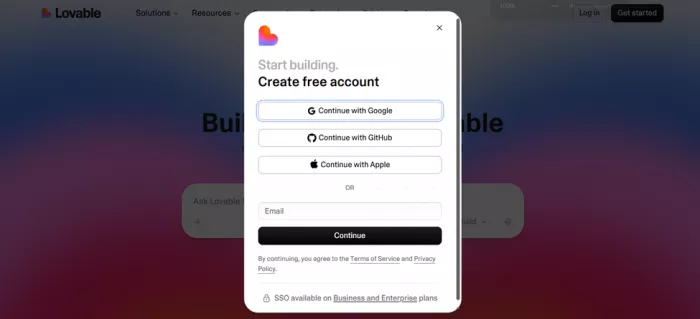
The signup modal offers Google, GitHub, Apple, or plain email. I chose email to see the whole flow. Password rules are light, at least 8 characters and one number, and a single Cloudflare checkbox replaces the usual captcha puzzles. There is no credit card field in the entire onboarding, which already puts it ahead of half the tools I test.
STEP 02 · ONBOARDING
Three screens, under a minute
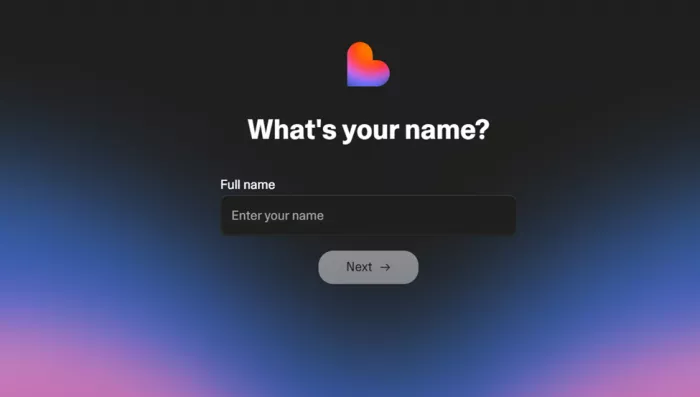
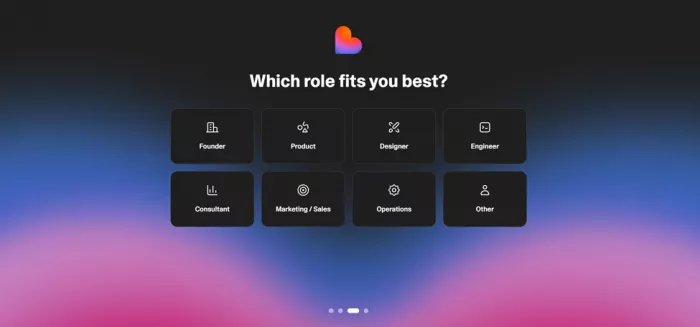
Lovable asks for your name, your role from eight options (Founder, Product, Designer, Engineer, Consultant, Marketing/Sales, Operations, Other), and your company size from Solo up to 200+. The dashboard then greeted me by first name, so the answers clearly feed personalization rather than a sales list alone.
STEP 03 · THE DASHBOARD
One prompt box and a lot of nudges
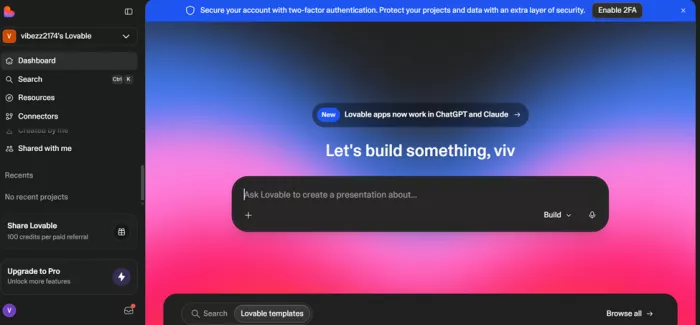
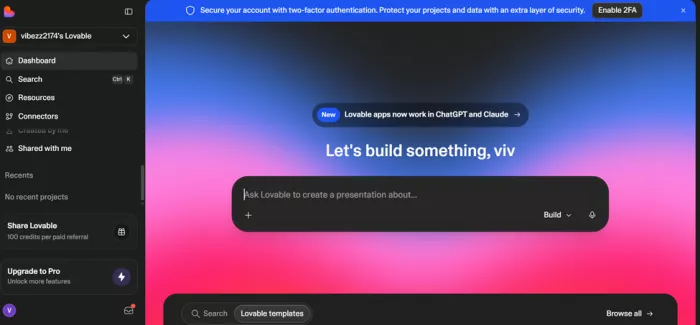
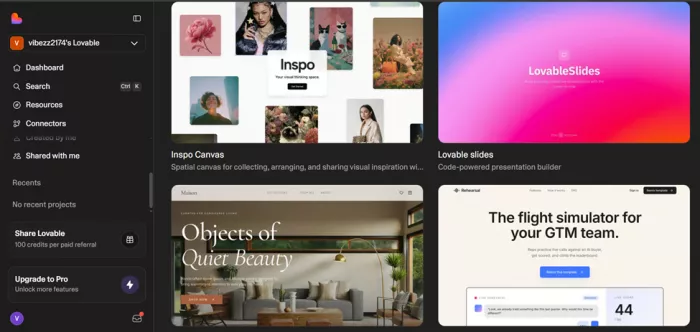
The workspace opens on a big prompt field, a banner pushing two factor authentication, and another announcing that Lovable apps now work inside ChatGPT and Claude. Below sits a template gallery: Inspo Canvas for visual moodboards, Lovable Slides for code powered presentations, a storefront demo called Maison, and Rehearsal, a sales call simulator. The sidebar also dangles a referral deal worth 100 credits per paid signup.
STEP 04 · BUILD VS PLAN
The switch worth knowing about
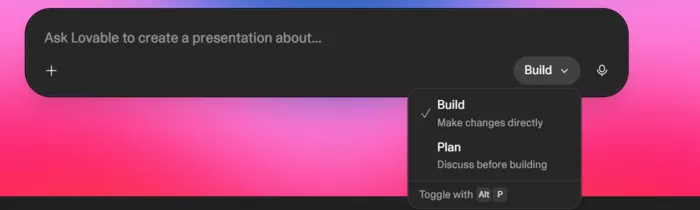
A dropdown on the prompt box, toggled with Alt+P, flips between two modes. Build makes changes directly. Plan discusses the approach before any code gets written. I stayed in Build for speed and learned later that Plan is the smarter default when credits are scarce, because a wrong build still costs you.
STEP 05 · FIRST PROMPT
Five words, working app
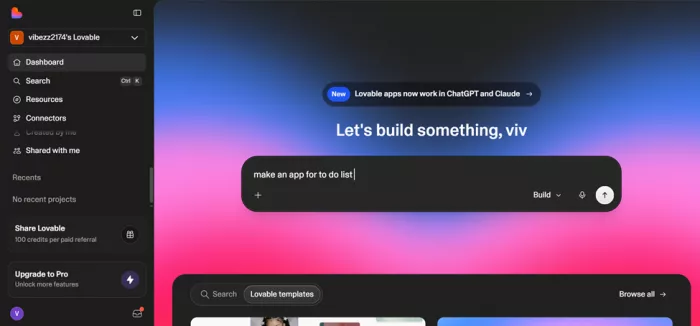
My entire spec was: make an app for to do list. Lovable named the project My Daily Tasks, set up the workspace, and started generating without a single clarifying question. A live preview fills the right half of the screen, and an annotation tool lets you click any element and describe a change in place.
STEP 06 · 12:28 PM · ADDING AUTH
Login and private data from one sentence
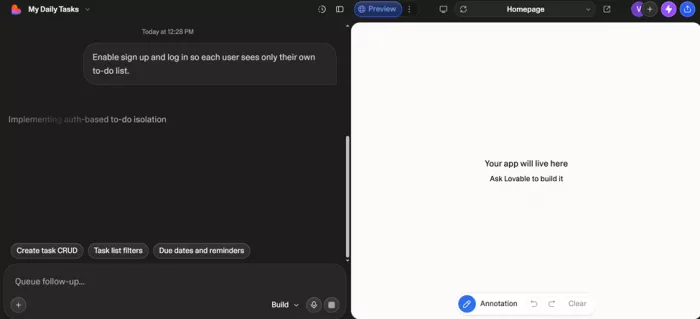
I typed: Enable sign up and log in so each user sees only their own to-do list. The status line read Implementing auth-based to-do isolation, and minutes later the preview showed a landing page with a Sign in / Sign up button. The generated auth screen includes Continue with Google plus email and password, none of which I configured myself. After every response, suggestion chips propose next moves, things like Create task CRUD, Task list filters, and Due dates and reminders.
STEP 07 · 12:36 PM · ITERATING
Edits land clean, and each one is metered
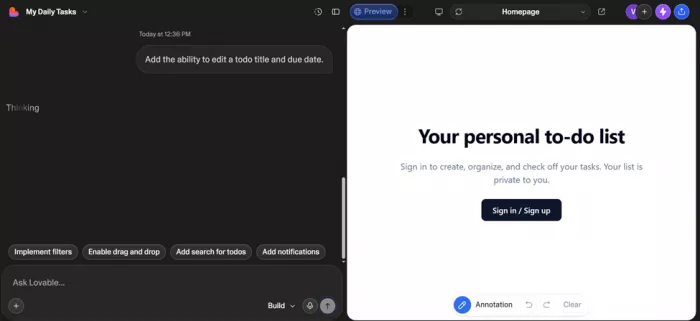
Add the ability to edit a todo title and due date went through just as smoothly, and the chips refreshed with drag and drop, search, and notifications. This is where the math turns real. Every message you send costs at least one credit, and the free plan hands you five per day. Iterate casually and a day's allowance is gone before lunch.
STEP 08 · PUBLISHING
Live URL in one click, badge included
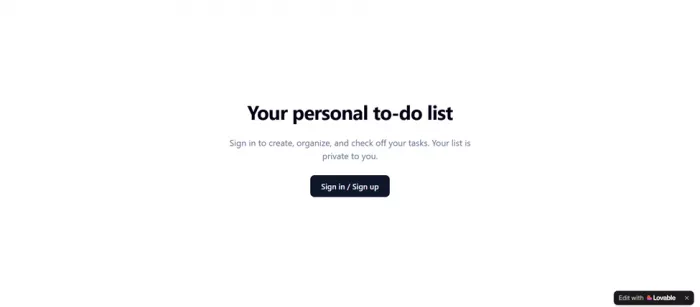
Publishing took one click and the app went live on a lovable.app address. An Edit with Lovable badge sits pinned to the corner of every free plan app, and it stays there until you pay.
STEP 09 · THE WALL
Where the free ride ends
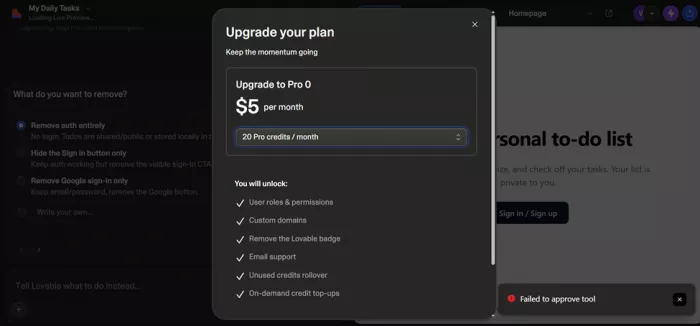
When I asked to rework the sign in setup, Lovable answered with a clarifying card: remove auth entirely, hide the button, drop only Google sign in, or write my own instruction. Before I could pick, my credits ran dry and an upgrade modal appeared offering a $5 per month Pro 0 step with 20 Pro credits, listing user roles and permissions, custom domains, badge removal, email support, credit rollover, and on demand top ups. A Failed to approve tool error also flashed in the corner during this exchange, the only bug of my whole session.
What stood out while building
SPEED One prompt, working app Five words produced a scaffolded project with routing, styling, and a live preview. No setup screens, no stack decisions, no config. | BACKEND Auth and database included A single sentence wired sign up, log in, and per user data isolation. The Supabase powered backend was configured for me, not by me. |
GUIDANCE Suggestion chips After each build, Lovable proposes logical next features. Half my roadmap came from tapping chips instead of writing prompts. | CONTROL Build and Plan modes Build executes immediately. Plan talks the change through first, which protects credits on bigger moves. Alt+P flips between them. |
SHIPPING One click publish Live on a lovable.app URL in seconds. Custom domains and badge removal unlock on paid plans. | OWNERSHIP Your code, exportable GitHub sync means the React codebase is yours to take elsewhere. The lock in lives in the workflow, not the code. |
Lovable pricing in 2026
Lovable runs on credits, and every AI message consumes them. Here is the published structure as of July 2026, checked against the pricing page and current buyer guides.
| PLAN | PRICE | CREDITS | WHAT YOU GET |
|---|---|---|---|
| Free | $0 | 5 / day | Full builder access, public projects, Lovable badge on published apps, no card required |
| Pro | From $25/mo | 100/mo + 5 daily | Private projects, custom domains, badge removal, rollover of unused credits, scales to 10,000 credits at $2,250/mo |
| Business | $50/mo | 100/mo + 5 daily | Everything in Pro plus SSO, security controls, and team features for the whole workspace |
| Enterprise | Custom | Custom | Central admin, custom credit pools, procurement friendly controls |
WHAT THE PRICING PAGE UNDERSELLS Two things I only learned by using it. First, the editor offered me a $5 per month Pro 0 rung with 20 credits when my free allowance died, a tier the public pricing page never mentions. Second, subscriptions are just the entry ticket: once your app is live, Lovable Cloud and Lovable AI meter their own usage for database, storage, and in app AI features. Free allowances cover small projects, but several 2026 pricing guides, plus a well trafficked r/lovable thread from May, describe real bills landing well past the plan line once you build in earnest. |
Lovable review scorecard
| CRITERIA | SCORE | MY NOTES AFTER TESTING |
|---|---|---|
| Ease of use | 4.8 / 5 | Signup to first working app without one confusing moment. Chips and annotations keep non-coders moving |
| Build speed | 4.7 / 5 | Minutes from prompt to preview, seconds from preview to a live URL |
| Backend & auth | 4.4 / 5 | Login, user isolation, and a database from single sentences. Genuinely full stack, not a mockup |
| Output quality | 4.2 / 5 | Clean, modern pages on the first pass. Vague or complex asks can take billed retries |
| Docs & support | 3.9 / 5 | Good docs and an active community. Email support sits behind the paywall, and I hit one tool error |
| Pricing value | 3.4 / 5 | Fair for prototypes, punishing for heavy iteration. Usage billing makes the true cost hard to predict |
| Overall | 4.2 / 5 | The best first hour in the category, with a meter you need to respect |
What real users say about Lovable
My session was one data point, so I pulled the current picture from the biggest review platforms and communities. The pattern is remarkably consistent with what I experienced.
G2 4.6 / 5 · 273 reviews Ease of use dominates the praise, flagged in 112 reviews, with non-coders shipping real products. The credit system is the top complaint at 40 mentions. One reviewer put the tension plainly: “the free credits finish quicker than expected.” |
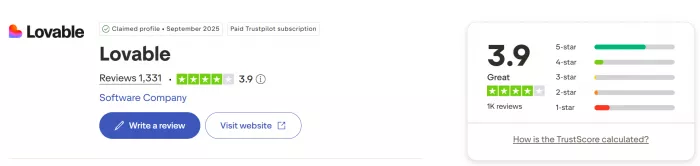
Trustpilot 1,300+ reviews A split crowd. Teams celebrate speed, like one that wrote “we manage to build simple application and internal tools in a few hours.” The unhappy reviews cluster around credit burn and support response times, not the product itself. |
Reddit · r/lovable Community sentiment The subreddit skews practical. A widely shared May 2026 thread titled Credit consumption is getting out of hand collects reports of edits eating multiple credits, and the standing advice is to draft in Plan mode and keep each prompt small and specific. |
Forbes June 2026 The business press treats Lovable as the vibe coding bellwether. Forbes reported talks to raise at a $12 billion valuation, roughly double the December 2025 mark, and noted both founders have pledged half of any exit proceeds to charity. |
Pros and cons
What won me over
- Fastest idea to working app flow I have tested, measured in minutes
- Auth, database, and hosting configured from one sentence prompts
- Free plan is usable every day, with no card and no countdown
- Plan mode and suggestion chips cut down wasted prompts
- GitHub sync keeps the code yours, portable anytime
- Publishing is instant, with a shareable URL for feedback
What wore me down
- Credits drain fast under iteration, and failed attempts bill the same
- Free projects are public and carry the Lovable badge
- Cloud and AI usage push real costs past the sticker price on live apps
- Vague or complex prompts can need several paid retries
- The occasional glitch, like the Failed to approve tool error I hit
- The public pricing page hides tiers and costs you meet in product
Who should use Lovable, and who should skip it
USE IT IF You need something real, fast Non technical founders validating an MVP, teams building internal tools, designers turning ideas into clickable products, and marketers who need a working demo by Friday. That sweet spot is wide. | SKIP IT IF You are in it for the long haul Sustained production development on a tight budget favors flat rate tools like Cursor or Replit. Apps with heavy custom backend logic will outgrow prompt driven edits, and the credit model punishes long debugging sessions. |
Final verdict after testing
After three days, one shipped app, and a hard stop at the paywall, here is where I land. Lovable earns its reputation inside the first hour. Watching a complete login system appear because I typed one sentence is the closest thing to magic this category offers right now, and nothing else I have used matches its distance from signup to live URL. The company numbers back the feeling, because you do not reach $200 million in recurring revenue inside a year by shipping a demo.
I also felt the meter running the entire time. Five free credits a day is enough to learn the tool and not quite enough to build with intent, which is clearly the point of the design. My working advice: treat $25 a month as the real starting price, budget above it once your app goes live and starts drawing Cloud and AI usage, and switch to Plan mode before any change you cannot describe in one clean sentence.
Do that, and Lovable is the fastest route from idea to something you can put in front of users in 2026. I am keeping my account, and I am keeping an eye on my credit counter. 4.2 out of 5.
Comments