OpenAI has launched GPT-Live, a new voice model system designed to make conversations with ChatGPT feel more natural, responsive, and closer to real human dialogue. Released on July 8, 2026, the update replaces the older Advanced Voice Mode with a new architecture built for real-time interaction.
The launch is significant because voice has become one of ChatGPT’s most widely used features. More than 150 million people use ChatGPT voice and dictation every week, making spoken interaction one of the most important ways users now engage with AI.
GPT-Live-1 is powering ChatGPT Voice for paid Go, Plus, and Pro users, while Free users are receiving a smaller GPT-Live-1 mini model. The rollout is taking place across ChatGPT on the web and the iOS and Android apps in supported regions.
A More Natural Voice System
The biggest change is how the model listens and responds. Advanced Voice Mode worked more like a turn-based system. A user spoke, the system waited for a pause, then processed the input and replied. That often made conversations feel slightly rigid, especially when a user paused mid-sentence or spoke in a noisy environment.
GPT-Live uses a full-duplex architecture. That means it can listen and speak at the same time, continuously deciding whether to respond, keep listening, pause, acknowledge the speaker, or wait for more context.
In practice, the system can give small verbal signals such as “yeah,” “got it,” or “mhmm” while a person is speaking. It can also avoid interrupting when a user pauses to think, handle mid-sentence interruptions more smoothly, and filter out background noise such as traffic or room chatter.
That makes the experience feel less like issuing commands and more like speaking with an assistant that understands the rhythm of a real conversation.
Background Reasoning While You Talk
GPT-Live also introduces background delegation. When a user asks something that requires deeper reasoning, web research, or a more complex answer, the voice system can pass that work to a more powerful model in the background while continuing the live conversation.
At launch, GPT-Live uses OpenAI’s frontier model layer behind the scenes, with the system designed to upgrade as newer models become available. That means the voice model does not need to carry the full intelligence burden on its own. It acts as the conversational surface while stronger reasoning systems support harder tasks behind the scenes.
This gives OpenAI a flexible setup. The voice experience can stay fast and natural, while more advanced reasoning can happen separately when needed.
Reasoning Levels and Visual Cards
Users also get different reasoning tiers. Instant mode is designed for quick replies, while Medium and High modes are built for more thoughtful responses. Free users receive access to the Instant tier only, while paid users get deeper reasoning options depending on plan availability.
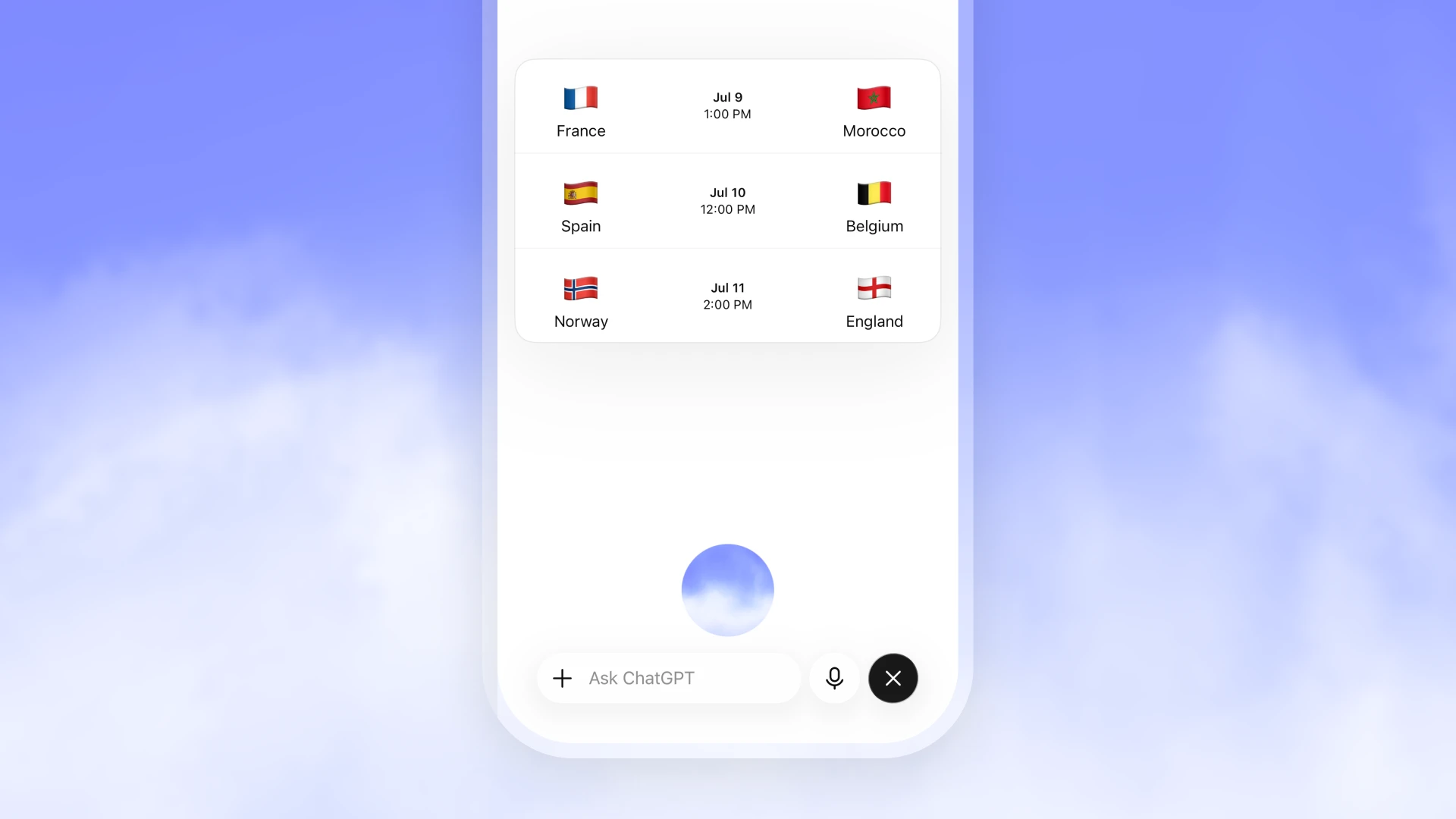
OpenAI has also added nine updated voices and visual cards that can appear alongside the conversation. These cards can show structured information such as weather, stocks, sports, and maps while the voice conversation continues.
That turns ChatGPT Voice into more than audio chat. It becomes a multimodal assistant that can speak, reason, and display useful information at the same time.
Stronger Benchmarks
OpenAI says GPT-Live shows major gains over Advanced Voice Mode. At its highest reasoning level, GPT-Live-1 scored 84.2% on a graduate-level scientific reasoning benchmark, compared with 45.3% for the previous voice system.
The improvement is even sharper on web-search tasks, where GPT-Live-1 scored 75.2% compared with less than 1% for the older mode. In human preference testing, participants chose GPT-Live over Advanced Voice Mode in most comparisons.
The numbers suggest that GPT-Live is not only more natural in tone, but also better at handling difficult questions and research-heavy tasks.
Safety Built Into Voice
OpenAI has also added audio-native safety systems for more sensitive conversations. These safeguards cover areas such as self-harm, emotional reliance, psychosis, mania, violence, and sexual content.
The system can redirect a response, surface support resources, or stop a voice conversation in higher-risk situations. Teen protections include age-appropriate behavior, parental controls for ChatGPT Voice, and notifications in serious safety cases.
The voice system is also limited to predefined voices and includes safeguards to prevent imitation of real people.
What Is Still Missing
GPT-Live does not include video or screen sharing at launch. Users who need those features can still use the older voice mode where available. It is also not available at launch in some areas of the ChatGPT ecosystem, including the desktop app, Codex, temporary chats, custom GPTs, or developer API access.
For developers, a separate real-time voice API remains the current option for building voice agents. GPT-Live is focused on the ChatGPT user experience for now.
Early reaction has been positive around speed and naturalness, but not every user prefers the new voices. Some have described them as less warm or more synthetic than the previous voice style.
Even with those limits, GPT-Live shows where AI interfaces are heading. Voice is becoming a primary way to use AI, and full-duplex conversation is quickly becoming the new standard. OpenAI is no longer treating voice as a feature layered on top of chat. It is turning voice into a front door for real-time, agentic AI.
Comments